Why salon chains need a real pouch supplier scorecard
Cotton drawstring pouches are small items, but they sit in highly visible customer moments: retail haircare bundles, sample kits, stylist welcome packs, spa amenities, holiday gift-with-purchase programs, ecommerce inserts, and store-opening promotions. The pouch usually costs less than the products inside it, yet thin fabric, oil stains, crooked logos, weak cords, mildew odor, or mixed cartons can make a premium salon program feel careless.
Early quotations often look similar while hiding different assumptions. One supplier may quote 120 GSM cotton with a simple one-sided cord. Another may quote 180 GSM canvas with double drawstrings and screen printing. A third may send an attractive sample but quote bulk with lighter fabric unless the purchase order locks the specification.
A cotton drawstring pouch supplier scorecard for salon chains turns sales language into comparable evidence. It weighs specification fit, branding control, QC, packing readiness, lead time, documentation, and commercial terms. Use it before shortlisting, before deposit, and after delivery so the next reorder is based on performance rather than memory.
- Treat branded pouches as retail packaging, not disposable inserts.
- Use pass/fail gates before weighted scoring; a low price should not rescue a supplier that cannot meet launch timing or QC basics.
- Attach the approved spec sheet, artwork, packing standard, and golden sample reference to every PO.
- Keep supplier comments and evidence links in the scorecard for reorder review.
Start with the pouch job, contents, and route to stores
The right pouch depends on what it must hold and how it will move through the salon chain. A sachet giveaway needs a different fabric, seam, and carton plan from a premium kit containing a glass oil bottle, brush, and travel-size shampoo. If the RFQ only says “cotton drawstring pouch with logo,” suppliers will quote to their own assumptions, and the lowest quote may simply be the lightest construction.
Define the contents, combined weight, display method, expected reuse, and distribution route before asking for prices. If stores or a distribution center will fill the pouch later, count accuracy, low-wrinkle packing, and SKU labels become important. If the supplier will fill or kit the pouch, the inspection plan must include filled-pouch appearance, closure, and logo visibility.
Finished size is not the same as usable space. A 180 x 240 mm pouch may lose 25-35 mm of usable height to the drawstring channel. Width also tightens when bottles or brushes are inserted. For critical fit, send physical contents or dimensional drawings and require the supplier to test closure with real or equivalent items.
- Sample sachet pack: prioritize low bulk, clean logo, and simple carton handling.
- Retail product bundle: prioritize fit, handfeel, print placement, and consistent presentation.
- Glass bottle or brush kit: prioritize seam strength, bottom corners, drawcord durability, and higher GSM.
- Holiday GWP: prioritize appearance, delivery date, SKU separation, and warehouse receiving accuracy.
- Ecommerce insert: prioritize flat packing, low lint, low odor, and predictable carton data.
Specify fabric GSM, cotton type, and finish clearly
Fabric weight is a major cost and quality driver. For lightweight sachets or short-term event giveaways, 100-120 GSM cotton may be adequate. For many salon sample kits and small retail bundles, 140-160 GSM provides a practical balance of cost, handfeel, printability, and freight efficiency. For heavier contents, brushes, or reusable premium packaging, 180-240 GSM cotton canvas gives more structure and perceived value.
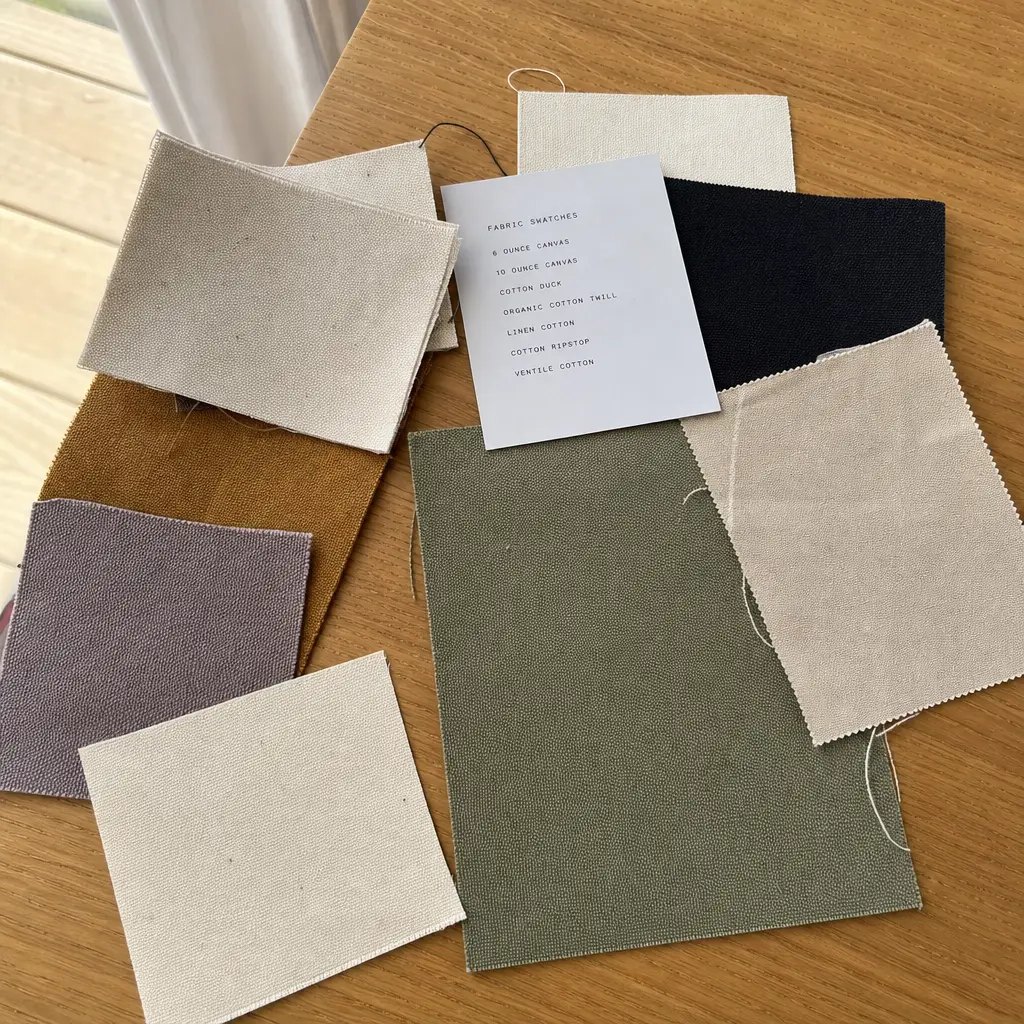
Avoid relying only on words such as muslin, canvas, calico, or natural cotton. These terms vary by supplier. The RFQ should state composition, weave, GSM, fabric finish, and whether the fabric is stock, custom dyed, bleached, unbleached, organic, recycled blend, or treated. Natural cotton can show seed flecks and slub; that may be acceptable for a wellness look but not for a clean spa-white program.
If the chain wants to claim organic cotton, recycled cotton, certified material, or plastic reduction, score document quality separately. A generic certificate does not automatically prove the actual order used claimed material. Ask whether documentation applies to yarn, fabric, facility, transaction, or finished product.
- 100-120 GSM: economical for sachets, light amenities, and short event runs.
- 140-160 GSM: practical for many salon sample kits and branded small bundles.
- 180-240 GSM: better for premium kits, heavier products, brushes, and reuse.
- Natural cotton: approve limits for seed flecks, slub, stains, and shade variation.
- Bleached or white cotton: cleaner appearance but stricter handling needed to prevent dirt and yellowing.
- Dyed cotton: confirm lab dip, MOQ, colorfastness expectations, and reorder shade risk.
Score vendors with weighted criteria and pass/fail gates
A supplier scorecard should not be a loose preference list. Start with pass/fail gates: correct artwork use, no unsafe contamination, ability to meet the launch window, willingness to make a pre-production sample, agreement to written tolerances, and acceptance of inspection before shipment. A supplier that fails one of these gates should not win because of unit price.
After gates, apply weighted scoring. For most salon-chain pouch programs, specification fit and QC process should carry the highest weights because they affect sample-to-bulk consistency. Packing readiness also deserves weight when goods flow through a distribution center or ship directly to stores. Price is still important, but score it as commercial value, not as the only decision point.
A 1-5 scale works well when each score is tied to evidence. Score 5 when the supplier has provided proof and accepted written controls. Score 3 when the supplier appears capable but evidence is incomplete. Score 1 when answers are vague, inconsistent, or unsupported.
- Example total score: multiply each 1-5 rating by the criterion weight, then add weighted points.
- Vendor A may score 4.4/5 with higher unit price but strong QC and packing; Vendor B may score 3.1/5 if cheaper but vague on GSM and inspection.
- Set a minimum score, such as 3.8/5, for chain-wide programs and a higher threshold for premium retail kits.
- Keep a separate red-flag list for failed gates, late samples, unanswered questions, or changed specifications.
Compare construction, cord, and branding methods before price
Construction details affect both appearance and function. Specify seam type, seam allowance, channel depth, stitch density, reinforcement, and whether the pouch closes from one side or both sides. For heavier kits, ask about reinforced bottom corners or bartacks at stress points. For lighter sachet pouches, avoid over-engineering but still require clean seams and consistent shape.
Drawcord is another common substitution point. Cotton cord, polyester cord, braided cord, flat tape, and jute-style cord all feel different and price differently. Define diameter, color, length, knot style, end treatment, and substitution policy. A cord that looks acceptable on a flat sample may be too short or rough after repeated use.
Screen printing is often the most practical option for simple salon logos, especially one to three solid colors. Digital print or heat transfer can work for complex art, but test handfeel, edge quality, odor, adhesion, cracking, and blocking. Embroidery can look premium on heavier canvas but may pucker lightweight fabric. Woven or side labels give a subtle reusable look and reduce large ink-area risk.
- Set logo placement from measured reference edges, not only from a digital mockup.
- Use a physical strike-off on actual fabric for branded orders.
- Typical print-position tolerance may be ±3 mm for small pouches or ±5 mm for larger pouches where practical.
- Check that ink does not transfer or stick after stacked packing pressure.
- Confirm whether print is done in-house or subcontracted, and who controls rework decisions.
Make MOQ, price breaks, and quote comparison transparent
MOQ is often driven by components rather than sewing. A workshop may be able to sew 500 pouches, but custom dyed fabric, special cord color, woven labels, certified cotton, printed cartons, or screen setup can create higher minimums. Standard natural cotton and stock cord colors usually allow lower MOQs.
Ask every supplier to quote the same specification at relevant volumes, such as 1,000, 3,000, 5,000, 10,000, and 30,000 pieces. This shows whether price improves through production efficiency or whether a supplier is changing materials at higher volume. It also helps the salon chain decide whether to standardize one base pouch across multiple campaigns.
Compare total cost, not only ex-works unit price. Hidden costs include sample fees, courier fees, screen charges, digitizing, lab dips, testing, barcode labels, carton labels, moisture bags, final inspection support, and extra sorting. Freight can also change the winner: loose cartons increase CBM, while overly tight cartons may crease logos and distort drawstring channels.
- Ask which component drives MOQ: fabric, dyeing, cord, label, print, sewing, certification, or packing.
- Separate first-order setup costs from repeat-order unit pricing.
- Quote the same packing method across suppliers so carton data is comparable.
- If custom dyeing is required, agree lab dip approval, leftover material handling, and reorder shade risk.
- Compare landed and operational cost: unit price, fees, freight, duty if applicable, inspection, and warehouse labor.
Include commercial terms in the supplier score
For chain programs, commercial clarity can prevent delays and chargebacks. The quote should state Incoterm, freight responsibility, payment terms, deposit, balance timing, quote validity, currency, lead time basis, and whether pricing is firm after sample approval. If the buyer arranges freight, the supplier must still provide accurate carton dimensions, gross weight, net weight, CBM, and cargo-ready date.
Clarify ownership of screens, printing plates, digitizing files, patterns, custom labels, and approved artwork files. If the salon chain pays for tooling or digitizing, the agreement should state whether those assets can be used for reorders, transferred, or restricted from other customers. Also confirm how long the supplier retains golden samples, swatches, and production records.
Cancellation and change-order risk should be addressed before deposit. Custom fabric, dyed materials, printed labels, and cut panels may become non-cancelable once production begins. For retail or store programs, prevent chargebacks by aligning carton labels, barcode requirements, ship windows, pallet or carton weight limits, and ASN or documentation requirements where applicable.
- Score higher when payment milestones are tied to sample approval, production progress, and pre-shipment inspection.
- Confirm Incoterms such as EXW, FOB, CIF, DAP, or DDP and who bears freight, duty, and delay risk.
- Ask for reorder pricing basis: same spec, same artwork, same packing, and defined validity period.
- State who pays for rework, sorting, replacement goods, or air freight if defects are supplier-caused.
- Require written approval for material substitution, artwork changes, or packing changes.
Use sample approval as the production lock
A disciplined sample process usually includes material review, print strike-off, and pre-production sample. Material review confirms GSM, shade, weave, and handfeel. The strike-off confirms logo size, color, opacity, placement, curing, and finish. The pre-production sample confirms final construction, drawcord, seam, print, and packing format.
Functional testing matters. Fill the pouch with actual products or equivalent weight. Confirm that it closes fully, the logo remains visible, seams are not stressed, and the filled shape suits the product price point. A pouch can look good empty but twist, bulge, or hide the logo when filled.
The approval record should be useful to an inspector. Photograph the sample with a ruler, record finished size, usable height, channel depth, cord diameter, print size, and placement. Attach the artwork file name and version. Seal one golden sample for the buyer, one for the supplier, and one for any third-party inspector.
- Do not authorize bulk cutting, dyeing, printing, or sewing until the PP sample is approved in writing.
- Test drawstring movement, cord fraying, knot security, and closure smoothness.
- Rub print with dry and lightly damp white cloth after curing to check transfer.
- Approve acceptable and unacceptable natural cotton appearance with photos.
- Confirm fold direction so the logo is not creased through the center.
Set QC thresholds with AQL-style inspection detail
Quality control should cover appearance, function, safety, and packing accuracy. Visible defects include stains, oil marks, mildew, crooked print, shade mismatch, loose threads, and uneven cord ends. Functional defects include open seams, tearing at the channel, cord breakage, poor closure, wrong size, and fabric too weak for the contents.
Agree defect classifications before production. Critical defects are safety, brand, or usability failures: needle fragments, mold, severe contamination, wrong logo, wrong material, or mixed SKU cartons. Major defects are likely to cause rejection or complaints: seam opening, broken cord, strong odor, heavy stains, significant print misalignment, ink transfer, or size outside tolerance. Minor defects are limited issues that do not materially affect use, such as trimable thread or approved cotton specks.
For bulk orders, use an AQL-style sampling plan or another written sampling method. The inspector needs the approved sample, technical specification, artwork, packing instruction, defect photos, and PO. Final inspection should include measurements, print checks, seam checks, odor and moisture review, count verification, carton label review, and packing photos before shipment release.
- Critical examples: needle fragment, mold, wrong brand print, wrong material, unsafe contamination, mixed SKU carton.
- Major examples: open seam, broken drawcord, severe print shift, heavy stain, strong odor, undersized pouch, ink transfer.
- Minor examples: trimable loose thread, slight approved slub, small fold mark away from logo, minor cord variation within tolerance.
- Require inspection report with sample size, defect counts, photos, measurements, carton checks, and pass/fail decision.
- Keep defect and delivery records in the scorecard before approving reorders.
Turn delivery performance into reorder decisions
The first order should create a supplier record, not just a shipment. After delivery, compare actual performance against the scorecard: sample accuracy, response speed, on-time shipment, bulk match to golden sample, carton accuracy, defect rate, documentation quality, and issue resolution. A supplier that scored well before deposit but performed poorly should not automatically receive the reorder.
Reorders are where specification drift often appears. Fabric lots change, cord suppliers change, print operators change, and packing teams may assume the previous method without checking the latest PO. Require the supplier to reference the same approved specification and submit updated swatches or first-piece photos when fabric, shade, cord, or artwork changes.
For salon chains running repeated campaigns, standardization can reduce cost and risk. One approved base pouch size, fabric, cord, and packing format can support multiple seasonal artworks. The scorecard then becomes simpler: suppliers are judged on maintaining the standard, controlling artwork changes, and meeting campaign dates.
- Review actual lead time versus promised lead time after each order.
- Track shipment defects by critical, major, and minor category.
- Compare carton quantity and label accuracy with warehouse receiving feedback.
- Ask for corrective action before approving repeat orders after any major issue.
- Keep golden samples, swatches, artwork versions, and inspection reports organized by program and date.
Specification comparison for buyers
| Supplier option | What to verify | Commercial advantage | Buyer risk to control |
|---|---|---|---|
| Direct sewing factory | cord material proof, reinforcement close-ups, load-test photos, approved sample tag, and bulk-line first-piece record | Better sample-to-bulk control and faster production feedback | May be weaker on export paperwork or branded packing unless checked early |
| Trading company | Factory name, production photos, trim-source proof, and who owns QC decisions | Can coordinate small mixed orders and extra services | Markup can hide real factory capability and slow defect decisions |
| Specialized bag workshop | cord diameter, eyelet or reinforced channel, bottom corner reinforcement, seam allowance, bar-tack position, and load target | More practical for detailed construction, trims, and repeat programs | Capacity may be limited during peak seasons |
| Low-price general supplier | 6-10 oz cotton canvas, 210D polyester, rPET, or blended cotton with shrinkage and colorfastness expectations set before sampling | Useful for simple promotional runs with loose specs | Material downgrades, weak packing, and vague inspection scope can erase savings |
| Retail-ready supplier | fold direction, cord protection, bundle count, carton compression, moisture bag, and retail label position | Can handle labels, SKU separation, carton marks, and receiving rules | Higher unit cost must be compared against reduced warehouse work |
| Compliance-focused supplier | Fabric records, labeling review, test plan, and production traceability | Safer for retail programs and repeat brand orders | Documentation claims need evidence, not only sales language |
| Local sample room plus bulk factory | Signed sample, bulk factory handoff, first-piece photos, and deviation owner | Good for complex branding before large production | Sample room quality may not match bulk line unless handoff is controlled |
Buyer checklist before sampling
- Define the pouch use: retail haircare kit, sample sachet pack, stylist amenity, holiday gift-with-purchase, ecommerce insert, loyalty gift, training kit, or store-opening pack.
- List actual contents, dimensions, combined weight, bottle shape, cap height, accessory size, and whether the pouch must close fully when filled.
- State finished size with tolerance and specify whether height includes the drawstring channel; add usable internal height when fit is critical.
- Specify fabric composition, weave, finish, and target GSM, such as 120 GSM cotton, 140-160 GSM cotton, or 180-240 GSM canvas.
- Set acceptable GSM variation, commonly around ±5% for standard cotton unless the brand needs a tighter internal rule.
- Define drawcord material, diameter, color, length, knot or end treatment, and one-sided or two-sided closure.
- Attach final vector artwork with print size, color reference, placement from edges, orientation, and print-position tolerance.
- Choose branding method: screen print, heat transfer, digital print, embroidery, woven label, side label, hangtag, or no print.
- Require a physical strike-off for branded orders and a pre-production sample before mass cutting, printing, or sewing.
- Define packing: fold direction, bundle count, individual wrap if any, carton quantity, SKU labels, barcode labels, carton marks, and moisture protection.
Factory quote questions to send
- Are you quoting as a direct factory, trading company, distributor, or retail-ready packer, and where will cutting, sewing, printing, inspection, and packing occur?
- What fabric composition, weave, finish, and GSM are included, and can you provide a cut swatch from the proposed bulk fabric range or lot?
- Is the quoted size finished size after sewing, and what tolerance applies to width, total height, usable height, channel depth, and print position?
- Which seam construction is included: plain seam, overlock internal edge, French seam, folded seam, reinforced bottom, bartack at channel opening, or another method?
- What drawcord is quoted: cotton cord, polyester cord, braided cord, flat tape, jute-style cord, or other; what diameter, length, color, and knot style are included?
- Which print method is quoted, how many colors are included, and what setup, screen, digitizing, artwork, or strike-off charges are separate?
- What MOQ applies to pouch size, fabric GSM, fabric color, drawcord color, print method, label, certification claim, and packing format, and which item drives the minimum?
- What are price breaks at 1,000, 3,000, 5,000, 10,000, and 30,000 pieces using the same specification and packing method?
- What are the payment terms, Incoterm, quote validity, production deposit, balance timing, tooling ownership, and cancellation or change-order rules?
- What documents will be provided before shipment: packing list, carton data, inspection report, production photos, test reports if required, and certificate copies for claim-sensitive orders?
Quality-control points to confirm
- Measure fabric GSM from a cut sample using scale and area calculation; do not approve by handfeel alone. Record the tolerance in the PO, commonly around ±5% for standard cotton.
- Check finished width and height flat after sewing. Practical starting tolerances are often ±5 mm for small pouches and ±8-10 mm for larger pouches, depending on fabric and fit risk.
- Verify usable internal height when bottles, brushes, or tall retail items must fit; the drawstring channel reduces fillable height.
- Inspect seam allowance, stitch density, thread tension, skipped stitches, open seams, loose threads, bottom corners, and any specified bartack or reinforcement.
- Test drawstring function by repeated opening and closing. The cord should slide smoothly, not fray quickly, not pull out, and not tear the channel.
- Measure print placement from agreed reference edges and compare with approved strike-off. Check opacity, color, curing, edge sharpness, odor, cracking, peeling, and ink transfer.
- Inspect natural cotton for excessive seed flecks, stains, oil spots, mildew, insect marks, broken yarns, contamination, and shade variation outside the approved standard.
- For dyed cotton, compare against approved lab dip or shade standard and check panel-to-panel variation, cord-to-fabric harmony, and reorder shade risk.
- Use AQL-style sampling or another written sampling plan for final inspection; classify critical, major, and minor defects before production.
- Require pre-shipment inspection documentation: inspection date, sample size, defect counts, photos, measurements, carton checks, packing photos, and acceptance or rejection decision.