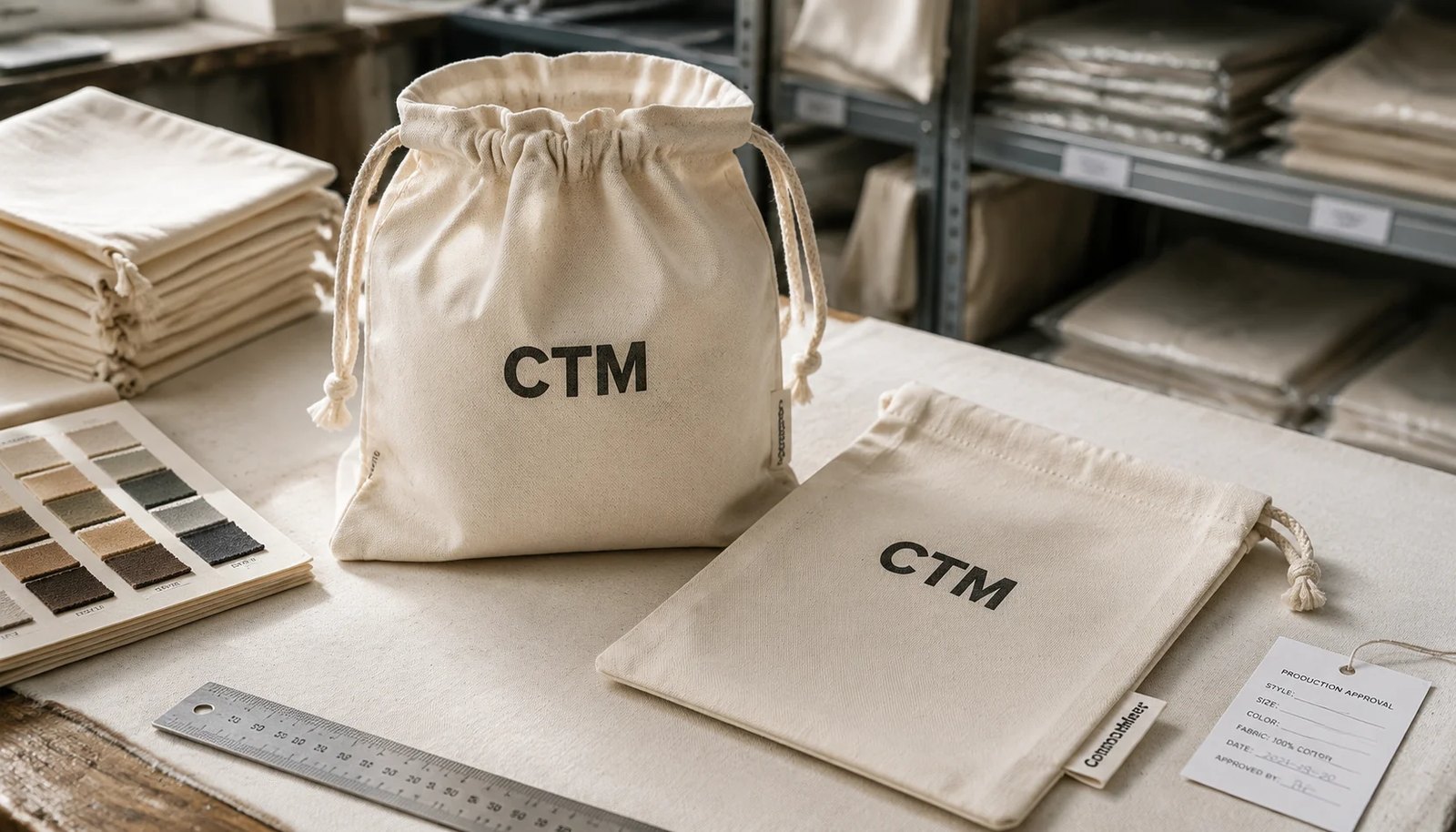
What a museum shop pouch supplier scorecard should measure
A cotton drawstring pouch for a museum shop is not just a low-cost packaging item. It may carry the museum name, exhibition identity, artist license, donor program, or retail brand. The supplier scorecard should measure whether the supplier can control the product details that affect shelf presentation and sellable quality: fabric handfeel, drawcord function, print sharpness, SKU separation, and repeat-order consistency.
The strongest scorecard is practical rather than decorative. It should help a buyer compare one direct factory, one trading company, and one local decorator on the same basis. A low FOB price is useful only if it includes the right GSM, correct printing, realistic MOQ, compliant packing, and enough production time. For museum shops, the common failures are not dramatic; they are small mismatches that make a pouch look cheap beside a book, ornament, ceramic piece, or limited-edition print.
- Score fabric and sewing separately; a good fabric can still fail with weak drawcord channel stitching.
- Score artwork control separately from general production capability; museum designs often include fine lines and small type.
- Score packing and carton labeling because shop receiving teams often manage many exhibition SKUs at once.
- Score repeatability if the pouch will become a permanent museum store item, not only a one-time event item.
Start the scorecard with use case, not pouch size
The same cotton drawstring pouch specification can be right or wrong depending on use. A pouch for a small enamel pin set does not need the same fabric as a pouch for a ceramic ornament. A pouch sold as a souvenir needs better finish than a pouch used only as protective packaging inside a box. Before comparing suppliers, classify the pouch by its commercial role: retail merchandise, gift-with-purchase, reusable packaging, donor gift, or exhibition bundle.
This classification affects every downstream decision. A retail pouch needs a cleaner print, more controlled stitching, and better packing because customers handle it before purchase. A protective pouch inside another retail carton may allow simpler packing and lower GSM. A membership or donor pouch may need a soft handfeel and refined branding rather than maximum durability. When suppliers receive only a size and logo, they quote the easiest version and leave the buyer to discover the mismatch later.
- For jewelry, pins, coins, or magnets: 120-180 GSM cotton can work if the pouch is not positioned as premium.
- For retail souvenir pouches: 200-270 GSM cotton canvas is usually a safer handfeel and shelf-quality range.
- For heavier ceramics or hard goods: consider 270-340 GSM canvas, reinforced stitching, or a gusseted shape.
- For archival or delicate goods: discuss fabric lint, dye transfer risk, and whether natural unbleached cotton is acceptable.
Fabric GSM and construction details that change the quote
Cotton drawstring pouch quotes often look inconsistent because suppliers are not pricing the same construction. A 140 GSM plain cotton pouch and a 270 GSM canvas pouch may have similar dimensions but different fabric cost, cutting behavior, print absorption, sewing speed, and freight volume. Museum shop buyers should request fabric weight in GSM and, where possible, a swatch from the quoted material before treating prices as comparable.
Construction also changes cost. A flat pouch with single drawcord is cheaper than a double-drawcord pouch with two-way closure. A boxed bottom or gusset improves capacity but adds cutting and sewing operations. A folded top drawstring channel is common, but the channel width must match cord diameter. If the channel is narrow or the side openings are poorly finished, the pouch may close unevenly or fray at the cord exit.
- Typical economy cotton: about 120-160 GSM for light gift packaging and low-cost giveaways.
- Common retail cotton canvas: about 200-270 GSM for museum shop merchandise and reusable packaging.
- Heavy canvas: about 280-340 GSM when structure and durability matter more than low freight cost.
- Common size tolerance: +/-5 mm for small pouches and +/-10 mm for medium or large pouches, unless otherwise agreed.
- Key construction choices: flat or gusseted body, single or double drawcord, cord material, channel width, bottom seam type, and side label position.
Print method scoring for museum artwork
Museum shop artwork frequently includes fine lettering, line drawings, collection marks, exhibition names, dates, or licensed images. These details make print method selection more important than on a simple promotional pouch. Screen printing is usually the best balance for solid one-color or two-color artwork, especially when the order quantity is enough to absorb screen setup. It gives stable repeatability and good opacity when the ink and mesh are chosen properly.
Digital print or heat transfer can be suitable for multicolor artwork, gradients, and small runs, but buyers should evaluate handfeel and durability. A large transfer patch can feel plastic on natural cotton. Very fine artwork may fill in on rough canvas. Metallic ink, puff ink, discharge printing, and water-based ink may be possible, but each needs a real strike-off. Museum buyers should never approve detailed artwork from a flat digital mockup alone because cotton weave and ink absorption change the final look.
- Use screen print for museum logos, simple icons, and solid exhibition marks.
- Use heat transfer or digital print for full-color images only after approving handfeel and edge definition.
- Keep fine text away from drawcord channels, heavy seam areas, and pouch corners.
- Define print position from measurable edges, such as 45 mm below top edge and centered left to right.
- For dark fabric, price an underbase if light ink must remain bright.
MOQ logic: why total quantity is not enough
A common RFQ mistake is stating only the total order quantity, such as 5,000 cotton drawstring pouches, while hiding that the order contains 20 designs of 250 pieces each. The supplier then quotes as if production is efficient, but later adds print setup charges, packing labor, or a higher unit price. A serious scorecard should reward suppliers that explain MOQ by fabric color, size, artwork, and packing method instead of giving one vague minimum.
For custom cut-and-sew production, MOQ is affected by fabric purchase quantity and cutting efficiency. For printed pouches, MOQ is also affected by screen setup, ink mixing, artwork changeover, and drying or curing workflow. Museum shops often need several designs tied to exhibitions or collections. A practical compromise is to standardize one or two pouch sizes and one base fabric, then print multiple designs within a controlled artwork plan.
- State quantity per size: for example, 3,000 pieces at 150 x 200 mm and 2,000 pieces at 250 x 300 mm.
- State quantity per artwork: for example, 1,000 pieces each of five exhibition designs.
- Group designs by print method and ink colors to reduce setup waste.
- Avoid combining dyed cotton and natural cotton under one assumed MOQ; they may require different fabric procurement.
- For reorder planning, ask whether the supplier can hold screens, repeat fabric, or match a previous approved sample.
Supplier evidence that belongs in the scorecard
A supplier can say they produce cotton pouches, but the evidence should show whether they can manage museum-style retail details. Useful evidence includes photos of actual cut-and-sew lines, print strike-offs on cotton, close-ups of drawcord channels, carton label examples, and a sample approval record. General catalog photos do not prove that the supplier controls the process, especially if printing is outsourced.
For importers and distributors, the most important evidence is process visibility. A direct factory should be able to explain fabric sourcing, cutting, sewing, printing, finishing, inspection, and packing. A trading company can still be a good route if it manages multiple factories well and provides clear QC documentation. A local decorator may be best for urgent small runs, but buyers should score it honestly on long-term consistency and unit cost.
- Fabric evidence: swatch card labeled with GSM, weave, color, and finish.
- Print evidence: real print sample on the same or similar cotton, not only a paper proof.
- Sewing evidence: close photo of side seam, bottom seam, drawcord exit, and channel topstitch.
- Packing evidence: carton mark sample showing SKU, design name, quantity, PO number, and carton count.
- Repeat-order evidence: ability to keep approved sample, artwork file version, and production notes for reorder matching.
Sample approval: separate look, feel, and function
Museum shop buyers often focus on the logo during sample review and miss the basic functional checks. A cotton drawstring pouch must open smoothly, close evenly, hold the intended product, and sit acceptably on the shelf or inside a gift set. A beautiful print on a pouch that is too tight for the product creates returns and repacking work. A good approval process separates appearance, material handfeel, dimensions, and function.
The sample path can include a fabric swatch, print strike-off, prototype sample, and pre-production sample. Not every project needs all four, but higher-value retail programs should not skip the pre-production sample. The pre-production sample should use the actual bulk fabric, actual cord, actual print method, actual sewing construction, and intended packing. If the supplier sends a similar stock pouch with a quick logo print, treat it as a concept sample only.
- Measure flat width and height, then test with the real product or product dummy.
- Pull the drawcord open and closed at least 10 times to detect channel friction.
- Rub the print with a dry white cloth and lightly fold the printed area to observe cracking risk.
- Check whether natural cotton specks, slubs, or shade variation are acceptable for the museum brand.
- Photograph and sign the approved sample, then require the factory to keep a matching counter sample.
Packing and carton decisions affect both cost and store receiving
Packing is often treated as an afterthought, but it can change labor cost, carton volume, inspection speed, and museum shop receiving accuracy. Bulk packing by design is usually efficient when pouches are used as packaging or sold from a display bin. Individual polybags may be required when each pouch needs a barcode, price sticker, or clean presentation, but they add material cost and can increase carton CBM.
For museum shops and distributors, SKU accuracy is critical. One carton containing mixed designs without clear inner separation can create receiving errors and wrong replenishment counts. The RFQ should state whether the supplier must pack by design, by size, by barcode, or by sales set. Carton marks should include PO number, item code, design name, quantity, carton number, gross weight, net weight, and destination mark if required.
- Bulk pack option: 50 or 100 pieces per inner bag, then a master carton labeled by SKU.
- Retail-ready option: individual bag, barcode sticker, hang tag, or belly band, quoted separately.
- Avoid over-compression on printed pouches before ink is fully cured.
- Request carton dimensions, gross weight, and CBM in the quote for landed-cost comparison.
- If cartons will go to multiple museum locations, define split packing before production starts.
Lead time risks around exhibitions and seasonal launches
Museum pouch orders often connect to fixed dates: exhibition openings, holiday retail windows, donor events, and catalog launches. The supplier scorecard should measure schedule reliability, not just quoted production days. Bulk lead time usually starts after sample approval, artwork approval, deposit, and final packing information are complete. If any of those items remain open, the production clock has not truly started.
The main schedule risks are late artwork, fabric color approval, print strike-off rejection, mixed-design production, and incomplete carton or barcode data. A supplier that promises a very short lead time without listing dependencies may be creating risk rather than solving it. Buyers should build the order calendar backward from the required delivery date, allowing time for sample shipping, approval comments, bulk production, inspection, export booking, customs, and domestic distribution.
- Typical sample sequence may require 5-10 working days after artwork and fabric details are clear.
- Bulk production time depends on quantity, print complexity, and factory season; request a project-specific schedule.
- Allow extra time for dyed cotton, custom cords, woven labels, or special retail packing.
- Do not release bulk production until barcode data and carton marks are final.
- For sea freight programs, compare production completion date against vessel cutoff, not only ex-factory date.
Quote comparison: use landed cost per sellable pouch
A supplier scorecard should convert each quote into a landed-cost view. The lowest unit price may exclude screen charges, sample fees, label sewing, retail packing, extra cartons, inland freight, or inspection cost. It may also use lighter fabric than requested. For procurement teams, the fair comparison is the cost per sellable pouch delivered to the required destination, using the same specification and same packing assumptions.
Quote data should be complete enough for finance and logistics teams. At minimum, collect unit price, currency, Incoterm, MOQ, fabric GSM, size, print method, number of print colors, setup charges, sample charges, packing method, pieces per carton, carton dimensions, gross weight, CBM, production lead time, payment terms, and quote validity. If a supplier cannot provide carton data before production, request an estimated carton plan and update it after pre-production sample approval.
- Normalize all quotes to the same Incoterm before comparison, such as EXW, FOB, CIF, or DDP.
- Add setup charges across the real quantity per artwork, not across total program quantity.
- Compare CBM impact when choosing heavy canvas, individual packing, or rigid retail inserts.
- Include defect allowance: a cheap supplier with higher defect rates may cost more after sorting.
- For distributors, calculate margin by SKU because low-quantity designs carry higher setup cost.
Specification comparison for buyers
| Supplier option | What to verify | Commercial advantage | Buyer risk to control |
|---|---|---|---|
| Direct sewing factory | cord material proof, reinforcement close-ups, load-test photos, approved sample tag, and bulk-line first-piece record | Better sample-to-bulk control and faster production feedback | May be weaker on export paperwork or branded packing unless checked early |
| Trading company | Factory name, production photos, trim-source proof, and who owns QC decisions | Can coordinate small mixed orders and extra services | Markup can hide real factory capability and slow defect decisions |
| Specialized bag workshop | cord diameter, eyelet or reinforced channel, bottom corner reinforcement, seam allowance, bar-tack position, and load target | More practical for detailed construction, trims, and repeat programs | Capacity may be limited during peak seasons |
| Low-price general supplier | 6-10 oz cotton canvas, 210D polyester, rPET, or blended cotton with shrinkage and colorfastness expectations set before sampling | Useful for simple promotional runs with loose specs | Material downgrades, weak packing, and vague inspection scope can erase savings |
| Retail-ready supplier | fold direction, cord protection, bundle count, carton compression, moisture bag, and retail label position | Can handle labels, SKU separation, carton marks, and receiving rules | Higher unit cost must be compared against reduced warehouse work |
| Compliance-focused supplier | Fabric records, labeling review, test plan, and production traceability | Safer for retail programs and repeat brand orders | Documentation claims need evidence, not only sales language |
| Local sample room plus bulk factory | Signed sample, bulk factory handoff, first-piece photos, and deviation owner | Good for complex branding before large production | Sample room quality may not match bulk line unless handoff is controlled |
Buyer checklist before sampling
- Define the pouch purpose first: gift packaging, paid souvenir, membership gift, exhibition merchandise, or wholesale bundle.
- State finished size in width x height, not only approximate size, and include acceptable tolerance such as +/-5 mm for small pouches or +/-10 mm for larger pouches.
- Specify fabric weight in GSM or ounces, plus color, finish, and whether natural cotton specks are acceptable.
- Clarify whether the drawcord should be cotton, polyester, jute, or ribbon, and whether it must match the body fabric or contrast with it.
- Provide print artwork at actual size with Pantone references, line thickness notes, and any restricted areas near seams or drawcord channels.
- Separate quote quantities by design, not only total PO quantity, so setup cost and packing risk are visible.
- Request one approved counter sample retained by the supplier and one physical sample retained by your buying office.
- Define packing by SKU, design, inner quantity, carton quantity, carton marks, barcode needs, and whether cartons must meet retailer receiving rules.
- Set QC acceptance points for size, fabric weight, print position, print adhesion, drawcord function, seam strength, stains, and loose threads.
- Compare quotes using landed cost per sellable pouch, not only FOB unit price.
Factory quote questions to send
- Are you quoting a custom cut-and-sew pouch or a stock blank pouch with decoration?
- What exact fabric weight, composition, weave, and color are included in the quote?
- Is the fabric prepared for shrinkage control, and what shrinkage tolerance do you use after washing or finishing?
- What print method is included, how many colors, and what setup charges apply per design?
- What is the MOQ per size, per fabric color, and per artwork design?
- Can multiple museum designs share the same base fabric and size to reach fabric MOQ?
- What sample types are available: material swatch, print strike-off, proto sample, and pre-production sample?
- What is the sample lead time and bulk lead time after approval, and what steps are on the critical path?
- Do you pack by design and carton label each SKU separately, or will mixed designs be packed in one carton?
- What inspection standard do you use for AQL, and what defects are treated as critical for printed cotton pouches?
Quality-control points to confirm
- Finished size measured flat after sewing and pressing, with tolerance agreed before bulk cutting.
- Fabric GSM checked against approved swatch, normally with a tolerance around +/-5% unless the buyer sets a stricter range.
- Color shade compared under consistent lighting, especially for natural, black, cream, and dyed cotton lots.
- Print position measured from top edge and side seam, not judged by eye only.
- Print color compared to approved strike-off or Pantone target, allowing realistic tolerance on absorbent cotton.
- Print adhesion tested by rubbing, light folding, and tape pull where suitable for the ink system.
- Drawstring channel checked for smooth opening and closing without cord snagging or seam obstruction.
- Seam strength tested by moderate pull at side seams, bottom corners, and drawcord channel ends.
- Loose threads, oil marks, fabric slubs, needle holes, and stains sorted before packing.
- Cartons verified for SKU accuracy, quantity, inner pack count, carton marks, and barcode readability if used.