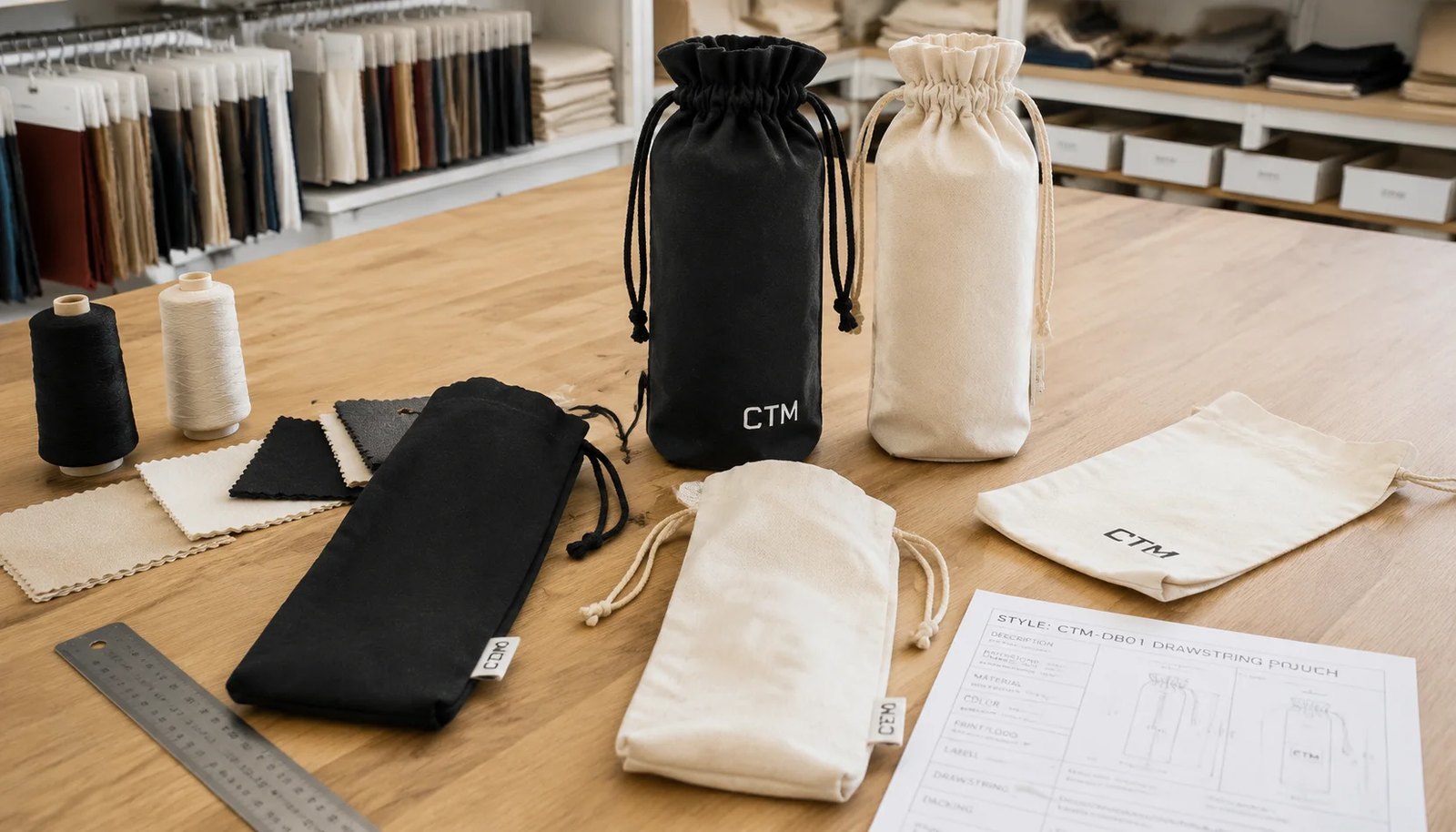
Why compliance matters more for liquor retail pouches than for generic gift bags
Cotton drawstring pouches used in liquor retail look simple, but the buying risk is not simple. The pouch has to fit a real bottle shape, present the brand well on shelf, survive store handling, and arrive packed in a way that does not create receiving problems. A supplier that is fine for general promo bags may still fail on bottle fit, print registration, or carton discipline. That is why a compliance checklist is more useful here than a broad sourcing article.
For liquor retail programs, the hidden failures usually happen after artwork approval. The logo may look good on a sample made from one fabric, then spread or fade on bulk made from another GSM. A pouch sized for a standard 750 ml Bordeaux bottle may not fit a broader-shoulder spirits bottle. Cartons may arrive with mixed sizes because the supplier treated the order as a generic textile shipment. A buyer who defines compliance at the quote stage avoids those predictable failures.
- Main retail risks: wrong bottle fit, inconsistent print, shade variation, mixed packing, delayed repeat orders
- Main factory risks: unclear finished size, under-specified fabric, over-simplified MOQ assumptions, outsourced printing without controls
- Main importer cost impact: re-sorting at warehouse, repacking, markdowns due to poor presentation, and higher complaint rate from stores
Start with the right pouch specification, not just a logo file
Most weak RFQs for cotton liquor pouches list only approximate dimensions and a logo. That is not enough for reliable quoting. A factory needs bottle dimensions, target fabric type, closure style, and retail use case. A pouch for a single holiday gift run can be optimized differently from a year-round private-label accessory. If your RFQ is vague, suppliers will quote different constructions and the price comparison becomes meaningless.
For liquor pouches, the most common material choices are lightweight cotton sheeting around 120-140 GSM, mid-weight cotton around 180-220 GSM, and cotton canvas around 8 oz to 10 oz, roughly 270-340 GSM. Lightweight fabric lowers cost but shows bottle shape sharply and can look less premium. Heavier canvas gives better drape and shelf presence, especially for dark print or embroidery, but increases freight and sewing cost. The right choice depends on whether the pouch is acting as a simple cover or part of a premium gift presentation.
- Typical pouch spec fields: finished width x height, bottom seam type, top hem depth, drawstring channel width, rope diameter, logo size, print side count
- For standard 750 ml bottles, always provide maximum bottle diameter and total bottle height including cap or stopper
- If using heavy canvas, verify whether bottle corners or closure edges create excessive seam stress when inserted
Choose fabric weight by retail use, not by unit price alone
GSM affects more than thickness. It changes print appearance, seam bulk, packing volume, and how the pouch hangs around the bottle. A 120-140 GSM cotton pouch can work for promotional events, tasting-room giveaways, or secondary packaging where low cost is the main target. The tradeoff is lower opacity, less structure, and a softer top channel that may not cinch cleanly around heavier bottles.
For liquor retail shelves, many buyers prefer 180-220 GSM if they want a balanced middle ground. It gives cleaner presentation without moving fully into canvas cost. Premium programs often use 8 oz cotton canvas, around 270 GSM, or 10 oz around 340 GSM where a denser handfeel supports dark branding and stronger drawstring channels. Heavier is not always better. If the pouch is packed flat in high carton quantities, extra GSM raises landed cost quickly.
- 120-140 GSM: budget promotional pouch, low opacity, lower freight, less premium feel
- 180-220 GSM: balanced option for retail gift use, better print hold, moderate cost
- 8 oz / about 270 GSM: premium shelf presentation, stronger seams, higher packing volume
- 10 oz / about 340 GSM: structured premium pouch, best for upscale presentation, but highest freight and sewing time
- Ask supplier whether GSM is finished-fabric weight and whether tolerance is controlled by lot
Print method and branding choice affect both compliance and damage rate
The safest branding method for most liquor pouches is still simple screen printing. It gives predictable color for solid logos, scales well in bulk, and is easier to inspect than complex heat transfer decoration. On natural cotton, one-color or two-color screen prints are usually the most stable route. If your artwork has fine gradients or photographic detail, heat transfer or DTF-style decoration may be proposed, but these methods can create a different handfeel and may crack or lift if the pouch is heavily creased in transit.
Embroidery and woven labels can work well for premium programs, but they should be chosen for specific reasons, not just appearance. Embroidery adds cost, extends sampling time, and can distort lightweight fabric if backing and stitch density are not balanced. Woven side labels are useful when buyers want a clean body without large front print, but side-label placement must be controlled so it is still visible once the pouch is filled.
- Screen print: best for solid logos and repeat retail orders
- Heat transfer: useful for detailed artwork but review adhesion and crease sensitivity
- Embroidery: premium look, higher cost, not ideal for light GSM fabric
- Woven label: subtle brand mark, good for premium private-label programs
- For dark dyed cotton, review crocking and print contrast under store lighting
MOQ logic: why two low quotes may not be quoting the same order
MOQ on cotton drawstring pouches is usually driven by the combination of fabric color, print setup, and size variation. One supplier may quote a low unit price based on 5,000 pieces in one size, one color, one logo. Another may quote a higher unit price but allow mixed sizes under one fabric lot and one print setup. If your retail program includes 375 ml and 750 ml bottle pouches, or different logo versions by chain, MOQ structure can change the true purchase cost more than the nominal unit price.
Buyers should separate technical MOQ from commercial MOQ. Technical MOQ comes from fabric dyeing lot, print screen setup, and sewing efficiency. Commercial MOQ is what the factory is willing to accept to keep the line loaded. Natural cotton with black one-color print usually gives the most flexible MOQ because there is no dyed-fabric minimum. Dyed pouches, custom cords, and multiple logo versions each tighten the MOQ and raise waste risk.
- Lowest MOQ route: natural cotton, one size, one-color print, standard cord
- Higher MOQ drivers: custom dyed fabric, multiple print versions, specialty cord, heavy embroidery
- Mixed-size orders can be efficient only if panel layout and packing plan are controlled together
- Ask whether overrun or underrun tolerance applies and how excess pieces are billed
Supplier evidence: what proves a pouch factory can run retail orders cleanly
Compliance for this category is mainly operational. A useful supplier should be able to show measurement records, fabric incoming checks, approved print swatches, and packed-carton identification discipline. Buyers often over-focus on presentation decks and under-focus on whether the supplier can maintain SKU separation inside cartons. For liquor retail, that mistake shows up later as warehouse sorting labor and wrong goods sent to stores.
Good supplier evidence includes actual photos of inline production, not staged showroom images only. Look for cutting stacks tagged by size, print samples marked with artwork code, and export cartons labeled by SKU and quantity. If the supplier uses subcontractors, the same evidence should exist across those steps. A factory that cannot clearly identify where printing or sewing happens will struggle to support claims when defects are found after shipment.
- Useful evidence: bulk fabric lot records, print strike-off approval, measurement sheets, packed-carton photos, carton marks by SKU
- Useful production proof: side seam construction photos, drawstring channel sample cutaway, actual cord options with diameters
- Weak evidence: only digital mockups, only finished beauty shots, no production-stage records
Sample approval should simulate bulk, not just prove the artwork
Many sample approvals fail because the first sample was treated as a marketing sample rather than a production sample. A hand-cut pouch in substitute fabric can confirm approximate shape, but it should not be used as final approval for bulk. For procurement teams, the critical approval is the pre-production sample made with bulk-like fabric, actual print process, actual drawstring, and intended seam construction. That sample should be measured against the real bottle, not only reviewed flat on a table.
A practical approval flow is dummy sample for size, then pre-production sample for construction, then bulk pilot review if the order is large or technically sensitive. If the pouch is intended for multiple bottle SKUs, test all target bottles before bulk starts. Some tall bottles fit by height but bind at the shoulder once the drawstring closes. If you discover that after production, there is no easy fix except discounting or repacking.
- Dummy sample use: verify rough dimensions and bottle insertion
- Pre-production sample use: verify exact fabric, print shade, seam allowance, cord, top closure behavior
- Fit test should include insertion, closure, hanging appearance, and removal by store staff
- Approve print position from seam reference points, not only by visual estimate
QC thresholds that stop the common retail complaints
The most frequent complaints on cotton drawstring pouches are off-size pieces, poor seam finishing, drawstrings that do not run smoothly, and inconsistent print. These are basic textile issues, but they become retail issues when stores receive mixed-looking goods. The fix is to set acceptance criteria before production starts. AQL inspection alone is not enough unless the measurement method and defect classification are already defined.
For example, a width shortfall of 1.5 cm may be minor on a flat pouch but critical if a 1 L bottle no longer fits. A small print shift may be acceptable on a natural cotton promo pouch but not on a premium black pouch sold as a gift accessory. Defining major and minor defects by retail use keeps final inspection commercial rather than abstract.
- Major defect examples: bottle cannot fit approved sample size range, open seam, broken drawstring channel, wrong artwork, mixed colorway in one carton
- Minor defect examples: slight print position shift within tolerance, minor thread tail, small natural cotton slub if fabric specification allows it
- Useful thresholds: seam secure with no skipped stitches at stress points, hem depth consistent, logo readable and centered to agreed tolerance
- If using dark dyed fabric, inspect lint, shade variance, and surface marks under white lighting
Packing plan can decide warehouse cost more than buyers expect
Retail packaging accessories often become expensive after arrival because of poor carton planning. Cotton pouches can tangle if loosely packed, especially double-pull styles. If mixed sizes or logo versions are packed in the same carton, warehouse teams may need to sort manually. A low FOB price can disappear quickly once inbound handling and relabeling are added. This is why carton method belongs in the compliance checklist, not just at shipping stage.
Flat packing is usually the most efficient route, but it should still follow bundle discipline. For example, 25 pieces per inner bundle, one SKU per bundle, one SKU per carton unless the buyer explicitly authorizes mixed cartons. If barcode or retailer item labels are required, decide whether labels go on individual polybags, paper bands, or outer cartons only. Each choice changes labor and material cost.
- Typical export packing: flat packed, 100-500 pcs per carton depending on GSM and pouch size
- Heavier 8 oz or 10 oz canvas sharply reduces units per carton and increases freight cubic volume
- Bundle by SKU and print version to avoid warehouse sorting
- Limit carton gross weight to buyer warehouse standard, commonly around manual handling thresholds agreed in advance
- Outer carton marks should include PO, SKU, size, color, quantity, carton number, and country of origin if required
Lead time risk is usually in fabric and approvals, not sewing capacity
Buyers often assume cotton pouches are quick because the sewing operation is simple. In reality, the lead time risk often sits before sewing starts. Dyed fabric booking, print strike-off approval, and pre-production sample sign-off can consume more time than stitching the order. If the program uses natural cotton and standard black print, the schedule is easier. Once you add custom dyed fabric, multiple artwork versions, or premium trims, the critical path lengthens.
A realistic planning approach is to separate lead time into sample development, material preparation, bulk production, and inspection/dispatch. A factory quote that gives only one total number hides risk. Procurement teams should ask which steps can run in parallel and which cannot. For example, carton artwork can be approved while sewing runs, but bulk print should not start before final logo sign-off unless the buyer accepts that exposure.
- Shorter lead-time route: natural cotton stock fabric, one-color screen print, standard cord, standard pouch size
- Longer lead-time route: custom dyed cotton, embroidery, custom woven labels, multiple size splits
- Watch approval bottlenecks: lab dip, strike-off, pre-production sample, barcode data, shipping marks
- For repeat orders, preserve approved spec sheets and signed sample references to reduce re-approval time
Specification comparison for buyers
| Supplier option | What to verify | Commercial advantage | Buyer risk to control |
|---|---|---|---|
| Direct sewing factory | cord material proof, reinforcement close-ups, load-test photos, approved sample tag, and bulk-line first-piece record | Better sample-to-bulk control and faster production feedback | May be weaker on export paperwork or branded packing unless checked early |
| Trading company | Factory name, production photos, trim-source proof, and who owns QC decisions | Can coordinate small mixed orders and extra services | Markup can hide real factory capability and slow defect decisions |
| Specialized bag workshop | cord diameter, eyelet or reinforced channel, bottom corner reinforcement, seam allowance, bar-tack position, and load target | More practical for detailed construction, trims, and repeat programs | Capacity may be limited during peak seasons |
| Low-price general supplier | 6-10 oz cotton canvas, 210D polyester, rPET, or blended cotton with shrinkage and colorfastness expectations set before sampling | Useful for simple promotional runs with loose specs | Material downgrades, weak packing, and vague inspection scope can erase savings |
| Retail-ready supplier | fold direction, cord protection, bundle count, carton compression, moisture bag, and retail label position | Can handle labels, SKU separation, carton marks, and receiving rules | Higher unit cost must be compared against reduced warehouse work |
| Compliance-focused supplier | Fabric records, labeling review, test plan, and production traceability | Safer for retail programs and repeat brand orders | Documentation claims need evidence, not only sales language |
| Local sample room plus bulk factory | Signed sample, bulk factory handoff, first-piece photos, and deviation owner | Good for complex branding before large production | Sample room quality may not match bulk line unless handoff is controlled |
Buyer checklist before sampling
- Define bottle size range clearly: 375 ml, 750 ml, or 1 L, including maximum bottle diameter, body height, and closure height
- State finished pouch size with tolerance, and specify whether dimensions are measured flat before or after sewing
- Choose fabric weight by use case: 120-140 GSM for low-cost promo packs, 8 oz or about 270 GSM for better structure, 10 oz or about 340 GSM for premium bottle presentation
- Specify fabric composition requirement such as 100% cotton canvas, cotton sheeting, or blended fabric not allowed
- List print method by artwork type: screen print for solid logos, heat transfer only for fine multicolor art, embroidery only if budget and lead time allow
- Approve drawstring material and construction: cotton rope, herringbone tape, or braided cord, plus single or double pull closure
- Require pre-production sample matching bulk fabric, print color, seam construction, and drawstring type rather than only a mock sample
- Set QC tolerances for pouch width, height, hem depth, stitch density, print position, and color variation
- Define individual packing and carton packing method, including whether flat packed, bundled, barcoded, polybagged, or master-carton only
- Request production lead time split by sample approval, fabric booking, printing, sewing, and final inspection, not only one total date
Factory quote questions to send
- What fabric construction are you quoting: plain weave cotton, cotton canvas, or another base, and what is the tested GSM tolerance in bulk?
- Is the quoted size based on finished sewn dimensions or cut-panel dimensions, and what measurement tolerance will you hold in production?
- Which print method is included in the quote, how many print colors, and what is the maximum print area before cost changes?
- Is the drawstring material cotton, polyester, or blended cord, and does the quoted price include knotting, aglet finishing, or heat cut ends?
- What is your MOQ by size, color, and logo version, and can mixed sizes share one total MOQ under the same fabric and print setup?
- Can you provide a pre-production sample made from bulk-like fabric and actual logo process, and is the sample charge refundable against order?
- What are your standard carton dimensions, units per carton, and carton gross weight for this pouch size?
- How do you control color consistency for dyed cotton fabric and logo print between repeat orders?
- Which parts of production are done in-house and which are subcontracted, specifically printing, sewing, drawstring preparation, and packing?
- What inline and final QC records can you share, including measurement reports, defect sorting, and needle control procedure if required by retail policy?
Quality-control points to confirm
- Finished size tolerance should be agreed by dimension, commonly within plus or minus 0.5 to 1.0 cm depending on pouch size and fabric stability
- Fabric GSM should be checked from bulk lot, not only supplier declaration; thin spots and mixed GSM within one order create inconsistent drape and bottle protection
- Print position must be centered to approved tolerance and should not creep into side seams or bottom seam allowance
- Print adhesion and crocking should be reviewed on sample and random bulk pieces, especially on black or dark dyed pouches
- Drawstring channel must feed smoothly without twisting, broken stitching, or trapped cord ends
- Stitch density and seam security should be consistent at side seams, bottom seam, and top hem, with no skipped stitches or open seam ends
- Cutting quality matters on light fabrics; frayed raw edges hidden inside hems can still shed lint and weaken seams during retail handling
- Dyed fabric shade should be checked by lot; mixed shade cartons create visual mismatch on shelf or in gift sets
- Carton count accuracy and inner bundle labeling should be verified before sealing, especially when multiple logo versions ship together
- Odor, mildew, and moisture condition should be reviewed before shipment for sea freight programs to avoid store rejection on unpacking