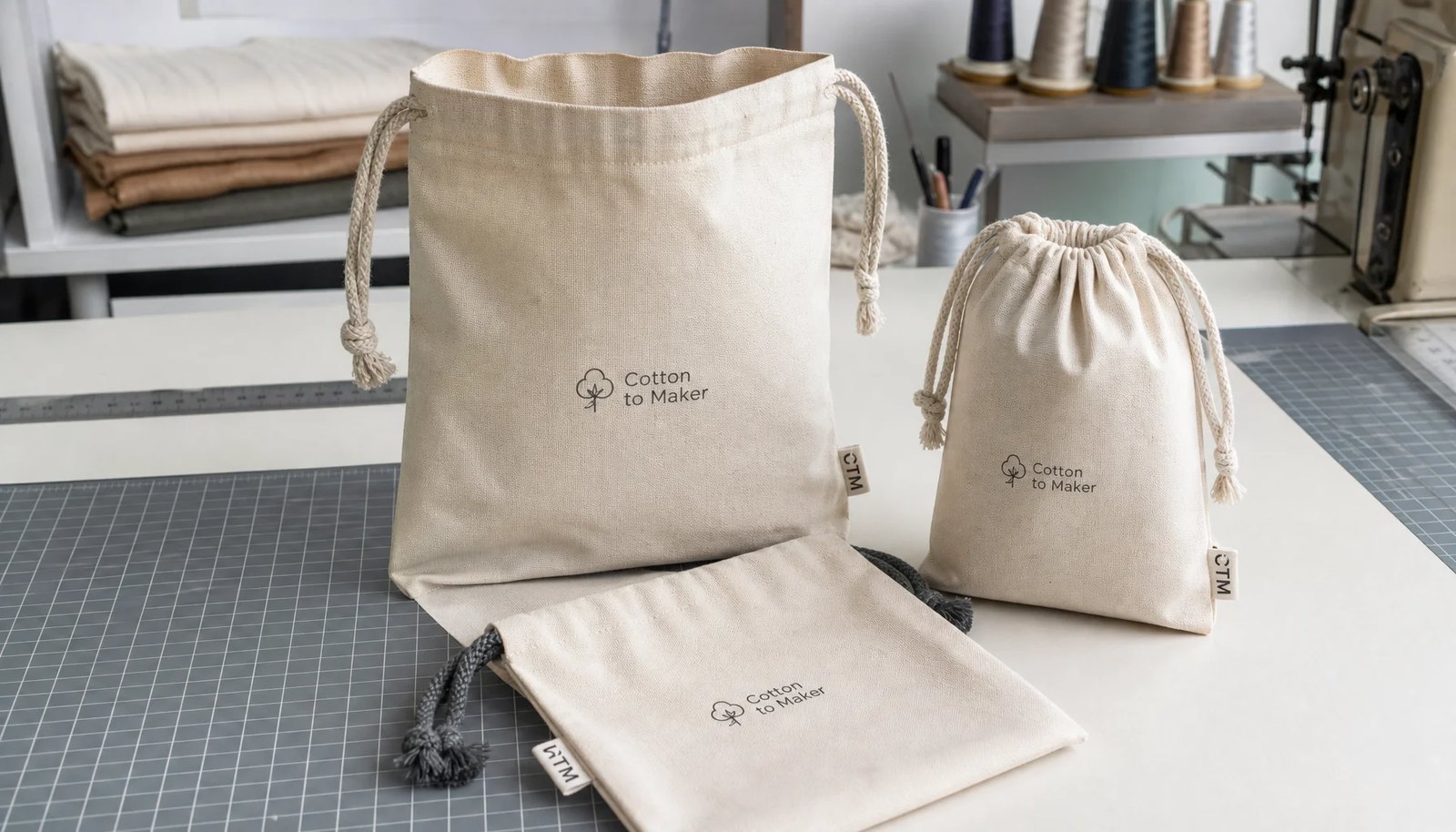
The Compliance Problem Behind a Simple Pouch
Custom cotton drawstring pouches are often treated as easy add-on merchandise for university bookstores. The order can still fail if the supplier does not understand licensed logo handling, fabric claims, retail packing, and the fixed campus delivery window. A pouch used for an alumni gift set or orientation kit carries more compliance pressure than a generic promotional bag because it may display protected university marks and move through a formal purchasing process.
The practical buying problem is not only finding a low unit price. Procurement teams need a supplier that can convert a bookstore requirement into controlled production: correct fabric, correct print, clean sewing, reliable carton data, and documents that support import and retail sale. A compliance checklist gives buyers a way to compare quotes on the same basis instead of choosing the supplier with the shortest email and the cheapest sample.
- Treat university artwork as controlled content, not a casual decoration file.
- Separate retail requirements from giveaway requirements before requesting quotes.
- Build approval time into the schedule for bookstore, licensing, and department review.
- Use the checklist before sampling, not after bulk production starts.
Start With the Use Case and Size
The first RFQ line should describe what the pouch will hold. A 10 x 14 cm cotton pouch for a pen set is a different product from a 25 x 35 cm pouch for apparel, dorm accessories, or graduation merchandise. Flat dimensions do not always reflect usable internal space because drawcord closure consumes opening width and bulky contents push against the side seams.
For university bookstores, the most common mistake is copying a pouch size from a retail photo without testing the actual contents. If the pouch is sold as packaging for a sweatshirt, tech accessory, water bottle, or course material bundle, the buyer should measure the packed contents and add room for easy insertion. Factories can adjust size, but late size changes affect cutting plans, fabric consumption, carton counts, and sometimes MOQ.
- Small accessory pouch: commonly 10 x 14 cm to 15 x 20 cm for pins, stationery, or jewelry-style items.
- Gift kit pouch: commonly 20 x 25 cm to 25 x 30 cm for mixed bookstore merchandise.
- Apparel pouch: usually needs heavier fabric and a larger opening, not only a larger flat panel.
- Acceptance criterion: finished size tolerance should be stated before sampling, typically plus or minus 0.5 cm to 1 cm depending on size.
Fabric Weight and Material Claims
Cotton drawstring pouches can be made from light plain cotton around 120 to 140 GSM, mid-weight cotton around 160 to 180 GSM, or heavier cotton canvas around 200 to 280 GSM. Light fabric keeps cost down and works for event giveaways, but it wrinkles more easily and can look thin under retail lighting. Heavier canvas feels more sellable, carries heavier contents better, and usually improves print appearance, but it raises material cost, carton weight, and sometimes sewing time.
Material wording matters when the bookstore wants sustainability messaging. Natural cotton, organic cotton, recycled cotton, and unbleached cotton are not interchangeable claims. If the pouch will carry a hangtag or website description, the supplier should provide material composition and any certificate details before the buyer approves copy. If certification is required, confirm whether it covers the material, the finished product process, or only the supplier’s general facility.
- 120 to 140 GSM: suitable for low-cost inserts, light gifts, and event distribution.
- 160 to 180 GSM: balanced option for standard bookstore gift pouches with better hand feel.
- 200 to 280 GSM canvas: stronger retail option for higher perceived value and heavier contents.
- Compliance note: do not print organic or recycled claims unless documents support the exact order.
Print Method and Licensed Artwork Control
For most cotton drawstring pouches, screen printing is the best cost-performance option when the university logo uses solid colors. It gives clean coverage, predictable pricing by color, and good durability when the ink is matched to cotton fabric. Heat transfer works better for gradients, small multicolor art, or photo-style graphics, but buyers should check edge feel, wash resistance if relevant, and how the transfer behaves on textured cotton.
University marks require tighter control than ordinary promotional artwork. The RFQ should state whether the supplier may keep logo files, whether production photos can show the mark, and whether overruns must be destroyed or shipped. For Pantone matching, the supplier needs the exact code, fabric color, print method, and approval sample. A color approved on white paper may not match the same way on natural cotton because cotton undertone can warm the ink.
- Screen print: best for one to four solid colors and repeat orders with stable artwork.
- Heat transfer: useful for detailed multicolor logos but needs adhesion and edge checks.
- Embroidery: usually better on thicker canvas and may distort lightweight cotton pouches.
- Acceptance criterion: print position tolerance should be defined, for example within 3 mm to 5 mm from approved placement.
MOQ Logic Behind Supplier Quotes
MOQ is rarely just a sales policy. For custom cotton drawstring pouches, MOQ is driven by fabric availability, cutting efficiency, print setup, dyeing, label production, packing components, and the factory’s sewing line planning. A supplier quoting a very low MOQ may be using stock fabric and a simplified print process, while a supplier quoting a higher MOQ may be pricing actual custom material and controlled packing.
Buyers should compare MOQ with the full specification, not as a standalone number. A 500-piece order using stock natural cotton with one-color screen print is easier than a 500-piece order using custom-dyed organic cotton, two-sided print, woven labels, hangtags, and barcode stickers. If campus departments place multiple small orders, the better route may be one master order with split packing by department, rather than several separate low-MOQ orders.
- Lower MOQ is realistic when using stock fabric, standard size, one print position, and bulk packing.
- Higher MOQ is normal for custom dye, certified material, woven labels, or special carton marking.
- Cost driver to isolate: print setup charges can make small orders look expensive per unit.
- RFQ tip: request tiered pricing at two or three quantities so the bookstore can see the break point.
Supplier Evidence That Matters
A compliant supplier should provide evidence tied to the order, not just a general profile. Useful evidence includes sample room photos, fabric swatch options, print test photos, sewing line capability, carton packing examples, and inspection reports from similar pouch products. These documents help buyers separate a real pouch factory from a reseller that forwards specifications to an unknown workshop.
For importers and distributors, transparency is especially important because responsibility can become unclear when quality issues appear. The buyer should know who controls fabric purchase, who prints, who sews, and who performs final packing. If any step is outsourced, the supplier should still own the inspection process and delivery schedule. Subcontracting is not automatically a problem, but unmanaged subcontracting is a frequent cause of late samples and inconsistent print color.
- Request actual pouch samples, not only tote bag samples from another production line.
- Look for consistent seam finishing and drawcord channel construction in sample photos.
- Require production responsibility in writing if printing or packing is subcontracted.
- Save the approved sample as the comparison standard for bulk inspection.
Sample Approval Before Bulk Production
A pre-production sample should represent the real bulk order. For a bookstore pouch, this means actual fabric weight, actual drawcord, actual print method, correct logo size, correct packing components, and any label or hangtag. A digital proof is useful for layout, but it cannot prove cotton texture, ink coverage, drawcord function, or sewing quality.
The sample approval process should produce measurable comments. Instead of writing that the pouch looks good, the buyer should approve dimensions, print color, print position, seam construction, closure function, label placement, and packing. If the university licensing office must approve the logo, build that step into the calendar. Factories can move quickly after sample approval, but they should not start bulk cutting or printing while artwork is still under review.
- Approve a physical sample for retail merchandise, licensed logos, or first-time suppliers.
- Use photo approval only for repeat orders with unchanged fabric, artwork, and packing.
- Mark any correction directly on sample photos to avoid vague revision instructions.
- Acceptance criterion: bulk goods should match the signed sample in material, color, construction, and packing.
Packing Rules for Bookstore Receiving
Packing is part of compliance, not an afterthought. University bookstores may require barcode stickers, hangtags, department labels, carton marks, inner polybags, or split packing by store location. If those details are added after the quote, the supplier may need extra labor, different materials, and more production time. The RFQ should state whether pouches are individually packed, bundled, or bulk packed.
Carton data also affects landed cost. A heavier 240 GSM canvas pouch may look like a small price increase at unit level, but it can raise carton gross weight and reduce units per carton. Importers should request carton dimensions, carton quantity, net weight, and gross weight before shipment booking. Distributors serving multiple campus stores should also confirm whether mixed designs are allowed in one carton or whether each SKU must be packed separately.
- Retail packing: individual polybag or paper band, barcode label, hangtag, and clean folded presentation.
- Giveaway packing: bulk pack by count, usually lower labor cost and faster packing.
- Split packing: requires exact SKU, department, or campus location instructions before production ends.
- Receiving criterion: carton marks should match the purchase order and packing list exactly.
Lead Time and Schedule Risk
Lead time should be quoted as a calendar, not a vague number of days. A realistic schedule includes artwork review, sample making, sample transit, buyer approval, material preparation, cutting, printing, sewing, trimming, packing, final inspection, and freight handover. The critical path changes depending on the specification. Stock natural cotton with one-color print can move faster than custom-dyed certified cotton with woven labels and retail packaging.
University bookstore timing is often tied to semester openings, orientation, homecoming, graduation, or donor events. Missing the delivery window can make a perfect pouch commercially useless. Buyers should lock artwork early, avoid late size changes, and reserve inspection time before shipment. If air freight is being considered to save a late order, compare the added freight cost against the value of changing to stock fabric, reducing packing complexity, or splitting the shipment.
- Fastest route: stock fabric, standard size, one-sided print, bulk packing, simple carton marks.
- Higher-risk route: custom fabric, multi-color print, licensing delays, labels, and split packing.
- Schedule control: approve sample and artwork before the factory purchases custom materials.
- Commercial safeguard: include the required delivery date and penalty-sensitive event date in the RFQ.
Quote Data for Landed-Cost Comparison
A low unit price is not enough for an importer or retail buyer to compare suppliers. The quote should separate product cost, print setup, sample cost, label cost, packing cost, inland freight, export carton data, and payment terms. Without carton dimensions and gross weight, the buyer cannot estimate ocean, air, courier, or warehouse handling cost accurately.
The best quote format shows what is included and what is excluded. For example, one supplier may include one-color screen print and bulk packing, while another may quote only blank pouches. A third may include individual polybags but exclude barcode labels. These differences can be larger than the apparent unit price gap. Procurement teams should normalize quotes by building a comparison sheet using the same quantity, same specification, same packing, and same trade term.
- Quote line items: pouch unit price, print setup, sample, label, hangtag, packing, and carton marking.
- Logistics data: pieces per carton, carton size, net weight, gross weight, and total carton count.
- Commercial terms: MOQ, payment terms, lead time after approval, incoterm, and quote validity.
- Comparison rule: reject quotes that do not state what fabric GSM and packing method are included.
Specification comparison for buyers
| Supplier option | What to verify | Commercial advantage | Buyer risk to control |
|---|---|---|---|
| Direct sewing factory | cord material proof, reinforcement close-ups, load-test photos, approved sample tag, and bulk-line first-piece record | Better sample-to-bulk control and faster production feedback | May be weaker on export paperwork or branded packing unless checked early |
| Trading company | Factory name, production photos, trim-source proof, and who owns QC decisions | Can coordinate small mixed orders and extra services | Markup can hide real factory capability and slow defect decisions |
| Specialized bag workshop | cord diameter, eyelet or reinforced channel, bottom corner reinforcement, seam allowance, bar-tack position, and load target | More practical for detailed construction, trims, and repeat programs | Capacity may be limited during peak seasons |
| Low-price general supplier | 6-10 oz cotton canvas, 210D polyester, rPET, or blended cotton with shrinkage and colorfastness expectations set before sampling | Useful for simple promotional runs with loose specs | Material downgrades, weak packing, and vague inspection scope can erase savings |
| Retail-ready supplier | fold direction, cord protection, bundle count, carton compression, moisture bag, and retail label position | Can handle labels, SKU separation, carton marks, and receiving rules | Higher unit cost must be compared against reduced warehouse work |
| Compliance-focused supplier | Fabric records, labeling review, test plan, and production traceability | Safer for retail programs and repeat brand orders | Documentation claims need evidence, not only sales language |
| Local sample room plus bulk factory | Signed sample, bulk factory handoff, first-piece photos, and deviation owner | Good for complex branding before large production | Sample room quality may not match bulk line unless handoff is controlled |
Buyer checklist before sampling
- Define the pouch use case: bookstore retail item, orientation giveaway, kit packaging, graduation gift, or department resale.
- Specify size by usable internal space, not only flat dimensions; include allowance for books, apparel, bottles, or stationery sets.
- State fabric composition and target GSM, such as natural cotton 140 GSM for light giveaways or 200 GSM canvas for retail use.
- Confirm logo ownership, university trademark approval process, Pantone references, and whether the supplier may print licensed marks.
- Choose the print method based on artwork and handling: screen print for solid marks, heat transfer for gradients, embroidery only for thicker fabric.
- Request pre-production sample photos and a physical sample when color accuracy, retail presentation, or licensed logo approval is required.
- Define MOQ by the real cost drivers: fabric purchase, dyeing, print setup, label production, cutting loss, and carton consolidation.
- Require packing details, including units per inner polybag, carton quantity, carton dimensions, gross weight, and barcode or hangtag needs.
- Set inspection acceptance criteria before production, including size tolerance, print rub resistance, seam strength, drawcord function, and packing accuracy.
- Ask for a lead-time calendar showing material readiness, sample approval, bulk sewing, printing, inspection, and shipment handover dates.
Factory quote questions to send
- Are you the factory sewing the cotton drawstring pouches, or will sewing, printing, or packing be subcontracted?
- What fabric weights do you keep in stock for natural cotton, dyed cotton, and canvas drawstring pouches?
- What is the MOQ for our requested size, GSM, print colors, drawcord type, and packing method?
- Which print method do you recommend for our artwork, and what is the expected print setup charge per color or per position?
- Can you provide a pre-production sample using the actual fabric, drawcord, print method, and packing components?
- What are your normal size tolerances, print-position tolerances, and acceptable defect levels for bulk inspection?
- How many pieces fit per export carton, and what are the estimated carton dimensions and gross weight?
- What quote data will you provide for landed-cost planning: unit price, tooling, sample cost, packing cost, inland freight, and shipment terms?
- What documents can you provide for material composition, trademark control, packing list, commercial invoice, and country-of-origin requirements?
- If the university trademark office requests changes after sample review, how will that affect lead time and cost?
Quality-control points to confirm
- Fabric GSM should be checked against the approved sample with a reasonable tolerance, commonly within plus or minus 5 percent unless the buyer specifies otherwise.
- Finished pouch size should be measured flat and after drawcord closure; tolerance should be stated, such as plus or minus 0.5 cm for standard small pouches.
- Seams should have even stitch density, no skipped stitches, no open seam ends, and reinforcement at drawcord channel stress points when the pouch carries heavier contents.
- Drawcords should slide smoothly, have matched length on both sides, and use knots, tips, or stitching that prevent easy pull-out during normal retail handling.
- Print color should match approved Pantone or signed sample within agreed tolerance, with no heavy ink buildup, cracking, pinholes, ghosting, or misregistration.
- Print adhesion should pass a basic rub test and handling test before bulk packing, especially for dark ink on natural cotton or heat transfer on coarse fabric.
- Lint, loose threads, oil marks, dye stains, and fabric slubs should be graded according to whether the pouch is a retail item or giveaway item.
- Packing should match the purchase order: correct count per polybag, carton marking, hangtag, barcode, warning label where required, and no mixed designs in unmarked cartons.
- Final random inspection should include AQL level, defect classification, carton count, sample comparison, and photo records of critical measurements.