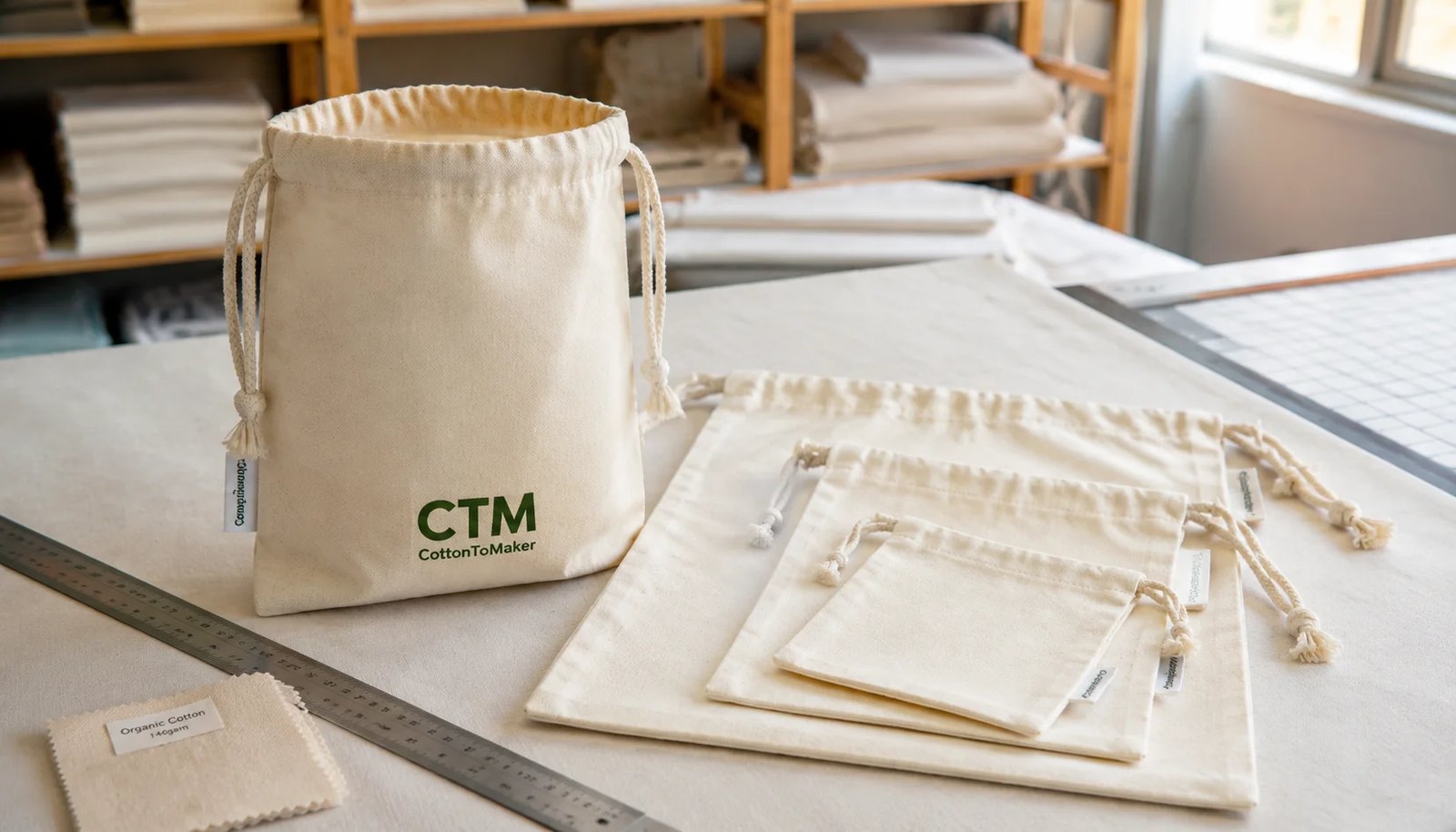
Start With the Use Case
A cotton drawstring pouch for a natural grocer can mean several different products. It may be a lightweight produce pouch, a bulk aisle refill pouch, a private-label wellness kit bag, a holiday gift pouch, or a reusable package for soaps, tea, jars, or accessories. The supplier compliance checklist should start with the product use, because the use decides fabric weight, print durability, cord strength, labeling, packing, and the level of documentation needed.
For procurement teams, the most common mistake is sending a general RFQ that says only natural cotton drawstring pouch with logo. That leaves too much room for the supplier to quote the cheapest fabric and a basic print, while another supplier quotes a heavier pouch with better sewing and more complete paperwork. The quotes will not be comparable, and the lowest price may become expensive after sample revisions, failed inspections, or retailer receiving issues.
- For loose produce or light refill goods, start around 4 oz to 6 oz cotton, with breathable fabric and clean drawcord operation.
- For jars, wellness bundles, candles, or heavier retail kits, move toward 7 oz to 10 oz canvas and stronger side seams.
- For premium gift packaging, handfeel, shade consistency, and print finish may matter more than maximum load capacity.
- For food-adjacent use, define whether the pouch directly touches food or only holds packaged goods.
Fabric Weight and Construction
Cotton pouch quotes must state fabric weight in GSM or ounces per square yard. Natural grocer buyers often prefer unbleached natural cotton because it supports a simple, low-plastic packaging message. However, natural cotton varies in seed fleck, shade, yarn cleanliness, and handfeel. A buyer who needs a clean retail look should request a controlled natural shade range or approve a fabric swatch before production.
Light cotton keeps cost and freight weight down, but it can look transparent and may not hold a printed logo cleanly. Heavier canvas feels more substantial and handles repeated use better, but it increases unit cost, carton weight, and sometimes MOQ because the supplier must book a specific fabric roll. A practical specification should link GSM to the load and presentation requirement instead of treating heavier fabric as automatically better.
- 4 oz or about 135 GSM cotton: low-cost, light items, simple giveaways, not ideal for heavy refill use.
- 5 oz to 6 oz or about 170 to 200 GSM cotton: common for reusable produce and grocery accessory pouches.
- 7 oz to 8 oz or about 240 to 270 GSM canvas: stronger retail kits, better logo body, higher perceived value.
- 10 oz or about 340 GSM canvas: premium and durable, but confirm drawcord channel bulk and sewing capability.
Supplier Route and Evidence
The keyword in this sourcing task is supplier compliance, not only product specification. A natural grocer or brand selling through natural grocery channels usually needs more than a photo and a price. The supplier should prove who controls fabric purchase, cutting, sewing, printing, packing, and inspection. When these steps are split across subcontractors without disclosure, the buyer has less control over compliance documents and corrective actions.
A direct factory is often the strongest route for repeat programs because the same team can adjust size, fabric GSM, cord details, print position, and packing. A trading company can still be useful when bundling several bag categories, but the buyer should require transparency. Stock distributors are fast, but they rarely offer the same control over material origin, shade, and custom documentation.
- Request the legal supplier name that will appear on invoice, packing list, compliance documents, and any test report.
- Confirm whether cutting, sewing, printing, and packing happen in one site or through named partners.
- Review past production photos for similar pouch styles, not unrelated tote bags.
- Require material declarations before deposit, not after goods are finished.
Compliance Documents That Matter
Natural grocers are sensitive to sustainability, chemical safety, labeling accuracy, and truthful material claims. Buyers should avoid broad promises such as eco-friendly cotton pouch unless the claim is backed by specific documents. A supplier can usually provide a fabric composition declaration, product specification sheet, azo-free dye or ink statement, and restricted substance declaration. Organic cotton claims need stronger chain documentation and should not be assumed just because the fabric is natural-colored.
If the pouch may touch unpackaged produce or bulk goods, the buyer should clarify the regulatory path with its own compliance team. A cotton pouch is not automatically food-contact approved in every market. The practical sourcing approach is to define the intended use in writing and then request documents that match that use. If testing is needed, identify the test standard, sample source, timeline, and who pays before production starts.
- Fabric composition declaration should list fiber content and match the purchase order material.
- Organic cotton evidence should identify the certified material chain, not only show a supplier marketing certificate.
- Ink and dye statements should cover the actual print method and color used on the order.
- Country of origin, care label, and packaging label requirements should be settled before label artwork is approved.
Printing and Logo Risk
For cotton drawstring pouches, the logo is usually printed on a flexible fabric panel close to a drawcord channel. That creates risks that do not show up on a flat digital proof. The fabric may stretch during printing, the drawcord channel may distort the top area, and the print may look uneven on coarse natural cotton. A factory should recommend a print method based on fabric weight, artwork detail, print size, and order quantity.
Water-based screen printing is a practical default for one-color or two-color natural grocery branding. It keeps the fabric soft and usually works well on natural cotton. Heat transfer can handle small details or full-color marks, but it may feel less aligned with a natural fabric story and should be tested for cracking or peeling. Embroidery can look premium on canvas, but it adds cost, can pucker lighter fabric, and is not ideal for very small text.
- Define print size in millimeters and position from the finished pouch edge.
- Use Pantone reference for brand color, but allow a realistic fabric and ink tolerance.
- Keep fine text away from coarse fabric and folded drawcord areas.
- Approve print strike-off or pre-production sample before bulk printing.
- Include rub test and visual color approval in the QC checklist.
MOQ and Cost Drivers
MOQ for cotton drawstring pouches is not only about sewing quantity. It is affected by fabric booking, dyeing, cord color, print setup, cutting loss, and carton handling. A supplier may accept a low unit quantity if using stock natural cotton and standard cord, but MOQ rises when the buyer requests custom dyed fabric, organic certified cotton, special cord, multiple sizes, or multi-color printing.
When comparing quotes, buyers should separate fixed setup costs from unit costs. A low MOQ may carry a high print setup charge or sample charge. A larger order may reduce unit labor and printing cost but increase inventory risk. The best RFQ gives suppliers a target order quantity plus possible reorder volume, so they can quote the first shipment and repeat orders more accurately.
- Main cost drivers include fabric GSM, cotton grade, size, print colors, cord type, sewing complexity, and packing method.
- Natural stock fabric normally prices better than custom dyed cotton because no dye lot is needed.
- Multiple sizes can share fabric but still require separate cutting, sampling, and carton control.
- Inner packing by store or assortment may add labor even if the pouch itself is simple.
Sample Approval Standard
A cotton pouch sample should not be treated as a souvenir. It is a control document for bulk production. The approved sample should show the final finished size, fabric weight, drawcord material, logo process, label position, seam construction, and packing style if possible. If the first sample uses substitute fabric or a temporary cord, the buyer should record what is temporary and require a pre-production sample before mass production.
Sample comments should be measurable. Instead of saying logo too high, state the required distance from top finished edge to logo top. Instead of saying fabric too thin, state the target GSM and acceptable tolerance. This reduces repeated sample cycles and prevents the supplier from guessing at buyer intent.
- Measure pouch width, height, bottom gusset if any, drawcord channel height, and cord length.
- Weigh or verify fabric against the approved GSM reference.
- Photograph the approved sample with ruler and color card when possible.
- Sign off on logo size, placement, print color, and print handfeel.
- Keep one sealed approved sample for incoming or pre-shipment inspection comparison.
Packing for Grocery Distribution
Packing is a serious cost and compliance issue for natural grocer orders. A pouch that is acceptable at the factory can become a receiving problem if cartons are mixed, overweight, unlabeled, or packed in a way that wrinkles the product. Distribution centers need predictable carton counts and clear SKU identification. Store allocation programs may require inner packs by quantity, color, or assortment.
Sustainability expectations also affect packing. Some natural grocers prefer reduced plastic, paper bands, or bulk inner packing instead of one polybag per pouch. That choice must be balanced with cleanliness and moisture protection during ocean freight or warehouse handling. If the pouch is natural cotton, moisture and odor control matter because unbleached fabric can show stains and absorb smells.
- Quote units per inner pack, units per master carton, carton dimensions, gross weight, and net weight.
- Avoid mixed cartons unless the PO and receiving system are designed for them.
- Use carton liners or moisture control when shipment route has humidity risk.
- Set carton weight limits that warehouse teams can handle safely.
- Mark cartons with PO number, item code, size, color, quantity, country of origin, and carton sequence.
Lead Time and Schedule Risk
A realistic lead time separates sample development, material booking, bulk cutting, printing, sewing, inspection, and export packing. A supplier quoting only production days may be leaving out artwork approval, fabric waiting time, and test report timing. Natural cotton stock fabric can move quickly, while organic cotton, dyed cotton, special cord, or retailer-specific labels can extend the schedule.
Buyers should build the calendar backward from in-store date or distribution center delivery date. The compliance review should happen before deposit or during sampling, not after bulk goods are packed. If a third-party inspection is required, reserve time for failed inspection, rework, and reinspection. This is especially important for seasonal grocery promotions where a late pouch has little value.
- Typical planning blocks include artwork proof, sample making, sample shipping, buyer approval, fabric booking, production, inspection, and freight handoff.
- Custom fabric, organic documentation, and multi-color artwork are common schedule extenders.
- Late carton specification changes can delay packing even when sewing is complete.
- Inspection should occur when 100 percent of goods are finished and at least 80 percent are packed, unless the buyer defines another rule.
Compare Quotes by Landed Value
The cheapest FOB price is not always the lowest landed cost. A thin pouch with weak stitching may create returns or brand damage. Oversized cartons can raise freight cost. Poor documentation can delay retailer approval. A buyer comparing supplier quotes should normalize the specification first, then compare unit price, setup charges, sample cost, testing cost, carton cube, inspection cost, and defect responsibility.
A strong quote should read like a production plan. It should state the material, GSM, size, print method, MOQ, lead time, packing, carton data, payment terms, and document availability. If one supplier gives a vague quote and another gives complete data, the complete quote is usually easier to manage even when the first unit price looks lower.
- Normalize all quotes to the same fabric GSM, finished size, print colors, and packing method.
- Calculate freight impact from carton dimensions and gross weight, not estimated unit weight only.
- Include sample, mold or screen setup, testing, inspection, and rework responsibility in the comparison.
- Score suppliers on responsiveness, document quality, sample accuracy, and corrective action process.
- Treat missing quote data as risk, not as a harmless blank.
Specification comparison for buyers
| Supplier option | What to verify | Commercial advantage | Buyer risk to control |
|---|---|---|---|
| Direct sewing factory | cord material proof, reinforcement close-ups, load-test photos, approved sample tag, and bulk-line first-piece record | Better sample-to-bulk control and faster production feedback | May be weaker on export paperwork or branded packing unless checked early |
| Trading company | Factory name, production photos, trim-source proof, and who owns QC decisions | Can coordinate small mixed orders and extra services | Markup can hide real factory capability and slow defect decisions |
| Specialized bag workshop | cord diameter, eyelet or reinforced channel, bottom corner reinforcement, seam allowance, bar-tack position, and load target | More practical for detailed construction, trims, and repeat programs | Capacity may be limited during peak seasons |
| Low-price general supplier | 6-10 oz cotton canvas, 210D polyester, rPET, or blended cotton with shrinkage and colorfastness expectations set before sampling | Useful for simple promotional runs with loose specs | Material downgrades, weak packing, and vague inspection scope can erase savings |
| Retail-ready supplier | fold direction, cord protection, bundle count, carton compression, moisture bag, and retail label position | Can handle labels, SKU separation, carton marks, and receiving rules | Higher unit cost must be compared against reduced warehouse work |
| Compliance-focused supplier | Fabric records, labeling review, test plan, and production traceability | Safer for retail programs and repeat brand orders | Documentation claims need evidence, not only sales language |
| Local sample room plus bulk factory | Signed sample, bulk factory handoff, first-piece photos, and deviation owner | Good for complex branding before large production | Sample room quality may not match bulk line unless handoff is controlled |
Buyer checklist before sampling
- Define pouch use first: produce, bulk aisle, wellness kit, gift-with-purchase, refill program, or retail packaging.
- Specify finished size after sewing, not just cut size; include tolerance such as plus or minus 5 mm for small pouches or plus or minus 10 mm for larger pouches.
- List fabric type, weight, color, and finishing: natural cotton, bleached cotton, dyed cotton, organic cotton, or recycled cotton blend.
- State whether the pouch may touch food, food packaging, cosmetics, supplements, or only non-food merchandise.
- Require fabric composition declaration and test documents that match the order material and supplier name.
- Lock print method, logo size, Pantone or ink color reference, print position, and acceptable registration tolerance before bulk approval.
- Include drawcord material, diameter, color, knot or tip finish, and pull strength expectation.
- Request one pre-production sample made with bulk fabric, bulk cord, and final artwork before authorizing production.
- Define inspection level, AQL target, defect list, and whether third-party inspection is required before shipment.
- Require carton packing data in the quote: units per inner pack, units per export carton, carton size, gross weight, and pallet preference if any.
Factory quote questions to send
- Are you the cut-and-sew factory for this cotton drawstring pouch order, or will any process be subcontracted?
- What fabric constructions can you offer for natural cotton pouches, including GSM or ounce weight, weave, shrinkage range, and available certifications?
- What is the MOQ by size, fabric color, print color, and cord color, and what cost changes if we combine multiple sizes under one purchase order?
- Which print method do you recommend for our artwork, and what are the setup charge, minimum print area, color tolerance, and rub-resistance standard?
- Can the pre-production sample be made with bulk fabric and bulk cord, and will you send photos of measurement, print placement, and drawcord channel construction?
- Which compliance documents can you provide before deposit, and which require paid testing on production material?
- What finished-size tolerance, sewing tolerance, and fabric weight tolerance do you apply in normal production?
- What carton packing plan are you quoting, including units per carton, carton dimensions, gross weight, and whether mixed cartons are allowed?
- What is the production lead time after sample approval and deposit, and what material or printing factors can extend it?
- How are defects handled if inspection finds failed seams, wrong GSM, print color deviation, mold, odor, incorrect labels, or carton shortage?
Quality-control points to confirm
- Finished pouch length and width measured flat after sewing, with the drawcord channel included or excluded exactly as defined in the spec sheet.
- Fabric weight verified from approved swatch or lab report, with tolerance stated in GSM or ounces per square yard.
- Seam strength checked at side seams, bottom seam, and drawcord channel under normal pulling force for the intended load.
- Drawcord runs freely through the channel, is even on both sides, and does not fray or detach during repeated opening and closing.
- Print position measured from fixed edges, not estimated by eye, with clear tolerance for left-right and top-bottom alignment.
- Print surface tested for rubbing, cracking, obvious pinholes, and ink transfer after light abrasion.
- Pouch is free of oil marks, mildew odor, loose threads, broken stitches, needle holes, mixed shades, and visible dirt.
- Packing count is verified by inner pack and export carton, with no mixed SKU cartons unless the purchase order allows them.
- Carton labels match purchase order, SKU, size, color, quantity, country of origin, and any retailer routing requirement.