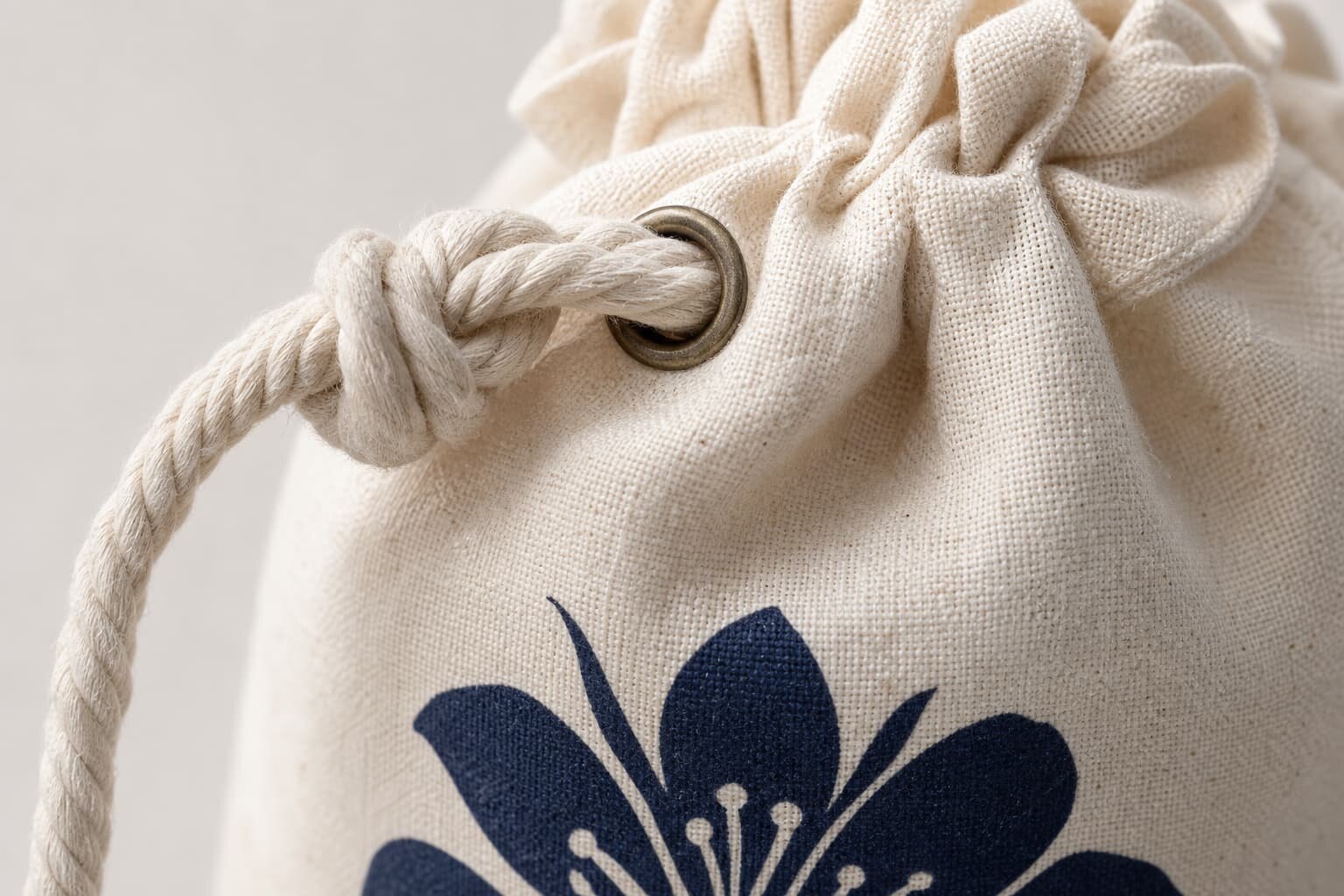
Why Sample Approval Matters Before Bulk Production
A cotton drawstring pouch looks simple, but many order disputes start because the approved sample was treated as a visual reference only. For procurement teams, the sample is not just a nice photo for the brand manager. It is the working contract for fabric weight, finished size, logo execution, stitching, drawcord function, packing, and acceptable variation.
The main buying problem is that a pouch can pass a quick desk review and still fail in real use. It may be too tight for the product, too thin for a premium gift set, too stiff to close neatly, or printed with ink that looks good on a flat proof but rough on cotton texture. A proper cotton drawstring pouch sample approval checklist turns these risks into measurable points before the factory cuts bulk fabric.
- Use sample approval to lock the physical product, not only the artwork.
- Test the pouch with the actual item it will carry, including retail packaging if applicable.
- Separate commercial approval from technical approval; both must be documented.
- Ask the factory to list any sample differences from planned bulk production.
Start With the Correct Sample Type
Not every sample has the same meaning. A stock sample shows workmanship and approximate fabric feel, but it does not prove your logo, color, size, or packing. A logo sample confirms print execution, but it may use available fabric instead of your final bulk fabric. A pre-production sample is the strongest approval reference because it should use the intended fabric, drawcord, thread, label, print method, and packing details.
Buyers should state which sample type is required in the RFQ. If timing is tight, you can approve a development sample for design direction, then require a final pre-production sample before bulk cutting. This prevents the common mistake of approving a showroom pouch and later discovering that the bulk order uses another fabric weight, another cord, or a different print position.
- Stock sample: useful for factory capability, not final bulk approval.
- Custom logo sample: useful for artwork and print method confirmation.
- Size sample: useful when the pouch must fit a product or kit exactly.
- Pre-production sample: best reference for bulk production and inspection.
- Packing sample: needed when retail labels, barcodes, sleeves, or inner cartons are involved.
Confirm Fabric GSM, Construction, and Hand-Feel
For cotton drawstring pouches, fabric weight strongly affects cost, appearance, print result, and closure performance. Lightweight cotton muslin may be suitable for jewelry, small gifts, herbs, or promotional giveaways. Medium cotton or cotton canvas gives better structure for cosmetics, candles, accessories, and retail packaging. Heavier cotton looks premium but may not gather smoothly at the drawstring channel, especially on small pouch sizes.
Do not approve fabric by description only. Ask for GSM, fabric type, color treatment, and any washing or shrinkage process. For many commercial pouches, 5 oz to 8 oz cotton is a practical range, but the correct choice depends on product weight, brand positioning, print coverage, and target price. Natural cotton may include small specks and shade variation; if the brand requires a clean white surface or exact color, specify bleached or dyed fabric and approve color tolerance.
- Light cotton around 100-140 GSM: low-cost, soft, suitable for small lightweight items.
- Medium cotton around 150-220 GSM: balanced option for branded gift and retail pouches.
- Cotton canvas around 220-300 GSM: stronger structure, higher cost, less flexible closure.
- Natural cotton: eco-style appearance but visible cotton seed specks may remain.
- Bleached or dyed cotton: cleaner presentation but needs shade control and color fastness checks.
Measure Finished Size, Opening, and Product Fit
A pouch size in a quote is often written as width by height, but buyers must confirm whether this is cut size or finished size. Finished size after sewing is the usable dimension. The drawstring channel also reduces the internal height, so a 15 x 20 cm pouch does not provide a full 20 cm of usable packing depth. If your product is boxed, rounded, sharp, or heavy, the real fit must be tested before approval.
During sample review, place the actual product inside the pouch and close the drawstring naturally. Check whether the pouch looks overfilled, whether the top can close, and whether the drawcord still moves smoothly. A pouch that fits when open may fail when closed because the channel and seam allowance reduce space. If the product will be handled in retail, also check whether repeated opening creates distortion or seam stress.
- State finished width and finished height in the purchase order.
- Define tolerance, for example plus or minus 5 mm for small pouches or as agreed by size.
- Confirm usable internal height below the drawstring channel.
- Test product fit with the exact retail box, bottle, jewelry card, or accessory set.
- Check whether bulky products require a gusset, wider pouch, or heavier fabric.
Approve Logo Print on the Real Cotton Surface
Artwork approval on a PDF is not enough for cotton drawstring pouches. Cotton has texture, absorbency, weave lines, and natural unevenness. Fine text, small icons, gradients, and thin outlines may look sharp on screen but lose clarity after printing. The sample should show logo size, position, color, edge definition, ink coverage, and hand-feel on the actual fabric surface.
Screen printing is usually the most practical method for simple one-color or two-color pouch logos. Heat transfer can handle gradients and small details, but the finish may feel more like a film on cotton. Embroidery adds perceived value but can distort lightweight fabric or create backing marks inside the pouch. Woven labels are useful when the pouch surface should remain clean, but label placement and stitching must still be approved.
- Check print position from top edge, side seam, and bottom edge, not by eye only.
- Confirm Pantone or approved color reference, but allow realistic tolerance on natural cotton.
- Review whether ink is soft, rubbery, raised, cracked, or too heavy for the fabric.
- Rub the printed area lightly after curing to check obvious ink transfer or weak adhesion.
- Avoid tiny text under the factory's recommended minimum line thickness.
Check Drawstring, Channel, and Closing Function
The drawstring system is the part users touch most, so it should not be treated as a minor trim. Cotton cord, flat tape, polyester cord, and self-fabric drawstrings all create different cost and appearance. Cotton cord matches natural pouches, but the color and diameter may vary. Polyester cord is more consistent and strong, but it can look less natural. Flat cotton tape gives a softer retail feel but needs a wider channel.
Approval should include function testing. Pull the cord open and closed repeatedly, then check whether the channel wrinkles evenly, whether knots slip, and whether the cord ends fray. A narrow channel can make the pouch hard to close. A weak channel stitch can tear when the pouch carries heavier contents. For larger pouches, double drawstrings often improve closure balance and user experience.
- Confirm cord material, diameter or width, color, and end finishing.
- Check single-pull versus double-pull closure based on pouch size and product weight.
- Pull each sample several times to feel friction and watch channel movement.
- Inspect knot size so the cord does not disappear into the channel.
- Review whether cord color may bleed onto light cotton during moisture exposure.
Inspect Stitching, Seam Strength, and Workmanship
Cotton drawstring pouches are usually simple sewn products, but small workmanship issues become visible quickly when thousands of pieces are packed together. Crooked seams, uneven top channels, thread ends, skipped stitches, and distorted corners make the pouch look lower value even if the fabric and print are correct. For branded retail packaging, workmanship is part of the product presentation.
The sample should define the sewing standard for bulk production. Check stitch density, seam allowance, back-tacking at stress points, inside seam finishing, and the top channel construction. If the pouch holds heavier products such as candles, glass bottles, or hardware, ask whether the seam strength is suitable or whether reinforcement is needed. A small cost saving on sewing can create larger costs in returns or repacking.
- Look for skipped stitches, loose thread, needle holes, oil marks, and uneven trimming.
- Check whether side seams are straight and symmetrical after pressing.
- Confirm top channel width is consistent and wide enough for the selected drawcord.
- Review corner shape because sharp corners and rounded corners give different appearances.
- Ask the factory to keep stitch type and thread color consistent with the approved sample.
Link MOQ, Sample Approval, and Cost Decisions
MOQ is not only a sales number. For cotton drawstring pouches, MOQ can be driven by fabric purchase, dyeing, printing setup, cutting efficiency, trim procurement, and packing labor. A buyer may request a low quantity, but a custom dyed fabric, special cord color, woven label, or individual retail sleeve can push MOQ higher than the basic pouch MOQ.
Sample approval should happen before the buyer compares final quotes. Otherwise, suppliers may quote different assumptions: one may quote 140 GSM cotton while another quotes 220 GSM canvas; one may include individual polybags while another quotes bulk carton packing. To compare supplier quotes correctly, issue the same approved sample specification to every factory and ask each supplier to separate unit price, setup charges, sample charges, packing charges, and freight terms.
- Basic natural cotton pouch MOQ may be lower than custom dyed fabric MOQ.
- Screen printing MOQ may depend on setup time and number of colors.
- Woven label, special cord, barcode sticker, and retail sleeve may each carry separate MOQ.
- Larger pouch sizes create more fabric waste and can change price tiers.
- A lower unit price is not comparable if fabric GSM, packing, or logo method is different.
Approve Packing Before the Factory Packs Bulk Goods
Packing is often left until the end, but it affects cost, carton size, inspection, and warehouse handling. Bulk flat packing is efficient for distributors and importers who will repack locally. Individual polybags, recycled paper sleeves, hangtags, barcodes, and inner cartons add labor and material cost but may be necessary for retail or fulfillment operations.
The approved sample should include the intended packing method if packing is part of the buyer's requirement. Confirm how many pouches per inner bundle, how many per export carton, whether pouches are folded or flat, and whether cartons need moisture protection. Cotton products can absorb moisture during storage and shipping, so packing should avoid damp cartons, excessive compression, and direct contact with dirty surfaces.
- Confirm individual packing only if it is needed; it changes cost and inspection time.
- Define carton quantity, carton dimensions, gross weight limit, and carton marks.
- Check whether the pouch should be ironed, folded, or packed flat.
- Approve barcode label position and scan quality before bulk labeling.
- Use desiccants or moisture control where shipping route, season, or storage conditions require it.
Build the Approval Record for Production and Inspection
A good approval record removes guesswork. It should include the signed physical sample, final artwork file, fabric specification, drawcord specification, size chart, tolerance, packing instruction, and any approved deviations. If the buyer accepts a slightly darker print or a minor fabric shade difference, write it down. If not documented, the factory may treat the sample as flexible.
Before bulk production starts, ask the factory to confirm that the approved sample is feasible for mass production with available fabric, trim, equipment, and lead time. The inspection company should also receive the same approval record. During final inspection, goods should be compared against the signed sample and purchase order, not against verbal messages or old artwork versions.
- Keep one sealed sample at the factory and one sample with the buyer or inspector.
- Mark the approved sample with date, project name, version number, and buyer signature if possible.
- Attach fabric swatch, print strike-off, and packing reference when full sample shipping is not practical.
- Include tolerance rules for size, shade, print position, and minor workmanship defects.
- Do not release bulk cutting until the factory confirms the final approved version.
Specification comparison for buyers
| Spec decision | Recommended option | When it fits | Buyer risk to check |
|---|---|---|---|
| Fabric weight | 5 oz to 8 oz cotton for most retail and gift pouches | Cosmetics, accessories, candles, jewelry, event gifts, and reusable brand packaging | Too light may show product outline or feel cheap; too heavy may increase cost and reduce drawstring closure flexibility |
| Fabric color | Natural, bleached white, dyed solid color, or Pantone-matched fabric | Natural for eco positioning, white for sharp printing, dyed color for brand campaigns | Dyed lots need color tolerance approval and may require higher MOQ or longer lead time |
| Print method | Screen print for solid logos; heat transfer for gradients; embroidery or woven label for premium finish | Screen print suits most one to three color pouch orders with stable cost | Fine lines can fill in on textured cotton; print size and ink hand-feel must be approved on actual fabric |
| Drawcord | Cotton cord, flat cotton tape, polyester cord, or self-fabric drawstring | Cotton cord gives a natural look; polyester improves strength and color consistency | Cord diameter, knot strength, fraying, and color fastness affect usability and complaint rate |
| Closure construction | Single drawstring for small pouches; double drawstring for larger or heavier contents | Single pull lowers cost; double pull improves opening balance and appearance | Weak channel stitching or narrow channel width can jam the cord during use |
| Sample type | Pre-production sample made with bulk-intended fabric, cord, print ink, and stitching | Needed before approving branded retail, subscription box, or distributor orders | A sales sample made from available fabric may not represent bulk production unless differences are documented |
| Packing | Flat pack in export carton; optional individual polybag, belly band, or recycled paper sleeve | Flat bulk packing suits distributors; individual packing suits retail or fulfillment centers | Packing changes carton size, labor cost, barcode placement, and inspection method |
| Tolerance | Confirm size, GSM, print position, and stitching tolerance before approval | Useful when products must fit inside the pouch or match retail shelf packaging | Approving a visual sample without written tolerance leaves disputes open during inspection |
Buyer checklist before sampling
- Confirm pouch finished size after sewing, not only cut fabric size, and state acceptable tolerance in millimeters.
- Approve fabric composition, weave, color, and GSM using the same standard that will be used for bulk inspection.
- Check whether the sample fabric is greige, natural, bleached, dyed, washed, or pre-shrunk, because shrinkage changes finished size and print position.
- Test the actual product inside the pouch for fit, drawstring closure, bulging, fabric opacity, and ease of removal.
- Review logo size, print method, ink color, print position, edge sharpness, hand-feel, and rub resistance on the actual cotton surface.
- Pull the drawcord repeatedly and check cord diameter, channel width, knot security, fraying, and whether both sides close evenly.
- Inspect seam allowance, stitch density, skipped stitches, loose thread, corner strength, and channel stitching at the stress points.
- Confirm whether the approved sample includes all labels, side tags, care labels, barcodes, inserts, hangtags, or retail sleeves.
- Record all accepted deviations from artwork, fabric shade, print shade, and size so the factory does not guess during bulk production.
- Approve carton packing method, pieces per carton, inner packing, moisture protection, carton marks, and maximum carton weight.
Factory quote questions to send
- Is the quoted fabric 100% cotton, recycled cotton, organic cotton, cotton canvas, cotton muslin, or a cotton blend, and what GSM tolerance is included?
- Will the bulk fabric be the same construction as the approved sample, including yarn count, weave, shrinkage treatment, color, and hand-feel?
- What is the finished pouch size tolerance after sewing and ironing, and how will oversized or undersized pieces be handled?
- Which print method is included in the quote, how many logo colors are included, and what is the maximum printable area for this pouch size?
- Is a print setup charge, screen charge, digital proof, lab dip, strike-off, or pre-production sample cost included or billed separately?
- What drawstring material, diameter, color, knot style, and closure construction are included in the quoted price?
- What MOQ applies to the pouch size, fabric color, custom dyeing, logo printing, woven label, and retail packing separately?
- How many days are required for artwork proof, sample making, sample revision, fabric procurement, bulk production, packing, and final inspection?
- Does the quote include individual polybags, master cartons, carton marks, barcode labels, desiccants, or retailer-specific packing requirements?
- What quote validity period applies, and what cost items may change if fabric price, exchange rate, artwork, packing, or order quantity changes?
Quality-control points to confirm
- Measure finished pouch width and height on at least several points because cotton can skew during cutting, sewing, and pressing.
- Weigh a fabric swatch or check supplier GSM report against the approved specification before cutting bulk fabric.
- Compare bulk fabric shade against the approved sample under consistent lighting, especially for natural, bleached, and dyed cotton.
- Inspect logo print adhesion, edge clarity, color accuracy, position, and curing; perform dry rub and light scratch checks where suitable.
- Check drawcord pulling strength and channel stitching because failure usually appears during normal opening and closing, not during visual inspection.
- Open the pouch fully and test product insertion to confirm the channel does not restrict usable opening width.
- Review inside seams and thread trimming; loose threads inside small pouches can catch jewelry, cosmetic caps, or hardware.
- Confirm carton count, packing orientation, moisture protection, and carton compression resistance before shipment release.
- Compare bulk goods against the signed approved sample, not only against a PDF artwork file.
- Document acceptable minor differences in advance, such as natural cotton specks, small weave slubs, or slight shade variation.