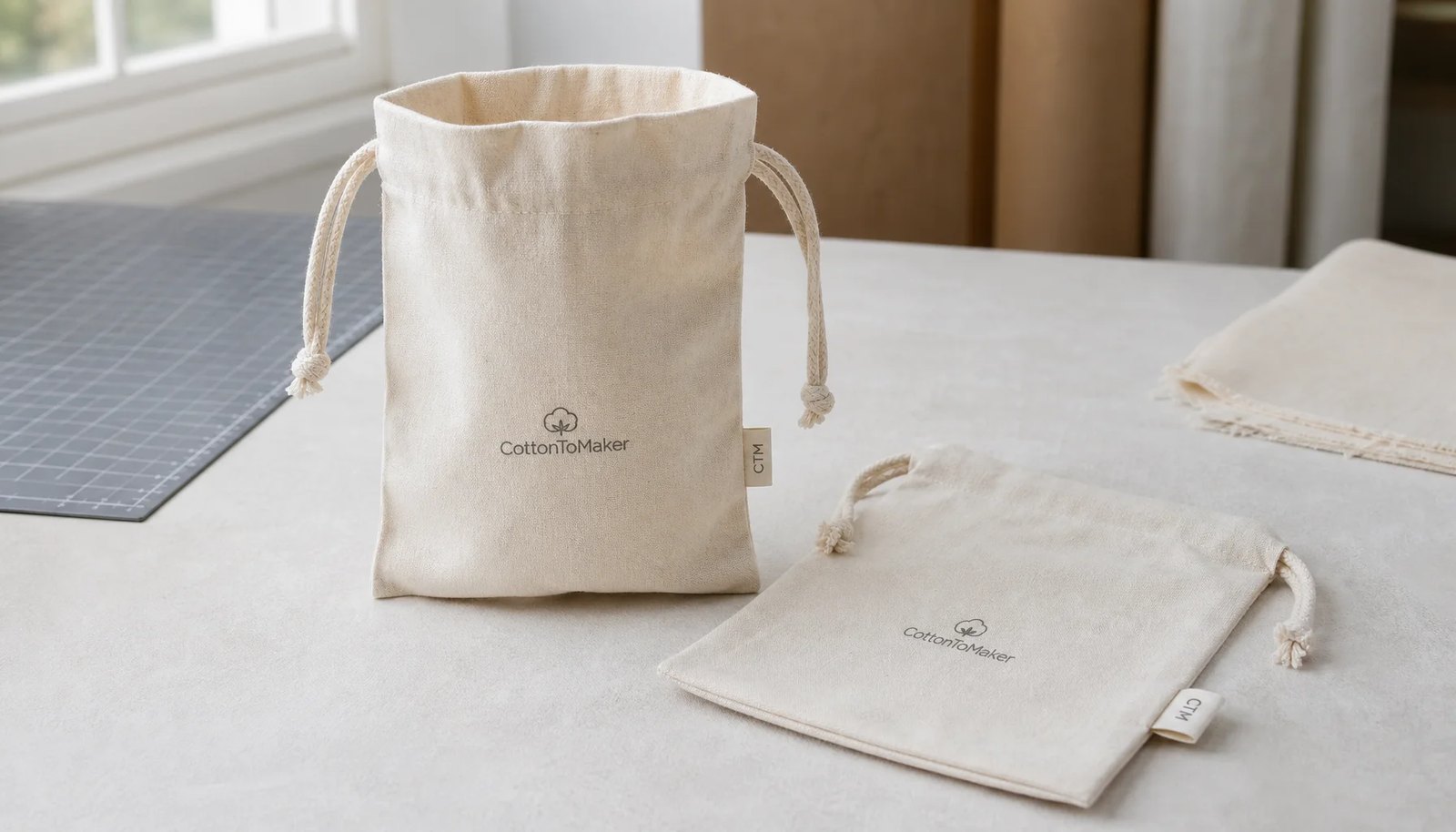
Why university bookstore pouches fail inspection
Cotton drawstring pouches for university bookstores look simple, but they combine textile, print, sewing, licensing, retail packing, and delivery requirements in one small item. The most common failures are not dramatic factory mistakes. They are practical gaps in the RFQ: fabric weight not defined, logo color approved only by digital proof, drawcord length not measured, and packing instructions written after production has already started.
For bookstore buyers, the risk is higher because the product usually carries a university mark and may be sold during a fixed campus window. A pouch that arrives two weeks late, has a weak mascot print, or is mixed across departments can miss orientation, alumni weekend, graduation, or holiday buying periods. Quality inspection needs to start at quote stage, not at the warehouse door.
- Treat the pouch as a retail SKU, not a generic promotional bag.
- Write the inspection standard into the purchase order before sampling.
- Approve physical samples for fabric, print, cord, stitching, and packing.
- Separate critical defects from tolerable natural cotton variations.
Lock the fabric specification before comparing prices
The first quote comparison point is fabric weight. A 4 oz cotton pouch and an 8 oz cotton canvas pouch can share the same finished size but feel like different products. For low-cost event giveaways, 4 oz to 5 oz cotton, roughly 135-170 GSM, may be acceptable if the pouch holds light inserts. For bookstore resale, gift packaging, or merchandise kits, 6 oz to 8 oz cotton canvas, roughly 200-270 GSM, normally gives a better hand feel and stronger retail impression.
Buyers should also define whether the fabric is natural, bleached, dyed, or custom color. Natural cotton can show seed flecks, yarn slubs, and shade variation between batches. That may be acceptable for a sustainability-positioned campus product, but it should be described in the approved sample and defect standard. If the bookstore expects a clean white background for a detailed logo, bleached cotton may be required and the price comparison changes.
- Quote fabric by GSM or oz, not only by the word cotton.
- State whether GSM is before or after washing, dyeing, or finishing.
- Use heavier fabric for resale and lighter fabric for event distribution.
- Define acceptable slubs, seed specks, and shade variation for natural cotton.
Choose the print method around artwork risk
Most university bookstore pouch orders use screen printing because it is economical, stable, and suitable for bold logos, department names, and one to three color artwork. The factory should print a strike-off on the same cotton fabric used for bulk production. Printing on a smoother test cloth and then switching to an open-weave natural cotton fabric is a common reason for fuzzy edges, uneven ink coverage, and unexpected color shift.
Complex mascots, gradients, or small typography may push the order toward DTF, heat transfer, or digital printing. These methods can solve detail problems but introduce different inspection risks: plastic hand feel, cracking on folds, poor adhesion, heat marks, or reduced breathability. For licensed university artwork, the buyer should decide whether retail appearance, durability, or cost has priority before approving the print route.
- Screen print works best for solid logos and repeat bookstore programs.
- DTF or transfer print needs rub, fold, and adhesion checks on finished pouches.
- Logo position should be measured from seams, not only judged by eye.
- Pantone reference, approved sample, or signed color swatch should control print color.
Set measurable inspection tolerances
A quality inspection checklist only works when tolerances are written clearly. For small pouches, finished size tolerance is often around plus or minus 5 mm; for larger drawstring pouches, plus or minus 10 mm may be practical depending on fabric weight and sewing method. The buyer should define finished size after sewing, not cut panel size, because fabric shrinkage and seam allowance affect the final product.
Print position also needs a tolerance. A logo that is 8 mm off center may look acceptable on a large tote but obvious on a small pouch. For university bookstore retail, print-position tolerance of plus or minus 3-5 mm is often more realistic than a vague request for perfect center alignment. The acceptance standard should also cover pinholes, smudges, ghosting, ink buildup, and broken registration.
- Measure finished width, height, and drawcord-channel height on flat samples.
- Define logo centerline and distance from top edge before bulk printing.
- Classify open seams, wrong logo, wrong color, and broken cord as major or critical defects.
- Do not rely on catalog dimensions if the order uses custom fabric or custom sewing.
Build the approval sample like a production control tool
A good approval sample is not a photo for internal presentation. It is the control item for cutting, printing, sewing, packing, and final inspection. The sample should use the same fabric weight, fabric color, drawcord, thread, seam type, print method, and packing style quoted for mass production. If any component is substituted during sampling, the supplier should mark it clearly and provide a date for the corrected pre-production sample.
For university bookstore buyers, one signed sample should stay with the buyer or importer, and one should stay at the factory production line. If a third-party inspection company is used, photos of the approved sample should be included in the inspection brief. This prevents the final inspection from becoming a debate about whether a slightly yellow natural cotton shade or a rougher cord was intended.
- Approve actual production fabric before bulk cutting.
- Keep one physical golden sample for buyer-side comparison.
- Photograph front, back, inside seams, drawcord channel, and packing format.
- Record sample approval date, revision number, and any accepted deviations.
Understand MOQ logic before negotiating
MOQ for cotton drawstring pouches is usually driven by fabric preparation, print setup, labor efficiency, and packing complexity. A factory may accept a small total quantity if all pouches use the same fabric, same size, same print color, and same packing. The same total quantity split into five department logos, three fabric colors, and individual retail barcode stickers can become a very different production job.
Buyers should compare MOQ by SKU, not only total order quantity. A bookstore order of 5,000 units may look simple until it is divided into bookstore logo, athletics logo, alumni logo, orientation kit version, and gift-shop version. Each variation can require separate screens, artwork checks, packing labels, and inspection sampling. The best RFQ tells the factory which variables are fixed and which are flexible.
- Ask for MOQ by fabric color, pouch size, logo version, and packing style.
- Combine departments under one fabric and one size when cost control matters.
- Expect separate setup charges for separate logo screens or print colors.
- Compare total program cost, not only the lowest unit price on one SKU.
Read the quote like a factory merchandiser
A useful quote for university bookstore pouches should include finished size, fabric weight, material composition, fabric color, print method, number of print colors, drawcord type, packing method, carton quantity, carton dimensions, gross weight, sample cost, setup charges, MOQ, lead time, and trade term. If these items are missing, the quote is not ready for approval, even if the unit price looks attractive.
The lowest quote may exclude items that appear later as change fees. Common hidden cost areas include print screens, PMS color matching, pre-production sample courier cost, barcode labels, individual polybags, moisture-control packs, carton marks, inland trucking, and inspection rework. For importers and distributors, CBM and gross weight can shift the landed cost enough to change the supplier ranking.
- Request CBM estimate before comparing air, sea, or courier options.
- Separate unit price from setup, sample, labeling, and packing charges.
- Confirm whether price includes export carton and carton marking.
- Use landed cost per sellable pouch as the decision metric.
Inspect sewing and drawstring function, not only appearance
Drawstring pouches fail in use at the side seam, bottom corner, cord channel, or cord knot. A front logo can look perfect while the pouch still feels cheap because the drawcord snags, one side is shorter, or the channel stitching is uneven. Inspection should include repeated open-and-close testing on random samples, especially for heavier canvas where the channel can become tight.
Stitch density, backstitching, thread trimming, and seam alignment affect both appearance and durability. For retail bookstore use, loose thread should not be treated as harmless if it catches during shelf handling or makes the product look unfinished. The final inspection should open the pouch, turn it partly inside out where practical, and review seam allowance and skipped stitches.
- Test drawcord movement by opening and closing each selected sample several times.
- Reject cords that pull out, fray badly, or have uneven finished length beyond tolerance.
- Inspect bottom corners because point loads collect there.
- Check channel width against cord diameter before approving bulk sewing.
Control packing for bookstore receiving
Packing is often the last instruction written and the first problem found during receiving. University bookstores may need pouches packed by SKU, department, event, barcode, carton mark, or display quantity. If a factory mixes logo versions in the same carton without a clear label, the receiving team may spend hours sorting inventory during a peak sales week.
Flat packing is usually efficient for cotton drawstring pouches, but it can crease heavy ink prints if cartons are over-compressed. Individual polybags protect clean white or light natural cotton pouches during long export handling, but they add cost and may conflict with campus sustainability goals. Paper banding, inner bundles, or master carton separators can be a better middle option if the product is not individually sold in sealed packaging.
- Define units per inner bundle and units per export carton.
- Use carton labels that match purchase order SKU names and bookstore receiving codes.
- Avoid over-tight cartons for large front prints or transfer graphics.
- Confirm whether individual packing is required for retail sale or only warehouse handling.
Plan lead time around approval bottlenecks
A realistic schedule separates artwork proofing, material sourcing, sample making, sample approval, bulk fabric preparation, printing, sewing, trimming, packing, inspection, and shipment booking. For a repeat order with approved fabric and artwork, production can move faster. For a new bookstore program with licensed artwork, custom dyed fabric, multiple logo versions, and retail labeling, the approval steps can take longer than the sewing.
The buyer should protect immovable campus dates by setting internal approval deadlines before the factory clock starts. Artwork changes after the print screen is made can cost more than time; they can also create mismatched samples and inspection confusion. If the order is tied to orientation or graduation, build in time for sample courier delays, inspection rework, customs, and inland delivery.
- Separate sample lead time from bulk production lead time in the PO.
- Freeze artwork before screen making or transfer film production.
- Reserve time for inspection and corrective action before vessel cutoff.
- Do not approve mass production from photos when color or fabric hand feel matters.
Specification comparison for buyers
| Spec decision | Recommended option | When it fits | Buyer risk to check |
|---|---|---|---|
| Fabric weight for daily bookstore resale | 6 oz to 8 oz cotton canvas, about 200-270 GSM | Good balance for reusable gift packaging, spirit merchandise, orientation kits, and light accessories | Too light may show contents and wrinkle badly; too heavy may raise freight cost and reduce drawstring closing performance |
| Fabric weight for low-cost event packs | 4 oz to 5 oz cotton, about 135-170 GSM | Short-run welcome events, low retail price points, and flat insert items such as pins, cards, or stationery | Buyer should test seam strength and opacity because thin fabric can tear at the side seam under point loads |
| Print method for bookstore logos | Screen print with water-based or discharge-compatible ink after fabric shrinkage is understood | Best for one to three solid university colors and repeat orders where color consistency matters | Logo edges can bleed on open-weave cotton; approve strike-off on actual production fabric, not paper proof only |
| Print method for complex artwork | DTF or heat transfer only after wash, rub, and cracking tests | Detailed mascots, gradients, small alumni graphics, or limited seasonal collections | Transfers can feel plastic, crack at folds, or fail if the pouch is pressed before fabric moisture is controlled |
| Drawcord construction | Cotton cord or braided polyester cord with secured knots and consistent cord length | Cotton cord supports natural positioning; polyester cord gives smoother closing for frequent use | Loose cord ends, unequal cord lengths, and poor channel stitching create returns even when fabric looks acceptable |
| MOQ planning | Start from print setup, fabric dyeing minimum, and carton efficiency rather than a round catalog MOQ | Useful when bookstore buyers split colors, departments, or logo versions across one purchase order | Many quotes hide setup charges by raising unit price; compare total landed cost by SKU, not only headline MOQ |
| Packing format | Flat packed in export cartons with inner polybag or paper banding based on retail handling needs | Works for bookstore stockrooms, campus event kitting, and distributor cross-dock handling | Over-tight packing can crease prints; mixed-SKU cartons without labels cause receiving errors during rush season |
| Inspection level | AQL-based final inspection plus buyer-approved golden sample for size, fabric, cord, and print | Appropriate for retail resale orders, licensed merchandise, and campus-branded promotional packs | Without written defect definitions, factories and inspectors may disagree on slubs, color variation, and print pinholes |
Buyer checklist before sampling
- Define pouch finished size with tolerance, not only nominal cut size; common tolerance is plus or minus 5 mm for small pouches and plus or minus 10 mm for larger sizes.
- Specify fabric composition, fabric weight in GSM or oz, weave style, color, shrinkage expectation, and whether the fabric is greige, bleached, dyed, or natural cotton.
- Approve a printed pre-production sample made with actual production fabric, drawcord, thread color, seam type, and packing method.
- Set print acceptance criteria for logo position, color matching standard, edge sharpness, ink hand feel, rub resistance, and visible registration shift.
- Record drawstring length, cord material, cord diameter, knot style, channel width, and whether the pouch closes fully without fabric bunching.
- Require seam strength checks at side seams, bottom corners, and drawcord channel because these are the failure points during bookstore use.
- Confirm carton quantity, carton dimensions, gross weight, inner packing, barcode label position, SKU separation, and mixed-carton rules.
- Use a final inspection checklist tied to the purchase order, approved sample, artwork file, and packing instruction before balance payment or shipment release.
- Compare quotes using landed cost per sellable pouch, including setup, sample, print screens, inland freight, export carton volume, and expected inspection cost.
Factory quote questions to send
- What exact cotton fabric weight will be used in GSM and oz, and is the quoted weight before or after finishing?
- Is the quoted fabric natural, bleached, dyed, or custom color, and what color tolerance standard will be used for production approval?
- Which print method is included in the unit price, how many colors are included, and what are the separate setup or screen charges?
- Will the pre-production sample use bulk fabric, bulk cord, bulk thread, and the same print process as mass production?
- What is the realistic MOQ by size, fabric color, logo version, and packing style, and which cost items change if the order is split across departments?
- What finished-size tolerance, print-position tolerance, and defect classification will the factory accept in the final inspection?
- How many days are needed for artwork proof, sample making, sample revision, bulk fabric preparation, printing, sewing, packing, and export booking?
- What carton size, carton quantity, gross weight, and CBM estimate are included in the quote?
- Can the factory provide production photos or inline inspection records for fabric cutting, printing, sewing, and packing before final inspection?
- What happens if the final inspection finds unacceptable print defects, wrong fabric weight, short quantity, or mixed SKU packing errors?
Quality-control points to confirm
- Fabric GSM verified from a cut sample before production and again during final inspection if the order uses custom cotton fabric.
- Finished pouch size measured flat at width, height, and drawcord-channel position using the approved tolerance in the purchase order.
- Print color checked against Pantone, approved lab dip, or signed physical sample under consistent lighting.
- Logo placement checked from top edge, side seam, and visual center; placement tolerance should be written before mass production.
- Seam strength checked by manual pull test and visual inspection for skipped stitches, broken thread, loose backstitching, and open bottom corners.
- Drawcord function tested by opening and closing repeatedly; cord should move smoothly and not pull out during normal handling.
- Print durability checked by dry rub, light wet rub where relevant, and fold-flex review on a finished pouch.
- Packing checked for correct SKU separation, carton markings, inner quantity, moisture control, barcode position, and retail-ready cleanliness.
- Quantity checked by carton count, inner count, and random unit count so short shipment is caught before export.
- Final inspection report tied to the approved sample, purchase order, artwork file, and carton packing list.