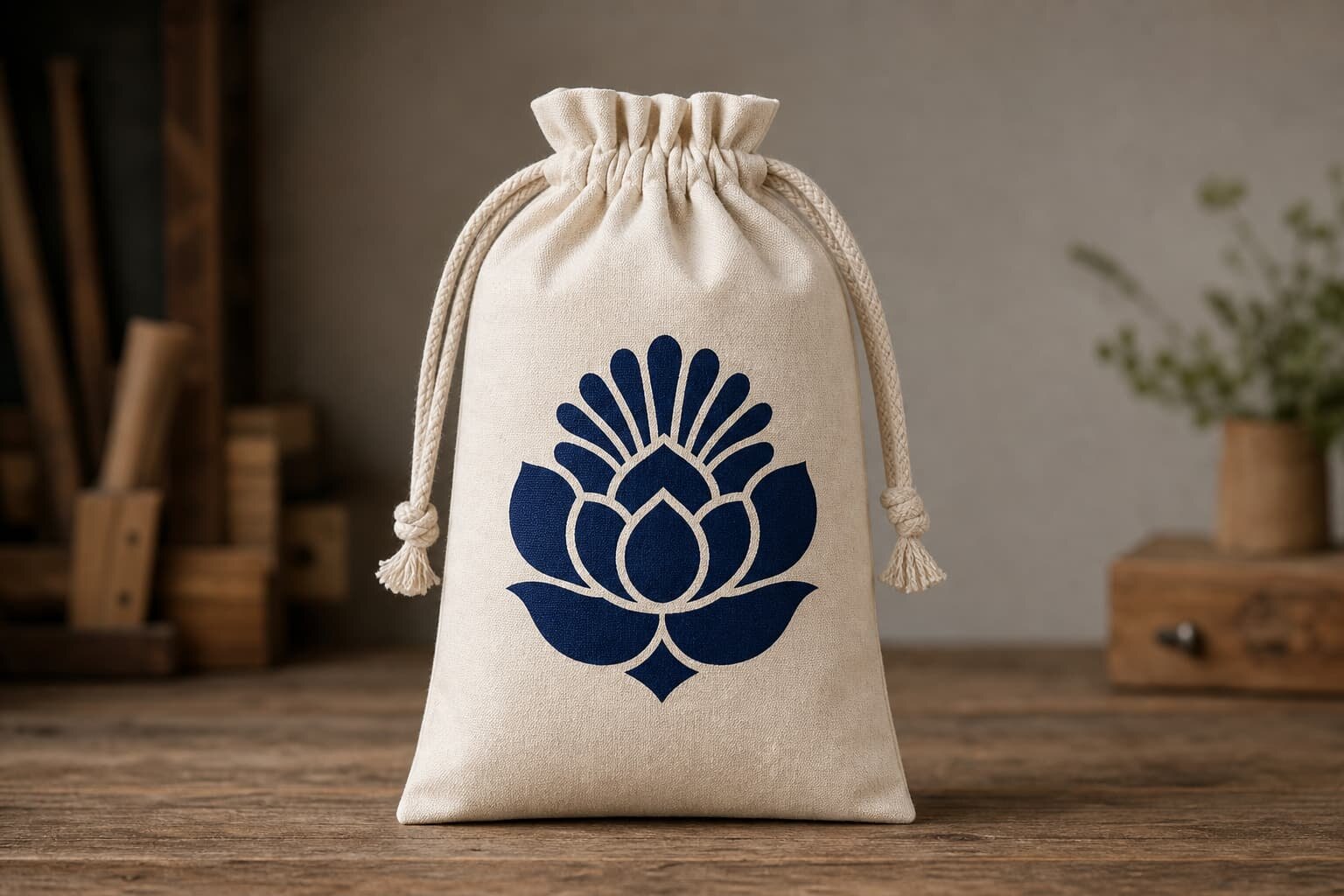
Why MOQ Planning Matters for Cotton Drawstring Pouches
Cotton drawstring pouch MOQ is not only a number printed on a supplier quotation. It is the result of fabric sourcing, cutting efficiency, print setup, sewing line changeover, cord preparation, packing labor, and carton handling. If a buyer asks for a low quantity across too many sizes, colors, and artwork versions, the factory may still accept the inquiry but will either increase the unit cost, simplify the specification, or hide setup costs inside the price.
For procurement teams, the buying problem is usually not whether 500, 1,000, or 3,000 pieces can be produced. The real problem is how to structure the first order so the factory can run it efficiently while the buyer still controls inventory risk. A good MOQ plan should answer four questions before RFQ release: what is the real pouch specification, how many variations are needed, which processes create separate minimums, and what order quantity gives a fair comparison between suppliers.
- Treat MOQ as a production structure, not only a negotiation point.
- Separate total order quantity from MOQ per size, color, print design, and packing format.
- Use one controlled spec sheet when comparing factories, otherwise the lowest quote may be based on weaker fabric or simpler packing.
- Plan the first order around operational need: launch quantity, replenishment speed, storage space, and inspection budget.
Start With the Use Case Before Choosing Quantity
A cotton drawstring pouch used for jewelry packaging has a different MOQ logic from a pouch used for glass jars, hotel amenities, reusable product kits, or event giveaways. The use case decides fabric weight, drawcord strength, logo method, packing standard, and acceptable defect risk. Buyers often start by asking for the cheapest pouch in a requested size, then discover later that the pouch is too transparent, too soft, or too small after drawcord closure.
Before asking for MOQ, define the product going inside the pouch and how the end user will handle it. If the pouch is a one-time promotional package, 4 oz cotton may be acceptable. If it supports a retail brand image or carries a heavier product, 6 oz or 8 oz usually gives better structure. If the pouch will be folded into another carton, thickness and drawcord bulk affect packing more than many buyers expect.
- For lightweight samples or gift packaging, check opacity and seam quality before upgrading fabric weight.
- For retail products, request a sample with the actual product inserted and photographed from front, side, and top.
- For heavier contents, test bottom seam load, drawcord channel stitching, and whether the pouch mouth closes fully.
- For kitting operations, confirm whether pouches must arrive flat, bundled, individually packed, or barcode labeled.
Fabric GSM Drives Cost, MOQ, and Factory Flexibility
Fabric is usually the biggest cost component in a cotton drawstring pouch, so GSM selection has a direct effect on MOQ planning. Common buyer language uses ounces, while some factories quote in GSM. As a working reference, 4 oz cotton is often around 135 GSM, 5 oz around 170 GSM, 6 oz around 200 GSM, 8 oz around 270 GSM, and 10 oz around 340 GSM. Exact conversion varies by fabric construction, so buyers should approve actual swatches rather than rely only on numbers.
MOQ becomes more flexible when the requested fabric is already available in the factory supply chain. Natural cotton in common weights is usually easier to source than custom dyed cotton, organic certified fabric, unusual weave, or a special canvas color. If the buyer needs a very specific shade, the dyeing MOQ may be higher than the sewing MOQ. This is why a quote must state whether the fabric is stock, made-to-order, dyed-to-order, or purchased against a larger fabric minimum.
- Ask for fabric weight in both oz and GSM to avoid misunderstanding between sourcing and QA teams.
- Request fabric swatches for natural, bleached, dyed, and canvas options if the brand position depends on handfeel.
- Check whether shrinkage is controlled before cutting or whether the finished size may change after pressing or washing.
- Do not compare a 4 oz quote with a 6 oz quote as if they are the same pouch; carton volume and perceived value also change.
Understand the MOQ Layers Behind One Pouch Order
A cotton drawstring pouch order can have several minimums at the same time. The sewing factory may have a minimum production run, the fabric supplier may have a fabric roll or dye lot minimum, the printer may have a screen setup minimum, and the packing team may have extra handling requirements for retail-ready units. When these are not separated, the quotation becomes difficult to compare and later change requests become expensive.
For example, a buyer may request 3,000 pieces total across three sizes, two cotton colors, and five logo designs. On paper this is a 3,000-piece order. In production it may become 30 small batches if every size, color, and logo combination is treated separately. That structure can create more sampling, printing setup, cutting markers, line changeovers, inspection points, and packing labels. The factory may then raise the price or push the buyer toward a higher MOQ per SKU.
- Total order MOQ: the minimum pieces needed to open a production order.
- Per size MOQ: the minimum efficient cutting and sewing quantity for each pouch dimension.
- Per color MOQ: the fabric or dye lot minimum for each body fabric color.
- Per artwork MOQ: the minimum quantity for each logo design or print screen setup.
- Per packing MOQ: the minimum labor-efficient quantity for special retail packing, barcode stickers, or assorted kits.
Build a Smarter Size and SKU Plan
Size planning is one of the easiest ways to reduce MOQ pressure without weakening the product. Many buyers create too many pouch sizes because every internal department requests its own ideal dimension. In production, each size requires a separate cutting setup, sewing adjustment, sample check, packing count, carton calculation, and inspection measurement. A first order with three well-chosen sizes is usually easier to manage than seven sizes with very small quantities.
Start with the product dimensions, then add practical allowance for insertion, drawcord closure, seam allowance, and fabric thickness. A pouch that looks correct when laid flat may become tight after the cord is pulled. If the product has square corners, sharp edges, or a rigid box, more allowance is needed. For retail buyers, the finished pouch should also look proportionate on shelf or inside the product carton, not only fit the product technically.
- Group products into shared pouch sizes instead of designing one pouch for every SKU.
- Use finished size and usable inner size as separate lines in the specification.
- Request size tolerance, for example plus or minus 5 mm for small pouches or a suitable tolerance for larger sizes.
- Confirm drawcord channel height because it reduces usable inner height after closure.
- For mixed-size orders, ask whether the same fabric roll, cord, and print color can be used across all sizes.
Print Method Choices That Change MOQ
Logo printing is often the second major MOQ driver after fabric. Screen printing is usually practical for simple one-color or two-color logos, especially on natural cotton. It gives good coverage and stable cost at volume, but each color needs setup and color matching control. If the artwork changes across SKUs, the factory may need separate screens and separate print approval for each version.
Heat transfer, digital print, embroidery, woven label, and sewn-in side labels can all be valid, but each has different minimums and quality risks. Heat transfer may help for full-color graphics or lower quantities, but buyers should check handfeel, edge durability, and cracking. Embroidery can look premium but may pucker lightweight cotton. Woven labels require label MOQ and lead time. A small CTM-style sample logo or brand logo should be tested on the actual fabric weight before bulk production.
- For screen print, provide Pantone code, artwork size, position from pouch edges, and number of print colors.
- For heat transfer, test adhesion, flexibility, wash or rub resistance, and whether the transfer edge is visible.
- For embroidery, avoid very fine text on lightweight fabric unless the factory confirms backing and stitch density.
- For woven labels, confirm label size, fold type, sewing position, label MOQ, and whether labels are supplied by buyer or factory.
- Always approve a print strike-off on actual bulk fabric, not only a digital artwork proof.
Sample Approval Should Protect the Bulk Order
Sampling is not a decoration step; it is the buyer's main tool for locking the production standard. For cotton drawstring pouches, a useful sample approval normally includes fabric swatch, blank sample, print strike-off, pre-production sample, and final sealed sample. Not every order needs every step, but skipping the wrong step can lead to disputes about fabric handfeel, print color, finished size, or drawcord function.
Buyers should avoid approving only photos if the pouch is new or the order quantity is large. Photos can help confirm layout, but they do not show GSM accurately, cord feel, print handfeel, or seam strength. A pre-production sample should be made with the intended fabric, drawcord, print process, size, and packing method as close as possible to bulk. If the sample uses substitute fabric or a different cord, that must be written clearly in the approval notes.
- Check finished width and height after the pouch is sewn and pressed, not only cut panel size.
- Pull the drawcord open and closed several times to confirm smooth movement and equal cord length.
- Rub the print area with a dry white cloth to check obvious ink transfer before approving bulk.
- Insert the actual product and check whether the pouch closes without distortion.
- Keep one sealed approved sample with the buyer and one with the factory for final inspection reference.
Packing and Carton Specs Affect Real Landed Cost
Many cotton drawstring pouch quotes look attractive until packing requirements are added. Bulk packing is normally the most economical: a fixed number of pouches per inner polybag, then a fixed quantity per export carton. Retail packing can require individual polybags, paper belly bands, hangtags, barcode labels, warning labels, size stickers, or assorted color sets. Each extra handling step increases labor, material cost, packing time, and inspection complexity.
Carton data also matters for freight and warehouse planning. Heavier canvas pouches, thicker cotton cord, or individual packaging can increase carton volume more than expected. A buyer comparing two quotes should request pieces per carton, carton dimensions, gross weight, net weight, and estimated CBM. Without that information, the lower unit price may not be the lower landed cost.
- Define whether pouches are packed flat, folded, bundled, or individually packed.
- Confirm inner pack quantity, carton quantity, carton material strength, and carton mark requirements.
- Ask whether cartons are size-specific or mixed, especially for distributor orders with many SKUs.
- If barcode labels are required, provide label file, placement instruction, scan requirement, and approval process.
- Request carton dimensions before final PO if sea freight, air freight, or warehouse slotting cost is important.
Lead Time Planning by Production Stage
Lead time for cotton drawstring pouches should be planned by stage instead of as one vague production promise. A practical timeline includes fabric confirmation, sample making, artwork proof, print strike-off, pre-production sample approval, bulk material preparation, cutting, printing, sewing, trimming, inspection, packing, and export handover. If any approval is delayed, the production schedule moves, especially during peak season.
MOQ and lead time are connected. A small order with many variations can take longer per piece than a larger simple order because the factory must change setup repeatedly. A larger order using one fabric, one print color, and one packing method may run more smoothly. For urgent programs, buyers should reduce SKU complexity before asking the factory to compress lead time.
- Ask the factory to quote sample lead time and bulk lead time separately.
- Clarify when lead time starts: after deposit, after artwork approval, after sample approval, or after material arrival.
- Build buffer for print strike-off approval if Pantone color or logo placement is sensitive.
- For dyed fabric, confirm dyeing lead time and whether lab dip approval is required before bulk fabric production.
- Do not release final delivery dates to internal sales teams until the sample approval path is confirmed.
Compare Factory Quotes With the Same Data
The most common quote comparison mistake is sending a loose inquiry and treating every response as equal. One factory may quote 4 oz natural cotton with bulk packing, another may quote 6 oz cotton with individual packing, and a third may include screen charges inside the unit price. The cheapest quote may not be cheaper after fabric, print setup, packing, sampling, and freight volume are normalized.
A professional RFQ should ask each factory to break out the main cost drivers. Buyers do not need a factory's internal cost sheet, but they do need enough detail to understand what is included. At minimum, request unit price by quantity tier, fabric spec, print method, setup charges, sample cost, packing method, carton data, lead time, payment terms, and validity period. If a supplier refuses to state whether MOQ is per SKU or total order, the buyer should clarify before issuing a purchase order.
- Compare quantity tiers such as 500, 1,000, 3,000, and 5,000 pieces only if the same spec is used.
- Ask whether screen charges, sample fees, label setup, and custom carton marks are included or separate.
- Request quote validity because cotton fabric and freight-related costs can move.
- Check Incoterms and export packing assumptions before comparing landed cost.
- Ask for alternate pricing if simplifying size mix, print colors, or packing can reduce MOQ pressure.
Specification comparison for buyers
| Spec decision | Recommended option | When it fits | Buyer risk to check |
|---|---|---|---|
| Fabric weight for small gift pouch | 4 oz to 5 oz cotton, about 135-170 GSM | Jewelry, cosmetics, small promotional kits, lightweight retail packaging | Too thin for dark contents or sharp corners; ask for fabric opacity photo with product inside |
| Fabric weight for reusable retail pouch | 6 oz cotton, about 200 GSM | Most branded drawstring pouch orders where cost and durability must balance | Quote may look similar across suppliers but fabric construction and shrinkage can differ |
| Fabric weight for premium or heavy contents | 8 oz to 10 oz cotton canvas, about 270-340 GSM | Candles, glass jars, tools, wine accessories, heavier kits | Higher sewing time, thicker drawcord channel, larger carton volume, and possible higher MOQ |
| Logo method for simple 1-2 color artwork | Screen printing with Pantone reference and strike-off approval | Most cotton pouch bulk orders above factory minimum print quantity | Ink penetration and edge sharpness vary by fabric texture; approve print on actual bulk fabric |
| Logo method for full color artwork | Heat transfer or digital print after sample testing | Gradient artwork, small MOQ brand launches, photo-style graphics | Handfeel, wash resistance, and cracking risk must be checked before bulk approval |
| Drawcord choice | Cotton cord matching natural or dyed body color | Retail packaging, eco-positioned promotions, reusable gift bags | Cord diameter affects closing function; thin cord looks cheap and thick cord may jam in small channels |
| Size mix strategy | Limit first order to 1-3 sizes using same fabric and print colors | New SKU launch, distributor test order, seasonal packaging program | Too many sizes split MOQ and increase setup, sampling, labeling, and packing error risk |
| Packing format | Bulk pack 50-100 pcs per inner polybag, carton by size and color | Wholesale, distributor, or in-house kitting operations | Retail-ready individual packing adds labor, material, barcode control, and carton volume |
| MOQ negotiation route | Consolidate fabric, print color, cord, and packing across SKUs | Buyers needing lower per-SKU quantities without losing factory efficiency | Factory may accept total MOQ but still require minimum per color, per size, or per print setup |
Buyer checklist before sampling
- Confirm whether the MOQ is per order, per size, per fabric color, per print design, or per packing method.
- Define finished pouch size with tolerance, not only approximate usable product size.
- Select fabric weight in oz or GSM and request a fabric swatch before confirming bulk production.
- State whether natural, bleached, dyed, or organic cotton is required, because fabric sourcing MOQ changes.
- Limit early orders to fewer size and color combinations to avoid unnecessary setup and inventory risk.
- Request print strike-off on the actual fabric, especially for fine lines, solid ink areas, or Pantone matching.
- Specify drawcord material, diameter, color, knot or no-knot finish, and whether cord ends need trimming.
- Confirm packing count per inner bag, carton quantity, carton dimensions, gross weight, and carton marks.
- Ask for sample approval steps: pre-production sample, print strike-off, size set if multiple sizes, and sealed sample.
- Compare quotes using the same spec sheet and ask factories to separate fabric, printing, packing, and tooling charges.
Factory quote questions to send
- Is your MOQ calculated by total order quantity, fabric color, pouch size, logo artwork, or print color?
- What fabric weights are available from stock, and which options require greige fabric weaving or dyeing MOQ?
- Can you quote 4 oz, 6 oz, and 8 oz versions of the same pouch size so we can compare cost and carton volume?
- What is the minimum print quantity for screen printing, heat transfer, woven label, and embroidery on this pouch?
- Are sample fees, screen charges, label setup, and carton label setup included or listed separately?
- What is your standard size tolerance after sewing and pressing, and how do you control shrinkage on cotton fabric?
- How many days are needed for blank sample, print strike-off, pre-production sample, bulk production, and packing?
- Can you provide carton dimensions, pieces per carton, gross weight, and estimated CBM before order confirmation?
- What inspection standard do you recommend for seam strength, print adhesion, drawcord function, stains, and size tolerance?
- If we split the order into two delivery batches, does the MOQ, unit price, or fabric dye lot control change?
Quality-control points to confirm
- Measure finished width, height, drawcord channel height, and usable inner space against the approved sample.
- Check fabric GSM, handfeel, weave density, color shade, and visible slubs against the confirmed swatch.
- Test drawcord closing and opening function for smooth movement, balanced cord length, and no skipped channel stitching.
- Inspect side seams, bottom seams, bartacks if used, loose threads, needle holes, and seam allowance consistency.
- Check logo position, print color, ink coverage, edge sharpness, rubbing resistance, and curing result.
- Review stains, oil marks, lint, fabric creases, and contamination because natural cotton shows dirt easily.
- Verify packing quantity, inner bag count, carton label, barcode if required, assortment ratio, and carton strength.
- Confirm approved sample, bulk production, and final packed goods use the same size, fabric, cord, and print method.