Why MOQ Matters for Coffee Roasters
Coffee roasters often start with small-batch runs, testing new blends and packaging designs. A cotton drawstring pouch MOQ that is too high can lock you into inventory you cannot sell quickly. Understanding how MOQ is calculated helps you negotiate better terms and avoid overcommitting.
MOQ is not a random number. It is driven by fabric cutting efficiency, print setup costs, and production line scheduling. A factory that runs 10,000 meters of fabric per shift will have a higher MOQ for custom fabric than one that stocks standard blanks. Knowing these drivers lets you choose the right supplier for your volume.
For coffee roasters, the pouch is part of the brand experience. A well-chosen pouch protects the beans, communicates quality, and differentiates your product on the shelf. But if MOQ forces you to order 5,000 pouches for a 200-bag test run, you tie up capital and warehouse space. The goal is to align MOQ with your sales forecast and cash flow.
This guide walks you through every factor that influences MOQ—from fabric weight to packing format—so you can plan your procurement with confidence. Whether you are a micro-roaster ordering 500 pouches or a regional brand scaling to 10,000 units, the principles are the same: know your specs, ask the right questions, and negotiate from a position of knowledge.
- MOQ is typically 500–2000 pcs for custom cotton drawstring pouches.
- Standard sizes and natural fabric have lower MOQ than custom sizes or bleached white.
- Print method (screen print vs. woven label) significantly affects MOQ.
- Bulk packing reduces MOQ compared to retail-ready packaging.
- Align MOQ with your sales forecast to avoid overstocking.
Fabric Weight and Type: The First MOQ Driver
Fabric weight, measured in GSM (grams per square meter), directly affects MOQ. A standard 140 GSM natural cotton pouch is a common stock fabric, so MOQ is lower. If you specify 180 GSM for a heavier feel, the factory may need to order that fabric specially, raising MOQ by 30–50%.
Fabric type also matters. Unbleached natural cotton is widely available and cheaper. Bleached white or organic cotton may require separate sourcing, increasing MOQ. If your brand uses multiple fabric types, consider standardizing on one to reduce MOQ across SKUs.
The table below shows how GSM and fabric type interact with MOQ. Use it as a starting point when discussing specs with suppliers. Note that these are typical ranges; actual MOQ depends on the factory's current stock and production schedule.
When evaluating fabric, always request a swatch card. A swatch lets you feel the hand, see the natural color variation, and test how the fabric holds up with your beans. Some roasters prefer a slightly heavier 160 GSM pouch for 16 oz bags, while 140 GSM works well for 12 oz retail bags. The difference in cost per pouch is often less than $0.05, but the perceived quality difference can be significant.
- 140–160 GSM is the sweet spot for cost and durability.
- Unbleached natural cotton has the lowest MOQ.
- Organic cotton may have a higher MOQ due to certification and sourcing.
- Request a fabric swatch before committing to a specific GSM.
- Heavier GSM (180+) increases MOQ and unit cost but adds perceived quality.
Print Method: Screen Print vs. Woven Label
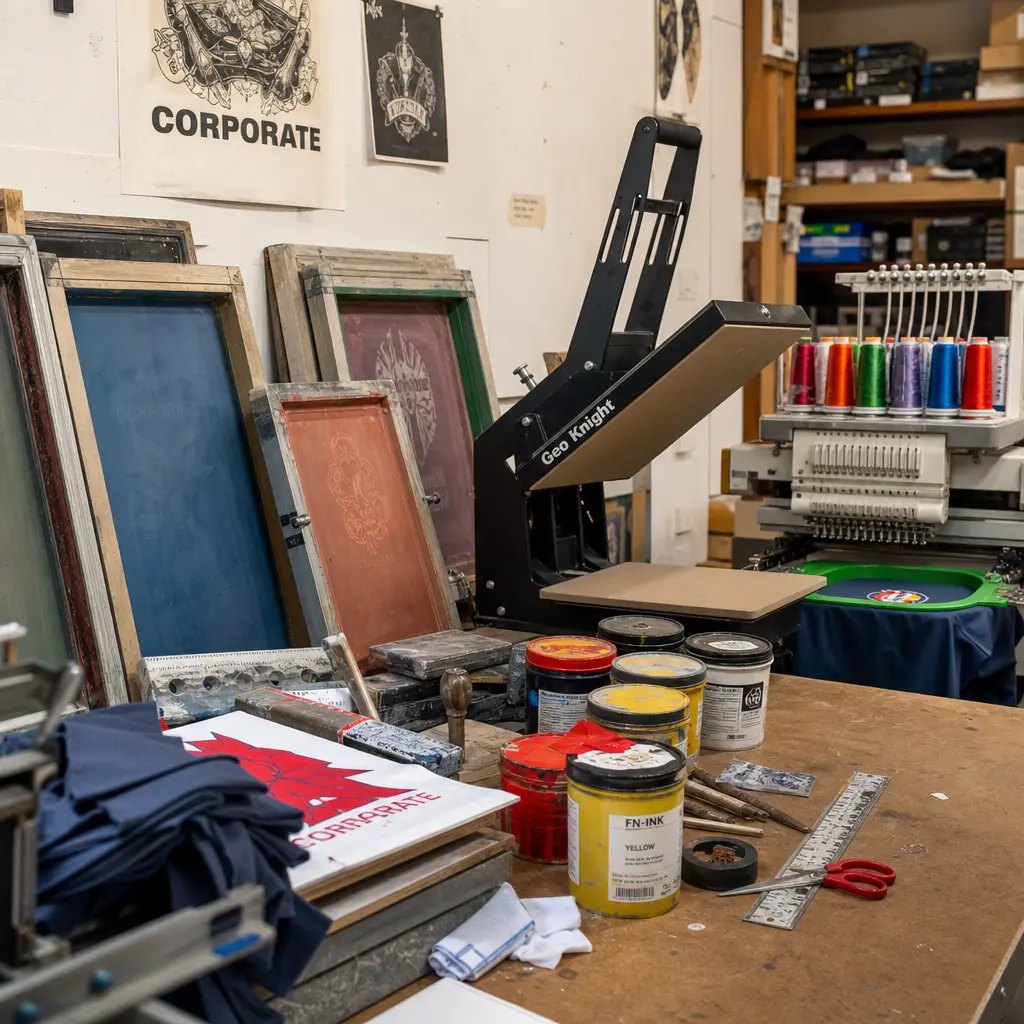
Screen print is the most common method for cotton drawstring pouches. Setup cost is low, and MOQ is typically 500–1000 pcs per design. If you need multiple colors, each color requires a separate screen, which can increase MOQ. For 1–2 color prints, MOQ remains manageable.
Woven labels offer a premium look and are sewn onto the pouch. However, label production has its own MOQ (often 500–1000 pcs per label design). If you have multiple pouch sizes, each may need a different label size, multiplying MOQ. Consider using the same label across all sizes to reduce MOQ.
A third option is no print at all—using a blank pouch with a hang tag or sticker. This keeps pouch MOQ at its absolute minimum and shifts the branding cost to tags, which typically have lower MOQ (250–500 pcs). This approach works well for roasters who change blends frequently and want to avoid committing to a single printed pouch design.
When comparing print methods, also consider durability. Screen print on cotton can fade with repeated washing or heavy handling. Woven labels are permanent and add a tactile element. For coffee roasters selling at farmers' markets or subscription boxes, the label's longevity may justify the higher MOQ and cost.
- Screen print: MOQ 500–1000 pcs per design, 1–2 colors ideal.
- Woven label: MOQ 500–1000 pcs per label design, plus sewing cost.
- Full-bleed print or 4+ colors may double MOQ.
- Ask if the factory can combine multiple print designs into one run.
- Blank pouch + hang tag: lowest pouch MOQ, tag MOQ 250–500 pcs.
Pouch Size and Shape: Custom vs. Standard
Standard sizes (e.g., 10x14 cm, 12x16 cm) are cut from existing dies, so MOQ is lower. Custom sizes require new die-cutting, which adds tooling cost and raises MOQ. If you need a unique size, ask if the factory can adjust a standard die to reduce MOQ.
Shape also matters. A flat pouch is simpler than a gusseted bottom or reinforced corners. Complex shapes increase cutting waste and sewing time, driving up MOQ. For first orders, stick to a simple rectangular shape to keep MOQ low.
Coffee roasters should match pouch size to their bag dimensions. A 12 oz bag of whole beans typically fits a 10x14 cm pouch, while a 16 oz bag needs 12x16 cm or larger. Always test with your actual filled bag—bean density varies by roast level, and a dark roast takes more volume than a light roast for the same weight.
If your product line includes both 12 oz and 16 oz bags, consider whether one pouch size can accommodate both. A slightly oversized pouch for the 12 oz bag may be more cost-effective than two separate SKUs with two MOQs. Calculate the total landed cost per unit for both scenarios before deciding.
- Standard sizes: MOQ as low as 500 pcs.
- Custom size: MOQ typically 1000–2000 pcs.
- Gusseted or reinforced shapes may add 20–30% to MOQ.
- Ask for a list of standard sizes before designing your pouch.
- Test pouch fit with your actual filled coffee bags, not empty ones.
Packing Format: Bulk vs. Retail-Ready
Bulk packing (100 pcs per polybag) is the most cost-effective and has the lowest MOQ. If you sell directly to consumers, you may need retail-ready packaging: individual polybags with header cards or hang tags. Each retail SKU adds its own MOQ for packaging materials.
If you have multiple blends or roast levels, consider using a common pouch with a sticker or tag for differentiation. This keeps MOQ low while allowing product variation. Stickers and tags have their own MOQ, but it is usually lower than custom printing.
Retail-ready packaging also affects your fulfillment workflow. Individually bagged pouches take less time to pack orders but cost more upfront. Bulk-packed pouches require your team to handle and inspect each pouch before use. Factor in labor cost when comparing packing options.
For e-commerce roasters, consider a hybrid approach: bulk-pack the pouches and add a branded insert card inside the shipping box. This avoids the MOQ and cost of individual polybags while still delivering a branded unboxing experience.
- Bulk pack: MOQ 500–1000 pcs.
- Retail-ready (polybag + header card): MOQ 1000–2000 pcs per SKU.
- Stickers or hang tags: MOQ 500–1000 pcs per design.
- Combine multiple products under one pouch design to reduce MOQ.
- Hybrid approach: bulk pouch + branded insert card for e-commerce.
Sample Approval: A Critical Step Before Bulk
Never skip the pre-production sample (PPS). A sample confirms fabric weight, print color, size, and stitching quality. Sample cost is typically $30–$80, and some factories deduct it from the bulk order. Confirm this before placing the order.
Sample lead time is usually 7–14 days. Factor this into your overall timeline. If you need a sample before committing to MOQ, ask for a stock sample first. Stock samples are cheaper and faster, but they may not reflect your exact print or size.
When you receive the PPS, inspect it against a checklist: fabric GSM (weigh it if possible), print alignment, stitch density, drawstring function, and overall dimensions. Take photos and notes. If anything is off, request a revised sample. It is far cheaper to fix issues at the sample stage than after 2,000 pouches are produced.
Some factories offer a 'sample first, MOQ later' approach: you pay for the sample and shipping, and if you proceed to bulk, the sample cost is credited. This protects both parties and ensures you are not locked into a production run before seeing the quality.
- Always request a PPS before bulk production.
- Confirm sample cost and whether it is refundable with bulk order.
- Stock samples are a low-cost way to evaluate fabric and construction.
- Sign off on the sample in writing to avoid disputes.
- Inspect PPS against a checklist: GSM, print, stitch, drawstring, dimensions.
Lead Time and Rush Orders
Standard lead time for custom cotton drawstring pouches is 30–45 days from sample approval. This includes fabric sourcing, cutting, sewing, printing, and packing. If you need a faster turnaround, some factories offer rush orders at 15–20 days, but MOQ may increase by 50% or a premium charge applies.
Plan your ordering cycle around your roast schedule. If you launch a new blend quarterly, order pouches 8 weeks ahead. For seasonal blends (e.g., holiday), order 12 weeks ahead to account for sample approval and production delays.
Lead time is not just production time. It includes sample approval, fabric procurement, and shipping. Sea freight from Asia to the US adds 3–5 weeks; air freight adds 1–2 weeks but costs 3–5x more. Build a realistic timeline that includes all these stages.
Ask your supplier about their production capacity and peak seasons. Many factories are busiest before Chinese New Year (January–February) and before the holiday season (August–October). Ordering outside these windows can reduce lead time and sometimes MOQ.
- Standard lead time: 30–45 days.
- Rush order: 15–20 days, with higher MOQ or premium.
- Order 8–12 weeks ahead for seasonal blends.
- Confirm lead time in writing and ask about partial shipment options.
- Sea freight adds 3–5 weeks; air freight adds 1–2 weeks at higher cost.
Cost Breakdown: Understanding the Price per Piece
Unit price at MOQ is the baseline. As order quantity increases, unit price drops due to economies of scale. A typical price curve: at MOQ (500 pcs), $0.80/pc; at 1000 pcs, $0.65/pc; at 2000 pcs, $0.55/pc. Ask for a tiered quote to see the savings.
Tooling cost (die-cutting, screen setup) is often a one-time fee. If you reorder the same design, tooling cost is not repeated. This makes reorder MOQ lower than first order MOQ. Confirm reorder MOQ with your supplier.
The table below shows a realistic tiered pricing structure for a 140 GSM natural cotton pouch with 1-color screen print, size 12x16 cm, bulk packed. Use this as a benchmark when evaluating quotes. Prices vary by region, factory, and current cotton prices.
When comparing quotes, always calculate the landed cost per pouch: unit price + tooling amortization + shipping + duties + any local handling. A $0.55 pouch can become $0.75 landed after all costs. This is the number that matters for your margins.
- Unit price drops 15–30% when doubling order quantity.
- Tooling cost is one-time; reorder MOQ is usually lower.
- Ask for a tiered quote: MOQ, 2x MOQ, 5x MOQ.
- Factor in shipping cost per piece for landed cost comparison.
- Calculate landed cost: unit price + tooling + shipping + duties.
Supplier Selection: What to Look For
Not all factories are equal. Some specialize in cotton bags and have lower MOQ for standard sizes. Others focus on large runs and may not accommodate small roasters. Look for suppliers that offer sample service, clear MOQ breakdowns, and flexible packing options.
Request references from other coffee roasters or small brands. A supplier that understands the coffee industry will know about bag size requirements for 12 oz or 16 oz beans. They may also offer custom drawstring lengths or reinforced bottoms for heavier loads.
Evaluate suppliers on five criteria: MOQ flexibility, sample policy, communication speed, quality consistency, and industry experience. A supplier with a slightly higher unit price but better communication and lower MOQ may be more valuable than the cheapest option.
When you shortlist suppliers, send the same RFQ (request for quote) to at least three. Compare their responses not just on price, but on how thoroughly they answer your questions. A supplier that gives vague answers about MOQ or lead time is a red flag.
- Choose a supplier with experience in food-grade packaging.
- Ask for a list of standard sizes and MOQ for each.
- Request references from similar-sized buyers.
- Check if the supplier offers sample service and clear communication.
- Evaluate on MOQ flexibility, samples, communication, quality, and experience.
Avoiding Common MOQ Mistakes
One common mistake is ordering too many pouches for a test blend. Start with the minimum MOQ and reorder if the product sells. Another mistake is assuming MOQ applies to the total order, not per SKU. If you have three designs, each may have its own MOQ.
Also, watch out for hidden costs: sample fees, tooling charges, and packaging minimums. Get everything in writing before placing the order. A good supplier will provide a clear quote with all costs itemized.
A third mistake is ignoring reorder lead time. If your first order takes 45 days and your reorder takes 30 days, you need to place the reorder when you still have 30 days of inventory left. Running out of pouches means you cannot ship coffee, which costs far more than the pouch itself.
Finally, do not overlook the minimum order value (MOV). Some factories have a low piece MOQ but a high MOV. For example, MOQ 500 pcs at $0.80 each is $400, but if MOV is $1,000, you need to order 1,250 pcs or add other products. Always ask about both MOQ and MOV.
- Start with minimum MOQ for test blends.
- Confirm MOQ per SKU, not per total order.
- Get all costs in writing: sample, tooling, packaging.
- Plan for reorder lead time to avoid stockouts.
- Ask about MOV in addition to piece MOQ.
Specification comparison for buyers
| Spec decision | Recommended option | When it fits | Buyer risk to check |
|---|---|---|---|
| Fabric weight (GSM) | 140–160 GSM natural cotton | Standard retail pouch; good balance of cost and feel | Below 130 GSM may feel flimsy; above 180 GSM increases MOQ and cost |
| Fabric type | 100% natural cotton (unbleached) | Coffee roasters wanting a rustic, eco-friendly look | Bleached white requires separate production run; higher MOQ |
| Print method | Screen print (1–2 colors) | Small to medium runs; low setup cost | 4+ colors or full-bleed print may double MOQ due to screen setup |
| Print method | Woven label (sewn-on) | Premium look; reusable across reorders | Label production has its own MOQ (often 500–1000 pcs) |
| Pouch size | Custom size (e.g., 12x16 cm) | Unique product dimensions | Non-standard size may increase MOQ by 30–50% if it requires new die-cutting |
| Drawstring type | Cotton cord (matching fabric) | Natural look; consistent with material | Synthetic cord may lower MOQ but contradicts eco-branding |
| Packing format | Bulk pack (100 pcs/bag) | Lowest MOQ; cost-effective | Retail-ready packaging (polybag with header card) adds MOQ per SKU |
| Sample approval | Pre-production sample (PPS) | Required before bulk production | Some factories charge for PPS; confirm if cost is deducted from bulk order |
| Lead time | 30–45 days for first order | Standard for custom pouches | Rush orders (15–20 days) may require 50% higher MOQ or premium charge |
Buyer checklist before sampling
- Confirm fabric weight (GSM) and type with supplier; request a swatch card before committing to MOQ.
- Ask for MOQ breakdown by print method: screen print vs. woven label vs. no print.
- Verify if MOQ applies per SKU or per total order; some factories combine multiple designs.
- Request a pre-production sample (PPS) and confirm sample cost and lead time.
- Check packing format: bulk vs. retail-ready; each format has different MOQ implications.
- Inquire about color matching: if you need a specific Pantone, confirm if that affects MOQ.
- Ask about reorder MOQ: is it the same as first order, or lower?
- Get a written quote that includes MOQ, unit price, tooling cost, and sample fee.
- Confirm lead time and whether partial shipment is allowed if MOQ is not met in one go.
- Review the supplier's minimum order value (MOV) if MOQ is low but total value is small.
Factory quote questions to send
- What is your MOQ for a 140 GSM natural cotton drawstring pouch in size 12x16 cm with screen print (1 color)?
- Does the MOQ change if I choose a woven label instead of screen print?
- Can you combine two designs (different print colors) into one production run to meet MOQ?
- What is the sample cost for a pre-production sample, and is it refundable with bulk order?
- What is the lead time for the first order, and for reorders?
- Do you offer bulk packing (100 pcs/bag) or only retail-ready polybag with header card?
- What is the MOQ for custom size vs. your standard size?
- Is there a minimum order value (MOV) in addition to piece MOQ?
- What is the cost per piece at MOQ, and how does it decrease at 2x and 5x MOQ?
- Can you provide a fabric swatch and print sample before I place the first order?
Quality-control points to confirm
- Fabric weight tolerance: check that actual GSM is within ±5% of specification.
- Print alignment: verify screen print is centered and within 2 mm tolerance.
- Stitch density: minimum 4 stitches per cm on side seams and bottom gusset.
- Drawstring channel: ensure channel width is consistent and drawstring pulls smoothly.
- Color fastness: test print or dye for rub fastness (dry and wet) before bulk production.
- Measurement check: confirm pouch dimensions after sewing (shrinkage can occur).
- Packing inspection: verify count per bag and label accuracy before shipment.
- Sample approval: sign off on pre-production sample before bulk production starts.