Why MOQ Negotiation Matters for Natural Grocers
Cotton drawstring pouches look simple, but MOQ negotiation can quickly affect fabric consistency, print quality, packing cost, and delivery reliability. For natural grocers, the pouch is often more than a small bag. It may hold tea, spices, wellness samples, soap bars, refill accessories, vendor gift sets, or private label items. A weak MOQ discussion usually leads to a quote that looks cheap but leaves unclear whether the factory priced a real production run or a leftover-material batch.
The useful negotiation target is not simply the lowest number of pieces. The target is the lowest workable MOQ that still allows the factory to buy or allocate consistent fabric, set up print correctly, sew efficiently, and pack the goods in a way your distribution team can receive. If the order is for a pilot program or regional launch, the supplier needs that context. A 600-piece trial order for one SKU is different from a 600-piece first release that may become a 10,000-piece repeat program.
- State whether the order is a trial, seasonal promotion, store rollout, or recurring private label program.
- Separate MOQ by size, artwork, fabric color, and packing method before comparing suppliers.
- Use MOQ breaks to understand the cost curve instead of negotiating from one flat number.
- Keep the conversation tied to production reality: fabric lot, print setup, sewing line efficiency, and packing labor.
Start With the Pouch Function
A natural grocery buyer should define the pouch by its product load, shelf role, and handling environment before fabric or MOQ is discussed. A pouch for loose tea samples does not need the same fabric weight as a pouch holding two glass spice jars. A reusable produce pouch may need a larger opening, stronger drawstring channel, and wash-care thinking. A gift pouch for a holiday wellness kit may need a cleaner print face and tighter packing count by set.
This function-first approach improves negotiation because it prevents over-specifying unimportant features and under-specifying the features that affect failure risk. If the pouch only carries a lightweight sample, 6 oz cotton may be enough. If the pouch is expected to sit on a retail shelf, be handled by shoppers, and represent a premium natural brand, 8 oz cotton often gives a better handfeel and print surface. When the factory understands the real use, it can suggest where MOQ flexibility is possible and where it will create defects.
- For tea, seed, soap, and small accessory pouches: consider 6 oz natural cotton with one-color screen print.
- For glass jars, gift kits, and premium private label packaging: consider 8 oz cotton with reinforced seam attention.
- For produce or refill programs: confirm opening width, cord durability, wash expectations, and shrinkage tolerance.
- For shelf-ready kits: define front print position, label placement, and carton packing by retail assortment.
Fabric Weight and Cotton Type Drive the MOQ
Fabric is one of the main reasons suppliers resist very low MOQs. If the factory already stocks natural cotton in 6 oz or 8 oz, it may support smaller orders. If the buyer requests a special fabric weight, dyed cotton, organic cotton, recycled cotton blend, or custom weave, the fabric mill MOQ becomes part of the finished pouch MOQ. Many quote problems happen when the buyer negotiates only with the sewing factory and forgets that fabric sourcing has its own minimums.
For most cotton drawstring pouches used by natural grocers, conventional natural cotton in 6 oz to 8 oz is the practical starting point. Some factories describe fabric by ounce per square yard, others by GSM. The RFQ should request both the commercial fabric description and a measurable range. If the quote says only natural cotton, the supplier has too much room to substitute lighter fabric. That substitution may not be obvious in a product photo, but it becomes clear when the pouch is filled, printed, or handled in store.
- 4 oz cotton: low-cost and light, but can look transparent and weak for premium grocery programs.
- 6 oz cotton: balanced for small pouches, gift packaging, samples, and general promotional use.
- 8 oz cotton: better structure, stronger feel, and cleaner print base for higher-value retail pouches.
- 10 oz cotton: durable but may be too stiff or costly for small drawstring pouches unless the load requires it.
- Organic cotton: suitable when the claim matters, but certificate scope and transaction documents must be verified.
How Factories Usually Calculate MOQ
A factory MOQ is not one single number. It is a combination of fabric availability, cutting efficiency, print setup, sewing line setup, trimming, inspection, and packing. A small drawstring pouch may use little fabric, but the setup work is still real. If each SKU has a different size, print artwork, label, and packing instruction, the order behaves like several small orders instead of one larger order. That is why a supplier may accept 3000 pieces total only if they are shared across a limited number of sizes and designs.
The strongest negotiation position is to reduce changeovers. For example, a buyer may negotiate 3000 pieces total across three sizes if all use natural 6 oz cotton, the same cotton cord, one print color, and the same packing method. The same 3000 pieces split across six sizes, four artworks, two fabric colors, and retail polybags may create a higher unit cost or a higher MOQ. The buyer should make this visible in the RFQ instead of leaving the supplier to guess.
- MOQ per fabric lot: the minimum amount needed to allocate or purchase consistent cotton fabric.
- MOQ per size: the minimum that makes cutting and sewing setup efficient for one finished dimension.
- MOQ per print design: the minimum that justifies screen setup, color matching, and print line changeover.
- MOQ per packing style: the minimum that supports separate labels, barcode stickers, or retail-ready cartons.
- MOQ per shipment: the minimum export order value or carton volume the supplier can handle economically.
Negotiation Levers That Do Not Damage Quality
The best MOQ levers simplify production without weakening the pouch. Buyers often push for a lower quantity and accept whatever hidden compromise appears later. A better approach is to offer the factory a cleaner production plan. Keep the same fabric, use stock natural color, share cord type, reduce print colors, approve a standard seam construction, and consolidate packing. These changes help the factory lower the workable MOQ while maintaining a repeatable standard.
There are also concessions that look harmless but create real risk. Accepting mixed fabric lots may reduce MOQ, but it can cause shade differences and different shrinkage between cartons. Allowing the factory to choose a similar fabric weight may reduce cost, but it can produce a pouch that feels too thin for retail. Skipping pre-production samples can save a few days, but it removes the strongest reference point for bulk QC. In MOQ negotiation, every concession should be linked to a known production effect.
- Good lever: combine several sizes under one cotton fabric lot when the program can tolerate shared material.
- Good lever: use one-color screen print instead of multiple spot colors for early-stage programs.
- Good lever: bulk pack by SKU instead of individual retail polybagging when warehouse handling allows it.
- Risky lever: accept leftover cotton fabric without confirming weight, shade, and shrinkage.
- Risky lever: remove inspection or sampling steps to make a small urgent order appear feasible.
- Risky lever: approve different drawstring materials across SKUs when the program needs a consistent shelf look.
Print Method Choices for Lower MOQ Orders
For cotton drawstring pouches, one-color screen printing is usually the most stable option for natural grocer programs. It gives a clean brand mark, handles simple line art well, and is predictable on natural cotton texture. The buyer should define print size, print position, ink color reference, and whether small text is acceptable on the chosen weave. Natural cotton is not a coated paper surface. Tiny ingredient text, thin reversed lines, and fine certification icons can fill in or break apart.
Digital printing can help when artwork has many colors or a very small trial quantity, but it should not be treated as automatically better. It may change handfeel, appear less saturated on natural fabric, or have different wash and rub performance. Heat transfer can reproduce detailed artwork, but it may feel less natural and can crack or peel if poorly selected. MOQ negotiation should consider print setup cost separately from pouch sewing cost. A low pouch MOQ may still be expensive if each design needs separate artwork preparation and approval.
- Screen print: best for simple logos, one to three solid colors, and repeatable retail programs.
- Digital print: useful for multicolor trials, but sample approval must cover color, handfeel, and durability.
- Heat transfer: suitable for detailed graphics only when the buyer accepts the film handfeel and edge profile.
- Woven label: good for small branding when front print is not needed, but setup and label MOQ may apply.
- Embroidery: premium but usually slower and less cost-efficient for small cotton pouches.
Sample Approval Must Match Bulk Production
A sample is only useful if it represents the actual bulk method. Many early samples are made from available fabric, substitute cord, or a different print process. That may be acceptable for size evaluation, but it is not enough for production approval. Before bulk production, the buyer should approve a pre-production sample made with the correct cotton weight, actual drawstring, actual print method, final label, and intended packing if packing is part of the retail requirement.
For natural grocers, sample approval should include both appearance and function. Fill the pouch with the intended product or an equivalent weight. Pull the drawstring repeatedly. Check whether the top channel bunches neatly or twists. Review whether the print remains centered when the pouch is filled. Measure the finished size after the pouch lies flat, not stretched. A pouch that looks good empty can behave differently when holding jars, soap bars, or produce items.
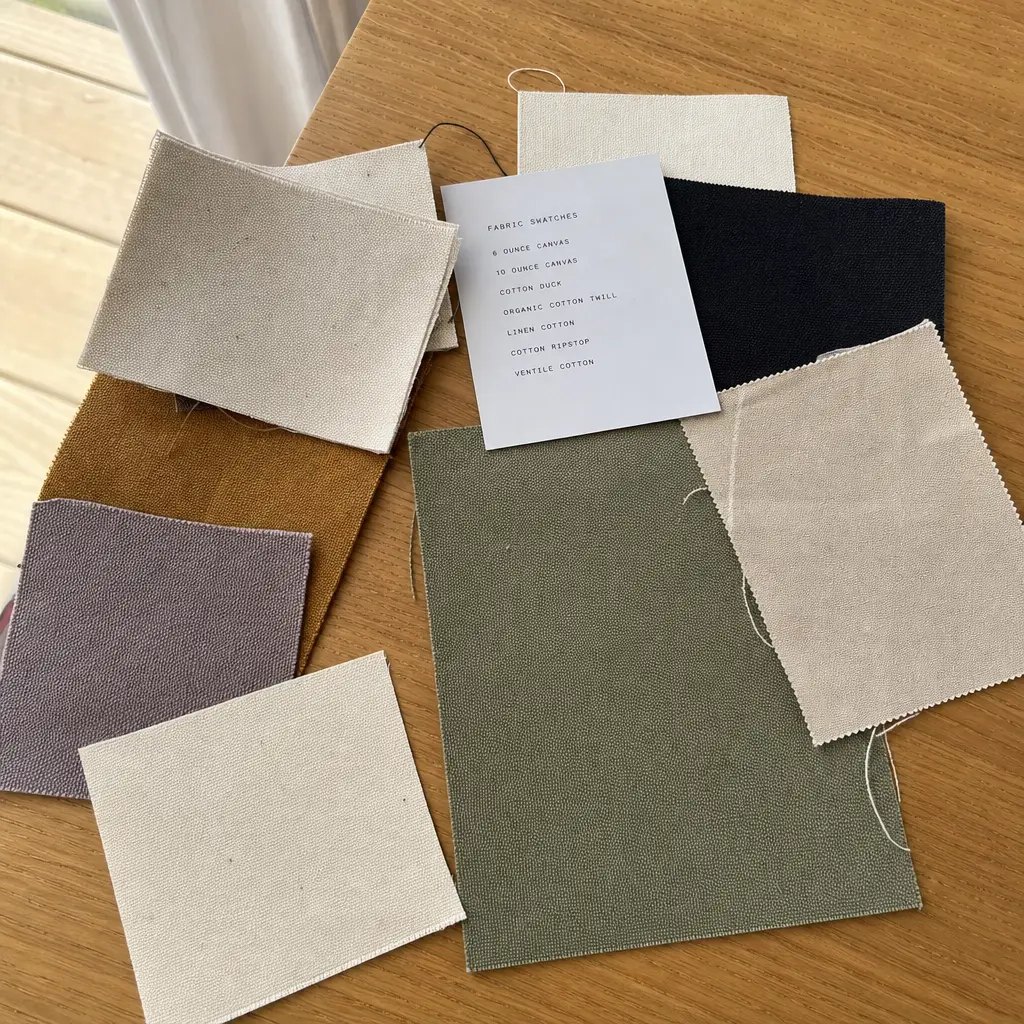
- Approve fabric swatch before sample if the cotton type or weight is critical.
- Measure finished size flat and record the allowed tolerance in the approval notes.
- Test drawstring opening and closure at least 20 cycles for obvious channel or cord issues.
- Place the real product inside the pouch before approving size and print position.
- Keep one signed or clearly labeled approval sample as the inspection reference.
Quote Data Needed for a Fair Comparison
A useful quote is not just a unit price. For cotton drawstring pouches, the quote should show what is included, what is excluded, and which assumptions drive the MOQ. Importers and retail buyers should request price breaks, material details, sample charges, setup charges, packing assumptions, carton data, and lead time by stage. Without those fields, the cheapest quote may only be cheaper because it excludes print setup, uses lighter cotton, or assumes bulk packing when the buyer needs barcode-ready individual packs.
The cleanest comparison is to build one quote sheet and require every supplier to answer it in the same structure. If one factory quotes 1000 pieces per design and another quotes 3000 pieces per purchase order, those are not equal. If one includes export carton marks and another excludes barcode stickers, the landed cost will move. MOQ negotiation becomes much easier when the buyer can see which cost is fixed, which cost decreases with volume, and which cost appears only because of a special requirement.
- Unit price by MOQ break: 500, 1000, 3000, 5000, or the buyer's realistic program levels.
- Material line: cotton type, fabric weight, color, cord material, label type, and any finishing.
- Print line: method, number of colors, print size, setup cost, sample cost, and color tolerance.
- Packing line: bulk bundle count, polybag details, carton size, gross weight, and carton marking.
- Schedule line: sample days, production days after approval, inspection window, and export packing days.
- Commercial line: Incoterm, payment term, quote validity, tooling ownership, and re-order conditions.
Packing Choices Affect MOQ and Landed Cost
Packing is often treated as an afterthought, but it can change both MOQ and landed cost. Bulk packing in inner bundles is usually the lowest-cost and lowest-plastic route. It works well when pouches are distributed to stores, inserted into kits by a co-packer, or used internally for sampling programs. Individual polybags add labor, materials, carton volume, and sometimes barcode control. Retail-ready packing can be necessary, but it should be specified early because it affects line speed and inspection.
For natural grocers, packing also has a brand and compliance side. If the buyer wants to reduce plastic, the RFQ should state whether individual polybags are prohibited, optional, or required only for certain SKUs. If cartons will move through a distribution center, carton marks and SKU separation matter more than decorative inner packaging. A good MOQ negotiation may keep the pouch specs stable and reduce cost through smarter packing rather than weaker fabric.
- Bulk bundle: lowest labor and plastic, suitable for store distribution and kitting operations.
- Individual polybag: cleaner for fulfillment but adds cost, plastic, and packing time.
- Paper band or belly band: useful for retail sets, but requires artwork, sizing, and extra handling.
- Mixed carton: acceptable only when carton labels clearly show size, color, artwork, and quantity per SKU.
- Master carton limits: keep gross weight practical for warehouse handling, commonly under the buyer's internal limit.
Lead Time Risk When MOQ Is Low
Low MOQ orders can still take time because setup steps do not disappear. Sampling, fabric confirmation, printing screens, cutting, sewing, trimming, inspection, and export packing all need sequence. A factory may fit a small order between larger jobs, but that flexibility depends on line loading. Buyers should avoid assuming that a smaller order automatically ships faster. In many factories, small custom orders move quickly only when the fabric is available, artwork is simple, and approvals are returned without delay.
Natural grocery programs often connect to seasonal promotions, store openings, vendor campaigns, or holiday retail sets. The schedule should include buffer for sample revision and packing confirmation. If the buyer negotiates MOQ aggressively and also requests urgent delivery, the factory may rely on available materials that are not the best match. It is better to separate the negotiation: first define the minimum acceptable spec, then identify which timeline is realistic at each MOQ level.
- Blank sample: useful for size and construction review before artwork is final.
- Printed pre-production sample: required before bulk if logo placement, ink color, or print durability matters.
- Bulk production: depends on fabric availability, print queue, sewing capacity, and packing complexity.
- Final inspection: should occur after packing is mostly complete but before shipment release.
- Shipping handover: export carton marks, packing list, and booking data should be ready before cargo cutoff.
Specification comparison for buyers
| Spec decision | Recommended option | When it fits | Buyer risk to check |
|---|---|---|---|
| Fabric weight | 6 oz cotton for light grocery gift sets; 8 oz cotton for repeated retail handling | 6 oz works for tea, soap, samples, small wellness items; 8 oz is better for heavier glass jars or premium reusable packaging | Very low MOQ quotes may switch to thinner 4 oz or loose-weave fabric unless GSM, ounce weight, and shrinkage tolerance are written into the RFQ |
| Cotton type | Conventional natural cotton for price-sensitive runs; organic cotton only when chain-of-custody documents are required | Conventional cotton is practical for local produce sets and seasonal retail; organic cotton fits certified natural programs and higher claim scrutiny | Do not accept an organic claim without transaction documents or certificate scope that covers fabric and finished goods processing |
| Pouch size range | Keep first orders within two or three shared base sizes, such as 10 x 14 cm, 15 x 20 cm, and 20 x 30 cm | Shared sizes help combine fabric cutting, sewing setup, and packing work across SKUs while still serving multiple product categories | Too many near-identical sizes create separate cutting markers, label placement variation, and carton confusion without improving shelf performance |
| Print method | One-color screen print for most natural grocery pouch orders | Best for simple brand marks, ingredient icons, farmers market graphics, and low to mid MOQ private label programs | Digital print may look cheaper at low volume but can change handfeel, color depth, and wash resistance; confirm approval samples before order release |
| Drawstring material | Cotton cord for natural positioning; polyester cord only when abrasion resistance or color matching is more important | Cotton cord supports a low-plastic packaging story and matches natural cotton fabric visually | Cord diameter and knot finishing affect both appearance and function; thin cord can cut into fabric channel and feel cheap |
| MOQ negotiation route | Negotiate by combining sizes, keeping one fabric lot, and limiting print colors before pushing only for a lower number | Useful when a grocer needs a pilot order, regional launch, or test program before national rollout | A low MOQ achieved through offcuts or mixed fabric lots can cause shade variation and uneven shrinkage across cartons |
| Packing format | Bulk pack inner bundles by SKU and size; individual polybags only when required by retail DC or fulfillment handling | Bulk pack reduces plastic, labor, and landed cost for store backroom distribution or kitting lines | Individual packing adds labor and carton volume; if required, define bag material, warning text, barcode placement, and bundle count |
| Lead time planning | Separate sample approval, fabric booking, production, QC, and export packing in the schedule | Best for natural grocers with seasonal campaigns, new store openings, holiday gift sets, or product launch calendars | MOQ concessions often depend on factory loading; urgent low-volume orders can lose priority behind larger confirmed programs |
Buyer checklist before sampling
- Define the pouch use case before negotiating MOQ: retail packaging, gift-with-purchase, bulk bin accessory, produce bag, sample kit, or vendor-funded promotion.
- Lock the main size, tolerance, fabric weight, drawstring type, print position, print color count, and packing style before comparing quotes.
- State whether cotton must be conventional, recycled, or organic, and list the exact documentation required for any sustainability claim.
- Limit early-stage SKU complexity by using common fabric, cord, and print method across sizes wherever possible.
- Request unit price at several MOQ breaks, such as 500, 1000, 3000, and 5000 pieces per design or per size.
- Separate setup charges, sample charges, screen charges, label charges, packing charges, and inland freight from the unit price.
- Confirm whether MOQ applies per size, per print design, per fabric color, per shipment, or per purchase order.
- Require a pre-production sample using actual fabric, actual cord, actual print method, and actual label before bulk production.
- Set acceptance criteria for fabric weight, finished size tolerance, print placement, drawstring function, seam strength, and carton marking.
- Review carton dimensions, gross weight, inner bundle count, barcode needs, and mixed-carton rules before approving final packing.
Factory quote questions to send
- What is your MOQ per size, per print design, per fabric color, and per shipment for natural cotton drawstring pouches?
- Can you quote the same pouch at 500, 1000, 3000, and 5000 pieces so we can see the real cost breakpoints?
- Which fabric weights are normally in stock for natural cotton pouches, and what are the measured GSM or ounce weights after finishing?
- If we combine several pouch sizes under one purchase order, can the MOQ be shared across the same fabric lot and drawstring material?
- What are the separate costs for screen setup, digital print setup, woven label setup, sample making, and revised samples?
- What print method do you recommend for our artwork, and what is the expected tolerance for print color, print position, and edge sharpness?
- How many days are needed for blank sample, printed pre-production sample, bulk production, final inspection, and export packing?
- Will the approved pre-production sample be kept as the factory reference sample for bulk QC?
- What packing method is included in the base quote, and what is the surcharge for individual polybag, barcode sticker, or retail-ready inner carton?
- What documents can you provide with shipment, such as packing list, commercial invoice, material declaration, inspection report, and cotton certification documents if applicable?
Quality-control points to confirm
- Finished pouch size should stay within the agreed tolerance, commonly +/- 5 mm for small pouches and +/- 10 mm for larger pouches unless the design needs tighter control.
- Fabric weight should match the approved reference swatch and quoted GSM or ounce weight; bulk fabric should not feel thinner, looser, or more transparent than the approved sample.
- Drawstring channel must open and close smoothly without broken stitches, blocked corners, loose threads, or cord ends pulling through during normal use.
- Print placement should be measured from top edge and side seams, with consistent orientation across the carton, especially for small front logos.
- Screen print should pass reasonable rub and tape checks after curing, with no obvious cracking, pinholes, heavy ink buildup, or fabric contamination.
- Side seams and bottom seams should withstand normal hand pulling for the intended product weight without seam slippage or skipped stitches.
- Labels, if used, must be sewn straight, face the correct direction, and match approved size, content, and placement.
- Packing must match approved bundle quantity, carton mark, SKU separation, barcode placement, and gross weight limits for the buyer's warehouse.