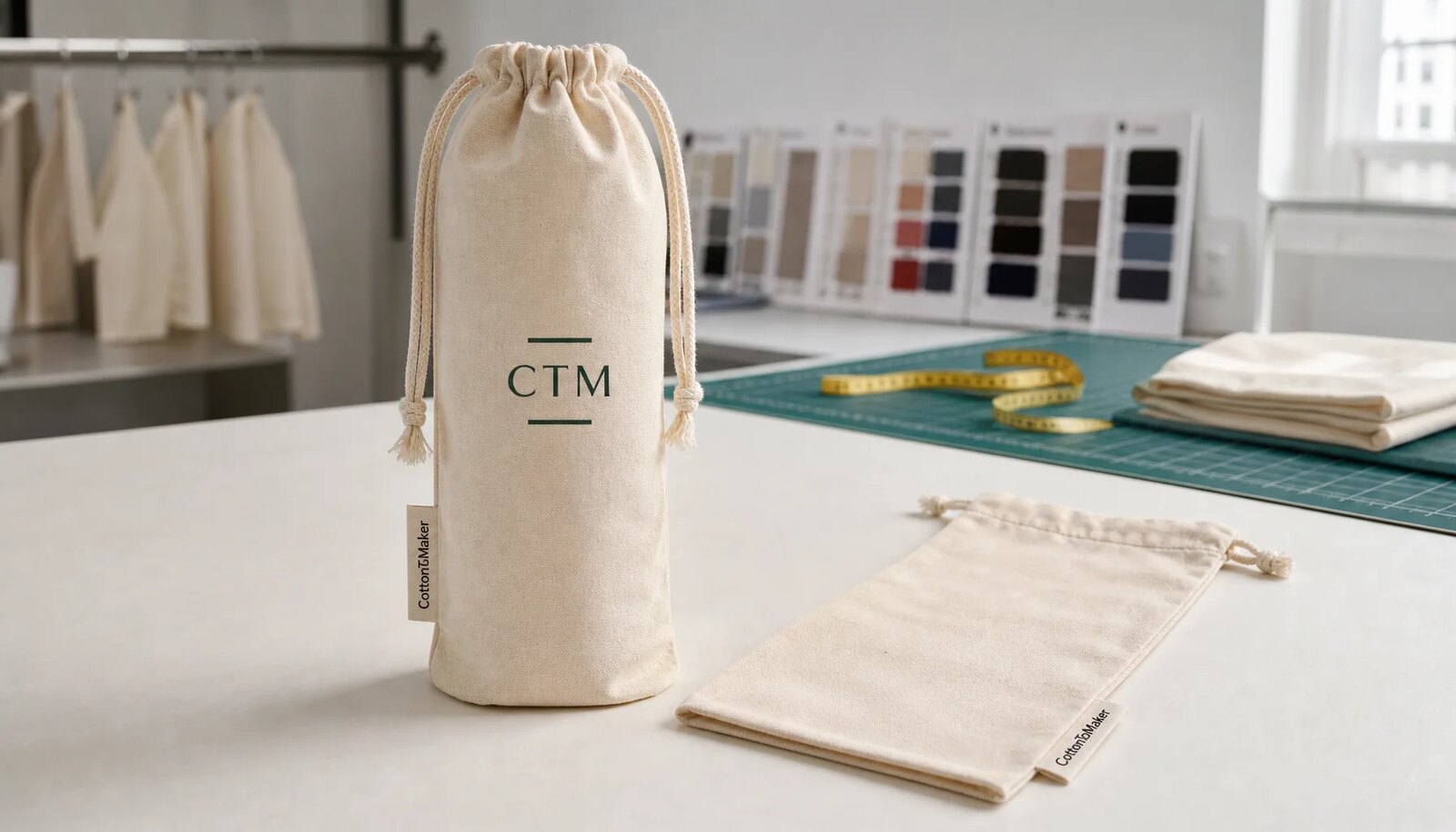
Why MOQ Negotiation Is Different for Boutique Wineries
Boutique wineries usually do not buy cotton drawstring pouches like a national retailer buys seasonal packaging. A winery may need 300 pieces for a tasting event, 800 pieces for a wine club release, or 1500 pieces for holiday gift packs. The problem is that factory MOQ is rarely based only on sewing capacity. It is tied to fabric roll yield, dyeing minimums, cord inventory, printing setup, cutting efficiency, and packing labor.
A useful MOQ negotiation starts by identifying which parts of the pouch can remain standard and which parts must be custom. If the buyer insists on custom fabric color, custom dyed cord, two-sided multi-color print, individual retail packaging, and urgent delivery, the MOQ will naturally rise. If the buyer keeps natural cotton fabric, standard cord, one logo print, and simple bulk packing, the factory has more room to combine materials and offer a lower trial quantity.
- Best negotiation position: standard fabric, standard cord, simple print, clear repeat potential.
- Weak negotiation position: custom dyed fabric, many SKUs, complex packaging, uncertain artwork.
- Factory concern: small orders can consume the same sampling, cutting, printing, and QC time as larger orders.
- Buyer advantage: wineries often reorder seasonally, so a supplier may accept a lower first MOQ if the spec is production-friendly.
Define the Pouch Use Before Negotiating Quantity
The same cotton drawstring pouch can be a gift wrap, a retail accessory, a shipping insert, or a premium brand presentation. Each use has a different acceptable weight, finish, print durability, and packing plan. A pouch for handover at a tasting room can use softer natural cotton and simple bulk packing. A pouch sold as a retail item may need a stronger fabric, cleaner seam finish, barcode label, and stricter shade control.
Before requesting MOQ concessions, procurement teams should write the buying purpose in the RFQ. This prevents the factory from quoting a low-cost promotional pouch when the winery actually needs a presentable retail gift bag. It also stops the buyer from over-specifying a heavy canvas pouch for an event giveaway where a lighter fabric would work and reduce both MOQ pressure and freight cost.
- Tasting room giveaway: prioritize fit, logo visibility, and low handling cost.
- Wine club gift pack: prioritize repeatable packing, carton labeling, and consistent logo placement.
- Retail accessory: prioritize fabric handfeel, seam neatness, barcode or hangtag compatibility.
- Distributor kit: prioritize SKU separation, carton strength, and delivery schedule reliability.
Fabric Weight and GSM Choices That Affect MOQ
For custom cotton wine pouches, 6 oz to 8 oz cotton canvas is often the most practical range. In GSM terms, this is roughly 200 to 270 GSM depending on the supplier’s fabric construction. A 6 oz fabric is softer, folds easily, and is usually enough for one-bottle gift packaging. An 8 oz canvas gives a more structured look and better perceived value, but it costs more and may reduce the number of pieces per carton.
Heavier options such as 10 oz or 12 oz can look premium, but they are not automatically better for boutique wineries. Heavy cotton can bunch around the drawstring, increase seam bulk, and add freight weight. It may also require a larger material order if the mill does not keep that weight in stock. If MOQ flexibility is important, the safest negotiation route is to ask the factory which natural cotton weights are already available and quote those first.
- 6 oz cotton: good for economical gift sleeves and event packaging.
- 8 oz canvas: good for winery retail, branded club gifts, and better shelf presentation.
- 10 oz canvas: useful only when the buyer wants a sturdier premium feel and accepts higher cost.
- Natural cotton stock fabric usually supports lower MOQ than custom dyed cotton.
- Pre-shrunk or washed fabric can improve fit consistency but may change cost and lead time.
Size, Bottle Fit, and Construction Details
Wine pouch sizing is not just length and width. Bottle shoulder shape, capsule height, cork finish, wax seal, and label protection can all change the correct pouch dimensions. A standard 750 ml Bordeaux bottle may fit a 15 x 35 cm pouch, but a wider Burgundy bottle or a sparkling bottle can need more width and a different drawstring position. If the pouch mouth is too narrow, staff will force the bottle in and stress the side seams.
The construction should be written clearly: single drawstring or double drawstring, cotton cord or ribbon, bottom seam style, overlock or folded seam, and whether the inside seam appearance matters. Many wineries do not need a luxury seam finish inside the pouch, but they do need a clean bottom seam that can carry the bottle weight. A small cost saving on stitching is not worth customer complaints about split seams during gifting.
- Send bottle dimensions or one physical bottle when the shape is unusual.
- Allow room for bottle shoulder and label thickness, not only bottle diameter.
- Specify whether the pouch should cover the neck fully or leave part of the neck visible.
- Use reinforced back-tacking near drawstring channel ends if pouches will be pulled frequently.
- Avoid over-tight sizing when the pouch will be packed by tasting room staff at speed.
Print Method Choices for Winery Branding
Most winery pouch artwork works well with one-color screen printing. It is cost-efficient, stable for repeat orders, and suitable for logos, vineyard names, vintage years, and wine club marks. Screen printing also allows better control of solid logo areas on cotton fabric, provided the artwork is not too fine and the ink is cured correctly. For MOQ negotiation, one-color screen print is usually the easiest custom branding method to support.
Heat transfer can be useful for small runs with detailed artwork or multiple colors, but it changes the surface feel and may not match the natural cotton appearance some wine brands want. Digital printing can handle gradients and full-color art, yet it may require more sample checking for color accuracy on natural fabric. Embroidery is possible, but it adds cost, can distort lighter cotton, and may be unnecessary unless the pouch is meant to feel like a premium reusable accessory.
- Screen print: best for simple logos, lower setup risk, and repeatable bulk production.
- Heat transfer: useful for detailed small artwork but needs adhesion and handfeel approval.
- Digital print: useful for full-color art but requires stronger color expectation management.
- Embroidery: premium look but higher cost, slower production, and possible fabric puckering.
- Print placement should stay below the drawstring compression area unless the design intentionally sits near the neck.
How Factories Calculate MOQ Behind the Quote
When a factory quotes MOQ, it is balancing material purchasing, machine setup, printing setup, labor planning, and quality risk. A small cotton pouch order may still require a full fabric roll, a dedicated cutting lay, printing screen preparation, sewing line allocation, packing staff, and export carton handling. That is why a buyer may see MOQ stated as 500 pieces for natural cotton but 1000 or 2000 pieces for dyed fabric or multiple print designs.
The most important quote detail is whether MOQ applies per purchase order, per design, per color, per size, or per shipment. A winery ordering 1000 pieces split across four logo versions may accidentally create four small production batches. The factory may then raise the price or reject the split after sampling. Procurement teams should make SKU split visible from the first RFQ instead of negotiating one total quantity and revealing the split later.
- Per fabric color MOQ: driven by fabric stock or dyeing batch minimum.
- Per print design MOQ: driven by screen setup, print alignment, and inspection time.
- Per size MOQ: driven by cutting efficiency and sewing line changeover.
- Per cord color MOQ: driven by cord inventory or custom dyeing requirement.
- Per packing style MOQ: driven by labor, printed labels, barcode stickers, or retail packaging materials.
Practical MOQ Negotiation Levers
The cleanest way to negotiate MOQ is to reduce variables without weakening the pouch. For example, use natural cotton instead of custom dyed cotton, keep the same pouch size across wines, print one side only, use one-color artwork, and accept bulk packing. These choices allow the factory to produce a small order with less setup waste. The buyer still receives a custom branded winery pouch, but the factory does not need to rebuild the entire supply chain for a trial order.
A second useful lever is forecast transparency. If the winery expects a holiday reorder or recurring wine club release, provide expected timing and quantity ranges. This should not be presented as a fake commitment, but as useful planning information. A factory may accept a first order at 500 pieces if the specification is repeatable and the buyer is clear that future orders will use the same fabric, size, and print position.
- Negotiate lower first MOQ by keeping one approved standard pouch body.
- Use quantity breaks instead of only pushing for the lowest unit price.
- Combine multiple winery departments into one production run if the print design can stay the same.
- Avoid splitting a small order into many logo, color, or cord variations.
- Offer a repeat-order forecast only if purchasing can realistically support it.
Quote Data Needed for a Fair Comparison
Two suppliers can quote the same pouch very differently if the RFQ is vague. One may include 8 oz cotton, screen charge, export cartons, and carton marking. Another may quote lighter fabric, exclude setup cost, and pack loosely. The cheapest unit price may become more expensive once sampling, freight, rework, or repacking is included. A fair comparison requires quote data that shows the total commercial picture, not only piece price.
Buyers should request price breaks at realistic quantities such as 300, 500, 1000, 2000, and 5000 pieces using the same specification. This shows where cost improves and where MOQ is mainly a setup issue. It also helps boutique wineries decide whether to buy only the launch quantity or increase volume for holiday programs. The factory should also state carton dimensions and gross weight because cotton pouches can be bulky when individually packed.
- Unit price by quantity break using identical fabric, size, cord, and print method.
- Sample cost, screen cost, artwork handling cost, and whether any cost is refundable.
- Carton quantity, carton dimensions, gross weight, and estimated CBM.
- Lead time for sample, pre-production approval, bulk production, and packing.
- Incoterm, export port, inland freight, and documents included in the quote.
- Validity period of the quote because cotton fabric and freight costs can change.
Sample Approval and Acceptance Criteria
For wine bottle pouches, sample approval should include both fit and branding. A digital mockup can show logo position, but it cannot prove that the bottle slides in smoothly, the drawstring closes cleanly, or the logo sits flat after the pouch is filled. A blank size sample is often enough to confirm fit before printing. Once the fit is approved, a printed pre-production sample should be used to lock fabric handfeel, print color, placement, cord, stitching, and packing.
Acceptance criteria should be measurable. Instead of approving a sample as looking good, the buyer should note finished dimensions, fabric weight range, print size, logo location, drawstring length, stitch density, and allowed shade tolerance. This protects both sides. The factory has a physical target for production, and the buyer has a clear basis for inspection if bulk goods drift from the approved sample.
- Measure pouch width, height, mouth opening, and drawstring channel position.
- Fit test with the actual bottle, including capsule, cork finish, and any wax seal.
- Rub and fold the printed area after curing to check adhesion and cracking.
- Compare print color under consistent lighting, especially on natural cotton fabric.
- Seal one approved sample with date, specification, and buyer signoff before bulk cutting.
Packing, Cartons, and Distributor Handling
Packing is often treated as a small detail, but it affects cost, receiving speed, and damage risk. Flat bulk packing is usually the most efficient for cotton drawstring pouches: for example, 50 or 100 pieces per inner polybag, then a fixed number of inner bags per export carton. This keeps carton count predictable and allows the winery or distributor to allocate stock by tasting room, warehouse, or sales region.
Individual polybags may be necessary for retail sale or clean presentation, but they add labor, plastic, volume, and inspection time. If the pouch is only used by staff to pack bottles, individual polybags often create waste and slow operations. Carton marks should include PO number, SKU, pouch color, print design, quantity, gross weight, carton number, and destination label if the order will be split among locations.
- Bulk inner packing: efficient for tasting room and warehouse use.
- Individual polybag: useful for retail sale, but raises labor and carton volume.
- Barcode labeling: necessary when pouches are sold or managed as separate retail SKUs.
- Carton strength: important because cotton pouches are dense and cartons may be stacked.
- SKU separation: critical when multiple winery logos or seasonal designs ship together.
Specification comparison for buyers
| Spec decision | Recommended option | When it fits | Buyer risk to check |
|---|---|---|---|
| Fabric weight for wine bottle pouch | 6 oz to 8 oz cotton canvas, roughly 200-270 GSM, pre-shrunk if tight sizing is required | Good for boutique wine gifting, tasting room retail, club shipments, and seasonal gift packs | Too-light fabric can show bottle shape sharply and wrinkle; too-heavy fabric increases MOQ pressure and freight weight |
| Pouch size and seam allowance | Single-bottle size around 15 x 35 cm or buyer-specified bottle profile with 1-1.5 cm seam allowance | Fits most 750 ml bottles when the winery uses standard Bordeaux or Burgundy bottles | Special bottle shoulders, wax seals, or taller capsules may require a physical bottle sample before bulk cutting |
| Drawstring material | Cotton cord in natural, black, or dyed-to-match standard colors | Best balance for low to mid MOQ programs because cord stock is easier to combine with other orders | Custom dyed cord may create separate MOQ, shade tolerance issues, and a longer pre-production timeline |
| Print method | One-color screen print or heat transfer for small artwork areas; digital print only when artwork has gradients | Works for winery logos, vintage year marks, club names, and simple tasting event graphics | Pantone control, ink coverage, and print cracking after drawstring compression must be approved on sample |
| MOQ negotiation lever | Keep fabric, cord, and pouch construction standard; negotiate lower quantity through shared material lots | Useful for boutique wineries testing a new gift program or regional distributor bundle | Changing size, fabric color, cord color, and print method together can make a low MOQ unrealistic |
| Packing method | Flat packed 50 or 100 pcs per inner polybag, export carton labeled by SKU, color, and PO | Suitable for warehouse receiving, tasting room replenishment, and distributor allocation | Individually polybagged pouches add labor, plastic cost, carton volume, and slower inspection speed |
| Sample approval route | Blank size sample first when bottle fit is uncertain, then printed pre-production sample before bulk | Reduces rework when the buyer has multiple bottle shapes or premium label protection concerns | Approving artwork digitally only can hide scale, drawstring position, seam distortion, and color shift |
| Supplier route | Direct factory for repeat programs; trading company only if multiple accessory categories are consolidated | Direct factory gives better control over MOQ logic, fabric substitution, cutting tolerance, and packing specs | A middle supplier may quote a low MOQ but not disclose fabric availability, leading to sample-to-bulk mismatch |
Buyer checklist before sampling
- Define the exact bottle type, height, shoulder shape, closure style, and whether the pouch must cover the full neck or only the body.
- Choose one fabric weight target, such as 6 oz cotton for lighter gift use or 8 oz canvas for a more structured retail pouch.
- Limit early MOQ negotiation to one or two variables: quantity, print color count, or packing method, not every specification at once.
- Provide logo artwork in vector format and specify Pantone or CMYK reference, print placement, print size, and acceptable color tolerance.
- Request a blank fit sample if the pouch is for a non-standard Burgundy, sparkling, dessert wine, magnum, or wax-sealed bottle.
- Separate sample cost, mold or screen cost, unit price, carton packing, inland freight, export charges, and optional courier cost in the quote.
- Confirm whether the quoted MOQ is per size, per fabric color, per print design, per cord color, or per purchase order.
- Set inspection points for fabric GSM, pouch dimensions, seam strength, drawstring pull, print adhesion, carton quantity, and barcode labeling.
- Decide whether pouches are for retail sale, gift wrapping, wine club shipments, or distributor kits because each use changes packing and tolerance priorities.
- Require a sealed pre-production sample before mass cutting when fabric color, printed logo, or pouch size is different from the last approved order.
Factory quote questions to send
- What is the minimum order quantity per size, per fabric color, per print design, and per cord color for this cotton drawstring pouch?
- Can the MOQ be reduced if we use your stocked natural cotton fabric, standard cotton cord, and one-color screen printing?
- What fabric weights are available from stock now, and what is the GSM tolerance you can control in bulk production?
- Please quote 6 oz, 8 oz, and 10 oz cotton options separately with unit price, carton size, carton weight, and estimated CBM.
- What is the sample lead time for a blank fit sample and a printed pre-production sample after artwork approval?
- Which print method do you recommend for our logo size and color count, and what are the setup costs or screen charges?
- What bottle dimension should we supply to avoid a tight fit at the shoulder, neck, or drawstring closure area?
- How will the pouches be packed: pieces per inner bag, inner bags per carton, carton dimensions, gross weight, and labeling format?
- What quantity break prices can you offer at 300, 500, 1000, 2000, and 5000 pieces using the same approved specification?
- If bulk fabric shade is slightly different from the sample, what tolerance or approval process will you use before cutting?
Quality-control points to confirm
- Fabric GSM should be checked by roll or cutting lot, with the agreed tolerance written into the purchase order instead of described only as light, medium, or heavy.
- Finished pouch dimensions should be measured after sewing and pressing; wine bottle pouches usually need tighter height and mouth-width control than general gift bags.
- Drawstring channels must allow smooth pulling without loose threads, skipped stitches, or cord ends slipping back inside the channel.
- Logo placement should be measured from pouch centerline or bottom seam, not judged by eye, especially when the drawstring compresses the upper area.
- Print adhesion should be tested by rubbing, folding, and light scratching after curing; high ink coverage on cotton can crack if rushed.
- Seams should be inspected for stitch density, back-tacking at stress points, and no open seams near the bottom corners where bottle weight sits.
- Bulk production should be compared against the sealed pre-production sample for fabric handfeel, cord color, print shade, and pouch shape.
- Carton quantity, carton marks, SKU separation, and inner packing should be checked before shipment because winery buyers often distribute by location or tasting room.