Why Logo Placement Is a Procurement Priority for Salon Chains
Salon chains use cotton drawstring pouches for retail product packaging, gift-with-purchase, or membership kits. The logo is often the only brand touchpoint on the pouch. If it's crooked, too low, or fades after a few washes, the pouch becomes generic packaging instead of a brand asset. For a chain with 20, 50, or 100 locations, inconsistent logo placement across a bulk order can create a disjointed customer experience and trigger returns or rework costs.
Logo placement also affects production cost and lead time. A placement that requires extra handling or a larger print area can push your MOQ higher or add setup fees. Understanding the tradeoffs before you send an RFQ saves time and avoids disappointment at sample stage. Procurement managers who specify placement tolerances upfront reduce the risk of batch rejection and keep their launch timelines intact.
- Centered placement on the front panel is standard and easiest to align during production.
- Distance from the top seam must account for the drawstring channel — typically 2–3 inches below.
- Avoid placing the logo near the bottom hem, as it may be hidden when the pouch is filled.
- Inconsistent placement across a bulk order can lead to brand perception issues and costly returns.
Fabric Weight (GSM) and Its Direct Impact on Logo Print Quality
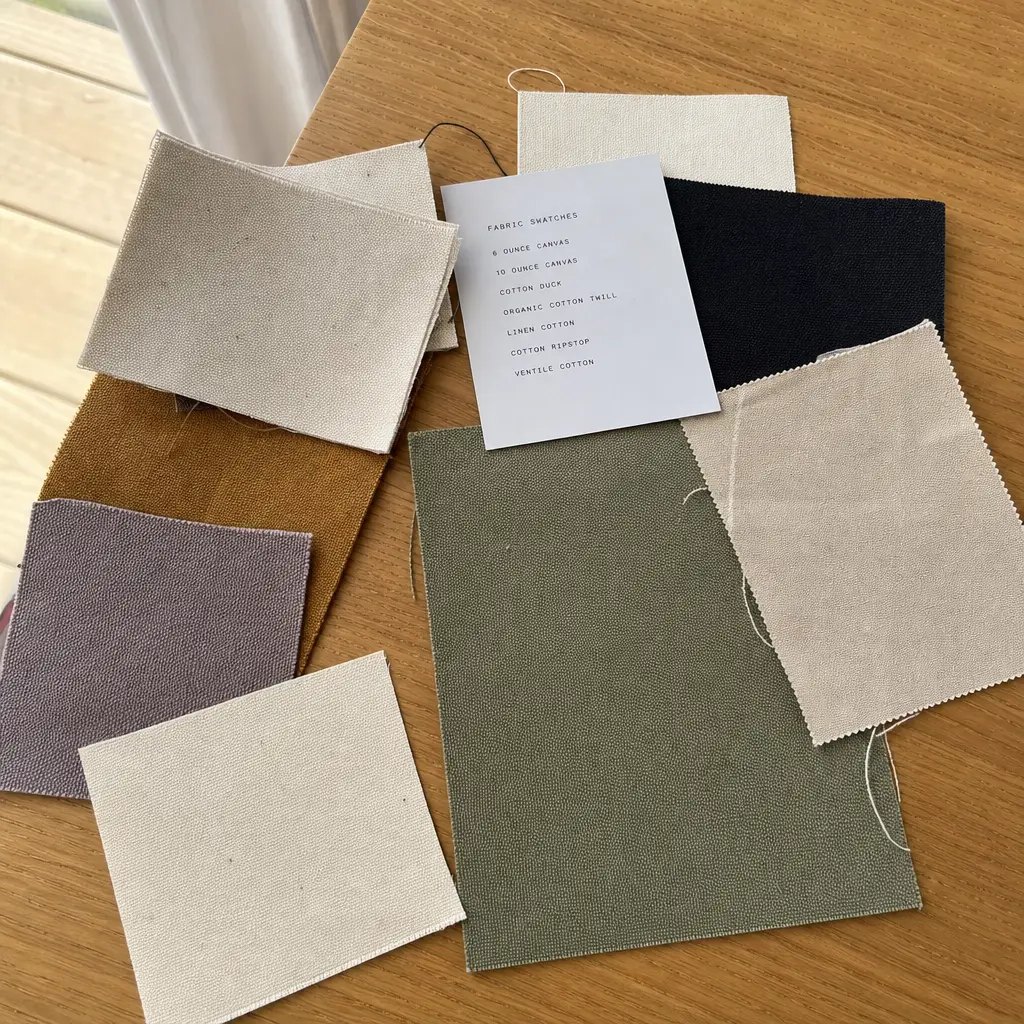
The GSM of your cotton fabric directly affects how the logo looks and lasts. For salon pouches, 140–160 GSM is the sweet spot. It gives enough body for the pouch to stand upright on a shelf, and the fabric surface is smooth enough for sharp print registration. Below 120 GSM, the fabric is too loose — ink can bleed, and the logo may look fuzzy. This is especially problematic for fine text or small brand marks that require crisp edges.
Above 180 GSM, the fabric becomes heavy and stiff. That might work for a tote bag, but for a small drawstring pouch it adds unnecessary cost and makes the pouch harder to close. The thicker fabric also absorbs more ink, which can alter color saturation and increase drying time during production. Always request a GSM test certificate from your supplier, and check it against your approved sample. A deviation of more than 5% from the specified GSM should trigger a quality hold.
- 140–160 GSM: balanced cost, print quality, and pouch structure.
- Below 120 GSM: risk of ink bleed, poor registration, and fuzzy logo edges.
- Above 180 GSM: higher cost, stiffer fabric, harder to drawstring, and altered ink absorption.
- Request a GSM test certificate and reject lots with more than 5% deviation.
Print Method Comparison: Screen Printing, Heat Transfer, and DTG for Cotton Pouches
Screen printing is the most common method for cotton drawstring pouches in bulk. It works well for 1–3 color logos and orders above 500 pieces. Water-based ink soaks into the cotton fibers, giving a soft hand feel and good wash durability. Plastisol ink sits on top of the fabric — it's more opaque but can crack over time if not cured properly. For salon chains that expect pouches to be reused or washed, water-based ink is the safer long-term choice.
Heat transfer is an option for smaller orders (under 300 pieces) but it has lower durability. The transfer layer can peel after 10–15 washes, especially on textured cotton. Direct-to-garment (DTG) printing offers full-color capability but is slower and more expensive per piece for bulk runs. DTG also requires pre-treatment of the fabric, which can affect the hand feel of natural cotton. For salon chains, screen printing with water-based ink is the most cost-effective and durable choice for orders above 500 pieces.
- Screen printing (water-based): best for 1–3 colors, bulk orders, soft hand feel, and wash durability.
- Screen printing (plastisol): more opaque, but may crack after many washes; better for single-use promotional items.
- Heat transfer: low MOQ, but lower durability; avoid for long-term brand use or reusable pouches.
- DTG: full color possible, but slower and costlier for >500 pieces; requires fabric pre-treatment.
Logo Placement Dimensions, Tolerances, and Artwork Guidelines
Standard placement for a salon pouch is centered on the front panel, 2–3 inches below the top seam. This avoids the drawstring channel and keeps the logo visible when the pouch is open or closed. The print area should not exceed 4 x 4 inches unless you have tested larger artwork on the same fabric weight. Larger print areas increase the risk of distortion when the pouch is filled and may require a multi-station screen setup.
Production tolerance for placement is typically ±3 mm. That means the logo can shift up to 3 mm from the specified position. If your logo has a border or requires exact centering, you need to communicate that clearly in your spec sheet and check it during sample approval. Ask your supplier if they use registration marks to maintain consistency. For multi-location salon chains, even a 3 mm shift can look inconsistent when pouches from different production lots are placed side by side in a retail display.
- Distance from top seam: 2–3 inches (50–75 mm) for standard 6x8 inch pouches.
- Maximum print area: 4 x 4 inches (100 x 100 mm) for standard cost; larger areas increase setup fees.
- Placement tolerance: ±3 mm; confirm with supplier before bulk production and include in the QC checklist.
- Use registration marks for multi-color logos to maintain alignment across the production run.
Color Count, Setup Costs, and Artwork Simplification Strategies
Each color in your logo requires a separate screen in screen printing. A 1-color logo has one setup fee; a 3-color logo has three. Setup fees typically range from $30 to $80 per screen depending on the factory. For a 500-piece order, adding a third color could increase the per-piece cost by $0.05–$0.15. Over a 10,000-piece order, that adds $500–$1,500 to the total cost.
If your logo has gradients or many colors, consider simplifying it for screen printing. Alternatively, use a 1-color version for the pouch and reserve the full-color logo for other materials. Many salon chains use a single brand color on pouches to keep costs low and maintain a clean, upscale look. When simplifying artwork, test the reduced-color version on a digital mockup first, then on a physical sample, to ensure brand recognition is not compromised.
- 1 color: lowest setup cost, fastest production, and lowest risk of misregistration.
- 2 colors: moderate cost, good for logo with accent; ensure registration marks are used.
- 3+ colors: higher setup fee, risk of misregistration on textured cotton; each additional screen adds $30–$80.
- Gradients: not suitable for screen printing; consider DTG for small orders or simplify to solid colors.
Drawstring Cord Specifications: Color Matching, Diameter, and Material Selection
The drawstring cord is a functional element, but its color and thickness affect the overall look. A matching cord (same color as the pouch) keeps the focus on the logo. A contrasting cord can work if it matches a logo accent color, but it adds another variable to control during production. Dye-lot matching is critical for contrast cords — even a slight shade difference can make the pouch look off-brand.
Standard cord diameter is 4 mm for most cotton drawstring pouches. Thicker cord (5 mm or more) can bulge at the closure and make the pouch harder to open. Thinner cord (3 mm) may break under repeated use, especially if the pouch is filled with heavy salon products. Always specify the cord material (cotton or polyester) and request a dye-lot match certificate if the cord color must match the pouch or logo. Cotton cord matches the natural feel of the pouch; polyester is stronger but has a synthetic sheen that may clash with the matte cotton fabric.
- Matching cord: keeps focus on logo; simplest to source and quality-check.
- Contrast cord: can accent logo, but requires dye-lot matching and adds a QC checkpoint.
- Diameter: 4 mm is standard; avoid 5 mm+ for small pouches to prevent closure bulge.
- Material: cotton cord matches the pouch fabric; polyester is stronger but has a synthetic sheen.
Sample Approval Process: A Step-by-Step QC Protocol for Procurement Teams
A pre-production sample is the only way to confirm logo placement, print quality, fabric hand, and cord color. Do not rely on digital proofs alone — they can't show how the ink sits on the fabric or how the pouch drapes. Request a sample on the exact fabric weight you plan to use, with the final print method and colors. Some suppliers offer a 'strike-off' sample (print on fabric only) before making a full pouch sample; this can save time if the print needs adjustment.
When you receive the sample, check the logo distance from the top seam, print registration, and ink adhesion. Fill the pouch with a typical product (e.g., a shampoo bottle) to see if the logo position still looks good. Wash the sample once to check for shrinkage or print damage. Only approve the sample after these checks. Document your approval with dated photos and measurements, and send a signed sample approval form to the supplier. This creates a clear reference standard for bulk production QC.
- Request sample on final fabric weight (140–160 GSM) with the exact print method and colors.
- Check logo placement distance from top seam using a ruler; photograph the measurement.
- Verify print registration and color accuracy under daylight and indoor lighting.
- Fill pouch with a typical product to test logo visibility when in use.
- Wash once to check shrinkage and print durability; repeat wash test if the pouch is intended for reuse.
- Document approval with dated photos and a signed form to create a QC reference standard.
MOQ Planning and Order Consolidation for Multi-Location Salon Chains
Screen printing typically requires a minimum of 500 pieces per design to justify the screen setup. If you have multiple salon locations, you can combine designs to reach the total MOQ. For example, 300 pouches for one location and 200 for another can be produced in the same run if the design is identical. However, if each location requires a different logo or color, each design will need its own MOQ.
If your total order is below 500 pieces, consider heat transfer or DTG printing. The per-piece cost will be higher, but you avoid the screen setup fee. For a salon chain testing a new pouch design, a small run of 200 pieces with heat transfer can validate the concept before committing to a larger screen-printed order. When planning MOQ across locations, create a consolidated forecast that groups identical designs to maximize volume discounts.
- Screen printing MOQ: typically 500 pieces per design; some suppliers accept 300 with a surcharge.
- Combine multiple locations under one design to meet MOQ and reduce per-piece cost.
- Below 500 pieces: use heat transfer or DTG at higher per-piece cost; ideal for pilot programs.
- Create a consolidated forecast across locations to identify volume discount opportunities.
Packing Specifications and Lead Time Management for Bulk Orders
Standard packing for bulk orders is 50 pieces per polybag, then packed in export cartons. Individual polybagging adds cost and waste — only request it if each pouch must be retail-ready. Ensure the packing method protects the printed area; avoid loose packing that can cause creasing or ink transfer between pouches. Specify that printed sides should face inward or be separated by tissue paper if the ink is prone to offsetting.
Lead time for screen-printed pouches is typically 25–35 days from sample approval, depending on factory capacity. Sample production takes 7–10 days. Factor in shipping time (2–4 weeks for sea freight) when planning your launch. Ask your supplier for a production schedule with milestones: sample approval, fabric cutting, printing, assembly, packing, and shipment. Build in a buffer of 7–10 days for QC inspections and potential rework. For seasonal salon promotions, work backward from the in-store date to determine the latest order placement date.
- Bulk pack: 50 pieces per polybag, then carton; specify printed side orientation to prevent damage.
- Individual polybag: only if retail-ready required; adds $0.03–$0.08 per piece.
- Lead time: 25–35 days after sample approval; sample time: 7–10 days.
- Request a production schedule with milestones and build in a 7–10 day buffer for QC and rework.
- For seasonal promotions, calculate the latest order date by working backward from the in-store date.
Landed Cost Analysis: Screen Printing vs. Heat Transfer for Salon Chain Budgets
For a 1,000-piece order of 140 GSM cotton drawstring pouches with a 2-color logo, screen printing typically costs $0.85–$1.20 per piece FOB, including setup. Heat transfer for the same order would cost $1.10–$1.50 per piece because of the transfer material and slower production. However, heat transfer has no screen setup fee, so for very small orders (200 pieces) it can be cheaper. The break-even point is usually around 300–400 pieces.
When comparing quotes, ask for a full landed cost breakdown: FOB price, shipping, insurance, customs duties, and any inspection fees. A lower FOB price may be offset by higher shipping costs from a distant port. Also factor in the cost of sample approval — some suppliers charge a sample fee ($30–$80) that is refundable with the bulk order. For accurate budgeting, calculate the total cost per pouch delivered to your distribution center, not just the ex-factory price.
- Screen printing (1,000 pcs, 2 colors): $0.85–$1.20/pc FOB; break-even vs. heat transfer at ~300–400 pcs.
- Heat transfer (1,000 pcs, 2 colors): $1.10–$1.50/pc FOB; cheaper for orders under 300 pieces.
- Always request a full landed cost quote including shipping, duties, and inspection fees.
- Calculate total cost per pouch delivered to your distribution center for accurate budget comparison.
Specification comparison for buyers
| Spec decision | Recommended option | When it fits | Buyer risk to check |
|---|---|---|---|
| Fabric weight (GSM) | 140–160 GSM | Salon pouches for retail or gift-with-purchase; needs structure but not stiff | Under 120 GSM may cause logo ink bleed; over 180 GSM increases cost and may feel heavy for small pouches |
| Print method | Screen printing (water-based or plastisol) | Solid logos, 1–3 colors, order volume >500 pieces per design | Heat transfer may peel after 10 washes; direct-to-garment (DTG) is slower and costlier for bulk |
| Logo placement | Centered on front panel, 2–3 inches below top seam | Standard brand logo; easy to align during production | Too close to drawstring channel can cause distortion; too low may be hidden when pouch is full |
| Maximum print area | 4 x 4 inches (100 x 100 mm) | Most salon logos fit this size; keeps cost per piece low | Larger areas may require multi-station screens, increasing setup fees and MOQ |
| Color count | 1–2 spot colors | Simple logo with brand color and one accent | Each additional color adds screen cost and increases risk of misregistration on textured cotton |
| Drawstring type | Matching cotton cord, 4 mm diameter, same color as pouch | Natural or bleached white pouches; cord color can match logo accent | Contrast cord draws attention away from logo; thick cord (>5 mm) may bulge at closure |
| Sample approval | Pre-production sample with final logo, fabric, and cord | Always required before bulk production | Relying on digital proof alone can lead to color shift, placement error, or fabric mismatch |
| MOQ per design | 500–1,000 pieces | Salon chain with 10+ locations; allows cost-efficient screen setup | Lower MOQ (<300) may force heat transfer or digital print, which are less durable |
| Packing | Bulk pack in polybag, 50 pieces per bag, then carton | Standard retail-ready packing; no individual polybag unless required | Individual polybag adds cost and waste; loose packing may cause creasing on printed area |
Buyer checklist before sampling
- Confirm fabric GSM is between 140 and 160 for balanced print quality and cost.
- Request a pre-production sample with final logo placement, print method, and drawstring color.
- Specify logo distance from top seam (minimum 2 inches) to avoid distortion near drawstring channel.
- Limit logo colors to 2 or fewer to control setup cost and registration risk.
- Ask for a wash test report (5 cycles) to verify print adhesion and colorfastness.
- Verify that the drawstring cord diameter is 4 mm and matches the pouch color or logo accent.
- Check that the print area does not exceed 4 x 4 inches unless you have tested larger artwork.
- Require bulk packing in polybags of 50 pieces, then carton, with no individual polybag unless specified.
- Obtain a written production tolerance statement for print placement (±3 mm) before confirming the order.
- Request a dye-lot matching certificate if the cord color must match the pouch or logo accent.
Factory quote questions to send
- What is your standard logo placement distance from the top seam for a 6x8 inch cotton drawstring pouch?
- Do you offer water-based screen printing for 140 GSM cotton? What is the minimum order for that method?
- How many color screens are included in your setup fee? What is the cost per additional screen?
- Can you provide a wash test certificate for the print method you recommend? How many cycles does it withstand?
- What is the lead time for a pre-production sample? Is there a sample fee, and is it refundable with bulk order?
- Do you offer a matched drawstring cord color option? Is there an extra charge for dye-lot matching?
- What is your MOQ per design for screen-printed pouches? Can we combine multiple designs to reach the total?
- How do you pack bulk orders? Can we request 50 pieces per polybag without individual wrapping?
- What is the tolerance for print placement variation across a production run? Do you use registration marks?
- Can you provide a production schedule with milestones: sample approval, fabric cutting, printing, assembly, packing, and shipment?
Quality-control points to confirm
- Print placement: measure distance from top seam on 5 random pieces per production lot; tolerance ±3 mm.
- Print registration: check that all colors align within 0.5 mm; no overlap or gaps.
- Ink adhesion: perform a tape pull test on a sample from each production batch; no ink transfer.
- Wash test: run 5 home-laundry cycles on a sample; logo must remain legible with no peeling or fading.
- Fabric weight: verify GSM using a circular cutter and scale on 3 random pieces; reject if below 135 GSM.
- Drawstring cord: measure diameter and check color against approved sample; reject if >0.5 mm deviation.
- Pouch dimensions: measure length and width on 5 pieces; tolerance ±5 mm.
- Packing: confirm polybag count and carton labeling matches packing list; no mixed designs in same carton.
- Seam strength: perform a pull test on the drawstring channel seam; reject if stitching breaks below 5 kg force.
- Colorfastness: test for crocking (dry and wet) on printed area; no visible transfer to white cloth.