Start with how the pouch will be used in the grocery program
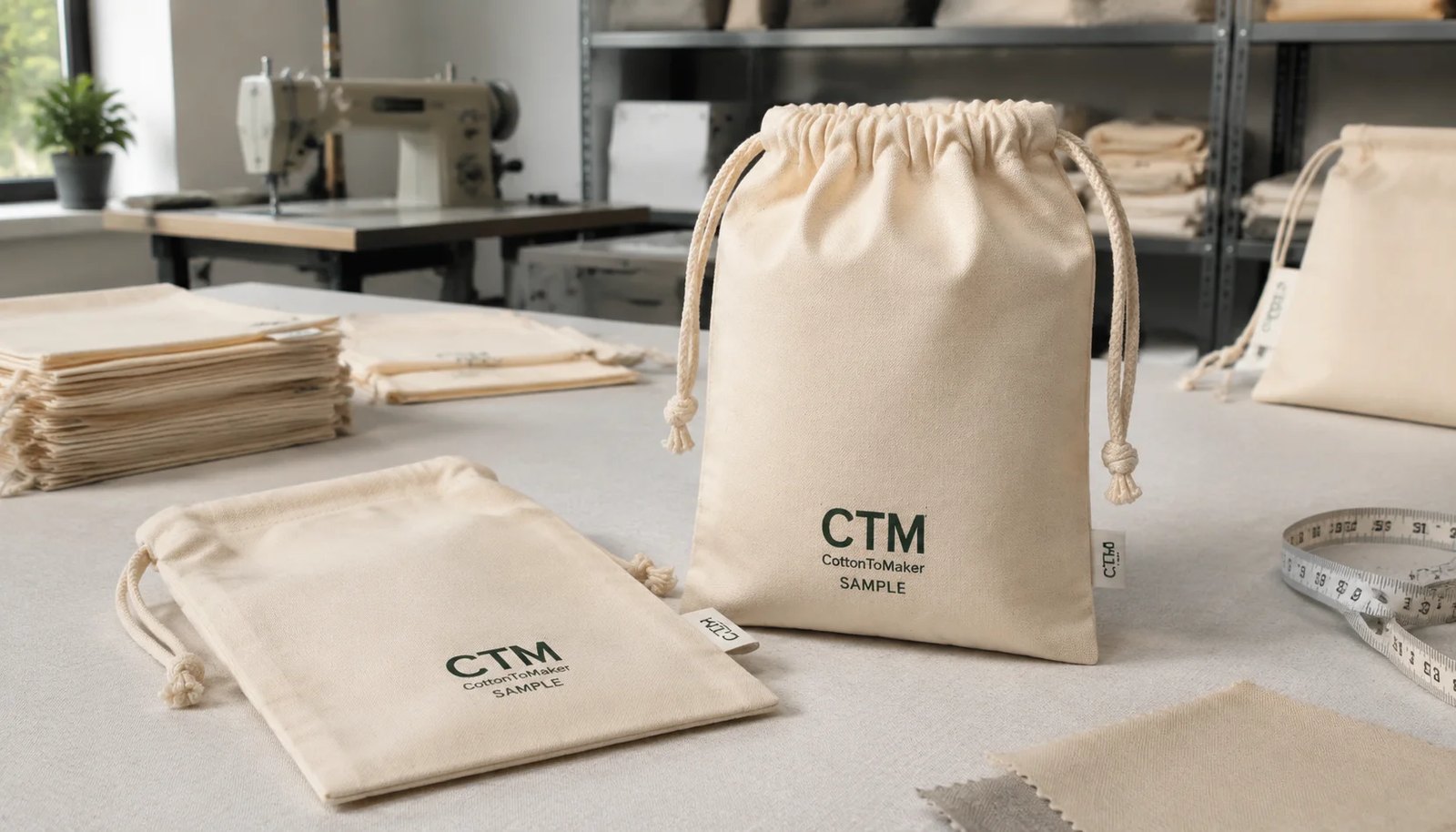
Logo placement on a cotton drawstring pouch is not only an artwork decision. For natural grocers, the same pouch may be used for bulk nuts, refill stations, herbal products, bakery gifts, wellness samples, or private-label kits. Each use changes how the pouch is filled, closed, displayed, and handled. A logo that looks centered on a flat empty sample can move, wrinkle, or partially disappear when the bag is filled with granola, soap bars, tea tins, or produce.
Before sending an RFQ, define the pouch job in practical terms. A lightweight produce pouch needs fast closure, low freight weight, and washable-looking branding. A retail gift pouch needs a cleaner print face, stronger seams, and better shelf presentation. A bulk-food pouch may be viewed while hanging closed, while a kit pouch may be presented flat in a carton. These details determine whether the logo belongs in the upper center, lower center, side label, or a repeated pattern.
- For pouches displayed closed, keep the main logo below the gathered fabric zone.
- For pouches packed flat inside kits, center the logo visually on the flat panel.
- For pouches filled with round or bulky items, reduce logo width so it does not wrap around the sides.
- For reusable produce programs, prioritize durable ink and readable care or reuse messaging.
- For premium grocery gift sets, consider a smaller logo with more blank cotton space for a cleaner natural look.
Choose the logo zone before finalizing pouch size
The usable print area is smaller than the finished pouch size. A drawstring pouch has a top channel, side seam allowances, a bottom seam, and sometimes a gusset. These areas are not safe logo zones. Printing too close to them causes distortion, ink buildup, uneven pressure, and inconsistent appearance after sewing. On small pouches, a few millimeters make a visible difference.
A practical RFQ should state the finished pouch size and the logo placement from fixed sewing points. For example, instead of writing “logo centered on front,” specify that the logo is centered horizontally, with the top of the logo 35 mm below the finished top edge and at least 12 mm below the drawcord stitch line. This gives the factory a measurable target and helps the inspection team judge the bulk goods.
- Keep at least 8–10 mm clearance from side seams on small pouches.
- Keep at least 12–20 mm clearance from the drawcord channel depending on pouch size.
- Avoid placing fine text across the lower seam or gusset fold.
- Use a flat artwork layout showing top edge, cord channel, stitch lines, and logo box.
- Approve the logo position on an actual filled sample when the pouch will hold rigid products.
Match fabric GSM to print quality and grocery handling
Cotton drawstring pouch fabric is commonly quoted by GSM. For natural grocery applications, 120–150 GSM works well for lightweight reusable produce pouches, bulk-bin bags, and low-cost promotional packaging. It keeps unit cost and shipping volume under control. The tradeoff is that very fine logo lines may look less sharp, and dark ink can show slight bleed-through on natural cotton.
For retail pouches, gift sets, wellness kits, and private-label packaging, 180–220 GSM usually gives a better surface for logo printing. The pouch feels more substantial and holds its shape better in display cartons. Above that range, the product can become too stiff for small drawstring formats, especially when the opening must cinch tightly. Heavy cotton also increases carton weight and can push landed cost higher than expected.
- 120 GSM: economical, light, suitable for simple one-color marks and produce use.
- 140–150 GSM: balanced option for many grocery refill and bulk programs.
- 180 GSM: cleaner print face and better retail handfeel without becoming too bulky.
- 220 GSM: premium feel for gift packaging, but test drawstring closure on small sizes.
- Natural unbleached cotton may show specks and shade variation; define what is acceptable.
Select a print method that fits the logo and the brand promise
Most natural grocer pouch logos are best handled by screen printing, especially if the artwork is one to three solid colors. Water-based screen print gives a softer handfeel on cotton and suits the natural product category better than a thick plastic-feeling print. It is also efficient for bulk orders once screens are made. For simple store logos, icons, QR-free messages, and department graphics, it is usually the safest production route.
Heat transfer can reproduce small details and gradients, but buyers should be careful when the pouch is sold or reused as a natural cotton item. Transfers may feel like a film on the fabric and can crack or lift under washing, folding, or repeated cinching. Embroidery is possible on heavier pouches, but it may pucker lightweight cotton and is less suitable for small text. Woven labels are useful for subtle branding, but they add sewing labor and placement tolerance issues.
- Use water-based screen print for simple logos, solid icons, and a natural handfeel.
- Use pigment screen print when stronger color coverage is needed on natural cotton.
- Use heat transfer only when fine gradients or photographic detail are truly required.
- Use embroidery mainly on heavier cotton and with larger, simple marks.
- Use woven or cotton labels for premium side branding, not as a substitute for large readable front branding.
Control logo size so it still reads after filling
A flat pouch sample can mislead buyers. Once filled, the front panel curves, the side seams move forward, and the drawstring pulls the top into folds. If the logo is too large, the outer letters may wrap around the sides and the center may bulge. This is a common issue for natural grocers using pouches for apples, soaps, jars, snack packs, or wellness bundles.
A safer rule is to keep the logo width at about 45–60% of the finished pouch width for general use. For very soft fillings, such as loose herbs or fabric items, a larger logo may work. For hard or bulky items, reduce the logo width and move it slightly lower so the gathered top does not interfere. Small legal lines, website addresses, or care instructions should be tested at actual print size; cotton texture can close up fine lettering.
- Minimum text height should be tested, not assumed from digital artwork.
- Avoid thin reversed-out lettering on natural cotton unless the print sample proves readability.
- For two-sided print, allow for slight front-to-back placement variation after sewing.
- For pouches under 10 x 15 cm, simplify artwork rather than forcing full brand lockups.
- For filled retail kits, photograph the approved filled sample and use it as the production reference.
Understand MOQ logic before splitting sizes and placements
MOQ is not only a factory sales rule. It comes from fabric purchasing, cutting efficiency, screen setup, sewing line changeover, cord preparation, packing style, and inspection time. A natural grocer may want four pouch sizes for bulk foods, wellness, bakery, and gift departments, but each size and logo position can behave like a separate production item.
Buyers can often improve pricing by grouping decisions. Keeping the same cotton GSM, same fabric color, same cord, and same print color across sizes reduces setup friction. If each department wants a different logo color, different placement, and different packing method, the supplier may quote higher unit prices or require separate MOQs. The cleanest RFQ shows the total program volume and the breakdown by SKU, so the factory can calculate efficient production instead of quoting every item as a small isolated order.
- Same fabric GSM across sizes usually helps cost and lead time.
- Same print color across sizes can reduce screen wash and setup changes.
- Different logo sizes may still require separate screens even if the artwork is similar.
- Side labels normally have their own MOQ because labels are produced separately.
- Mixed packing requirements can reduce the savings gained from combined production.
Approve samples with production evidence, not just a nice-looking pouch
A sample approval should prove that the factory can repeat the logo placement, print quality, fabric weight, sewing, and closure function in bulk. A handmade showroom sample is useful for concept review, but it may not represent bulk cutting or line sewing. For a serious grocery program, the pre-production sample should use the actual cotton GSM, actual cord, actual ink, and actual logo position.
Sample comments should be measurable. Instead of writing “move logo a little lower,” state the new distance from the finished top edge or drawcord stitch line. If the print feels too heavy, specify whether the issue is ink thickness, color density, or fabric show-through. Keep one approved sealed sample at the buyer office and one at the factory. During inspection, compare bulk goods against that physical standard.
- Measure finished width and height after sewing, with the pouch flat and relaxed.
- Pull the drawcord closed at least several times to see whether the logo area wrinkles badly.
- Fill the pouch with the intended product or a similar weight and shape.
- Rub the print surface lightly after curing to detect weak ink adhesion.
- Review shade variation on several pouches, not only one best sample.
Set QC thresholds for logo placement and pouch construction
Inspection criteria should separate cosmetic issues from functional failures. A tiny cotton slub outside the logo area may be acceptable on natural unbleached fabric, while an oil stain across the logo is not. A small placement variation may be normal in sewn cotton goods, but a logo touching the drawcord channel or disappearing into the side seam should be rejected if it violates the approved layout.
For many cotton pouch orders, practical placement tolerance is around ±3 mm on small pouches and ±5 mm on larger pouches, provided the logo still looks visually centered. Print defects should be judged by viewing distance and retail use. Ink smears, ghost images, missing strokes, heavy bleeding, and wrong color are more serious than small texture variation caused by the cotton weave. Functional defects include open seams, broken drawcord channels, cords pulling out, and pouches that cannot close.
- Major defect: logo in wrong position enough to affect retail presentation.
- Major defect: print color clearly not matching the approved standard.
- Major defect: open seam, skipped stitching causing weakness, or broken drawcord channel.
- Minor defect: small natural cotton speck outside the logo area if approved in advance.
- Critical defect: mold, contamination, sharp objects, or strong odor in packed goods.
Specify packing so the printed logo arrives in saleable condition
Packing is often treated as an afterthought, but it affects how cotton pouches look when they reach a distribution center or store. If printed pouches are compressed too tightly, the logo area can crease. If they are packed before ink is fully cured, ink transfer can mark the next pouch. If mixed SKUs are not separated clearly, store teams may receive the wrong size or logo version.
For grocery distribution, flat bulk packing in counted inner packs is usually efficient. Individual polybags add cost and waste, and many natural grocers prefer to avoid them unless required for cleanliness or barcode control. Paper bands or kraft sleeves may support a more natural retail presentation, but they add manual labor and should be included in the quote. Carton quantity should balance freight efficiency with handling weight; over-heavy cartons increase warehouse damage risk.
- Define units per inner pack and whether inner packs are polybagged, paper-banded, or bulk counted.
- Require print to be fully cured before packing to reduce offset marks.
- Separate sizes, logo versions, and departments by carton or clearly marked inner pack.
- Include carton marks, SKU labels, and barcode position if the goods go directly to a DC.
- Avoid extreme compression when the logo face must remain smooth for retail presentation.
Build a realistic lead time from artwork to shipment
The production clock does not truly start when a buyer first sends a logo. It starts after workable artwork, confirmed specs, deposit or purchase order, fabric availability, and sample approval are complete. Natural grocer programs often involve several internal reviewers, including brand, sustainability, packaging, and merchandising teams. Each revision to logo size or placement can reset sample approval and delay cutting.
A realistic schedule includes artwork cleanup, sample making, sample transit, buyer review, material preparation, printing, cutting, sewing, finishing, inspection, packing, and export booking. If the pouch is needed for a seasonal reset, store opening, or promotional launch, build buffer time before the required in-warehouse date. Rush production increases the risk of wet ink packing, mixed SKUs, and missed placement details.
- Artwork and dieline confirmation should happen before sample production.
- Sample approval should include written placement measurements, not only photos.
- Fabric lead time can change if using organic, dyed, recycled, or special-width cotton.
- Inspection should be scheduled before final carton sealing when possible.
- Freight planning should use carton dimensions and gross weight from the supplier quote.
Specification comparison for buyers
| Spec decision | Recommended option | When it fits | Buyer risk to check |
|---|---|---|---|
| Front center logo placement | Keep the logo within the flat body area, usually 25–35 mm below the drawcord channel and above the bottom seam | Best for bulk-bin pouches, produce pouches, gift sets, and loyalty-program bags where the brand must read clearly on shelf or at checkout | Logo may wrinkle or disappear if placed too close to the drawcord tunnel, side seam, or bottom gusset |
| Fabric weight for print clarity | Use 120–150 GSM cotton for lightweight produce pouches and 180–220 GSM for retail gift or kit pouches | 120–150 GSM keeps freight and unit cost lower; 180–220 GSM gives a smoother print face and more premium handfeel | Very thin fabric can show ink bleed-through; very heavy fabric may make small pouches bulky and harder to cinch |
| Print method for natural grocer branding | Use water-based screen print for solid one- to three-color logos; consider heat transfer only for detailed gradients | Screen print fits most natural grocery logos, simple icons, ingredient graphics, and store slogans | Heat transfer can feel less natural on cotton and may crack if the pouch is washed or heavily flexed |
| Logo size on small pouches | Limit imprint width to roughly 45–60% of pouch width, with minimum 8–10 mm clearance from stitch lines | Works for spice pouches, soap pouches, sample kits, granola packs, and checkout giveaways | Oversized logos distort after filling, especially when the product inside is round, hard, or irregular |
| Drawcord and logo interaction | Place branding below the cord channel and avoid printing on the gathered top section | Suitable for pouches that will be displayed closed, tied, or hung from merchandising hooks | A logo printed too high becomes unreadable once the cord is pulled closed |
| Side label versus body print | Use body print for main brand message; use a small woven or cotton side label for subtle repeat branding | Good for premium natural grocer private label programs or reusable packaging collections | Side labels add labor and MOQ complexity; label color and fold type must be approved before bulk cutting |
| MOQ and artwork setup | Group pouch sizes and print colors to reduce setup changes; keep the same logo color where possible | Useful when ordering several sizes for bulk foods, wellness, bakery, and gift departments | Multiple sizes with different print positions can create separate screens, separate approvals, and higher sample cost |
| Packing for retail distribution | Pack flat in counted inner polybags or paper bands, not tightly compressed, to protect print face and shape | Works for DC delivery, store replenishment, and distributor carton handling | Heavy compression can crease the logo area and make retail-ready pouches look used before arrival |
Buyer checklist before sampling
- Define the pouch use first: produce, bulk foods, gift kits, cosmetics, wellness samples, checkout giveaway, or reusable retail packaging.
- Specify finished pouch size after sewing, not cut fabric size, and include tolerance by dimension.
- Select fabric weight in GSM and state whether natural unbleached cotton color variation is acceptable.
- Mark exact logo placement on a dieline with distance from top edge, drawcord channel, side seam, and bottom seam.
- Limit logo size based on the filled pouch shape, not only the flat empty pouch.
- Choose print method, print color standard, and whether water-based ink or plastisol-free ink is required.
- State whether print is one side only, two sides, side label, inside label, or mixed branding.
- Request a pre-production sample using the actual fabric, cord, print method, and logo placement.
- Set acceptance criteria for print registration, ink coverage, seam strength, drawcord pull function, and stains.
- Define packing: units per inner pack, carton quantity, carton mark, barcode need, and whether individual packing is allowed.
Factory quote questions to send
- What is the quoted finished size tolerance for this pouch, and is the measurement taken flat with the drawstring relaxed?
- Which cotton GSM is included in the quote, and can you provide fabric weight test results or a cutting-room swatch?
- Is the cotton natural, bleached, dyed, organic, recycled, or conventional, and is any certification included or excluded from the price?
- What print method is quoted, what is the maximum print area, and how many colors are included before extra screen charges apply?
- Where exactly will the logo be placed relative to the top edge, drawcord channel, side seams, and bottom seam?
- Will the sample be made with bulk fabric and bulk ink, or is it only a reference sample from available stock?
- What is the MOQ per size, per fabric GSM, per print color, and per logo position?
- Are drawcords cotton, polyester, recycled cotton, or mixed material, and are cord tips, knots, or bartacks included?
- What packing is included in the unit price: bulk pack, inner polybag, paper band, individual bag, carton marks, or barcodes?
- What production lead time starts after which event: deposit, artwork confirmation, sample approval, or material arrival?
Quality-control points to confirm
- Finished pouch width and height measured flat against approved sample and tolerance.
- Logo centerline aligned to pouch centerline within agreed tolerance, commonly ±3 mm for small pouches and ±5 mm for larger pouches.
- Logo distance from drawcord channel, side seams, and bottom seam matches approved artwork layout.
- Print color compared under consistent light against approved swatch or Pantone reference.
- Ink coverage checked for pinholes, smudging, ghosting, bleeding, cracking, and heavy handfeel.
- Drawcord pulls smoothly from both sides, closes evenly, and does not tear the channel stitching.
- Side seams and bottom seams have no skipped stitches, open seams, broken threads, or loose backtacks.
- Fabric surface is free from oil marks, mold spots, heavy slubs in the logo area, and unacceptable shade variation.
- Packing count verified per inner pack and per export carton before sealing.
- Carton marks, barcodes, and SKU separation match the buyer’s distribution requirements.