Why logo placement belongs in the sourcing spec
A cotton drawstring pouch looks simple until it enters a real apparel program. Eco apparel brands use these pouches for socks, intimates, T-shirts, accessories, children’s garments, loungewear sets, gift-with-purchase kits, and reusable storage packaging. In each use, logo placement influences more than the front view. It affects cutting layout, print order, sewing tolerance, inspection criteria, carton sorting, and the final presentation of the packed garment.
The common mistake is treating the pouch like a flat digital canvas. A logo that appears centered in a mockup can look too high once the drawstring channel gathers. It can look too low when a bottom gusset expands. It may feel visually off-center when a side woven label is added. Small changes matter, especially on smaller pouches where a 10 mm shift can change the entire balance of the face panel.
Procurement problems usually begin with vague RFQ language. “Front center logo” sounds clear, but it does not define finished pouch size, top hem depth, drawstring channel height, print clear zone, or whether the mark is centered to the total finished width or the visible panel between seams. Two factories can quote the same image while planning different constructions. One may use a 25 mm channel, another a 35 mm channel, and a third a deeper folded hem. The photos may look similar, but the printable area, cost, and inspection outcome are not the same.
A stronger approach is to make logo placement measurable. The buyer should specify finished dimensions, maximum artwork box, vertical distance from finished top edge, horizontal centering rule, keep-out zones, and acceptable placement tolerance. This gives every party a shared reference: design, sourcing, supplier, factory floor, and third-party inspector. It also turns subjective sample comments such as “logo feels off” into precise instructions that can be quoted, produced, and inspected.
- Use finished dimensions and finished edges as the reference, not only a visual mockup.
- A 10 mm change in top hem or channel depth can noticeably alter logo balance on small pouches.
- Require suppliers to quote the same channel height, construction, logo size, and print method.
- Define whether the logo is centered mathematically or adjusted visually for a side label or gusset.
- Put logo placement tolerance on the PO before production, not after inspection.
Start with the packed apparel, not the empty pouch
Logo placement should begin with the product going inside the pouch. A lightweight sock pouch behaves differently from a pouch for folded knitwear or a children’s set. Socks, underwear, small accessories, and light tees often allow a compact front-center print with little distortion. Bulkier apparel creates volume at the bottom, pushes fabric outward, and can make a logo appear higher than expected. Multi-piece bundles add another variable because the pouch may not fill evenly from left to right.
The sales channel also changes the best logo zone. A pouch placed inside a retail gift box may show only the top portion. A pouch used for e-commerce fulfillment may need to avoid barcode stickers and warehouse labels. A reusable storage pouch may benefit from quieter branding, such as a small woven side label, so consumers are more likely to keep it after purchase. None of those decisions can be made well from an empty flat mockup alone.
Give the supplier the intended contents, folded dimensions, approximate packed thickness, and fill weight. If the pouch supplier will ship empty pouches to an apparel factory, they still need a target fill profile to make a realistic sample. Without that, the empty pouch may pass the sample review while the filled pouch fails the brand presentation test. The logo may bend across the lower bulge, disappear into a gusset fold, or sit too close to the gathered channel once the drawcord is pulled.
Think of the pouch as one part of the whole packaging system. Tissue wrap, belly bands, hangtags, retail stickers, carton labels, and fulfillment barcodes can all interfere with logo visibility. Map these items early. For B2B procurement, the goal is not just a nice pouch photo. The goal is a repeatable packing result across thousands of units, multiple garment sizes, and warehouse handling conditions.
- For socks, underwear, light tees, and small accessories, flat front-center placement is usually stable.
- For bulky apparel, approve the logo on a filled pouch using the intended garment fold.
- For boxed sets, check the visible pouch area inside the box before setting logo height.
- For reusable storage positioning, consider a small woven side label or modest front print.
- For warehouse or e-commerce use, avoid zones that may be covered by barcodes or handling labels.
Build the RFQ around finished pouch dimensions
A quote-ready spec starts with finished dimensions in millimeters. Finished width and finished height matter more than raw panel dimensions because fabric is consumed by side seams, bottom seams, top hems, and drawstring channel folds. If the logo is positioned from an unsewn fabric panel, its final position can shift after folding, stitching, pressing, and cord threading.
A useful instruction might read: finished pouch 220 mm W x 300 mm H, flat construction, 30 mm folded top hem with drawstring channel, one-color screen print, artwork box 85 mm W x 55 mm H, horizontally centered to finished width, top of artwork 75 mm below finished top edge, print placement tolerance +/-5 mm. That sentence gives the factory a production target and gives the inspector a measurement method.
Finished-size tolerance should be practical for sewn textile packaging. Many apparel pouch programs use around +/-5 mm for small and medium flat pouches and +/-8 mm for larger or gusseted pouches. If your pouch must fit a strict retail fixture, box cavity, or automated packing process, you may need tighter control. Discuss that before quoting. Tight tolerances can increase sorting, rejects, and cost; vague tolerances create disputes later.
Ask suppliers to identify the measurement points they will use. Width should normally be measured across the finished body, not across a wrinkled or pulled edge. Height should be measured from finished top edge to bottom seam or bottom fold, depending on construction. For gusseted pouches, define whether gusset depth is measured flat, expanded, or according to the approved sample method. The more precise the RFQ, the easier it is to compare suppliers fairly.
- State finished width, finished height, and gusset depth if any.
- Define top hem depth, channel height, side seam allowance, and bottom seam type.
- Specify logo position from finished top edge and finished side seams.
- Use an artwork box in millimeters, not only artwork file scale.
- Confirm whether artwork may be scaled or must remain exactly as supplied.
- Ask the supplier to mark measurement points on sample photos before approval.
Set safe logo zones around channels, seams, and gussets
The usable print area is always smaller than the visible pouch face in a mockup. The drawstring channel creates a gathered zone at the top. Side seams can pucker, especially on heavier fabric or where the seam passes through a label. Bottom folds and gussets distort once the pouch is filled. For clean branding, keep the artwork inside a defined safe zone that excludes these construction areas.
For many medium flat cotton drawstring pouches, buyers place the top of the logo roughly 60-90 mm below the finished top edge. That range is only a starting point. A 150 mm high accessory pouch and a 400 mm high hoodie pouch need different placement logic. The more reliable rule is this: keep the full artwork below the channel stitch line and above the lower fold or gusset influence area, with enough blank space around seams and labels.
Gusseted pouches need extra caution. A bottom gusset can improve capacity and help the pouch stand, but it changes the shape of the lower front panel. If the logo sits too low, it may bend across the expansion fold or be partially hidden when the pouch is filled. For apparel bundles and thicker folded garments, approve both an empty sample and a filled sample. Use the actual garment if available. If not, use a packing dummy with agreed dimensions and thickness.
Side labels deserve their own placement rule. If a woven label is inserted into the side seam, the main front logo may be mathematically centered yet visually feel unbalanced. Decide whether the front logo should stay centered to the total pouch width or be slightly adjusted for visual balance. Put that decision into the spec instead of leaving it to sample interpretation.
- Keep logo edges at least 10-15 mm away from side seams where possible for cleaner print appearance.
- Keep artwork out of the drawstring channel and away from the stitch line unless a special wrap design is approved.
- Avoid placing brand marks across bottom gusset folds or expansion zones.
- If using a side woven label, define whether the logo is still centered to the pouch or visually balanced with the label.
- For small pouches, reduce logo size rather than forcing a large logo close to seams.
Choose fabric weight with print quality, feel, and sewing bulk in mind
Cotton drawstring pouch fabric commonly falls around 140-270 GSM for apparel packaging, but each range has a different risk profile. Lighter 140-160 GSM cotton can work for low-cost dust bags, temporary packaging, or lightweight accessories. It is soft and economical, but it wrinkles more easily, may show product shadowing, and can make print opacity harder to control. On natural cotton, slubs and surface variation may also become more noticeable under a solid logo.
A 180-220 GSM cotton body is a practical starting point for many eco apparel brands. It usually gives enough structure for reusable packaging while remaining efficient to cut, print, sew, and close with a drawstring. This range often works well for tees, socks, intimates, accessories, e-commerce inserts, and gift-with-purchase programs where the pouch should feel more durable than disposable packaging but not overly stiff.
For premium gift sets, accessory kits, or heavier garments, 250-270 GSM cotton can provide a more substantial hand feel. The tradeoff is material cost, freight weight, seam bulk, and drawstring performance. A thick top channel can be harder to gather smoothly, especially if the cord is also thick. Above about 280 GSM, test closure carefully before approving bulk production. A pouch that looks premium when flat may feel awkward if the consumer must struggle to pull it closed.
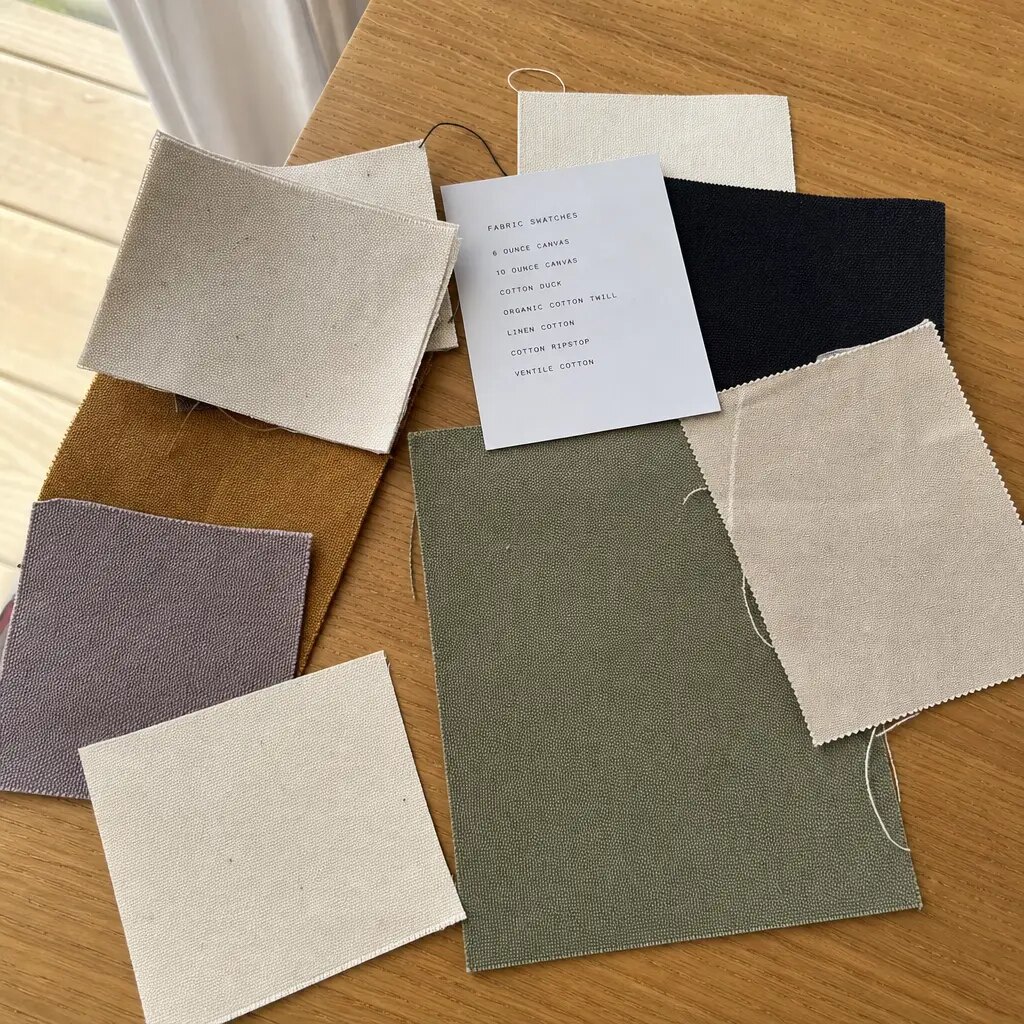
Do not specify nominal GSM without tolerance. Depending on fabric and mill control, suppliers may quote +/-5% or +/-10%. A 200 GSM cotton fabric delivered near the low end of a wide tolerance can feel closer to a lightweight pouch and may affect opacity. If hand feel matters to the brand, approve a fabric swatch and seal a reference sample. Also confirm whether the cotton is greige natural, washed natural, bleached, dyed, conventional, organic-certified, or a recycled blend. Each option affects shade, shrinkage, certification documentation, and print appearance.
- 140-160 GSM: economical and soft, but higher risk of wrinkles, show-through, and less stable print opacity.
- 180-220 GSM: common mid-range for reusable apparel pouches with good print and sewing balance.
- 250-270 GSM: stronger premium hand, but higher material cost, freight weight, and channel bulk.
- Above about 280 GSM, test drawstring gathering carefully before committing to bulk.
- Ask whether the fabric is washed, unwashed, bleached, dyed, or natural greige because each affects shrinkage, shade, and print appearance.
- For certified cotton claims, request certification scope and transaction documents rather than relying on general wording.
Match the branding method to artwork and buyer expectations
Screen printing is the usual choice for simple cotton drawstring pouch logos, especially one-color or two-color marks. It is efficient for medium and larger runs, offers good opacity when ink and curing are controlled, and helps the pouch retain a textile feel. Buyers should specify artwork color, print size, placement, and whether the print should be soft-hand or high-opacity. Those two print goals can pull in different directions, so clarify the priority.
Heat transfer can be useful for fine lines, small multi-color artwork, gradients, or trial orders where screen setup is not efficient. The tradeoff is tactile. Some transfers show a film edge, create surface shine, feel stiff, or crack after flexing if poorly specified. If a transfer is selected, approve it on the actual production cotton rather than on a substitute fabric. A photo is not enough. Bend the pouch, rub the surface lightly, and check edge lift.
Woven labels, hem labels, and loop labels suit brands that want quieter low-ink branding. They can make the pouch feel more like a reusable textile accessory than a promotional giveaway. The label spec should include label size, fold type, base color, logo color, insertion depth, stitch line, and reading direction. If the label is sewn into a side seam, it also affects seam thickness and visual balance.
Embroidery can look premium, but it is not automatically better. Dense embroidery can pucker lighter cotton and leave rough backing inside the pouch where it may contact garments. If embroidery is required, test it on the exact fabric weight and check the inside surface. For many eco apparel pouch programs, a clean one-color screen print or a small woven label gives better consistency with less production risk.
- Screen print: best for simple solid logos and repeat production.
- Heat transfer: suitable for fine detail or short runs, but inspect film feel and crack resistance.
- Embroidery: premium look, but avoid dense embroidery on lightweight cotton.
- Woven side label: subtle branding with added seam-control requirements.
- Front print plus side label: attractive but adds setup, sampling, MOQ, and QC checkpoints.
- Approve print strike-offs on actual fabric when color, opacity, or hand feel is important.
Write placement instructions that inspectors can measure
The best logo placement instruction is short, specific, and measurable. Define the artwork box and its distance from finished pouch edges. For example: artwork box 80 mm W x 50 mm H; horizontally centered to finished front width; top of artwork 70 mm below finished top edge; placement tolerance +/-5 mm. If you measure from the channel stitch line instead, use that reference everywhere: artwork file, sample comments, purchase order, and QC checklist.
Avoid approving supplier mockups that do not show dimensions. A mockup may look balanced because of screen scaling, not because it reflects the sewn pouch. Ask the supplier for a measured layout drawing or a sample photo with arrows showing the finished top edge, side seams, channel stitch line, logo box, and distance values. This small step prevents a lot of confusion between design, sourcing, factory production, and inspection teams.
When several pouch sizes are in the same program, decide whether the logo size stays constant or changes by size. A constant logo simplifies artwork control and supports consistent brand identity, but it can look large on small pouches and understated on large pouches. Size-specific artwork improves proportion, yet adds screen setups, artwork versions, MOQ splits, and inspection points. There is no single right answer; the key is to make the rule explicit.
Placement tolerance belongs on the PO. For screen-printed logos on sewn cotton pouches, +/-5 mm is a practical starting point for many programs. Smaller transfers or labels may use +/-3 mm if the supplier confirms capability. If the tolerance is missing, final inspection becomes subjective. One inspector may accept a shift that another rejects, and the factory may push back because no measurable standard was agreed before production.
- Use “top of artwork 75 mm below finished top edge,” not “logo slightly below center.”
- State whether the logo is centered to finished width or to visible panel between seams.
- Include logo size tolerance if the print method may vary slightly.
- Use +/-5 mm placement tolerance as a practical starting point for many screen-printed sewn pouches, unless your supplier confirms another standard.
- Add keep-out zones for labels, hangtags, barcodes, drawcord exits, and gusset folds.
- Keep the approved sample and measured drawing together for final inspection.
Compare quotes by cost drivers, not pouch photos
Cotton drawstring pouch quotes often look similar at first glance. The product photos may show natural cotton, a front logo, and a drawcord. Underneath, the quotes may cover very different products. Key cost drivers include finished size, fabric GSM, fabric color, construction, print method, number of print colors, number of logo positions, label type, cord type, packing method, and order split.
A 200 GSM natural cotton flat pouch with one-color front screen print is not comparable to a 260 GSM dyed gusseted pouch with custom cord, woven side label, two-side print, and individual barcode labeling. Both may be called “cotton drawstring pouches,” but the production work is different. Procurement teams should align the technical spec before comparing unit prices.
MOQ also needs detail. A supplier may quote a minimum for one body fabric, one size, one print artwork, and one cord color. If the buyer splits the order across three pouch sizes, two cord colors, and four artwork versions, the factory may need separate cutting, printing, sewing, packing, and labeling runs. The total PO quantity may look large, while each version behaves like a small batch.
Setup charges can hide in the quote. Ask whether screen charges, transfer film setup, label loom setup, strike-offs, pre-production sample fees, courier charges, barcode application, inner bundle labels, and special carton marks are included or separate. A lower unit price is not always the lower-risk option if approval steps and packing requirements are undefined. For B2B buyers, the best quote is the one that matches the spec and makes production variables visible.
- Ask for unit price and separate setup charges by artwork color, position, and version.
- Confirm whether the quote includes fabric testing, strike-offs, pre-production sample, and courier cost.
- Check MOQ by size, body color, cord color, label version, and print artwork.
- Custom-dyed fabric and dyed cords can increase lead time and colorfastness risk.
- Double-side printing increases inspection exposure because both panels must pass.
- Individual polybags, hangtags, inserts, and barcode labels add labor and material cost.
- Consolidating one pouch platform across several apparel SKUs usually improves cost control.
Use staged sampling before bulk production
Sampling works best when each sample has a clear purpose. First, approve the technical layout: finished size, construction, artwork size, and placement. Second, approve the fabric swatch and print strike-off if GSM, shade, opacity, or hand feel matters. Third, approve a pre-production sample made with intended fabric, cord, print method, label construction, and packing style. Trying to approve all details in one round often creates unclear comments and repeated revisions.
Sample comments should be written like production instructions. Instead of “move logo down a little,” write “move logo 10 mm lower; revised top of artwork to sit 80 mm below finished top edge.” Instead of “cord is too long,” write “reduce exposed cord length to 130 mm each side when pouch is fully open.” Instead of “fabric feels thin,” write “revise to 200 GSM cotton with agreed tolerance.” Clear comments can move directly into the PO and QC file.
Filled-sample approval is especially important for apparel presentation. Ask the supplier to test the pouch with the intended garment or a packing dummy with agreed folded dimensions. Check whether the logo remains visible, whether the pouch closes smoothly, whether the bottom bulges, whether a side label twists, and whether the drawstring length is practical. An empty pouch may pass every measurement and still fail once it holds the real product.
Keep control samples. The buyer, factory, and inspector should all work from the same approved reference. A sealed sample, measured layout drawing, artwork file, fabric swatch, and strike-off record are useful when production questions arise. They also reduce the chance that a late-stage change in cord color, label direction, or carton packing creates confusion after bulk sewing has started.
- Approve a measured digital layout before making physical samples.
- Request print strike-offs on actual bulk fabric for important brand colors.
- Review empty and filled samples for apparel presentation programs.
- Measure logo placement after sewing and pressing, not from raw panels.
- Record cord diameter, channel height, exposed cord length, knot type, and cord-end finish.
- Keep a sealed approval sample for production, QC, and dispute resolution.
QC, packing, and lead-time controls for apparel launches
Final inspection should cover more than general appearance. Cotton drawstring pouches are simple items, but defects become highly visible when thousands of units enter a branded apparel program. QC should measure finished size, logo position, logo size, print quality, seam construction, fabric shade, label orientation, drawstring function, packing count, carton assortment, and carton marks. Sampling should cover different cartons and production batches, not just the top pieces in one carton.
Print inspection should match the branding method. For screen print, check curing, adhesion, cracking after light flexing, pinholes, smudging, ink bleed, edge sharpness, opacity, and registration for multi-color artwork. For heat transfers, check peeling, bubbling, film edge visibility, stiffness, surface sheen, and cracking. For woven labels, check insertion depth, stitch security, fold type, reading direction, and exposed raw edges. For dyed cotton fabric or dyed cords, consider dry-rub and wet-rub checks to reduce the risk of color transfer to light apparel.
Packing instructions can protect or delay a launch. If pouches are shipped to an apparel factory for garment packing, they should be bulk packed by exact size, artwork version, PO, and destination. Mixed shipments need inner bundle labels. Individual polybags should be used only when they are needed for retail resale, warehouse scanning, or e-commerce handling; otherwise they add cost, plastic, and unpacking labor. If carton dimensions or gross weight matter to the warehouse, ask for them before shipment.
Lead time should be managed by milestones rather than a single date. Track artwork lock, strike-off approval, pre-production sample approval, material booking, printing, sewing, inspection, packing, and ex-factory date. Late artwork, barcode, carton mark, or destination changes can delay shipment even after pouches are sewn. For procurement teams, the safest schedule is one that gives enough time for measurable approval before bulk production begins.
- Use a QC diagram showing exactly where placement measurements begin and end.
- Inspect placement against the agreed tolerance, such as +/-5 mm, and record results.
- Check drawstring opening and closing on random units, including channel smoothness and knot security.
- Verify carton quantity, pouch size, artwork version, and destination marks against the PO.
- Use inner bundle labels for mixed sizes or logo versions.
- Request carton dimensions and gross weight before shipment if warehouse limits apply.
- Control late artwork, barcode, and carton-mark changes because they can delay shipment after production is complete.
Specification comparison for buyers
| Spec decision | Recommended option | When it fits | Buyer risk to check |
|---|---|---|---|
| Finished size basis | Specify finished pouch dimensions in millimeters after sewing and pressing, not raw panel dimensions | Essential for comparing supplier quotes and inspecting bulk production | If logo placement is based on raw cutting panels, the finished print may shift after hemming, channel folding, and seam take-up |
| Finished-size tolerance | Use practical tolerances such as +/-5 mm for small/medium flat pouches and +/-8 mm for larger or gusseted pouches, unless your program requires tighter control | Works for most apparel packaging where hand-sewn textile variation is acceptable | Overly tight tolerances can increase rejects and cost; vague tolerances cause disputes at final inspection |
| Fabric weight | 180-220 GSM cotton for most reusable apparel packaging; 250-270 GSM for premium gift sets; 140-160 GSM only for lightweight or cost-sensitive applications | Good balance for socks, tees, intimates, accessories, GWP sets, e-commerce inserts, and reusable packaging programs | Below 160 GSM can show contents, wrinkles, and uneven print opacity; above 280 GSM can add seam bulk, carton weight, and stiff drawstring gathering |
| Fabric weight tolerance | Ask for quoted GSM tolerance, commonly +/-5% to +/-10% depending on mill control and fabric type | Useful when comparing natural cotton, bleached cotton, dyed cotton, and certified cotton options | A nominal 200 GSM fabric delivered near the low end may feel closer to a lightweight pouch and affect print opacity |
| Bag construction | Flat pouch for tees, socks, intimates, and small accessories; bottom gusset for thicker folded garments or multi-piece bundles | Flat construction gives the cleanest print face and lower unit cost; gusset improves capacity and retail standing | Artwork placed too low on a gusseted pouch can bend across the expansion fold or disappear when filled |
| Front logo position | Keep full artwork below the drawstring channel and above the lower distortion zone; often top of artwork sits 60-90 mm below finished top edge on medium pouches | Best for one-color screen prints, simple brand marks, and consistent apparel presentation across sizes | Samples can look balanced empty but shift when filled; approve at least one packed sample using the intended garment fold |
| Logo placement tolerance | Define print location tolerance before bulk, commonly +/-3 mm for small labels or transfers and +/-5 mm for screen prints on sewn cotton pouches | Gives QC teams a measurable acceptance standard | If the tolerance is not on the PO, final inspection becomes subjective and suppliers may reject off-center claims |
| Logo size | Use a maximum artwork box, for example 60 x 40 mm for small accessory pouches, 80 x 60 mm for sock/tee pouches, or 100 x 120 mm for larger apparel pouches | Keeps branding visible without overwhelming a reusable eco pouch | Oversized artwork increases print defects, crosses wrinkles, and makes natural cotton slubs more noticeable |
| Print method | Screen print for simple solid logos; heat transfer for fine detail or short trials; woven label for subtle low-ink branding | Screen print is efficient at scale; transfer handles detail; labels suit minimalist eco apparel brands | Transfers can feel plasticky or crack if poorly specified; labels need controlled fold type, insertion depth, and reading direction |
Buyer checklist before sampling
- State finished pouch size in millimeters: width, height, gusset depth if any, and finished-size tolerance after sewing and pressing.
- Specify fabric composition, weave or hand-feel target, fabric weight in GSM, and acceptable GSM tolerance, such as 200 GSM cotton +/-5% or supplier standard if agreed.
- Confirm whether cotton is conventional, organic-certified, recycled blend, greige natural, washed natural, bleached, or dyed; request certificate scope only when certification is required.
- Define the use case: retail resale, garment packaging, gift-with-purchase, influencer seeding, e-commerce fulfillment, warehouse bundling, or dust/storage bag.
- List intended contents, folded dimensions, approximate packed thickness, fill weight, and whether approval must be checked both empty and filled.
- Provide vector artwork, Pantone or brand color references, and a maximum artwork box in millimeters; do not rely on a scaled PDF mockup alone.
- Define logo placement from finished reference points: finished top edge, side seams, bottom seam, channel stitch line, or gusset fold as applicable.
- State whether the logo is centered to the full finished width, the visible flat front panel, or a specific offset designed to balance a side label.
- List keep-out zones around the drawstring channel, hem stitching, side seams, bottom seam, gusset folds, side labels, barcodes, hangtags, and carton stickers.
- Name the branding method: screen print, heat transfer, embroidery, woven label, hem label, loop label, or front print plus sewn label.
Factory quote questions to send
- What finished pouch dimensions are included in the quote, and what finished-size tolerance will be used after sewing and pressing?
- What cotton fabric weight in GSM is quoted, what GSM tolerance applies, and how will GSM be checked in bulk?
- Is the body fabric greige natural, washed natural, bleached, dyed, organic-certified, or another specification, and does certification cover fabric, finished product, or transaction documentation?
- What fabric construction is used, such as plain weave or twill, and is the quoted fabric pre-shrunk, washed, or unwashed?
- What are the top hem depth, drawstring channel height, seam allowance, bottom seam construction, and gusset construction if applicable?
- What is the usable front print area after excluding the drawstring channel, side seam allowance, bottom seam, gusset folds, and expected gathering zone?
- Which print method is included, and what are the setup charges by color, position, artwork version, and repeat order?
- Are screen charges, digital setup, transfer films, label loom setup, strike-offs, courier costs, and pre-production samples included or charged separately?
- What logo placement tolerance do you normally hold on sewn cotton pouches, and can you meet +/-5 mm from the approved sample?
- What MOQ applies by pouch size, fabric color, cord color, print artwork, label version, and packing style?
Quality-control points to confirm
- Measure finished pouch size after sewing and pressing, recording width, height, and gusset depth where applicable against the agreed tolerance.
- Confirm fabric GSM by sampling from approved fabric or bulk fabric according to the agreed method; compare against the quoted GSM tolerance.
- Inspect fabric shade and surface for unacceptable stains, oil marks, heavy slubs, holes, shade variation, and lot mixing, especially on natural or bleached cotton.
- Measure print placement from the same reference points used in the spec, such as finished top edge and finished side seams, not from raw panel marks.
- Check print placement tolerance, commonly +/-5 mm unless the PO states another standard, across multiple cartons and production batches.
- Verify that the logo is clear of drawstring channel stitches, seam puckering zones, bottom folds, gusset expansion areas, and label insertion points.
- Check logo size against the approved artwork box and confirm that supplier has not scaled, stretched, rotated, or repositioned the artwork without approval.
- For screen print, inspect adhesion, curing, edge sharpness, opacity, ink bleed, pinholes, smudging, cracking after light flexing, and registration for multi-color prints.
- For heat transfer, inspect film edge visibility, peeling, bubbling, cracking, surface sheen, stiffness, and adhesion after flexing and rubbing.
- For embroidery, inspect puckering, thread breaks, backing irritation, loose threads, and inside-surface roughness that could contact garments.