Start With the End Use
For farmers market vendors, a cotton drawstring pouch is usually doing more than one job. It may be retail packaging for tea, seeds, soap, produce samples, dried goods, or handmade gifts. It may also be a reusable carry bag, a giveaway, or a secondary pack for online orders. That mix changes the right logo placement. A mark that looks balanced on a flat mockup can disappear when the pouch is tied shut, stacked in a basket, clipped to a hook, or filled with product.
The buying mistake is to treat placement as artwork styling instead of product behavior. If the pouch is going to be handed over at a stall, the logo has to read from a short distance and survive casual handling. If it is going into a retail kit, the mark may need to coexist with ingredients, sizing, or a barcode. The buyer should define the real use case first, because the use case determines where the logo can live and how large it needs to be.
For most market programs, visibility matters more than perfect symmetry. Customers will usually see the pouch for a few seconds, from one to three meters away, or in a flat-lay product image. That means the imprint has to be legible fast, not just technically centered. If the logo is too small, too close to the closure, or too low on the body, the pouch becomes packaging without brand value. The placement decision should protect readability in the finished state, not the empty sample state.
- Define whether the pouch is packaging, resale merch, a giveaway, or a reusable carry item
- Specify the viewing distance and whether the pouch will be tied closed during use
- Prioritize readability in the finished state, not only on a flat blank panel
Set the Base Pouch Spec First
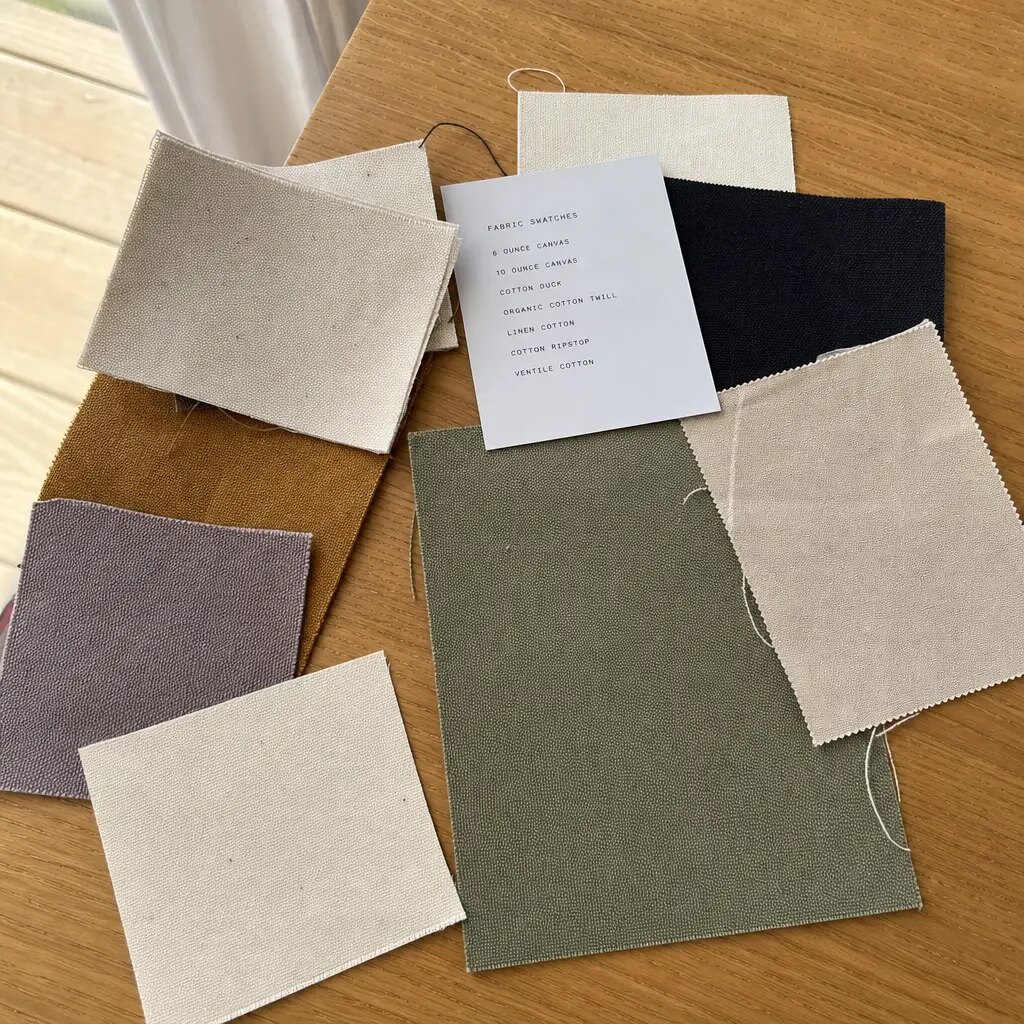
Logo placement is much easier to control when the pouch build is stable. Start with fabric weight, weave, finished size, seam allowance, and cord channel height before you freeze the artwork. For lightweight promotional pouches, 90-110 GSM can work, but the fabric will wrinkle more and the print face will be less stable. For most reusable market pouches, 120-160 GSM is the practical middle ground because it balances cost, drape, and printability. If the pouch needs more body or a cleaner premium feel, 160-200 GSM is a stronger starting range.
Construction changes the real print area. A flat pouch gives you a simple front panel, but a gusseted pouch changes shape as soon as it is filled. The top channel, side seams, and bottom fold all reduce the safe imprint zone. That is why a procurement brief should name finished dimensions, not just cut dimensions. If the supplier cannot state the sewn measurements and the seam allowance, the logo placement quote is still under-specified.
A useful spec ties the imprint to the sewn pouch in millimeters. For example, a buyer might allow a 120 mm by 90 mm imprint on a pouch with a 160 mm by 220 mm body, with explicit clearance from the top seam and side seams. The exact number matters less than the fact that it is attached to the finished product, not the flat art file. Ask for the safe print field, the excluded areas, and the expected shrink allowance before you approve the artwork.
- Choose GSM based on end use, not just unit price
- Lock seam allowance and cord channel height before approving placement
- Ask for the safe print field and excluded zones in millimeters
Choose the Decoration Route
For most cotton drawstring pouches, screen print is still the default because it is straightforward, durable, and cost-effective for simple artwork. It works best for one-color logos, bold wordmarks, and icons with thick strokes. On textured cotton, fine detail gets lost quickly, so small text and hairline rules are usually a bad investment. If the logo must be crisp, ask the printer what minimum line weight and type size they can hold on the actual fabric, then verify it on a strike-off.
Heat transfer can handle more color complexity and shorter runs, but it needs a durability check. Folding, friction, and repeated handling can cause edge lift or cracking, especially on pouches that will be reused. Embroidery gives a premium tactile look, but it is usually better on heavier bodies because thinner cotton can pucker around the stitch density. Woven labels and sewn patches move the brand mark off the fabric surface entirely and can be the right answer when the logo is small or the pouch is meant to last through frequent reuse.
The right method is the one that survives the actual use case at the lowest acceptable risk. If the brand needs a simple, repeatable pouch for market sales, a one-color screen print often gives the cleanest economics. If the product is a premium refill kit, a woven side label may be worth the added sewing step. The key is not to let the supplier choose the decoration route by default. Ask them to quote at least two methods if the brand can accept either, then compare based on durability, visibility, and cost.
- Use screen print for bold, simple logos and repeat orders
- Use heat transfer only if the artwork needs it and the wear risk is acceptable
- Use woven labels or sewn patches when the logo is small or the pouch is reused often
Place the Mark Where It Survives Use
The safest default is usually the upper center of the front panel, below the cord channel and clear of the side seams. That placement keeps the logo visible when the pouch is tied closed and avoids the lower area that tends to stretch when the pouch is filled. It also works well for hanging displays and flat-lay photography. If the pouch is part of a retail bundle, center-front branding usually gives the best mix of visibility and repeatability.
There are valid reasons to move the mark. A back-panel print works when the front panel is already carrying product data, a QR code, or a size mark. A side label works when the brand wants a softer premium finish or when the pouch will be handled so often that print durability becomes a concern. The rule is simple: keep branding away from the cord exit points, top seam bulk, and side seam intersections.
Think about the pouch in three states: empty, tied, and filled. A location that looks perfect on an empty panel can compress once the drawcord is pulled tight. A lower corner can vanish if the pouch is folded in transit. A centered logo can be clipped by the closure if the top margin is too tight. A good placement sketch should show the distance from the top seam, the distance from each side seam, and the maximum tolerance the factory may use during sewing.
- Use upper-center placement as the default for visibility
- Move branding to the back panel or side label when the front has other content
- Check the pouch empty, tied, and filled before approving final placement
Turn Placement Into a Measurable Spec
The difference between a clean order and a painful one is usually the quality of the placement instruction. A good spec does not say, "center logo on front." It says where the logo starts and ends, what the allowed movement is, and which physical features the factory must avoid. Include the finished pouch size, fabric weight, color reference, print method, number of colors, maximum imprint size, and exact placement reference points. If the logo must sit below the top seam by a specific distance, write that distance in the brief.
The drawing should use three reference points: top seam, centerline, and side seam. It should also show the safe imprint box and the excluded zones around the cord channel and stitch bulk. Buyers often skip these details and then blame the factory when the print lands too close to the closure. In practice, the ambiguity is the problem. The cleaner the spec, the less room there is for disagreement during approval or receiving.
If you are comparing multiple suppliers, keep the placement language identical across every RFQ. One supplier may quote a 90 mm logo, another may assume 110 mm, and a third may price a side label instead of a print. That creates false price comparisons. Standardize the brief before asking for numbers so the commercial decision is based on the same build, not on different assumptions. This matters even more when the supplier mix includes a factory, a trading company, and a domestic decorator.
- Use a dimensioned sketch, not a vague mockup
- Show top seam, centerline, side seam, and excluded zones
- Keep the placement language identical across all supplier quotes
Make Suppliers Quote the Same Build
A useful quote for cotton drawstring pouches has to separate the base pouch from the decoration, setup, packing, and sample work. If a supplier gives you one lump sum, you cannot see whether the price is driven by sewing, printing, labeling, or carton prep. That becomes a problem when the artwork crosses a seam, needs a second print pass, or requires a placement jig. The supplier may be priced correctly, but the quote is still hard to compare.
MOQ can change quickly by decoration route. A stock cotton pouch with one-color screen print usually supports a lower minimum than a pouch with a woven label, custom cord color, or special carton marking. That is why buyers should request price tiers at 500, 1,000, and 3,000 pcs when the order size is not fixed. The tier view shows whether setup is being amortized efficiently or whether the supplier is hiding cost inside a higher setup fee.
Quote basis matters just as much as MOQ. FOB, EXW, CIF, and DDP are not interchangeable. A lower FOB number can still become the highest landed cost once freight, duties, carton volume, customs handling, and a second sample round are included. Ask what is included and what is excluded. Then normalize the quotes to the same incoterm and the same carton spec. That is the only way to compare suppliers without missing hidden cost drivers.
- Ask for separate pricing for base pouch, decoration, setup, packing, and sampling
- Request 500, 1,000, and 3,000 piece tiers when the order size is flexible
- Normalize every quote to the same incoterm and carton specification
Use Sampling to Prove Print and Sewing
A pre-production sample should prove that the order can be made correctly, not only that the art looks good in a file. It needs the same fabric weight, same cord, same stitch construction, and same decoration method as bulk. A digital proof does not show weave distortion, shrinkage, opacity, or how the pouch sits once tied. The right way to judge the sample is in three conditions: flat, tied, and filled with the product you actually plan to sell.
Set the acceptance criteria before you approve the sample. The print should land within the agreed placement window, the logo should be readable at normal viewing distance, and the edges should be clean without bleed, ghosting, or seam interference. If the pouch will be reused, add a simple rub check and a closure cycle check. The goal is not laboratory certification. It is to catch obvious production risk before the bulk run starts.
If the supplier sends a strike-off, confirm whether it is a one-off sample or a production-accurate reference. Those are not the same. A one-off can be hand-finished more carefully than the line output and may not reflect actual mass production. The sample that matters is the one made from the same process path as bulk, on the same fabric, with the same cord and sewing construction. That is the sample that should anchor approval and accountability.
- Inspect the sample flat, tied, and filled
- Measure logo location against the approved sketch
- Reject samples with seam interference, bleed, or uncontrolled strike-through
- Use rub and closure checks if the pouch will be reused
Compare Landed Cost, Not Unit Price
The cheapest unit price is often not the lowest landed cost. To compare suppliers properly, put every quote on the same basis: same pouch size, same GSM, same logo placement, same decoration method, same packing spec, and same incoterm. Once that is normalized, hidden costs become visible. A lower unit price can be offset by setup charges, freight by volume, customs duty, carton rework, a second sample round, or a higher MOQ that forces overbuying.
A simple example shows the issue. If one supplier is $0.12 cheaper per pouch on 1,000 pcs but adds a $45 setup charge and a $90 freight delta, the apparent savings disappear immediately. The same problem shows up when a supplier quotes a smaller carton count but charges more for repacking or outer cartons. The useful procurement question is not who is cheapest on paper. It is which quote gives the best control over the full order.
For a farmers market vendor program, a slightly higher factory price can still be the better buy if it includes a clean strike-off, reliable print placement, clear carton specs, and fewer surprises at receiving. A late or inconsistent pouch order can damage a launch more than a modest unit-price difference. The supplier who explains overrun policy, remake policy, and freight assumptions is usually the one worth keeping on the shortlist.
- Normalize size, GSM, print method, pack spec, and incoterm before comparing quotes
- Add setup, freight, duty, and sample rounds into landed cost
- Weigh schedule reliability and rework risk alongside unit price
Pack for the Receiving Flow
Packing changes cost, labor, and receiving speed. Flat-packed pouches are usually the most efficient for freight and warehousing, but they can crease if cartons are overfilled or if the pouches are folded too tightly around the print area. Retail-ready pack-outs may require individual polybags, inserts, barcodes, or hangtags, and each of those adds handling time and carton volume. For many market vendor programs, simple counted inner packs are enough because the receiving team wants fast count accuracy and easy distribution.
Specify the pack logic in the RFQ. Define whether the cartons are single-SKU or mixed-SKU, whether the drawcord should be open or closed at packing, and whether any folding direction is required to protect the logo. Also specify inner pack counts and carton marks. If you expect store-level or warehouse receiving, add barcode placement rules and the label format. These details affect both the quote and the receiving experience. A carton that arrives with the wrong count or unclear marking can create labor that dwarfs any unit-price savings.
If the order includes multiple pouch sizes or colors, tell the factory whether assortments are allowed in one carton or whether each carton must contain only one SKU. Mixed cartons can save space but increase picking risk. Single-SKU cartons are easier to receive and replenish. Neither is automatically right. What matters is choosing the packing method that matches the buyer's receiving flow and then writing that decision into the purchase order.
- Choose flat pack or retail-ready pack before final pricing
- Define inner pack count, carton markings, and barcode rules
- State whether cartons may contain mixed SKUs or must be single SKU only
Pick the Supplier Who Controls the Failure Points
A strong vendor is not just the one with the lowest quote. It is the supplier that controls the steps most likely to fail: fabric booking, cutting, printing, sewing, packing, and final inspection. Ask who actually owns each step. A factory with in-house printing and sewing will usually have fewer handoffs than a trading company that depends on multiple subcontractors. Fewer handoffs do not automatically mean lower cost, but they usually mean fewer surprises on placement, color, and schedule.
The best comparison is operational, not just financial. Ask whether the supplier can show a comparable pouch with the same print method, whether they can hold a sample to the same placement tolerance across repeated runs, and whether they can explain how they manage artwork revisions after approval. If they cannot describe those controls, the quote is a weak indicator of production quality. A buyer should favor suppliers who can explain process control in plain terms and back it up with a real sample.
This matters especially for farmers market vendor programs, where order values can be modest but launch timing is tight. A supplier that saves a few cents but misses the seasonal window is not the better vendor. The right supplier gives you predictable placement, controlled packing, and a clear path from sample to bulk. If two quotes are close, choose the one with tighter process ownership and fewer assumptions.
- Prefer suppliers who control cutting, printing, sewing, and packing directly
- Ask for a comparable sample from the same process path
- Choose the supplier that reduces handoffs and explains its controls clearly
Specification comparison for buyers
| Spec decision | Recommended option | When it fits | Buyer risk to check |
|---|---|---|---|
| Fabric weight | 120-160 GSM for most reusable market pouches; 160-200 GSM when you need more body and a cleaner print face | Best for retail resale, refill programs, gift packaging, and pouches that will be handled often | Ask whether the quote includes shrink allowance, pre-shrunk fabric, or finished-size tolerance after sewing |
| Decoration route | One-color screen print on the front panel | Best for simple logos, repeat replenishment, and orders where unit cost matters more than tactile finish | Confirm the print is done in-house or by an approved subcontractor, because handoff can add lead time and color drift |
| Premium route | Sewn woven label or seam label | Best when the mark is small, the pouch is reused frequently, or the brand wants a softer premium feel | Check label width, stitch points, seam reinforcement, and whether the label distorts the pouch silhouette |
| Placement | Upper center of the front panel, below the cord channel and clear of side seams | Best for pouches that are tied closed, stacked in baskets, clipped to hooks, or photographed flat | Require a measured placement sketch so seam allowances do not push the logo into the closure area |
| Artwork complexity | Bold one-color wordmark or icon with thick strokes | Best for coarse cotton, small imprint areas, and low-to-mid MOQ programs | Fine serif text, hairline rules, and tiny legal copy can fill in or blur on textured cotton |
| Print tolerance | A stated window such as +/- 3 mm on centerline and +/- 5 mm from the top reference, unless the factory proves tighter control | Best for first orders, reorders across multiple suppliers, and programs where consistency matters | Do not accept a tolerance promise without a signed strike-off on the same fabric and same line |
| Sampling | Pre-production strike-off on actual fabric with actual cord and stitch construction | Needed for first orders, new suppliers, and any program where placement accuracy is commercial risk | Digital proofs do not show weave distortion, shrinkage, opacity, or how the pouch behaves when tied |
| Packing | Flat-packed with counted inner packs and carton marks | Best for export, warehouse receiving, and store replenishment | Overpacked cartons can crease the print, distort the body, and slow receiving checks |
Buyer checklist before sampling
- Final pouch size with finished tolerances, seam allowance, and cord channel height
- Target fabric weight in GSM, weave type, and color reference
- Vector logo file plus a measured placement drawing in millimeters
- Approved decoration method, number of print colors, and maximum imprint size
- Need for body print, woven label, embroidery, or sewn patch
- Pre-production sample on the same fabric, cord, and stitch construction
- Packing spec, inner pack count, carton marks, and barcode requirements
- MOQ by size and decoration method, plus overrun and underrun tolerance
- Requested incoterm, delivery window, and freight assumptions
- Inspection standard for print position, stitch quality, and carton count
Factory quote questions to send
- What exact fabric GSM, weave, and shrinkage allowance are included in your quote?
- Is the fabric pre-shrunk, or what finished-size tolerance do you build in after sewing?
- Is the logo printed, embroidered, label-sewn, or woven, and what is the maximum imprint size in millimeters?
- What are the setup charges, and are they charged per color, per placement, or per size?
- What MOQ applies to each pouch size and each decoration method?
- Can you quote 500, 1,000, and 3,000 piece tiers so we can see how setup amortizes?
- Can you supply a pre-production sample on the same fabric and with the actual cord before bulk production?
- What is your overrun and underrun tolerance, and what is the remake policy for off-center print or visible defects?
- How are the pouches packed, and what carton counts and carton dimensions should I use for freight planning?
- What incoterm and lead time apply at 500, 1,000, and 3,000 pcs?
Quality-control points to confirm
- Verify blank pouch size, seam allowance, and cord channel height against the approved tech pack
- Confirm logo position is within the agreed tolerance from the top seam and centerline; for many small pouches, a practical starting point is about +/- 3 mm on center and +/- 5 mm from the top reference
- Inspect print opacity, edge sharpness, and any show-through on the inside of the pouch
- Check that fabric weight and hand feel match the approved swatch or signed-off sample
- Measure the actual printed area against the approved art board, not only the visual center of the logo
- Test cord pull, knot security, and opening action after repeated closure cycles
- Inspect stitch quality for skipped stitches, loose thread ends, and puckering near seams
- Review pack count, barcode placement, carton marks, and polybag or inner pack spec
- Compare sample units from different cartons for color consistency and placement consistency
- Reject any pouch where the print touches the seam allowance, cord tunnel, or closure stitch line