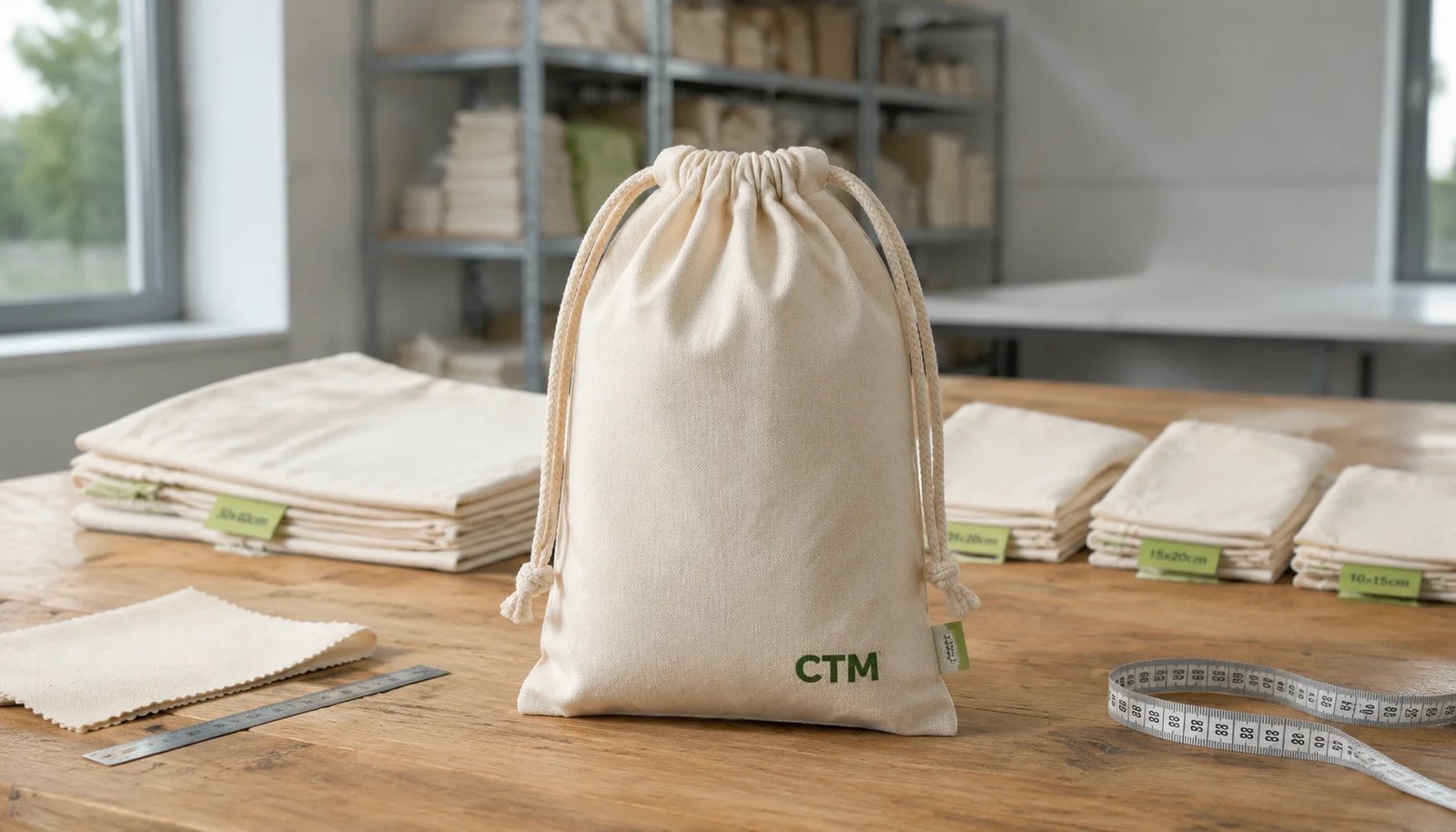
Why lead time planning fails on a simple cotton pouch order
Cotton drawstring pouches look straightforward, so buyers often compress the schedule too early. The usual mistake is treating them like a stock promotional item when the real lead time depends on fabric availability, panel printing sequence, cord preparation, assortment packing, and whether several sizes are being combined into one shipment. Natural grocer programs add another constraint: launch dates tend to be tied to seasonal merchandising, refill campaigns, gift-with-purchase bundles, or private-label rollouts. Missing the window by two weeks can leave the buyer holding late stock that no longer supports the planned promotion.
The most common source of delay is not sewing capacity by itself. It is late spec alignment. A quote requested as 'small cotton pouch with logo' may come back quickly, but the factory still cannot schedule fabric, screens, cutting markers, cord length, or packing layout until the buyer defines the exact size set, GSM, print area, and bundle count. The planning job is to remove spec ambiguity before the order reaches production. That is what shortens the actual path, not pressure emails after the PO is issued.
- Treat the critical path as: spec freeze > artwork approval > pre-production sample > material reservation > bulk production > final inspection > ex-factory booking
- Build the schedule from the latest acceptable warehouse receipt date backward, not from the PO date forward
- Separate factory production lead time from freight and warehouse appointment time
Start with the pouch specification that protects schedule, not just unit price
For natural grocers, a practical starting fabric is 6 oz to 8 oz cotton, roughly 200 to 270 GSM. That range holds shape better than lightweight muslin, prints more cleanly, and still folds flat enough for efficient packing. If the pouch will carry a soap bar, spice sachet set, refill accessory, or small gift assortment, this weight usually covers both shelf presentation and usability. Going lighter can reduce piece cost slightly but often increases print show-through, seam distortion, and customer complaints that the pouch feels disposable rather than reusable.
Size discipline matters more than many buyers expect. If the order includes five custom sizes for different SKUs, lead time stretches because cutting markers, sample approvals, and packing logic all multiply. Most importers are better served by standardizing to two or three sizes that share the same fabric and similar logo placement. This lets one fabric booking support several SKUs, raises production efficiency, and often keeps the order inside one workable MOQ structure instead of several fragmented mini-orders.
- Common practical weights: 140 to 160 GSM for low-cost sachets; 200 to 270 GSM for reusable retail pouches; 300 GSM and above for heavier gift packaging
- Typical size tolerance target: +/- 0.5 cm for small pouches, wider tolerance for larger hand-cut styles if agreed in advance
- Useful spec line in RFQ: natural cotton, 220 GSM target, single-color logo, finished size 15 x 20 cm, double cord, flat packed
How print method changes lead time and defect risk
For most natural grocer pouch programs, one-color screen printing is the safest commercial option. It offers good opacity on natural cotton, consistent brand marking, and manageable setup cost at wholesale volume. It also fits the production flow well when the factory prints on cut panels before sewing. Panel printing is slower to prepare than stamping a finished pouch, but it gives cleaner placement and fewer seam distortions, especially on smaller bags where the logo sits close to the bottom seam or side edge.
Digital printing can look attractive for low-volume multi-color graphics, but the buyer should think past artwork flexibility and evaluate handfeel, color variance, and production queue. Some factories outsource digital print work, which inserts another scheduling point. Heat transfer is usually faster for small test runs, but it can add stiffness and may not fit the natural, reusable packaging feel many grocers want. If your lead time target is tight, the print route should be part of the quotation comparison, not a later artwork decision.
- Screen print is usually best for 1 to 2 colors and moderate to high volume
- Define print position tolerance, for example +/- 3 mm or as commercially reasonable for handcrafted textile production
- Request print strike-off or pre-production sample when logo coverage is heavy or very fine lines are used
- Confirm whether print curing happens before final cutting and sewing, which affects shrinkage and size consistency
MOQ logic: where buyers lose time by splitting too many SKUs
MOQ for cotton drawstring pouches is rarely only about total pieces. Real factory MOQ is driven by material preparation, screen setup, labor efficiency, and packing splits. A supplier may offer a seemingly low MOQ, but once the order is split into multiple sizes, multiple logos, or retailer-specific carton marks, the effective MOQ rises because each split behaves like a separate production task. That is why comparing quotes only on piece price gives a false picture of the schedule and total cost.
A better route is to build one master order around shared fabric, shared cord, and one print color, then split only where commercially necessary. For example, an importer may combine 10 x 15 cm, 15 x 20 cm, and 20 x 30 cm pouches under one fabric booking if all use natural cotton and the same black logo. The supplier can then quote more efficiently on material and setup while preserving separate packing by size. This structure also reduces the chance that one slow-moving SKU delays the whole production slot.
- Request MOQ in three layers: total order MOQ, MOQ per size, and MOQ per artwork
- If multiple DCs need separate labels, ask whether carton marking splits affect lead time or only packing cost
- Clarify whether excess or short shipment tolerance is allowed per size assortment
Sample approvals that actually prevent production delay
A fast approval process does not mean skipping samples. It means using the right sample at the right stage. First, approve a digital layout for logo size and placement. Second, review a physical pre-production sample made in actual fabric, actual cord, and intended print method. This sample should represent the finished construction, not a substitute blank pouch from stock. Many schedule problems begin when buyers approve a generic sample and discover only during bulk inspection that the true fabric shrinks differently, the cord is thinner, or the logo shifts once the pouch is sewn.
The pre-production sample should become the reference standard for measurement, print appearance, and workmanship. Keep one approved reference with both buyer and factory. If the order is large or split across several sizes, ask the supplier which size will be the production control sample and whether each size needs separate approval. On small pouches especially, a few millimeters of print movement can make the logo look crowded against the seam. Resolving that on sample stage is faster than reopening screens during bulk.
- Approve actual finished size, not only flat panel size
- Review drawstring glide, knot finish, and top channel opening on the PPS
- Mark acceptable natural fabric slub level and shade variance on sample comments
- Keep the approved sample tied to the PO number and artwork revision
A practical lead time map for natural grocer pouch orders
Lead time planning becomes easier when broken into production blocks rather than one factory promise such as '25 days.' For a common wholesale pouch order with standard natural cotton, one-color print, and moderate volume, buyers should expect separate stages for artwork approval, sampling, material booking, bulk cutting and printing, sewing, packing, inspection, and dispatch. The exact days depend on season and order complexity, but the useful planning habit is to isolate which stage is fixed and which stage is compressible.
As an example only, a buyer might allow 2 to 4 days for artwork finalization, 5 to 7 days for a pre-production sample, 3 to 7 days for sample comments and approval, 15 to 25 days for bulk production after approval on standard material, and another 3 to 5 days for inspection and handover. If custom-dyed fabric, multiple print colors, or mixed retailer packs are involved, that window extends. A realistic plan includes a buffer before vessel cut-off or warehouse appointment because the pouch being finished in the factory does not mean it is packed, passed, loaded, and documented for shipment the same day.
- Build separate internal deadlines for artwork sign-off and PP sample sign-off
- Reserve freight space based on conservative ex-factory timing, not best-case timing
- Add extra time in peak gifting or holiday packaging season when print and sewing lines are congested
Packing decisions that affect both schedule and landed cost
Packing is often treated as a back-end detail, but on pouch orders it can create receiving issues, recount labor, and even shipment delay if not defined early. Flat packing is usually the most efficient format. For retail buyers and distributors, it helps to set exact units per inner bundle, whether bundles are by size only or by complete assortment, and what carton marks are needed for each distribution center. If the supplier has to wait for final carton label instructions after bulk is already finished, stock can sit at the factory while the ship window gets tighter.
Carton efficiency also affects freight. Heavy cotton pouches above roughly 270 GSM take more cubic space and more carton weight than buyers often estimate, especially in larger sizes. If the program includes several sizes, ask for a carton plan early: pieces per carton by size, carton dimensions, and gross weight. This lets you compare ocean freight cube, palletization at destination, and warehouse handling cost. A slightly cheaper unit price can lose its advantage if the pouch spec inflates freight and receiving labor.
- Useful packing line to include in PO: 50 pcs per inner poly by size, 10 inners per export carton, one SKU per carton unless otherwise approved
- Request carton gross weight below your warehouse handling limit if manual unloading is expected
- Require clear external carton marks: PO, style, size, quantity, carton number, country of origin
Quality thresholds to set before bulk, not during inspection
Buyers save time when quality expectations are converted into measurable acceptance criteria before the order runs. Cotton pouches are soft goods, so some natural variance is normal, but too many buyers leave workmanship standards undefined and then negotiate defect interpretation at final inspection. That invites conflict and schedule loss. Instead, define the defects that are major for your program: open seams, wrong size, missing print, severe print smear, trapped drawstring channel, mixed assortment, oil marks in selling area, or incorrect carton count.
Measurement control is especially important because cotton can shift after printing, pressing, and sewing. State where the bag is measured and in what condition. For example, measure width and height on a relaxed finished bag laid flat, excluding cord. If the logo position matters for retail display, define print location tolerance from the bottom seam or top hem. These details make third-party inspection more objective and reduce the risk that the factory has to rework packed cartons just before shipment.
- Set workmanship standard for seam density and prohibit skipped stitches at stress points
- Define what level of slub, nep, or natural fiber speck is commercially acceptable
- If mixed sizes are ordered, include carton assortment tolerance and recount method
- Link final inspection sample standard to the approved pre-production sample
How to compare supplier quotes beyond piece price
When several suppliers quote similar pouch specs, the right comparison is not only FOB price. Procurement teams should separate total material basis, print process, MOQ structure, sample lead time, ex-factory lead time, packing assumptions, and split-SKU handling. One supplier may look cheaper because the quote assumes lighter fabric, fewer pieces per size, or simpler bulk packing. Another may quote higher but include pre-production sample, panel print registration control, and manageable carton weights. Those differences directly affect whether the order ships on time and lands with fewer warehouse issues.
For natural grocer programs, quote clarity matters because promotions are usually linked to launch dates, not just replenishment. A supplier that can explain fabric source timing, screen preparation, in-line QC, and final packing flow is often more dependable than one that replies with only a low unit price and a round-number lead time. The buyer should also test responsiveness on practical details such as carton dimensions, print coverage limits, and how size splits impact MOQ. That is often a better indicator of future execution than a polished sales deck.
- Normalize every quote to the same GSM, size tolerance, print method, and packing basis before comparison
- Request separate tooling or screen costs if applicable instead of burying them in the piece price
- Compare ex-factory date assumptions, not just production day counts
- Flag any quote that does not state whether sample approval is included in lead time
A buyer workflow that reduces missed ship dates
The most effective workflow for pouch sourcing is to freeze the commercial spec before internal artwork rounds drag on. Procurement, brand, and packaging teams should align on size, GSM, logo color, and pack-out in one approval loop. Once those are fixed, the supplier can issue a stable quote and pre-production sample without reopening material logic. If the buyer sends artwork first but keeps changing pouch dimensions, every print file and cutting assumption gets reset. That is a classic way to lose a week on an item that looked simple.
After PO release, appoint one owner for milestone tracking. That person should monitor artwork approval date, PPS dispatch date, approval return date, bulk start date, inspection booking date, and ex-factory target. For importer programs involving consolidation, link pouch readiness to the container loading calendar early. Small textile items are frequently deprioritized when they are only one line among many SKUs in a container. A disciplined milestone sheet prevents the pouch order from becoming the quiet delay that holds the whole shipment.
- Use one revision-controlled specification sheet shared by buyer, supplier, and inspection team
- Keep all comments in one consolidated sample approval file to avoid conflicting instructions
- Do not book final promotion dates from the supplier's first estimate alone; wait until PPS approval is complete
Specification comparison for buyers
| Spec decision | Recommended option | When it fits | Buyer risk to check |
|---|---|---|---|
| Fabric weight | 6 oz to 8 oz cotton, about 200 to 270 GSM | Best balance for grocery bulk herbs, loose tea, soap bars, trial packs, and reusable shelf-ready gift pouches | Below 180 GSM can feel thin and print through; above 300 GSM adds cost, sewing time, and carton weight |
| Fabric type | Conventional natural cotton with color variance tolerance defined in approval | Suitable when the selling point is reusable natural packaging without requiring certified organic input | Natural shade can vary lot to lot; if shelf presentation matters, set acceptable shade range on bulk approval |
| Print method | 1-color screen print on cut panels before sewing | Best for grocer private label logos and care icons at mid to high volume | Panel printing needs artwork margin and registration tolerance; post-sew printing can distort near seams |
| Closure style | Single drawstring channel for small pouches, double cord for larger formats | Single cord lowers cost on sample sachet sizes; double cord closes faster for wider pouches | Cord length inconsistency affects pack-out and user experience; define finished exposed cord tolerance |
| Size range strategy | Standardize to 2 or 3 sizes sharing one fabric and print layout | Works well for grocers buying multiple SKUs such as seeds, gift sets, and refill accessories | Too many custom sizes break MOQ by size and slow cutting, sampling, and carton planning |
| MOQ route | One master order split by size or print if material and trim are shared | Useful for importers consolidating several store programs under one shipment | Suppliers may quote low MOQ but surcharge every split SKU; request MOQ and price break by size and artwork |
| Packaging method | Flat packed in inner poly bundles by size, then export cartons with clear carton marks | Best for distribution centers and repacking operations needing count control | If bundles are too large, recount time increases; if no carton map is supplied, receiving errors rise |
| Sampling sequence | Digital layout approval, then pre-production sample in actual fabric and print | Most efficient route when artwork is simple and schedule is tight | Skipping a true PPS can hide shrinkage, cord quality, and print handfeel problems until bulk |
| Shipment timing | Book ex-factory date with a 7 to 10 day buffer before vessel cut-off or warehouse appointment | Necessary for seasonal grocery promotions and importer consolidations | Factory completion date is not ship date; missed carton test, final inspection, or truck booking can erase the margin |
Buyer checklist before sampling
- Define pouch use first: produce bag, gift pouch, refill accessory, soap pouch, herb pouch, or mixed retail pack
- Lock finished size, fabric GSM, and closure style before requesting final quotes
- State whether natural cotton shade variation is acceptable or if a lab dip or bulk shade band is required
- Specify print method, print position, artwork size, and whether printing is on cut panels or finished bags
- Break out quantity by size, color, and artwork to expose hidden MOQ surcharges
- Request sample timeline separately for blank sample, pre-production sample, and bulk production sample retention
- Set measurement tolerances for width, height, hem, cord length, and print position
- Define acceptable defect levels for stitching, oil marks, needle damage, print smudge, and mixed-size packing
- Confirm packing format: units per inner bundle, bundles per carton, carton dimensions, carton gross weight, and carton marks
- Add milestone dates for artwork approval, pre-production approval, bulk completion, inspection, ex-factory, and ship window
Factory quote questions to send
- What is the exact lead time split for fabric booking, cutting, printing, sewing, inspection, and packing after artwork approval?
- Is the quoted lead time based on greige fabric in stock, dyed fabric, or fresh fabric weaving?
- What GSM tolerance do you allow on this cotton fabric, and how do you test it in bulk?
- Will the logo be screen printed on panels before sewing or on finished pouches after sewing?
- What is the MOQ by size and by artwork, and can several sizes share one master MOQ if the same fabric and print color are used?
- What surcharge applies if the order is split into multiple sizes or multiple shipping marks?
- How many days do you need for a pre-production sample in actual fabric and cord after artwork approval?
- What shrinkage should we expect after printing and sewing, and is finished size measured before or after final pressing?
- What is your standard cord material, diameter, and colorfastness for natural grocer applications?
- How are pieces packed per bundle and per carton, and what carton dimensions and gross weight do you expect at our order quantity?
Quality-control points to confirm
- Finished width and height within approved tolerance, measured on relaxed bag laid flat
- Fabric GSM within agreed tolerance band and matching approved handfeel
- Print color, opacity, and position aligned to approved artwork with no severe pinholes or smudging
- Top hem width consistent and drawstring channel open with no trapped stitches
- Cord length consistent pair to pair and knots secured without fraying ends
- Side and bottom seams even, no skipped stitches, open seams, or major puckering
- No obvious oil stains, mildew odor, heavy slubs in print area, or needle holes near stress points
- Correct assortment by size and artwork inside each inner pack and export carton
- Carton count, net weight, gross weight, and shipping marks matched to packing list