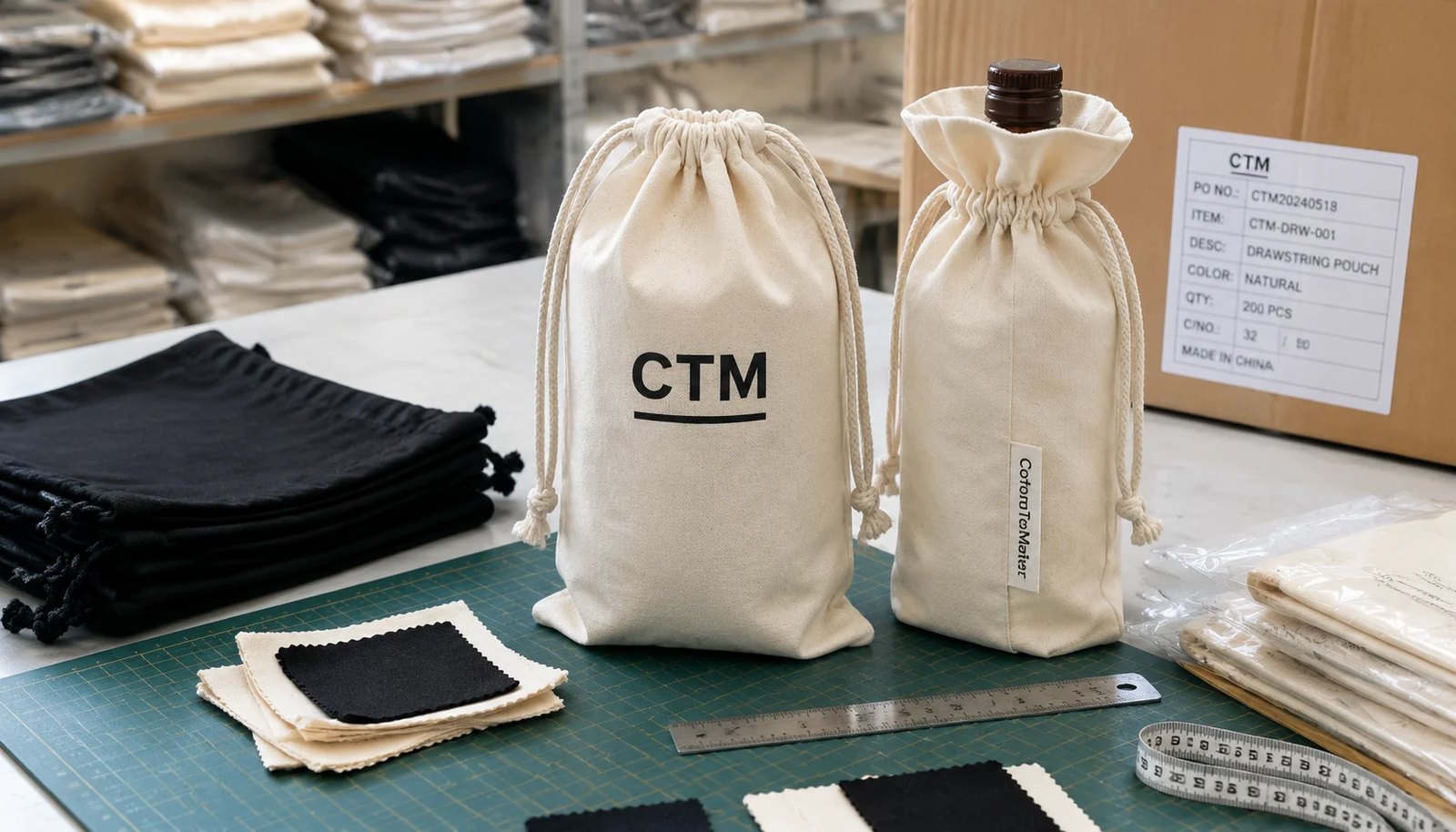
Why liquor retail pouch timing fails even when the pouch looks simple
A cotton drawstring pouch looks like a straightforward accessory, but liquor retail programs rarely fail because sewing itself is difficult. They fail because timing assumptions are loose. A buyer may have one logo, one pouch style, and one delivery month in mind, yet the real project includes bottle-fit confirmation, artwork approval, packing decisions, store allocation logic, and freight timing tied to a launch date.
That timing pressure is sharper in liquor retail than in many other soft-goods categories. Seasonal gifting, distributor promotions, holiday displays, and limited editions are date-sensitive. If the pouches land after the bottles are packed or after in-store display build dates, the order may still be usable, but the commercial value drops fast.
For procurement, the key is to stop treating lead time as a single factory promise. It is a chain of buyer approvals, material readiness, printing capacity, QC release, and shipment booking. The more clearly each gate is defined up front, the less likely the order is to drift.
- Plan backward from in-store or distributor handover date, not from ex-factory completion only.
- Separate supplier production days from your internal approval days.
- Treat bottle fit, print method, and packing as schedule items, not only specification items.
Start with bottle fit: the quote is only as good as the size brief
Many weak RFQs ask for a pouch size first and bottle details later. That often produces a misleading quote. A pouch for a tall slim 500 ml bottle does not consume material or sewing time the same way a pouch for a broad-shouldered 750 ml bottle does. Even when flat dimensions look close, insertion ease, drawcord closing height, and usable front print area can differ materially.
For liquor retail, buyers should brief the supplier from the bottle outward. Give the total bottle height, base diameter, shoulder width, neck or cap projection, and anything that can catch the fabric during insertion, such as wax-sealed tops, embossed labels, or raised glass branding. If the pouch is filled by store staff or a co-packer, insertion allowance matters as much as final appearance.
A common commercial mistake is choosing an aggressively snug size because the empty pouch looks neater. In practice, if operators have to push bottles into a tight pouch, side seams distort, logo panels twist, and throughput slows. A slightly more forgiving fit often improves both packing speed and finished retail presentation.
- State the bottle type clearly: 375 ml, 500 ml, 700 ml, 750 ml, magnum, or miniature set.
- Ask the supplier to recommend finished pouch dimensions based on the bottle, rather than quoting only from a guessed flat size.
- If the pouch must close above the bottle neck, specify the desired visible neck drop and drawcord position.
- Test sample insertion with the real bottle or a dimensionally identical dummy, not with paper measurements only.
Fabric weight and material choices that affect both look and lead time
Fabric selection is where retail appearance, unit cost, and production timing start to intersect. For many liquor pouch programs, 8 oz to 10 oz cotton canvas, roughly 270-340 GSM, is a practical range when buyers want more structure, better bottle silhouette, and a more premium handfeel. This range is not a rule for every project, but it is a useful planning benchmark for standard 700-750 ml gifting formats.
Lighter cottons, such as roughly 4 oz to 6 oz or about 140-220 GSM, can work for lower-cost promotions or event giveaways. The trade-off is less body around the bottle, more wrinkling in transit, and a flatter shelf impression. Light fabric can also telegraph seam bulk and bottle contours more than buyers expect. That is not automatically a defect, but it changes the retail message.
Material readiness also matters for schedule. Natural cotton is often easier to source than custom-dyed cotton, particularly if the supplier already supports stock weights. That should remain a planning assumption rather than a universal claim, because actual lead time depends on the mill, season, and color demand. Still, from a procurement standpoint, stock-supportable natural canvas usually creates fewer approval steps than a custom shade program.
- Use both oz and GSM in the spec sheet to reduce interpretation errors.
- If natural cotton is acceptable, define how much shade variation and slub presence is commercially acceptable.
- If the pouch color must match a brand palette, ask whether fabric is stock-dyed, yarn-dyed, or dyed to order.
- Heavier canvas improves structure but also increases carton weight and freight impact.
Print and decoration decisions that change queue time and reject risk
Decoration is not just a branding choice. It directly affects line planning, drying time, inspection effort, and defect exposure. For most wholesale cotton drawstring pouches used in liquor retail, a one-color screen print on the front panel is the most stable route. It is easier to standardize, easier to inspect, and generally simpler to scale than more decorative options.
The risk rises when the artwork is large, highly detailed, metallic, or printed in white on dark fabric. White on black cotton, for example, may need an underbase or extra pass to achieve opacity. Fine lines can break or fill in depending on the fabric surface. Large solid logos can take longer to dry and often need closer visual inspection. None of this means the design is wrong; it means the lead time should reflect the real process.
Logo placement also deserves more technical attention than buyers usually give it. A print that sits too close to the drawcord channel can distort after sewing and cord insertion. A safe front-panel placement usually sits below the top fold, with the tolerance measured from the final sewn edge rather than from the cut panel. That small distinction can prevent avoidable bulk rejection discussions later.
- Fastest common route: natural cotton body + 1-color front screen print + standard cotton cord.
- Ask for print placement tolerance in millimeters, not general wording like centered.
- If using dark fabric with white ink, ask whether opacity requires extra passes and how that affects timing.
- If embroidery is requested, confirm whether the fabric weight can support it without puckering.
MOQ split logic: how assortment planning affects real production efficiency
MOQ is often negotiated as if it only changes unit cost, but for pouch buying it also changes how easily the order fits on the floor. One size, one fabric, one print screen, and one cord specification can often run efficiently even at modest quantities. The same total volume spread across several sizes, multiple body colors, and different logo files behaves like several small orders bundled together.
This matters for liquor retail because assortments are common. A buyer may want one pouch for boutiques, one for chain retailers, and one for distributor gifting. That can be commercially valid, but the schedule should reflect the operational effect. Extra cutting markers, separate print setups, SKU-specific labels, and carton assortment logic all consume time even when the total piece count looks respectable.
If lead time is the priority, standardize what you can. Keeping the same construction while varying only body color or carton assortment is usually safer than changing both size and artwork. If channel differences are unavoidable, ask the supplier to price and schedule them as clearly separated components so the slowest SKU does not hide inside the average lead time.
- Best line efficiency usually comes from one finished size and one artwork file.
- Different heights or widths often require separate cutting plans even if the style name stays the same.
- Barcode or retailer label splits frequently slow final packing more than sewing.
- Repeat orders with unchanged materials usually move faster than new developments of similar volume.
Build a usable timeline around approval gates, not optimistic overlap
The most reliable lead time plan is built as a sequence of approval gates. That means defining what must be approved before fabric booking, what can proceed on artwork approval only, and what must wait for a sewn sample. Without those gates, buyers and suppliers often assume overlap that does not really exist.
A workable planning path for first orders is usually: RFQ clarification, artwork proof, development or pre-production sample, buyer approval, bulk material booking, cutting and sewing, printing or embroidery, final inspection, packing, and shipment release. Some factories can overlap parts of this, but procurement should not assume overlap until the supplier confirms the process order. For example, if print registration depends on final cut alignment, bulk printing may not sensibly start before panel cutting is locked.
Buyer-side approvals deserve equal attention. Marketing review, legal review, compliance checks, and distributor sign-off can easily consume days that the factory cannot control. When teams blame the supplier for missing a launch, the delay often started internally. The schedule should therefore show supplier days and buyer decision days separately.
- Digital proof confirms artwork, not bottle fit or actual drawcord behavior.
- Use a sewn pre-production sample for first orders or whenever size, fabric, or print position changes.
- Show internal sign-off deadlines on the same timeline as factory milestones.
- For peak gifting periods, add a planning buffer before cargo handover rather than assuming normal-season flow.
What to approve on samples before releasing bulk production
A good sample review goes beyond 'logo looks fine.' The sample should answer whether the bottle inserts smoothly, whether the front panel presents correctly when filled, whether the drawcord closes cleanly, and whether the pouch still looks acceptable after repeated handling. These are practical retail questions, not aesthetic extras.
For liquor retail, empty-pouch review can be misleading. A pouch may look balanced on a table but twist once a heavy glass bottle is inside. Similarly, a logo can appear centered on the flat panel yet sit too high visually after the channel is pulled closed. The filled sample is the real decision point.
Sample approval is also the best time to settle finishing details that later create avoidable disputes: cord length, knot style, fiber shedding at cord ends, side label placement, country-of-origin marking, and the exact packing count logic. Each of these looks minor on its own. In bulk production, each can create sorting or relabeling work if left vague.
- Measure finished width and height after sewing, not cut panels only.
- Insert and remove the actual bottle several times to check seam stress and user handling.
- Review the logo on the filled pouch from the retail viewing angle, not just flat on a desk.
- Confirm drawcord material, knot security, and whether trimmed ends need extra finishing.
- Approve any required label, barcode, or origin mark during sampling, not after bulk is sewn.
Packing decisions that influence receiving, freight, and launch readiness
Packing should be specified before bulk starts, because it affects labor, carton cube, and receiving accuracy. In many liquor retail programs, the pouch itself is simple but the downstream handling is not. A bottling site may need fast counting by inner pack. A retailer DC may need carton-level SKU labels. A mixed-channel program may need separate destination marks. If these details are decided late, finished goods often get repacked or relabeled under time pressure.
For most cotton pouch programs, flat packing by size and color in inner packs of 25 or 50 pieces is commercially sensible. It keeps counting manageable, preserves shipping efficiency, and avoids the unnecessary labor of individual piece bagging. Individual polybags should be used only when they solve a real operational need, such as hygiene policy, piece-level barcode scanning, or e-commerce handling.
Carton limits also matter. Even though pouches are soft goods, overpacked cartons create warehouse handling complaints and can complicate store allocation. If the order supports multiple retail destinations, carton marks should be standardized early so the final packing list aligns with receiving expectations.
- Define inner pack quantity by SKU before production begins.
- Set maximum carton gross weight and target carton dimensions if your DC has handling limits.
- Use carton-level or inner-level barcodes where possible before choosing piece-level stickers.
- If ocean transit moisture is a concern, specify carton liners or desiccant rather than defaulting to piece-level polybags.
QC that matters in liquor retail: defect classes, acceptance examples, and inspection focus
Quality control for cotton drawstring pouches should focus on whether the product works, presents consistently, and can be received without costly sorting. Buyers sometimes overfocus on tiny natural-cotton slubs while underdefining more serious issues such as size shortfall, open seams, missing cords, or severe logo drift. For a bottle pouch, a few millimeters can decide whether the unit is saleable.
A practical QC approach is to classify defects by commercial effect. Critical defects are rare in this category but can include contamination, mildew, or anything that makes the product unsafe or clearly unfit to ship. Major defects include bottle non-fit, open seams, missing drawstrings, severe front-panel stains, and logo misplacement that is obvious in normal retail display. Minor defects may include small slubs, slight shade variation within the agreed tolerance, or slight measurement variance that does not affect insertion or shelf use.
If you inspect by AQL, ask the supplier to explain acceptance in operational terms, not just by naming the level. Procurement teams should know what happens if a sample set contains, for example, two major open-seam defects or several cartons with count variance. Is the response repair, 100 percent sorting, or shipment hold? Those procedural answers are often more useful than the AQL number alone.
- Define acceptable size tolerance and emphasize that width shortfall may be more serious than extra width.
- Classify open seams, missing cords, severe print misplacement, and front stains as major unless your program says otherwise.
- Treat small natural slubs as minor only if they do not dominate the front presentation panel.
- Require carton count accuracy checks where goods are allocated to multiple stores or channels.
- Ask what corrective action follows failed inspection findings: repair, rework, resort, or rejection.
Peak-season buffers, reorders, and recovery options when dates tighten
Liquor retail pouch demand is often concentrated around gifting periods, and that means standard quoted lead times may not reflect real peak loading. Printing queues, packing resources, and export bookings can all tighten at the same time. A planning buffer of about 7-10 calendar days before ship date can be commercially sensible in heavy seasons, but it should be treated as an assumption to validate with the supplier, not a universal rule.
Reorders are where disciplined documentation pays off. If the first order captures approved finished size, GSM, fabric color standard, print dimensions, placement tolerance, cord specification, and packing method, the next order becomes a repeatable execution job rather than a partial redevelopment. That usually reduces both approval time and production ambiguity.
If the timeline is already under pressure, recovery options should be discussed early. Common options include simplifying decoration, reducing color splits, shipping the highest-priority SKU first, or standardizing packing to remove manual piece-level labeling. Not every rescue option is economical, but they are easier to evaluate before production starts than after the launch date is at risk.
- Keep a sealed approved sample and final spec sheet for next-season repeat orders.
- Separate first-shipment priorities from nice-to-have assortment splits when timing is tight.
- Ask whether partial shipment by SKU is practical before depending on it in a launch plan.
- Review simpler alternatives early: one body color, one logo color, fewer labels, and standard inner-pack counts.
Specification comparison for buyers
| Spec decision | Recommended option | When it fits | Buyer risk to check |
|---|---|---|---|
| Fabric weight | 8 oz to 10 oz cotton canvas, about 270-340 GSM | Best for most 700-750 ml bottle gift pouches needing structure and a more premium handfeel | Under about 180 GSM can look flat, wrinkle heavily, and show seam print-through around the bottle |
| Fabric type | Combed cotton canvas or cleaner-surface plain canvas | Better logo clarity and more consistent front-panel appearance for branded retail use | Low-grade cotton can show more slubs, shade variation, and rougher print edges |
| Finished size approach | Size from actual bottle dimensions plus insertion allowance | Useful when store staff or co-packers must insert bottles quickly without seam stress | Quoting from flat bag size only can produce a pouch that is technically made but operationally too tight |
| Closure style | Single drawstring with reinforced exits | Usually the simplest route for production speed, operator handling, and shelf use | Dual cords or narrow channels can add labor and snag risk if the pouch opening is tight |
| Print method | 1-color screen print on main front panel | Most stable option for bulk production with predictable cost and timing | Large solids, white on dark fabric, or very fine lines may need extra passes or tighter inspection |
| Logo placement | Front centered below channel, with 15-20 mm tolerance from approved spec | Supports shelf presentation while keeping artwork away from drawcord distortion | Artwork too close to the top fold can pucker after sewing and cord insertion |
| MOQ split logic | Split by color only where size and artwork stay the same | Helps seasonal assortment planning without multiplying setup too much | Different sizes or different artworks often reduce line efficiency and raise real lead time |
| Packing route | Flat packed by size and color, inner packs of 25 or 50 pieces | Good for importer DC receiving, bottle assembly sites, and retail allocation | Individual polybags add labor, cube, and waste unless they solve barcode or hygiene needs |
| Approval path | Artwork proof plus one sewn pre-production sample in final fabric | Balanced route for first orders and meaningful bottle-fit confirmation | Photo-only approval misses actual size, cord feel, seam behavior, and filled presentation |
Buyer checklist before sampling
- Define the bottle format the pouch must fit: 375 ml, 500 ml, 700 ml, 750 ml, magnum, or miniature set.
- Provide bottle height, base diameter, shoulder width, neck or cap projection, and whether wax seals or raised labels need extra clearance.
- State the target pouch fit: snug premium display, easy staff insertion, or looser reusable style.
- Specify fabric in oz and GSM, for example 8 oz to 10 oz or about 270-340 GSM for structured bottle presentation.
- Clarify whether natural cotton shade variation and minor slubs are acceptable on the front panel.
- State print method, artwork size, print location, print placement tolerance, and whether Pantone match is required.
- Confirm if white ink on dark fabric needs an underbase, second pass, or rub test expectation.
- Define drawstring material, diameter or width, cord color, knot style, and whether metal tips are prohibited.
- List MOQ assumptions by size, color, artwork version, and whether mixed carton assortments are needed.
- Choose the approval route: digital proof, development sample, pre-production sample, or sealed sample retained for repeat orders.
Factory quote questions to send
- Based on our bottle dimensions, what finished pouch width and height do you recommend, and what insertion allowance are you building into the quote?
- Is the quoted fabric stock-supported or made to order, and what GSM tolerance and shade tolerance do you expect in bulk?
- What MOQ applies per size, per body color, and per artwork if we split the program across retail channels?
- For our artwork and fabric color, which print method do you recommend and what production risk do you see with coverage, opacity, or fine detail?
- What print placement tolerance can you hold from the top seam and side seams, measured in millimeters?
- Can you provide a sewn pre-production sample in bulk fabric with final cord, final print, and the exact packing method before we release mass production?
- How many pouches fit per inner pack and per master carton at our size, and what are the packed carton dimensions and gross weight?
- What is included in your standard price: polybags, barcode stickers, carton labels, desiccant, export carton testing, and final inspection?
- What inspection level do you use, and how do you classify defects such as open seams, severe print misplacement, cord omission, front-panel stains, and size shortfall?
- If our vessel booking changes, how many days can you hold packed goods, and will there be any warehouse, relabeling, or repacking charges?
Quality-control points to confirm
- Finished size tolerance should be agreed before production. A common working example for standard pouches is about plus or minus 5 mm on width and plus or minus 8 mm on height, but bottle-fit critical sizes may need tighter control.
- Fabric weight tolerance should be written into the order. A common commercial assumption is within about plus or minus 5 percent of the approved bulk standard unless both parties agree otherwise.
- Seams at side panels, bottom seam, and drawcord exits should have no open seams, skipped stitches, or raw-edge failures visible on normal inspection.
- Drawstring movement should open and close smoothly without severe snagging, knot slippage, or obvious cord length imbalance.
- Print should match approved artwork position and expected color appearance, with no major smudging, ghosting, cracking, missing areas, or unacceptable pinholes in the main logo.
- Front presentation panels should be free from major oil marks, mildew odor, holes, and obvious weaving faults that are visible in normal retail display.
- Cord ends, knots, and exits should be consistent pair to pair so the pouch hangs evenly and looks balanced on shelf.
- Packing counts per inner and master carton must match carton marks and packing list, especially where the retailer allocates by store or SKU.
- A practical defect class example is: critical = missing pouch function or unsafe contamination; major = bottle cannot fit, open seam, missing cord, severe logo misplacement, or major front stain; minor = small slub or slight measurement variance that does not affect use.
- Ask the supplier to confirm the inspection plan in acceptance terms, such as what quantity of major defects would trigger sorting, repair, or rejection under the agreed AQL method.