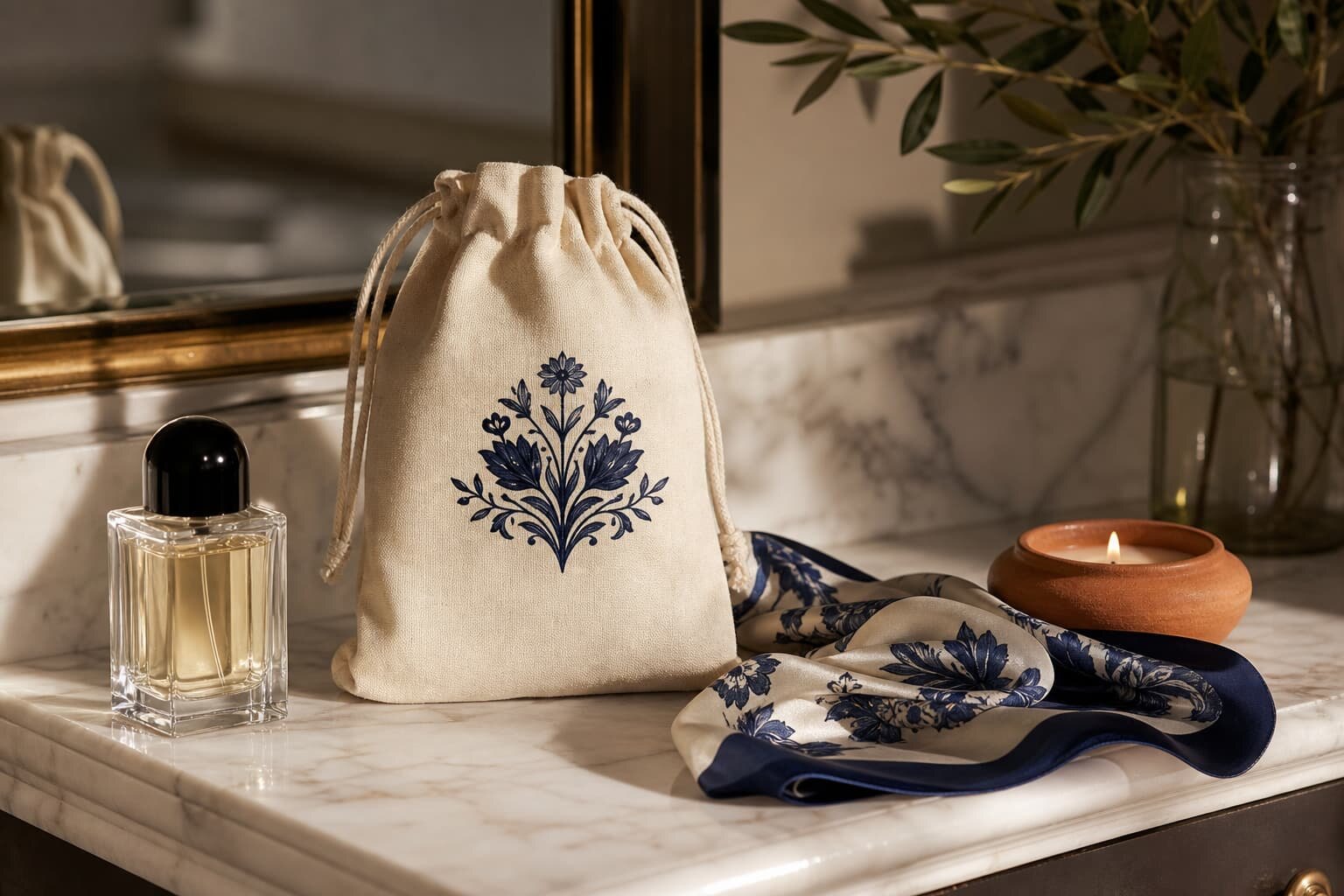
Why Handle Strength Matters on a Drawstring Pouch
For cotton drawstring pouches, the word handle can be misleading. Most pouches do not have a separate sewn handle like a tote bag. Buyers usually mean the drawstring cord, the top channel, and the way the pouch performs when someone lifts it by the cord. That is exactly where many failures happen: the cord is strong enough, but the fabric tears; the fabric is strong enough, but the stitch opens; or the stitch is acceptable, but the cord cuts into a weak exit point.
This matters commercially because drawstring pouches are often used as retail packaging, gift packaging, event kits, cosmetics sets, jewelry bags, or accessory pouches. If the pouch fails after filling, the buyer may face damaged products, store complaints, repacking labor, or urgent replacement costs. A handle strength test guide gives procurement teams a practical way to specify the pouch before quoting, approve the correct sample, and avoid arguing about defects after production is finished.
- Do not test only the cord; test the finished pouch as a complete carrying system.
- Decide whether the pouch is decorative packaging or reusable carrying packaging.
- Use a safety margin above the actual filled product weight.
- Check the top channel and side seam after the test, not only whether the pouch falls.
Define the Real Load Before You Ask for a Quote
A useful RFQ starts with the packed product, not with the pouch size alone. A 15 x 20 cm cotton pouch for jewelry has a very different strength requirement from the same size pouch holding glass cosmetics jars. Buyers should tell the factory the estimated product weight, shape, edge hardness, and whether the end user is expected to carry the pouch by the drawstring. Without that information, suppliers may quote the lightest construction that looks acceptable in photos.
For most procurement teams, the best approach is to set a working load and a test load. The working load is the expected filled weight in real use. The test load is higher, usually with a safety margin, to allow for pulling, swinging, and uneven handling. For example, if the pouch will hold a 400 g skincare kit, the buyer may request a finished pouch test at 1 kg static load. The exact number depends on your product and risk tolerance, but the test requirement should be written clearly before sampling.
- State product weight per filled pouch, including inserts, tissue paper, or retail cards.
- Mention if the product has sharp corners, glass jars, metal parts, or hard packaging.
- Tell the factory whether the pouch is meant for one-time gift packaging or repeated reuse.
- Ask for load testing on the final sample with your selected fabric, cord, print, and stitch method.
Fabric Weight and Construction Affect the Failure Point
Cotton fabric weight is usually quoted in ounces or GSM. Light cotton around 4 oz to 5 oz, roughly 110-140 GSM, can be suitable for dust bags, lightweight gifts, or jewelry packaging. For pouches that may be carried by the drawstring, many buyers move to 5 oz to 6 oz cotton or 8 oz canvas depending on the filled weight. Heavier fabric does not automatically solve every problem, but it gives the top channel and cord exit more material strength.
The fabric weave and finishing also matter. A loosely woven fabric may feel soft but stretch or fray at the seam. A tighter canvas may hold stitching better but make the drawstring harder to close if the top channel is too narrow. Dyed cotton, washed cotton, recycled cotton blends, and brushed fabrics can all behave differently during sewing and testing. This is why the sample should be made from actual bulk fabric, not a convenient stock substitute.
- For very light contents, 140-170 GSM cotton is often enough if sewing is clean.
- For heavier retail kits, consider 220-280 GSM cotton canvas with reinforced stitching.
- Avoid placing high-stress cord holes too close to raw or weak fabric edges.
- Ask for fabric GSM tolerance, because a quoted 180 GSM fabric may vary between batches.
Cord, Channel, and Stitching Are One System
Many buyers focus on cord thickness because it is easy to see. Cord thickness helps, but handle strength depends more on how the cord works with the channel and stitching. A 6 mm cotton cord in a weak single-stitched channel may still tear the pouch. A 4 mm cord in a well-stitched channel with good seam allowance may perform better. The cord should move smoothly without cutting the fabric or forcing the channel to twist.
For commercial orders, ask the factory to explain the top construction. Is the top folded once or twice? Is the channel single stitched or double stitched? Are the side seams overlocked, lockstitched, or reinforced near the cord exit? Are there bar tacks at stress points? These details affect labor time and cost, so they must be discussed before comparing quotes. A cheaper quote may simply remove reinforcement that your product needs.
- Use cotton cord when natural handfeel is important, but confirm shrinkage and colorfastness.
- Use polyester cord when higher abrasion resistance or color consistency is required.
- Keep enough channel height so the cord slides without bunching the fabric.
- Specify reinforcement at the cord exit if the pouch will be lifted repeatedly.
A Practical Handle Strength Test Method for Buyers
A buyer-level test does not need to be complicated, but it must be consistent. Fill the pouch with a test weight that matches your agreed requirement, close the drawstring as a user would, and suspend the pouch by the cord for a set time. After the static hold, inspect the cord, knots, top channel, side seam, bottom seam, and fabric around stress points. If the pouch passes static load but the channel is visibly distorted, that should be recorded as a warning, not ignored.
For reusable packaging, add repeated lift cycles. Lift the pouch by the drawstring, hold for a few seconds, place it down, and repeat. This simulates store handling and customer use better than one strong pull. Some buyers also test one-sided pulling, because users often grab only one cord. The acceptance standard should be practical: no tearing, no open seam, no broken thread, no cord detachment, no serious deformation that prevents closing, and no logo damage caused by stress near the channel.
- Static load example: filled pouch holds the agreed test weight for 30 minutes.
- Cycle test example: 50 to 100 lift cycles using realistic filled weight.
- One-sided pull check: pull one cord end to confirm the channel and seam do not open.
- Post-test inspection: check stitching, fabric tearing, cord fraying, print cracking, and closure function.
Logo Printing Can Change Strength and Appearance
Logo print is not separate from strength testing. Screen printing, heat transfer, digital printing, embroidery, woven labels, and sewn labels each affect the pouch differently. For most cotton drawstring pouches, screen print is a stable and economical choice for simple logos. Heat transfer can give sharp details, but if placed near the top channel or across a fold area, it may crack or peel when the pouch is pulled and closed repeatedly.
Print placement should avoid high-stress areas unless the design requires it. A large print close to the cord channel may look good on a flat sample but distort when the pouch is filled. Embroidery adds thread density and can pucker light fabric, especially below 150 GSM. A side label can look premium, but the seam must still pass the pull test. When approving samples, test the pouch after printing, not before printing, because ink, heat, and stitching order can change performance.
- Ask whether printing is done before sewing or after sewing.
- Keep large prints away from the cord channel if the pouch will be tightly closed.
- Check print cracking after repeated opening, closing, and load testing.
- For natural cotton, confirm whether ink coverage hides fabric flecks or highlights them.
How MOQ and Cost Change with Strength Requirements
MOQ is not only a factory policy. It is affected by fabric sourcing, dyeing, cutting, printing setup, cord color, and sewing complexity. A stock natural cotton pouch may have a low MOQ because the factory already has fabric and cord available. A dyed pouch with custom cord, heavier canvas, double stitching, and multiple logo colors may require higher MOQ or higher unit cost. Buyers should separate MOQ by size, fabric color, cord color, and artwork version to avoid surprises.
Strength requirements can add cost in several places. Heavier fabric increases material cost and carton weight. Wider or thicker cord increases trimming cost. Reinforcement stitching increases sewing time. Testing and sample revisions add development time. These costs are normal when the pouch is expected to carry real products. The procurement mistake is to compare a reinforced quote against a basic promotional pouch quote and treat them as the same specification.
- Material cost drivers: GSM, fabric type, dyed color, cord material, cord diameter.
- Labor cost drivers: double stitching, bar tacks, labels, tight size tolerance, trimming control.
- Print cost drivers: number of colors, print area, ink type, curing requirement, artwork versions.
- Packing cost drivers: individual packing, SKU sorting, carton strength, moisture protection, retail-ready folding.
Sample Approval Should Include Destructive Testing
Many buyers approve drawstring pouch samples based on size, color, and logo only. That is not enough if the pouch will be filled and carried. At least one sample should be tested to failure or to your agreed load requirement. This means the sample may be damaged, and that is acceptable. A damaged tested sample gives better information than a perfect-looking sample stored in a cabinet.
The approval sample should match bulk production materials. If the factory sends a sample from stock fabric but quotes custom dyed fabric for bulk, the strength result may not be valid. If the sample uses a different cord diameter, different thread, or temporary print method, note it in writing and request a corrected pre-production sample before mass production. Sample approval is the right stage to adjust channel width, seam allowance, cord length, and reinforcement before the order becomes expensive to change.
- Keep one visual approval sample and one tested sample with notes.
- Measure finished size before and after load testing.
- Photograph any seam opening, tearing, cord fray, or print cracking.
- Do not approve bulk production until material substitutions are closed.
Packing and Lead Time Can Affect Final Quality
Packing is part of product performance, especially for printed cotton pouches. If pouches are compressed too tightly, the cord may leave pressure marks, the print may crease, and the top channel may arrive deformed. If pouches are packed while not fully dry after printing or washing, odor, moisture, or ink transfer can become a problem. For export orders, ask for carton size, quantity per carton, gross weight, inner packing method, and whether desiccants or moisture protection are needed.
Lead time should be broken into stages: material procurement, sample making, print approval, cutting, printing, sewing, trimming, inspection, and packing. A pouch that requires custom dyed fabric, heavy canvas, or special cord will not follow the same schedule as a stock natural cotton pouch. If your order has a launch date, ask which approvals are on the critical path. Artwork confirmation, fabric color approval, and pre-production sample approval usually control the schedule more than sewing itself.
- Confirm whether pouches are flat packed, folded, bundled, or individually polybagged.
- Avoid heavy carton compression for pouches with thick cotton cord or large prints.
- Ask when strength testing happens: during sample stage, inline inspection, or final inspection.
- Separate sample lead time from bulk production lead time in your purchase plan.
How to Compare Supplier Quotes Without Missing Risk
A strong quote comparison does not start with the lowest unit price. Put each supplier quote into the same specification grid: size, GSM, fabric type, cord material, cord diameter, top channel method, stitch type, print method, packing, MOQ, sample cost, lead time, and test support. If one quote is lower, check whether the supplier omitted reinforcement, used lighter fabric, changed cord material, or assumed simpler packing.
Ask suppliers to confirm what is included and what is only an option. Some factories can quote a basic pouch quickly but need a revised price after seeing the load test requirement. That is better than discovering the issue during inspection. A professional supplier should be able to explain where the pouch may fail and suggest adjustments. For procurement teams, the goal is not to overbuild every pouch; it is to match construction to real use and document the acceptance standard before production starts.
- Compare finished product construction, not only pouch size and logo print.
- Reject vague terms such as thick cotton, strong cord, or standard stitching unless defined.
- Ask for photos or short videos of the finished pouch under load during sample review.
- Include functional defects in the inspection checklist so the factory knows what will be rejected.
Specification comparison for buyers
| Spec decision | Recommended option | When it fits | Buyer risk to check |
|---|---|---|---|
| Fabric weight for small gift pouch | 5 oz to 6 oz cotton, about 140-170 GSM | Jewelry, cosmetics samples, candles, small accessories under light load | Thin fabric may tear at the cord exit if the pouch is overfilled or pulled hard |
| Fabric weight for heavier retail kit | 8 oz to 10 oz cotton canvas, about 220-280 GSM | Skincare sets, glass jars, small tools, reusable retail packaging | Bulkier top channel can become stiff; confirm drawstring closes smoothly |
| Drawstring material | Cotton cord 4-6 mm or flat cotton tape for premium feel | Natural brand positioning, plastic-free packaging requests, soft handfeel | Cotton cord can shrink or twist after washing; check colorfastness and diameter tolerance |
| Cord channel construction | Folded top channel with double stitching or bar tack at stress points | Reusable pouch, buyer expects repeated opening and carrying | Single stitch may look acceptable on samples but fail during drop or pull test |
| Logo print method | Screen print for solid logos; heat transfer only after pull and rub check | Most brand logos on natural or dyed cotton pouches | Heavy ink or transfer film near the top channel can crack when fabric is pulled |
| Strength test method | Static load hold plus repeated pull test on finished sample | RFQ stage, sample approval, pre-shipment inspection | Testing fabric only is not enough; cord, stitching, and seam must be tested together |
| Packing method | Flat packed or bundled with cord laid straight; avoid over-compressed cartons | Export cartons for promotional, retail, or distribution orders | Tight compression can deform cord, crease prints, and hide weak top-channel stitching |
| MOQ logic | Separate MOQ by fabric color, cord color, print color, and pouch size | Buyers comparing multiple artwork or SKU variants | A low headline MOQ may increase unit cost if each SKU needs separate cutting, printing, and sewing setup |
Buyer checklist before sampling
- Define the expected load: product weight, number of items inside, and whether users will carry the pouch by the drawstring.
- State finished pouch size, fabric GSM or ounce weight, fabric type, cord diameter, cord material, and cord color.
- Ask the factory to test the finished pouch, not only raw fabric or loose cord.
- Include minimum load and test duration in the RFQ, for example static load for 30 minutes plus repeated lift cycles.
- Check the cord exit, top channel stitching, side seam, and bottom corners after testing for tearing, loose thread, seam slippage, or distortion.
- Approve a pre-production sample using the same fabric, cord, print, stitching, and packing method planned for bulk.
- Confirm whether logo position or print coverage weakens the top channel or seam area.
- Request carton packing details, including pieces per polybag or bundle, carton size, gross weight, and whether cords are tied or left loose.
- Separate acceptable cosmetic issues from functional failures in your inspection standard.
- Keep one signed approval sample and one tested sample for comparison during production inspection.
Factory quote questions to send
- What fabric weight and construction are you quoting: plain cotton, cotton canvas, recycled cotton, or brushed cotton, and what is the GSM tolerance?
- What cord material, diameter, and end treatment are included in the price?
- Is the top channel single stitched, double stitched, overlocked, or reinforced with bar tacks?
- What load test can you perform on the finished pouch, and how many samples will be tested before bulk shipment?
- Will the quoted sample use the same fabric, cord, thread, print method, and sewing method as bulk production?
- Does the logo printing process happen before or after sewing, and can print placement affect seam strength?
- What is the MOQ by size, fabric color, cord color, and print design?
- What are the main cost drivers if we increase GSM, change cord diameter, or add reinforcement stitching?
- What production lead time applies after sample approval and deposit, and what artwork or material approvals can delay it?
- What packing method is included in the quote, and can cartons safely hold the order without crushing cords or creasing prints?
Quality-control points to confirm
- Measure finished pouch size after sewing and compare with approved tolerance, especially width near the cord channel.
- Weigh fabric or confirm GSM certificate against actual handfeel and thickness from production samples.
- Pull both drawstrings evenly and separately to check whether the channel twists, tears, or opens at the seam.
- Inspect bar tacks, backstitches, and thread tension at cord exit points and side seams.
- Perform static load testing with realistic product weight plus safety margin, then check for seam slippage.
- Run repeated open-close and lift cycles to simulate retail use, not just a single laboratory pull.
- Check logo print adhesion, cracking, rub resistance, and distortion after the strength test.
- Confirm cord length consistency, knot security, and whether cord ends fray after handling.
- Review carton packing for compression, moisture protection, and mixed-SKU separation.
- Record failures by defect type so the factory can correct sewing method, not only replace individual pieces.