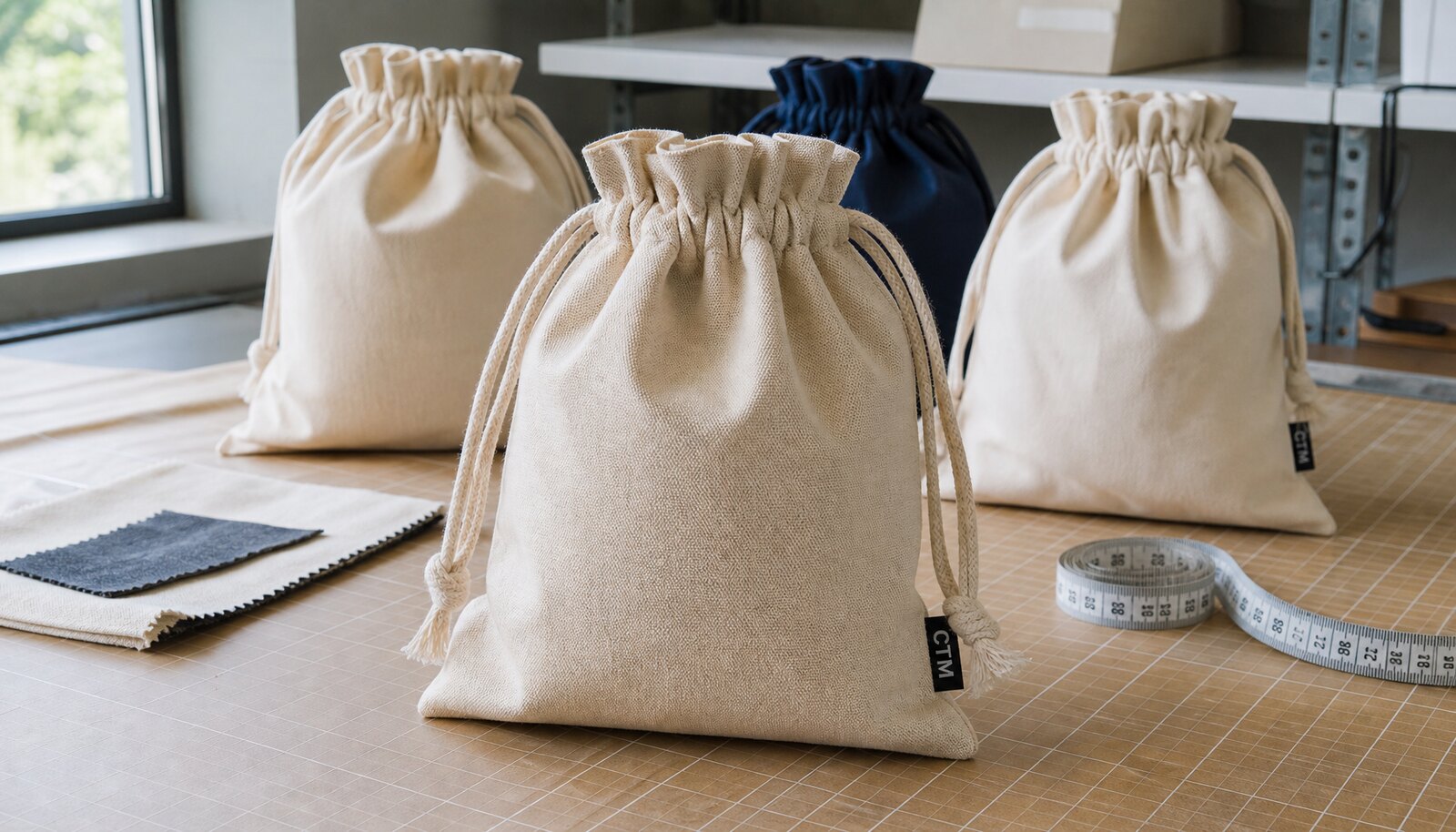
Start With the Buying Use Case
A cotton drawstring pouch only looks simple from a distance. In bulk buying, quality is really about whether the pouch protects the item inside, keeps its shape after handling, and arrives with the branding the buyer approved. A pouch for jewelry samples, for example, can survive on a lighter cloth and a narrow cord. A pouch for heavier accessories, bottled kits, or retail resale needs a firmer handfeel, stronger stitching, and more control over print placement. If the factory does not know the use case, it will usually optimize for the easiest sewing method, not the most reliable product.
Before you request quotes, lock down the few details that drive factory decisions: finished size, target load, closure style, print area, and packing format. Do not ask for a cotton pouch quote without saying whether it will carry one small item or a multi-piece kit. A good RFQ gives the supplier enough information to price fabric, labor, printing, and packing on the same basis. That is the only way to compare vendors without guessing why one quote is lower than another.
- State the end use, not just the pouch shape.
- Give the item weight or the kit contents the pouch must hold.
- Specify whether the pouch is for retail, promotion, storage, or shipping.
- Ask the factory to quote the same size, fabric, print, and pack format across all suppliers.
Choose Fabric Weight Before You Compare Price
For cotton drawstring pouches, GSM is one of the first numbers that should be on the quote. Around 100-120 GSM works for light promotional use, inserts, jewelry, or very soft gift packaging. The more common retail range is 140-180 GSM, which gives a better balance of drape, opacity, and sewing stability. If the pouch must feel more substantial or carry a heavier product, 180-220 GSM is safer, but the material will cost more and the pouch may become stiffer. Do not let a supplier quote only on look and feel. Ask for the exact GSM, fabric width, and whether the weight is based on finished cloth or greige cloth.
Fabric finish matters almost as much as weight. Natural unbleached cotton gives a casual look and can be cost-effective, but it may show more batch variation. Bleached cotton offers a cleaner print surface and more predictable color appearance. If the design uses fine artwork or tight logo registration, a smoother weave is easier to print on than a loose, slubby cloth. For buyers worried about shrinkage, request a prewashed or pre-shrunk fabric option, then ask the factory to state the expected dimensional change after washing or steam pressing. A quote that omits this is not complete enough for procurement.
- 100-120 GSM: light promotional pouches and low-load items.
- 140-180 GSM: the usual retail sweet spot for most buyers.
- 180-220 GSM: heavier contents, premium feel, more structure.
- Ask for fabric swatches and a GSM tolerance range before approval.
Build the Closure for Repeated Use
A weak closure is the fastest way to turn a cheap-looking pouch into a complaint. The drawstring channel should be wide enough for the cord to move freely, but not so loose that the top collapses or wrinkles. In most bulk programs, a 2.5-4 mm cord works well, with the right choice depending on pouch size and contents. If the pouch will be opened and closed many times, a double-cord design usually feels smoother and spreads wear better than a single thin cord. The top hem, channel seam, and corner reinforcement matter more than many buyers realize, because that is where the pouch fails first.
Ask the supplier how the cord ends are finished and how the stress points are reinforced. A clean inside knot is not enough if the stitching is weak or the hem width is too narrow. Good factories will show the stitch plan: hem width, bar tacks, seam allowance, and the exact point where the cord exits the channel. If a pouch has to hold something with a little weight, request a pull test or at least a sample check where the pouch is loaded and opened repeatedly. This is a simple way to catch a design that looks fine on paper but fails in use.
- Check cord diameter, finish, and whether the ends fray after repeated pulls.
- Ask for reinforced corners or bar tacks on larger or heavier pouches.
- Confirm the channel width so the cord does not bind.
- Do not approve a sample until the opening action feels smooth and balanced.
Match the Print Method to the Artwork
The best print method is the one that fits the artwork and the order volume, not the one that sounds most premium. For a simple logo with one to three solid colors, screen print is usually the most practical option on cotton. It handles repeat orders well, keeps unit cost under control, and gives a crisp result when the screen is prepared correctly. For complex graphics, small text, or gradient artwork, the factory may suggest heat transfer or another decoration method, but buyers should test it carefully on cotton because rough fabric can expose poor adhesion or edge lifting after handling.
If the logo is small or the pouch needs a cleaner look, a woven side label can be better than heavy ink coverage. It avoids print misalignment, gives a more finished feel, and is often easier to repeat from one batch to the next. Whatever method you choose, write down print position, size, color count, and acceptable placement tolerance. Also ask how the factory checks curing and rub resistance. A pouch that looks good in the first photo can still fail if the ink smears, cracks, or sits too thick on the cloth.
- Use screen print for simple logos and repeat bulk orders.
- Use a woven side label when you want branding without heavy ink coverage.
- Ask whether the quote includes one color, multiple colors, or multiple positions.
- Require a dry rub check and a placement tolerance on the approved sample.
Define Size the Way the Buyer Uses It
One of the most common sourcing mistakes is treating size as a single number. A factory may quote cut size, finished size, or flat size, and those are not the same thing. For procurement, the useful number is finished size, plus a tolerance that still protects the product inside. For smaller pouches, plus or minus 0.5 cm is a reasonable starting point. For larger pouches, plus or minus 1 cm may be acceptable if the contents still fit correctly. The supplier should also state seam allowance, because that affects usable space and the final appearance of the pouch.
Capacity matters more than catalog dimensions. A pouch that is technically wide enough may still be awkward if the opening is too tight, the top hem is too bulky, or the cord reduces the usable neck height. Ask the factory to test the actual product or kit inside the sample, then photograph the filled pouch from the front and side. That gives you a far better quality check than a flat lay image. If the pouch is meant for cosmetics, tea samples, accessories, or event packs, the RFQ should say which object is the fit reference so the factory knows what the dimensions are meant to do.
- Write finished size, not just approximate size.
- Ask the supplier to state cut size and seam allowance separately.
- Set a tolerance that still allows the item to fit and close properly.
- Use the real contents as the fit reference whenever possible.
Read the Quote Like a Factory Engineer
A good pouch quote is not just a unit price. It should show fabric GSM, fabric width, cord type, print method, sample cost, setup charges, carton format, and lead time. If any of those pieces are missing, the supplier may be assuming details that will later become extra charges. Procurement teams should separate one-time costs from repeat costs. Screen setup, artwork preparation, woven labels, or special packing may add upfront expense, but they do not always affect the repeat unit price in the same way. If the quote is vague, ask for a line-by-line breakdown before you compare suppliers.
MOQ logic usually follows setup logic. A quote for a natural cotton pouch with a single-color screen print can often be lower in MOQ than a custom-dyed pouch with multiple print positions and a woven label. The more custom items the order needs, the more likely the factory will ask for a higher minimum or a different price tier. Compare on landed logic, not just ex-factory logic. If one quote excludes cartons, polybags, or printing screens, it may only look cheaper at first glance. Ask the supplier to show what is included and what would be extra if you re-order the same style.
- Require a line-item quote, not a single lump sum.
- Separate setup fees from repeat production costs.
- Check whether cartons, labels, and inner packs are included.
- Compare MOQ against the exact combination of size, color, and print method.
Use Samples to Catch Problems Before Bulk
A pre-production sample is the most useful quality tool in a cotton pouch order because it translates the RFQ into something you can touch, measure, and inspect. The sample should show the agreed fabric, cord, print placement, label position, and packing method. If the sample looks close but not exact, do not assume bulk will be corrected automatically. The sample is the factory's reference for the entire run, so if you approve a weak sample, you are approving the risk with it. A golden sample should be signed and dated by both sides and held as the final standard for measurements and appearance.
Buyers should inspect both appearance and function. Check the print under bright light, pull the cord several times, inspect the seams inside and outside, and verify that the dimensions match the spec sheet. If the pouch uses a woven label, make sure the label size and stitching are clean, not twisted, and not too close to the drawcord opening. If changes are needed, send them in writing and request a revised sample. That is much safer than relying on verbal notes that disappear once production starts.
- Approve one signed golden sample and keep it with the PO file.
- Check measurements, print, cord length, and label placement on the same sample.
- Test function by opening and closing the pouch several times.
- Record every change in writing before bulk production begins.
Protect the Pouch in Packing and Cartons
Cotton pouches can arrive looking messy even when the sewing is fine, because folding and packing affect the final appearance. Flat folding saves space and helps export efficiency, but the fold direction should not crush the print or leave a hard crease across the logo. If the order is for retail distribution, ask the factory how they control fold position, label facing, and unit presentation. Inner polybags are not always necessary, but they help when moisture, dust, or mixed handling could stain or wrinkle the pouch before it reaches the buyer's warehouse.
Carton details should be part of the spec, not an afterthought. State units per inner bag, inner bags per carton, gross weight target, carton dimensions, and whether each carton needs size labeling or a master carton mark. Overpacked cartons can crush cords and distort the pouch shape. Underpacked cartons may waste freight space and increase handling cost. If the pouch will ship with other SKUs in a mixed program, ask for packing that keeps sizes and print versions separated so receiving teams can count and sort quickly.
- Define the folding direction so the print does not crease.
- Use inner polybags if moisture or dust could affect the product.
- Write the carton count and gross weight target into the PO.
- Confirm carton marks, barcode labels, and size separation before shipment.
Plan Lead Time Around Approval Gates
Lead time for cotton drawstring pouches depends on how many inputs are standard and how many are custom. If the factory is using stock cotton fabric, a standard cord, and a single-color print, the order can move faster than a program that needs custom dyeing, special labels, or revised packing. The timeline should start after artwork, sample approval, and packaging specs are locked. If a supplier gives a blanket lead time before those approvals, the number is only a rough estimate. Procurement teams should ask for a phase-by-phase schedule instead of a single promise date.
A realistic process usually moves through material confirmation, sample production, sample approval, bulk cutting and sewing, print application, final inspection, and packing. Each step can be delayed by missing artwork, late trim approval, or a change in packing count. That is why buyers should ask what can stop the line. The answer tells you where the risk is. If the factory says artwork and label approval are the only bottlenecks, the order is easier to control. If they cannot explain the sequence, the schedule may be too loose to manage.
- Start the clock after sample and artwork approval, not at inquiry stage.
- Ask for milestone dates for fabric, sample, bulk sewing, and packing.
- Confirm which inputs are long lead: fabric, cord, labels, or cartons.
- Treat any lead time given before approval as provisional.
Use One RFQ Sheet to Eliminate Guesswork
The best way to compare cotton drawstring pouch suppliers is to send every factory the same RFQ sheet and insist on the same answer structure. If one buyer message asks for price only, another asks for dimensions, and a third asks for a sample photo, the quotes will never line up. The real job is not to collect more quotes. It is to collect comparable quotes that reveal who understands the product and who is just guessing. Good factories answer with specific fabric, stitch, print, and packing details because they know those details control both quality and cost.
When quotes come back, push back on vague wording. Standard material, normal size, usual packing, and similar wording are red flags because they hide assumptions. Ask the supplier to restate the spec in their own words so you can see whether they understood the order correctly. If they cannot repeat the critical details, they are not ready for bulk. Use the buyer checklist, ask the quote questions, and keep the golden sample attached to the order file. That workflow is more useful than chasing the lowest number.
- Send one RFQ sheet to every supplier.
- Reject vague quote language that leaves room for interpretation.
- Use the same sample and acceptance standard for every factory.
- Choose the supplier who gives the clearest spec discipline, not only the lowest price.
Specification comparison for buyers
| Spec decision | Recommended option | When it fits | Buyer risk to check |
|---|---|---|---|
| Fabric weight | 140-180 GSM natural or bleached cotton | Most retail pouches, gift sets, accessory kits, and sample packs | Ask whether GSM is measured on finished fabric and whether shrinkage is controlled |
| Cord build | 2.5-4 mm cotton cord with reinforced channel | Frequent open-close use and pouches holding moderate weight | Check cord fray, pull feel, and whether the cord ends are knotted or securely finished |
| Print method | One- to three-color screen print | Simple logos and repeat bulk orders | Verify curing, rub resistance, and print position tolerance |
| Branding option | Sewn woven side label | Premium look, low-ink art, or when print area is small | Confirm label size, stitch color, and orientation |
| Finished size control | Finished dimensions with a stated tolerance | When the pouch must hold a specific product or kit | Avoid quotes that only mention cut size or approximate size |
| Packing format | Flat folded in inner polybags, then master cartons | Export shipments and retail distribution | Check creasing, moisture protection, and carton count |
Buyer checklist before sampling
- Finished size, seam allowance, and tolerance are written on the RFQ.
- Fabric weight, weave type, and finish are approved before bulk quoting.
- Cord material, diameter, and closure style are specified.
- Print method, number of colors, and artwork placement are confirmed.
- A pre-production sample is approved against a signed golden sample.
- MOQ is clear for each size, color, and print combination.
- Packing format, inner pack count, and carton marks are defined.
- Lead time starts only after sample and artwork approval.
- Change requests are logged in writing, not handled over chat only.
- Inspection method and acceptance criteria are agreed before the PO.
Factory quote questions to send
- What is the exact fabric GSM, and is it based on greige fabric or finished fabric?
- What is the finished size, cut size, and allowed tolerance after sewing?
- What cord material, cord diameter, and cord finishing method are included?
- What print method, ink type, color count, and print positions are included in the quote?
- Does the quote include screens, plates, woven labels, or setup charges?
- What is the MOQ per color, size, and artwork version?
- Is the sample fee refundable or credited against bulk production?
- What packing method is included, and how many units go into each inner pack and carton?
- What lead time is based on approved sample, approved artwork, and available fabric?
- What inspection standard or acceptance check do you use before shipment?
Quality-control points to confirm
- Measure finished length and width on random units from each lot against the approved tolerance.
- Weigh or verify fabric batch consistency so the delivered cloth matches the agreed GSM range.
- Check the cord for smooth pull, equal exit length, and fraying at the cut ends.
- Inspect top hems, side seams, and bar tacks for skipped stitches, loose threads, and weak points.
- Confirm print placement, color density, and rub resistance against the golden sample.
- Check label size, orientation, and stitching security if the pouch uses a woven side label.
- Open and close each sample repeatedly to see whether the channel collapses or twists.
- Review inner pack count, carton count, and master marks before shipment release.