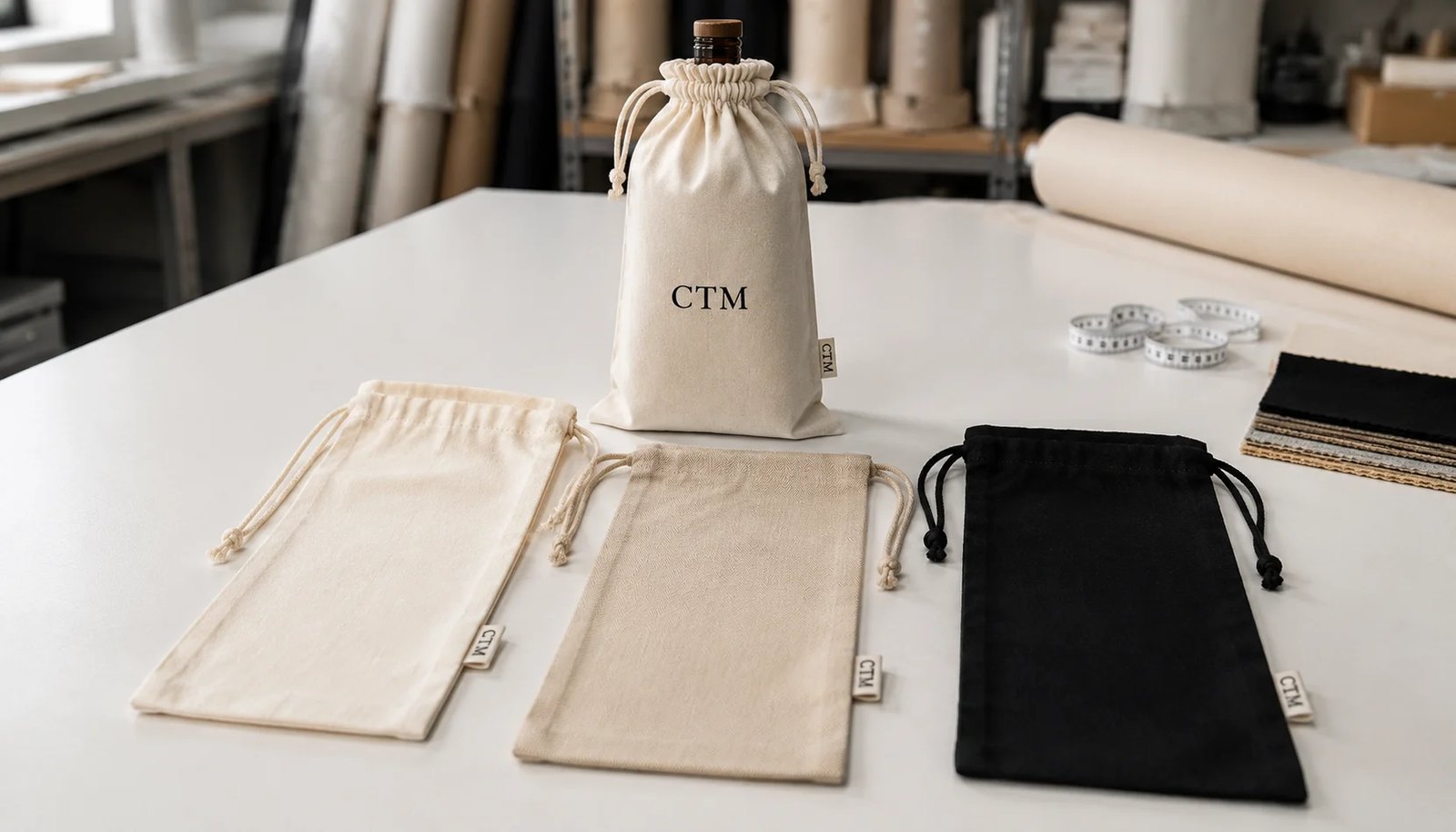
The core buying problem: fabric weight changes both presentation and damage risk
For liquor retailers, a cotton drawstring pouch is usually expected to do two jobs at the same time: make the bottle look more giftable and survive handling from packing line to shelf to customer carry-out. Fabric weight is the variable that most buyers underestimate. A pouch that looks acceptable as a flat swatch can fail once a full glass bottle is inserted. Common failure points are bottle shoulder show-through, bottom seam strain, wrinkled branding, and poor closure shape around the neck.
The wrong GSM also distorts quote comparisons. One supplier may price a 140 GSM cotton sheeting pouch, another may quote 240 GSM cotton canvas, and both may label the item simply as cotton drawstring pouch. The unit price gap may look large, but the specifications are not equivalent. For liquor retail use, fabric weight needs to be chosen around bottle type, shelf presentation, handling frequency, and shipping economics rather than by unit price alone.
- Low GSM reduces cost but increases transparency, wrinkling, and seam stress
- Mid-range GSM often gives the best balance for standard 750 ml bottles
- Higher GSM improves structure and premium feel but raises fabric, print, and freight cost
- Comparing quotes without the same GSM and construction leads to false savings
How to choose GSM by bottle format instead of by generic pouch category
A useful starting point is to classify the actual bottle, not the product line name. A slim wine bottle, a broad-shouldered whisky bottle, and a short premium gin bottle can all require different pouch proportions and stress points even if they hold similar volume. For most 750 ml standard-format liquor bottles, 200-220 GSM cotton canvas or dense cotton sheeting is a practical base level. It provides enough body for better print appearance and enough seam stability for normal retail handling.
For lower-volume formats such as mini bottles or tasting kits, 120-160 GSM may be acceptable when the pouch is mostly decorative and not expected to conceal the bottle shape. For heavier premium bottles, embossed glass, or gift programs that need a more substantial hand feel, 240-280 GSM performs better. Above that range, the pouch can start to feel bulky relative to the product and may waste freight space unless the premium positioning clearly supports it.
- 50 ml to 200 ml minis: often 120-160 GSM if cost-sensitive and non-premium
- 375 ml bottles: usually 160-210 GSM depending on bottle width and gifting level
- 750 ml standard bottles: commonly 200-220 GSM as the balanced commercial range
- Heavy glass premium bottles: often 240-280 GSM with stronger bottom seam construction
- Magnum or extra-tall formats: size and seam engineering matter more than GSM alone
Fabric construction matters as much as GSM
Buyers often specify GSM but not weave or construction. That creates room for supplier substitution. A 210 GSM open-weave cotton can behave very differently from a 210 GSM tighter cotton canvas. In liquor packaging, weave density affects opacity, print edge quality, seam holding, and how the pouch drapes around the bottle. Tighter constructions usually present better on shelf and provide a more stable surface for screen printing.
If the pouch will be dyed dark or carry a fine logo, construction becomes even more important. Loose fabrics can create fuzzy print edges and more visible weave gaps. For a practical RFQ, specify both GSM and fabric type, such as 210 GSM cotton canvas, or request supplier samples in two or three constructions at the same nominal weight. That makes approval decisions based on actual retail performance rather than on mill wording.
- Specify cotton sheeting vs cotton canvas, not just cotton
- Tighter weave generally gives cleaner logo edges
- Loose weave may feel softer but can show bottle contour more clearly
- Fabric finish affects shrinkage, hand feel, and final measured GSM
- For repeat orders, keep approved swatches against future lots
Print method should be selected with the fabric, not after it
Many pouch problems start when artwork is approved before the fabric is fixed. One-color screen print is the standard commercial option for liquor pouches because it is cost-effective, scalable, and durable on cotton. It works best on 180 GSM and above, where the surface is stable enough to carry a cleaner print. Fine serif logos, distressed artwork, and small text will all look different on 140 GSM sheeting compared with 240 GSM canvas.
Heat transfer can help when the artwork has more detail or tonal variation, but it adds process cost and can feel less natural on soft cotton if the transfer area is large. Woven labels or sewn patches are often better for premium gift programs because they avoid ink opacity issues on dark fabrics and keep branding consistent across batches. The tradeoff is extra trim MOQ and more sewing steps.
- One-color screen print: best value for most large-volume programs
- Two-color print: feasible, but registration tolerance must be defined
- Heat transfer: useful for detailed artwork, but test cracking and hand feel
- Woven label: stable branding option for dark or textured fabrics
- Embroidery: usually unnecessary for liquor pouches unless premium positioning justifies cost and slower output
MOQ logic: what really drives small-order penalties
Procurement teams often assume MOQ is only a sewing issue. In reality, pouch MOQ is usually set by fabric color, printing setup, and trim preparation. A factory may be able to sew a few hundred pieces efficiently, but if the order needs custom-dyed black fabric, a custom cord color, and a special woven label, the true economic MOQ rises fast. For natural cotton with one-color print and standard cord, low MOQs are more achievable because the factory can use stock greige or common base material.
This matters for liquor retailers running seasonal campaigns, store-group exclusives, or region-specific branding. Splitting one order into several colors or artwork versions may push each variant below the practical print or dye minimum. A better commercial structure is often one common pouch body with a shared fabric color and one changed branding element, such as a small label or hangtag applied later.
- Natural cotton usually supports lower MOQs than custom-dyed colors
- Large print area increases setup sensitivity on small runs
- Custom cords and labels create separate trim MOQs
- Variant-heavy programs often become expensive even when total units look sufficient
- Consolidating size or color can lower waste and speed approval
Sample approval should test fit, opacity, and seam behavior with the real bottle
A flat approval sample is not enough for this product. The pouch must be evaluated with the exact bottle shape, including closure, neck foil, and any neck tag. Many pouches pass visual review when empty but distort badly once loaded. Shoulder corners can pull on the side seams, the bottle base can spread the pouch width beyond the intended silhouette, and the drawstring may sit too low to close neatly around a taller stopper or cap.
A proper approval sequence usually includes a fabric swatch, print strike-off, fit sample, and then a pre-production sample from bulk-intended materials if timing allows. For dyed fabrics, review the sample under store lighting because black and navy can shift in appearance. For lighter fabrics, decide whether bottle shape visibility is acceptable before bulk starts. This is a presentation issue, not just a quality issue, and should not be left vague.
- Insert the actual filled bottle into the sample, not a similar size bottle
- Photograph front, side, and closed-neck views for approval record
- Review whether the bottom sits flat or creates seam tension
- Test drawstring closure with staff wearing normal retail handling gloves if relevant
- For dark dyed pouches, rub with a white cloth to detect early crocking risk
Packing decisions affect wrinkles, handling speed, and warehouse accuracy
Packing is often treated as a shipping detail, but for drawstring pouches it affects retail readiness and labor cost. If the pouches will be inserted over bottles at a bottling facility or retail assembly site, flat-packed bulk cartons usually work best. They reduce volume and speed line-side loading. However, cords can tangle if folded carelessly, and heavy compression can leave hard creases that make the pouch look cheap when first applied.
If the pouches are for premium gifting or direct dispatch kits, lighter inner packing control may be worth the added material and labor. The decision should be tied to your receiving and fulfillment workflow. A pouch packed in a small individual polybag may arrive cleaner, but the unpacking labor and waste disposal can outweigh the benefit. For many buyers, a compromise is inner bundles with size and quantity labeling, moisture protection in the carton, and no individual bag.
- Request fold method images if presentation on arrival matters
- Define pieces per bundle and bundles per carton for faster warehouse counting
- Keep carton gross weight practical for manual handling
- Use desiccant or poly liner when shipping in humid seasons or long ocean transit
- Label cartons by SKU, color, size, PO, and carton sequence
Lead time risk is usually in fabric and approval loops, not sewing alone
Simple cotton pouches sew quickly. Delays usually come earlier in the process: fabric booking, dyeing, print strike-off approval, and waiting for fit confirmation against the real bottle. This is why procurement teams should separate lead time into stages instead of accepting one blanket number. If a supplier says 30 days, that may not include lab dips, revised sample rounds, or waiting for branded trim.
Liquor retail programs often have non-movable seasonal windows, especially before year-end gifting periods. The practical way to reduce schedule risk is to freeze the bottle dimension, artwork, and color target early. Repeated late changes to size or print placement create hidden delays because patterns, screens, and packing counts all need adjustment. For repeat orders, keeping the same pouch body and only updating printed campaign wording is much safer than introducing a new dyed color close to ship date.
- Separate lead time into material, sample, print setup, production, and inspection stages
- Dyed fabric usually adds more schedule risk than natural fabric
- Premium trims can become the longest-path item on a simple pouch order
- Late bottle changes can invalidate approved pouch dimensions
- Build time for final inspection and rework, especially on dark printed styles
Cost comparison should include landed cost and failure cost, not ex-factory price only
A lower ex-factory quote on 150 GSM may look attractive until you factor in more pieces per damaged batch, weaker shelf presentation, and the possibility of re-packing when bottles show through or seams fail. On the other hand, over-specifying 280 GSM for a basic promotional pouch can unnecessarily increase material cost, ink usage, and freight volume. The correct decision is usually a commercial middle ground, supported by actual use conditions.
When comparing quotes, build a simple landed-cost sheet that includes unit price, expected print cost, carton quantity, cubic volume, gross weight, and defect exposure. Heavier fabric reduces pieces per carton and may increase ocean freight allocation. But if the pouch is customer-facing and tied to premium bottle presentation, the higher GSM can still be the cheaper choice overall because it reduces retail complaints and supports higher perceived value.
- Compare total cost per usable packed unit, not only factory unit price
- Include freight effect from carton count and CBM differences across GSM options
- Estimate waste or downgrade risk for lighter, more transparent fabrics
- Factor line-side handling speed if pouches are inserted during bottling or gift assembly
- Use two or three realistic bottle programs when benchmarking supplier quotes
The safest RFQ format for liquor pouch sourcing
A strong RFQ for this item should remove the ambiguity that causes most quote variation. Start with bottle dimensions and target use case, then define the pouch size, fabric weight range, construction, color, print method, and packing. If you are not sure whether 200 GSM or 240 GSM is right, request both options on the same quote form. That forces suppliers to compare like with like and reveals who is pricing honestly versus who is quietly changing the spec to win on headline price.
The RFQ should also state the quality points that matter commercially. For example, if bottle show-through is unacceptable, say so. If slight natural cotton shade variation is acceptable but logo placement must stay centered within a tight tolerance, state that too. Suppliers respond better to clear acceptance criteria than to generic requests for high quality.
- Bottle size and shape: height, widest body width, shoulder width, neck closure details
- Pouch finished size: width, height, useful inner dimensions if critical
- Fabric: cotton canvas or sheeting, target GSM, color requirement
- Branding: print method, print size, artwork colors, placement tolerance
- Construction: seam type, cord type, channel style, reinforcement requirement
- Packing: pieces per bundle, per carton, labeling, moisture protection
- Commercial terms: MOQ by color and artwork, sample cost, lead time by stage
Specification comparison for buyers
| Spec decision | Recommended option | When it fits | Buyer risk to check |
|---|---|---|---|
| 120-140 GSM cotton | Use only for promo gift pouches holding mini bottles or accessories, not standard 750 ml glass | Best when low unit cost matters more than structure and the pouch is secondary outer packaging | High show-through, easier wrinkling, weaker seam margin under bottle corners, print may look uneven on open weave |
| 150-180 GSM cotton | Entry-level retail pouch for light-duty use with standard bottle height and soft handling | Suitable for seasonal liquor gift sets, tasting events, and short shelf life programs | Bottle silhouette still visible on lighter colors, base seam stress rises if width allowance is tight |
| 200-220 GSM cotton | Most balanced choice for 750 ml liquor pouches with screen print or heat transfer branding | Fits many retail and distributor programs needing acceptable opacity, clean stitching, and manageable freight | Cord channel bulk increases slightly, panel shrinkage can affect final size if prewash is not specified |
| 240-280 GSM cotton canvas | Preferred for premium shelf presentation, repeated handling, and stronger body | Good for wine, whisky, tequila, and gift-ready packaging where the pouch itself supports perceived value | Higher fabric cost, more ink deposit needed on dark colors, carton count per CBM drops |
| Natural cotton with one-color screen print | Most economical branded option with stable lead time | Works for simple logos, vintage-style branding, and medium to large volume orders | Natural fabric shade varies lot to lot, so logo contrast and retail color expectations must be aligned by approved sample |
| Dyed black or deep color pouch with discharge look avoided | Use pigment or water-based screen print only if artwork coverage is practical | Best for premium spirits where dark pouch color improves shelf look and hides bottle shape | Color migration, crocking, and logo sharpness need wash and rub tests; white print opacity may require second pass |
| Cotton cord drawstring | Standard and cost-effective for most liquor pouch programs | Suitable when the pouch opens and closes occasionally and the bottle is not carried long distances by the cord | Cord fraying, knot pull-out, and inconsistent cord length are common mass-production issues |
| Herringbone tape or thicker braided cord | Upgrade for premium gift presentation and heavier bottle weight | Useful for heavy glass bottles, embossed branding, or higher-end retail gifting | Adds trim MOQ, slows assembly slightly, and may create carton bulk if not packed flat |
| Individual polybag omitted, master-carton flat pack | Recommended when the pouch is inserted at bottling or gift assembly site and sustainability matters | Good for importers able to handle clean dry warehouse conditions and faster unpacking | Dust control, moisture exposure, and carton abrasion become more important if no individual protection is used |
Buyer checklist before sampling
- Match pouch finished size to actual bottle dimensions including shoulder width, cap height, and any neck tag or closure wrap.
- Specify fabric weight in GSM and fabric type in plain language, such as 210 GSM cotton canvas, not just cotton pouch.
- State whether the pouch must hide the bottle outline on shelf or only protect from scratching during gifting.
- Define print method early: one-color screen print, heat transfer, woven label, or sewn patch, because artwork detail affects fabric choice.
- Request body, side seam, and drawstring channel construction details, including seam allowance and reinforcement if bottle weight is above standard wine weight.
- Approve a pre-production sample with the real bottle inserted, not a flat pouch sample only.
- Set acceptable size tolerance for width and height after sewing and, if dyed, after fabric finishing shrinkage.
- Confirm whether cords should be cotton, polyester, braided, twisted, or herringbone tape, and whether knot ends or metal tips are allowed.
- Define packing method by unit, inner pack, and master carton count based on your warehouse receiving process.
- Review freight efficiency: heavier GSM may improve retail presentation but reduce pieces per carton and raise landed cost.
Factory quote questions to send
- What exact fabric construction are you quoting: cotton sheeting, cotton canvas, or cotton-linen blend, and what is the finished GSM tolerance?
- Is the quoted GSM measured before dyeing and finishing or on finished fabric ready for cutting?
- What pouch size are you basing the quote on, and what bottle dimensions does that size realistically fit?
- What print method is included in the price, how many colors, and what print area is assumed?
- Does the quote include a strike-off, pre-production sample, and fit sample with real bottle loading photos?
- What is the MOQ by fabric color, by size, and by logo artwork version?
- Are drawstrings included as standard cotton cord, and what upgrade cost applies for braided cord, herringbone tape, or custom dyed cord?
- What seam construction is standard, and do you recommend reinforcement at the bottom corners for heavy glass bottles?
- How many pieces per export carton, what is the carton size and gross weight, and how does that change across GSM options?
- What lead time applies for lab dips, sample approval, bulk fabric booking, printing, sewing, and final inspection separately?
Quality-control points to confirm
- Finished size tolerance should be defined by width and height, with special attention to useful inner width after seams are sewn.
- Fabric GSM should be tested on finished material, not only mill declaration, especially when comparing supplier quotes.
- Fabric opacity and bottle show-through should be reviewed under retail lighting for light colors and lower GSM constructions.
- Bottom seam strength must handle the real filled bottle weight without seam grin, distortion, or thread breakage.
- Drawstring channel stitching should be straight and secure, with no skipped stitches at the opening ends.
- Cord length variation should be controlled so paired pouches close evenly and present consistently at retail.
- Print adhesion, sharpness, and color coverage should be inspected on the actual pouch fabric texture, not on paper proof only.
- Dyed pouches should be tested for crocking and color transfer, especially black, red, and navy shades used in premium liquor packaging.
- Needle detection or metal control procedure should be defined if the pouches will be packed near open bottle gift components or food-adjacent retail sets.
- Carton packing should keep pouches flat, dry, and free from cord tangling, oil marks, and compression wrinkles that affect first shelf appearance.