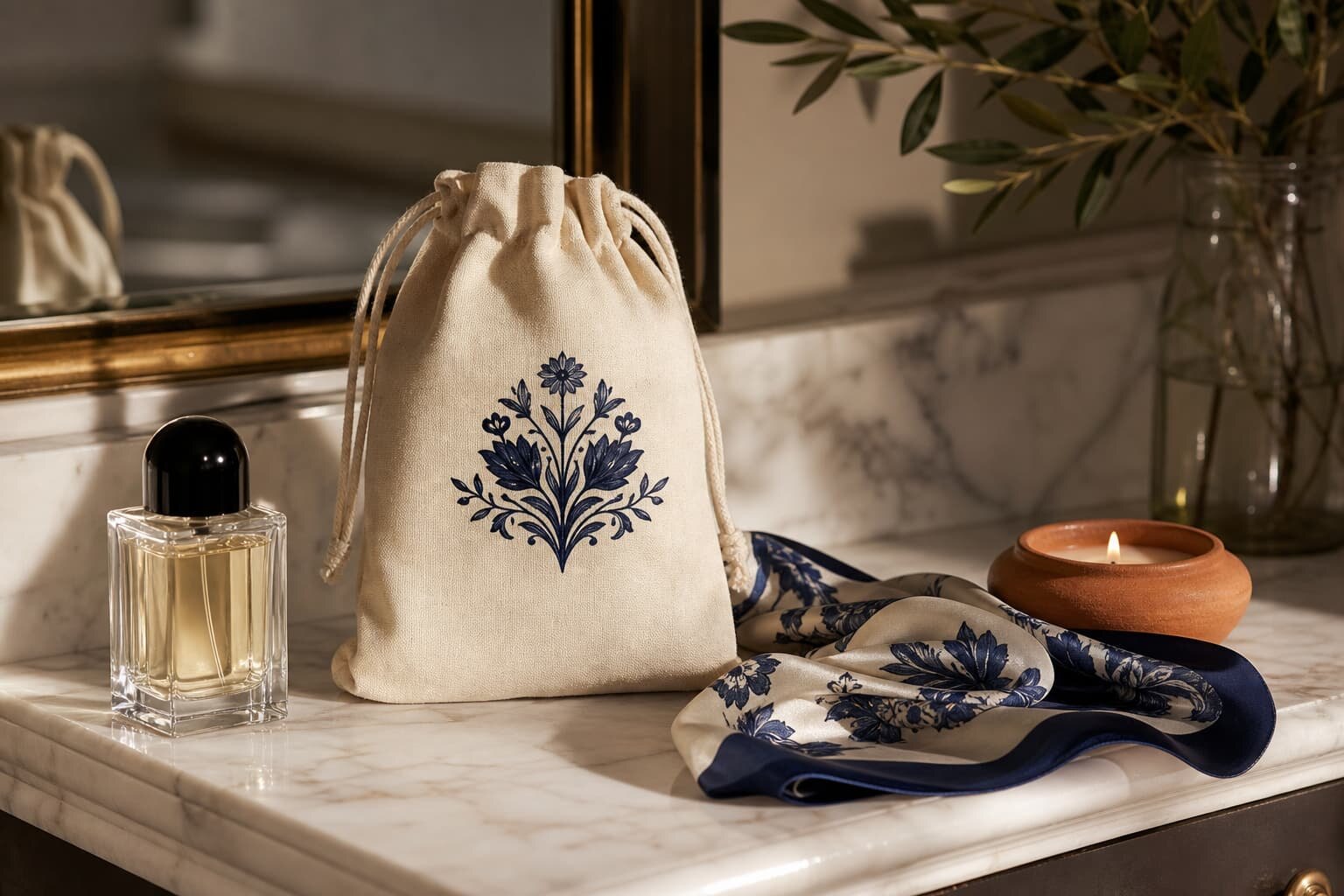
Start with the fill, not the fabric weight
The right cotton drawstring pouch GSM depends first on what goes inside the pouch and how the buyer expects it to perform. A pouch used for a pair of earrings or a hotel amenity kit can be light and flexible, while a pouch carrying a candle, a power bank, or a premium gift set needs more body, more seam support, and a better chance of holding its shape on shelf. If the fill is sharp, heavy, or irregular, the fabric cannot be too thin even if the printed artwork looks attractive on a sample.
Procurement teams often ask for a fabric weight first because it is easy to compare line by line. That is useful, but it can lead to the wrong spec if the sourcing brief does not define use case, fill weight, and display expectations. A good RFQ should describe the pouch as a packaging component, not just a fabric bag, because the right GSM also affects print clarity, cord pull, hand feel, and carton density.
- Light fill and low-value contents can usually use 100-120 GSM.
- Mid-value retail or gift use usually starts around 140-160 GSM.
- Heavier inserts or repeated use generally need 180 GSM or above.
What GSM really changes in a drawstring pouch
GSM is only one part of the story, but it changes several buying outcomes at once. Lower GSM cloth usually gives you a softer, thinner hand feel, lower fabric cost, and faster cutting and sewing. The tradeoff is weaker structure, higher show-through risk, and a greater chance that print edges will look uneven if the weave is open. Higher GSM usually improves body, opacity, and perceived value, but it also adds cost, increases carton weight, and can make the pouch feel bulky when folded.
Buyers should also remember that two fabrics with the same GSM can still behave very differently. Yarn count, weave density, finishing, and shrinkage control matter as much as the number itself. A tightly woven 140 GSM cloth may perform better than a loose 160 GSM fabric in print clarity and durability, so always ask the supplier how the cloth is constructed and how that construction affects the final use.
- Lower GSM usually reduces material cost but increases see-through risk.
- Higher GSM improves structure but can slow sewing and raise freight weight.
- Dense weave can outperform a heavier open weave on print and wear.
A practical GSM guide by product type
For most buyers, the selection starts with a simple use-case matrix. A 100-120 GSM pouch can work for light promotional sets, jewelry, small sachets, or mailer inserts where the bag is not expected to carry much force. A 140-160 GSM pouch is usually the safest middle ground for cosmetics, accessory sets, gift packs, and retail packaging because it balances hand feel, print performance, and price. Once the contents become heavier or the pouch must survive frequent reuse, 180-220 GSM becomes more realistic.
Very heavy cotton, usually 240 GSM or above, is not automatically better. It is best for structured premium pouches, larger reusable packs, or products that need a more substantial presentation. But if the pouch is small, thick fabric can make the opening stiff, reduce packing speed, and make the drawcord less smooth. That is why a buyer should match GSM to the product dimensions and not just to a generic premium image.
- 100-120 GSM: sachets, jewelry, sample kits, and low-cost giveaways.
- 140-160 GSM: the most common retail and gifting range.
- 180-220 GSM: better for premium packs, repeat use, and heavier contents.
- 240 GSM+: only when structure and durability matter more than compactness.
How print method, cord, and stitching change the spec
The print method can move the fabric weight decision as much as the product use. Screen print usually works well on medium and heavier cotton because the surface holds ink better and the bag has enough body to resist distortion during printing. On very light fabric, heavy ink coverage can cause waviness or show-through. If the art is large, multicolor, or highly detailed, the supplier may need to adjust cloth density, print screen count, or ink deposit, which can change both cost and minimum order quantity.
Cord type and stitching also matter. A thick drawcord on a thin pouch can feel mismatched and can even distort the top channel during closing. A light cord on a heavy pouch can feel underspecified and reduce the perceived quality. Ask the factory how they reinforce the channel, what stitch density they use, and whether the top edge needs extra hemming or bar tacks. These are small details, but they affect whether the pouch survives actual use.
- Screen print is usually the most stable choice for cotton pouch branding.
- Large ink coverage needs stronger fabric to avoid distortion.
- Cord diameter should match the fabric body and opening size.
- Reinforced seam points reduce failure near the drawstring channel.
How to compare quotes without getting trapped by a low GSM price
A low quote can hide a weaker fabric, a smaller cut size, or a cheaper packing spec. When comparing suppliers, do not accept a line that says only cotton pouch with print. Ask for the exact GSM, cloth width, finished pouch size, seam allowance, print area, and packing detail. A quote for 120 GSM with generous cut allowance is not comparable to one for 140 GSM with a smaller opening and tighter sewing allowance, even if the unit price looks similar.
It helps to break the quote into cost drivers. Fabric cost rises with GSM and cloth width. Sewing cost rises with complexity, reinforcements, and extra panels. Printing cost depends on colors, coverage, and method. Packing cost changes with polybag count, insert cards, barcode labels, and carton configuration. If a supplier cannot explain these drivers clearly, the buyer has little control over margin, and the risk of change orders after approval is higher.
- Compare quote on finished size, not just on fabric weight.
- Ask whether the price includes print setup, labels, and standard packing.
- Check if MOQ changes by color, artwork, or size variation.
- Make sure the supplier states what is excluded from the unit price.
Use samples to decide the final GSM, not to decorate the quote
A sample should answer one question: does this fabric weight work for the real product? The buyer should test the pouch with the intended fill, close it repeatedly, and inspect the base, channel, and seams after handling. If the sample is only judged empty on a table, the result can be misleading. A pouch that looks fine empty may sag, wrinkle, or print poorly once the fill is inside, especially if the cloth is too light or the drawcord is too heavy for the body of the bag.
For sample approval, ask for a production-intent sample made from the same fabric, print method, and cord spec that will be used in bulk. Check actual dimensions, shade, seam cleanliness, logo position, and opening performance. If the pouch is meant for retail, place the sample next to the packaged product or shelf mock-up so the team can judge whether the hand feel matches the brand positioning.
- Test the sample with the real product inside, not just empty.
- Confirm dimensions, shade, print position, and opening ease.
- Reject samples that are visually fine but fail under normal handling.
Packing and carton specs change with fabric weight
Fabric weight affects more than unit cost. It also changes how many pouches fit in a carton, how much the carton weighs, and whether the pack-out needs compression or careful folding. Lightweight pouches usually pack flatter and allow more pieces per carton, which can lower freight cost. Heavier pouches take up more volume, so a buyer may pay more in shipping even when the product unit price is acceptable. This matters for importers who compare delivered cost, not just factory cost.
Packing also affects appearance on arrival. If the pouch is printed and sold as a retail item, folding marks, creases, and dust can reduce shelf appeal. Ask the factory to define whether each piece goes in a polybag, how many pieces go in each inner pack, whether carton liners are needed, and how the carton is marked. For heavier GSM, it is worth confirming that compression during packing does not flatten the pouch in a way that makes the fabric crease permanently.
- Ask for pieces per inner bag and pieces per master carton.
- Check carton size because GSM changes both weight and volume.
- Confirm whether retail-ready pouches need individual polybags or bulk packs.
- Protect printed surfaces from rub damage during transit.
MOQ and lead time logic by fabric weight
MOQ is often linked to cloth sourcing and production efficiency, not just to the bag itself. Standard weights are easier to source and usually support lower MOQ. Special widths, custom dyeing, heavy fabric, or unusual finishing can raise the minimum because the mill and sewing line need more setup. If the buyer wants several artwork versions, each with a different print color, MOQ can multiply quickly even when the pouch size stays the same.
Lead time follows the same pattern. A simple 140 GSM natural cotton pouch with one-color print and standard cord is usually easier to plan than a custom heavy-weight pouch with special labels, extra stitching, and retail packing. When quoting, ask the factory to separate sample lead time, material lead time, and bulk production lead time. That helps you see where the schedule really sits and whether the weight choice is adding hidden delay.
- Standard GSM and standard color usually keep MOQ lower.
- More print colors or special finishing can raise MOQ quickly.
- Ask for lead time by stage: sample, material, sewing, and packing.
- Confirm whether the factory stocks the fabric or must source it first.
The decision framework buyers can use before issuing PO
A good final decision usually comes from three questions. First, what does the pouch need to carry and how often will it be used? Second, what print and brand presentation does the buyer need on shelf or in transit? Third, what target landed cost still protects the margin? If the pouch is a low-value promo item, a lighter fabric may be the correct commercial answer. If it is part of a premium retail set, saving a small amount on fabric weight can cost more later through complaints, returns, or weak presentation.
Before issuing the purchase order, align the spec sheet with the sample and the quote. The GSM, finished size, cord type, print method, packing method, and carton data should all match. If any one of those changes after sample approval, the buyer should expect some shift in cost or lead time. That is normal manufacturing reality, not a supplier problem, so the best protection is a clear approval record and a quote that names every key spec.
- Use end use, presentation level, and target landed cost together.
- Do not approve a sample unless the final production spec matches it.
- Treat any later change in GSM, print, or packing as a cost and schedule risk.
Specification comparison for buyers
| Spec decision | Recommended option | When it fits | Buyer risk to check |
|---|---|---|---|
| 100-120 GSM plain cotton | Lightweight, economical, close weave | Jewelry, sachets, event giveaways, low-fill promo packs | Can look thin or translucent; check seam strength and logo show-through |
| 140-160 GSM plain or twill cotton | Balanced default for most retail buyers | Cosmetics, gift sets, accessories, mid-value merchandise | Confirm print coverage, shrinkage, and whether the pouch still closes cleanly after fill |
| 180-220 GSM heavier cotton | Premium hand feel and better structure | Higher-value gifts, repeat-use retail packs, heavier inserts | Cost rises fast; check bulk, carton weight, and stitch efficiency |
| 240 GSM+ reinforced build | Structured pouch with wider seams or lining | Large items, premium packaging, reusable branded bags | May be too stiff for small products; confirm cord pull and opening size |
| Natural or unbleached cotton finish | Brand-led eco look with minimal processing | Lifestyle brands, organic positioning, artisanal retail | Shade variation and specks are normal; approve batch tone before bulk |
Buyer checklist before sampling
- State the end use clearly: product fill weight, retail use, gift pack, or promo giveaway.
- Specify finished size, seam allowance, and acceptable tolerance for length and width.
- Ask for fabric composition, weave, yarn count, and finished GSM, not GSM alone.
- Confirm whether GSM is measured before or after washing, printing, and finishing.
- Define logo method, print size, number of colors, and placement on the pouch.
- Request an actual production-fabric sample before bulk approval.
- Ask for shrinkage expectation, drawcord length, and closure performance after filling.
- Confirm packing method, inner pack count, master carton quantity, and carton marks.
- Compare MOQ by size, fabric color, and print color, not just the headline MOQ.
- Ask for bulk lead time, sample lead time, and what happens if artwork changes after approval.
Factory quote questions to send
- What is the exact fabric composition, weave, yarn count, and finished GSM with tolerance?
- Is the GSM measured on raw cloth or after washing, cutting, and sewing?
- What shrinkage allowance do you build into the cut size?
- Which print method do you recommend for this GSM, and what is the max print area?
- What is the MOQ per size, color, and print version?
- What are the sample charge, sample lead time, and whether the charge is refundable on bulk?
- What cord type, cord diameter, stopper option, and seam reinforcement are included?
- What is the standard packing spec per polybag and per carton?
- What are the bulk lead time and production milestones after sample approval?
- What is excluded from the quote, such as artwork setup, labels, inserts, or special packing?
Quality-control points to confirm
- Measure finished GSM on approved production fabric, not only on the mill spec sheet.
- Check pouch dimensions after sewing and after a light wash or steam test if the product will face shrinkage risk.
- Inspect seam density and stress points near the cord channel and bottom corners.
- Verify that the pouch closes smoothly with the intended product inside, not only when empty.
- Rub-test the print for cracking, fading, or bleed on the selected fabric weight.
- Check shade consistency across cartons, especially on natural or unbleached cotton.
- Confirm inner pack counts, carton quantity, carton labeling, and gross weight against the packing list.
- Inspect loose threads, skipped stitches, and cord lock function on a random carton pull.