Start With the Bookstore Scenario
A custom cotton drawstring pouch for a university bookstore should be specified by selling role first and fabric weight second. The same pouch may be used as orientation packaging, a checkout add-on, a graduation insert, a dorm-room organizer, or a premium alumni gift. Those uses do not deserve the same GSM, cord, print method, or packing plan. A pouch that is perfectly acceptable for stickers and coupons can look underbuilt when paired with a sweatshirt accessory or a paid gift bundle.
The first procurement step is to name the use case and the contents. A buyer sourcing 5,000 pouches for new-student welcome kits may care most about clean logo print, quick packing, and a low landed cost. A bookstore buyer sourcing 1,000 pouches for graduation gift sets may care more about hand feel, opacity, folded presentation, and carton separation by class-year artwork. A campus department buying pouches for small electronics should be thinking about seam strength and cord channel stress.
Vague RFQs create false savings. If the request says only "cotton drawstring pouch with logo," one supplier may quote a thin natural cotton pouch with bulk packing while another quotes a heavier pouch with better cord, print setup, and carton labeling. The lower price is not necessarily better; it may simply be a different product. A useful RFQ ties fabric weight to the way the pouch will be filled, handled, sold, and received.
- For orientation tables and event giveaways, start with 4 oz or 5 oz if contents are light and the pouch is not sold separately.
- For bookstore retail bins or gift wrap, start with 5 oz because it usually balances cost, opacity, and hand feel.
- For graduation, alumni, and higher-value merchandise, sample 6 oz before choosing a lower-cost weight.
- For tech accessories or dense contents, inspect seams and cord exits as closely as fabric GSM.
- For any paid product, judge the pouch like merchandise: fabric texture, print quality, cord feel, stitch finish, and packing all matter.
Use GSM and Ounces Without Guesswork
Cotton pouch fabric is usually described in ounces or GSM. A practical guide is 4 oz at about 135 GSM, 5 oz at about 170 GSM, 6 oz at about 200 GSM, and 8 oz canvas at about 270 GSM. These are useful sourcing shortcuts, not laboratory guarantees. Yarn size, weave density, bleaching, dyeing, washing, and finishing can all change how a pouch feels in hand.
The important procurement question is whether the supplier is quoting raw fabric weight or finished fabric behavior. A cotton cloth can shrink, relax, compact, or soften after processing. If one supplier quotes greige fabric weight and another quotes finished GSM, the comparison is not clean. Ask for the finished GSM tolerance and the measuring condition used for bulk production.
Finish also affects bookstore presentation. Natural cotton gives an approachable campus-store look, but flecks and shade variation are normal and should be approved in advance. Bleached cotton gives stronger contrast for dark university marks. Dyed cotton supports school colors or seasonal campaigns, but it raises colorfastness, dye-lot, and MOQ questions. Organic or recycled cotton can support a sustainability position only when the claim is documented clearly enough for product copy and licensing review.
- Ask whether GSM is measured before or after dyeing, washing, pressing, printing, and sewing.
- Use the approved finished pouch sample as the reference for bulk hand feel, not only a fabric-weight number in the quote.
- For natural cotton, approve the acceptable level of flecks, slubs, and shade variation before production.
- For dyed pouches, confirm dye-lot coverage, colorfastness expectations, and whether reorders may shift in shade.
- For organic or recycled claims, request documentation before using the claim in bookstore listings, labels, or campus marketing.
Choose 4 oz, 5 oz, 6 oz, or 8 oz
A 4 oz cotton pouch is best when the pouch is lightweight packaging. It can work well for admissions cards, event coupons, small pin sets, sticker bundles, and welcome materials. It folds compactly, keeps carton weight down, and closes easily. The tradeoff is retail perception: natural 4 oz cotton may show dark contents, wrinkle after compression, and feel too thin for a product that students or parents are expected to buy.
A 5 oz pouch is often the strongest default for university bookstores. It feels more substantial than a giveaway pouch without the freight and material jump of a premium fabric. For stationery bundles, gift cards, bookstore-branded packaging, small tech accessories, and general campus merchandise, 5 oz usually gives enough opacity and print stability while staying efficient in cartons.
A 6 oz pouch is the better choice when the pouch helps justify the product value. Graduation sleeves, alumni gifts, apparel accessories, and reusable retail pouches benefit from the added body. Larger pouch sizes also look cleaner in 6 oz because broad fabric panels do not collapse as easily. Use 8 oz canvas selectively. It can be excellent for utility-style pouches and premium kits, but on small formats it may feel stiff, bunch at the channel, or resist closing neatly.
- Under 15 x 20 cm: compare 4 oz and 5 oz; choose 5 oz if the pouch is sold or reused.
- Around 20 x 30 cm: start with 5 oz; sample 6 oz for paid bundles or higher-value gift packaging.
- Above 25 x 35 cm: consider 6 oz as the retail baseline, especially for apparel accessories or graduation items.
- For 8 oz canvas: test closure, print coverage, carton cube, and sewing at the corners before approving.
- For dark, sharp-edged, or bulky contents: avoid very light natural cotton unless show-through is acceptable.
Compare Landed Cost, Not Just Unit Price
Fabric weight affects cost, but it is rarely the only driver. Pouch size, order quantity, print colors, artwork versions, cord diameter, inner packing, labels, hangtags, carton cube, duty, freight mode, and inspection requirements can move the final landed cost as much as GSM. For budgeting, ask suppliers to quote fabric-weight options using identical assumptions. Otherwise the 4 oz quote may look cheaper because it excludes barcode stickers, export cartons, or printed samples that another supplier included.
Target price bands should be used as a screen, not a promise. At the same factory and quantity, 4 oz should normally price below 5 oz, while 6 oz and 8 oz should rise more noticeably because of material consumption, sewing behavior, carton weight, and freight. But a small pouch with one-color print may show a modest spread, while a large pouch with individual packing and several artwork versions may show a larger landed-cost gap.
Region also changes the calculation. Nearshore sourcing can be attractive for fixed event dates, shorter replenishment cycles, or programs with late artwork approvals. Offshore sourcing may offer stronger unit economics for larger planned runs, but it adds transit time, holiday calendars, duty exposure, and inland trucking variables. The buyer should compare total delivered cost and delivery confidence, not only FOB unit price.
- Request unit price by quantity tier and fabric weight, with setup charges shown separately.
- Ask for carton quantity, carton dimensions, net weight, gross weight, and CBM for each GSM option.
- Compare nearshore and offshore quotes using the same Incoterms, packing method, and inspection expectation.
- Include screens, samples, labels, hangtags, barcode stickers, carton marks, and final inspection in the budget review.
- For campus-event deadlines, assign value to lead-time confidence instead of chasing a small unit-price difference.
Specify Artwork and Print Method
Screen print is usually the practical choice for custom cotton drawstring pouches used by university bookstores. Most bookstore logos, school marks, class-year graphics, and department names are solid-color designs with clear type. On 5 oz and 6 oz cotton, a well-controlled screen print can deliver good opacity and a clean hand feel. The approval must happen on the actual cotton color and GSM because natural fiber texture changes how ink reads.
Transfer printing has a place when artwork is too detailed for economical screen printing. Mascot illustrations, gradients, full-color graphics, and many short-run department versions may be better suited to heat transfer or digital transfer. The risk shifts from registration to feel and durability: buyers should check edge halos, gloss, cracking, and whether the transfer patch feels too heavy on the pouch face.
Embroidery and woven labels should be used for specific merchandising reasons, not as automatic premium upgrades. Embroidery can pucker lighter cotton or distort small pouches. Woven labels can look polished and reduce large print-area issues, but they add sewing labor and may not satisfy licensing teams if the logo must be large and color-accurate. The cleanest approach is to match print method to artwork complexity, fabric weight, order quantity, and target retail position.
- Use screen print for one to three solid colors, simple university marks, bookstore names, and repeatable programs.
- Use transfer print for detailed mascot art, gradients, full-color designs, or many short-run artwork versions after durability testing.
- Set placement tolerance in the PO, such as +/- 5 mm for small logos and +/- 10 mm for larger pouch faces.
- Approve PMS color on printed cotton samples, not only paper proofs or digital mockups.
- Check logo appearance after the pouch is filled and closed, because the drawstring can shift the visual center.
Structure the RFQ for Campus Versions
University pouch orders often involve several campus stakeholders. The bookstore may need a standard retail pouch, admissions may need a welcome-kit version, athletics may want a team mark, alumni relations may need event packaging, and graduation may need a class-year design. The base pouch may be identical, but the artwork versions affect screens, setup, inspection, packing, and receiving.
A good RFQ separates the base product from variable artwork. The base spec should define finished size, GSM, fabric finish, cotton color, cord material, cord diameter, cord color, draw style, stitch construction, label rules, packing method, carton marks, and inspection requirements. The artwork table should list each logo file, print size, print colors, quantity, department, SKU if used, and carton separation rule.
MOQ needs to be clarified early. Some factories can combine total quantity when size, fabric, cord, and construction are identical. Different prints may still require separate screens, setup fees, or minimum print runs. Different fabric colors, cord colors, hangtags, barcode labels, or packing styles may trigger separate material and labor minimums. That information helps the buyer decide whether to consolidate designs or pay for more variation.
- Use one base spec for all versions that share size, GSM, fabric color, cord, stitching, and packing.
- List each artwork version with file name, print colors, print size, quantity, SKU, and campus department.
- Ask whether MOQ applies by total order, size, fabric color, cord color, artwork version, or packing style.
- Request repeat-order pricing and screen-storage rules when the bookstore expects reorders.
- Confirm whether cartons can be separated by department, event, item number, or receiving location.
Approve Samples Like a Buyer, Not a Browser
A digital mockup is useful for layout discussion, but it should not release production. For cotton drawstring pouches, the buyer needs a finished pre-production sample made with the selected fabric weight, fabric color, cord, stitch construction, print method, and packing reference. GSM affects how the pouch folds, how the mouth gathers, and how the logo sits when the pouch is full.
Sample review should imitate real bookstore handling. Put the intended contents inside the pouch or use equivalent weight and volume. Close the drawstring several times. Place the pouch in the retail position: flat on a table, stacked in a bin, hung if applicable, or inserted into a kit. Check whether the logo remains visible, whether the fabric creases across the print, and whether the cord feels right for quick staff handling.
Approval ownership should also be clear. Procurement may approve cost and timing, but licensing, athletics, alumni relations, or bookstore merchandising may need to approve logo color, scale, and placement. If several teams need sign-off, build that into the sampling timeline. Keep one signed approval sample with the buyer and require the factory to retain a matching sealed sample for production comparison.
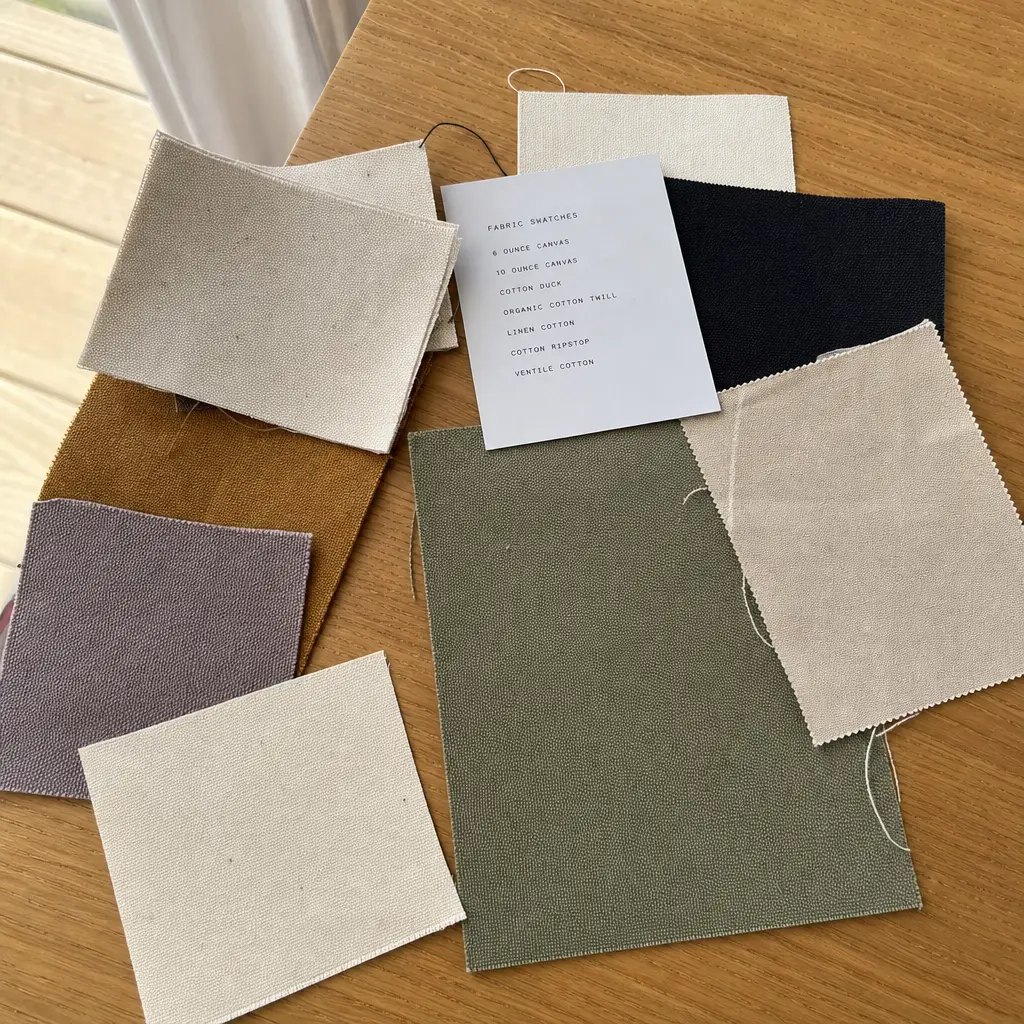
- Use fabric swatches to narrow GSM and color, but approve production from a finished pouch sample.
- Request a printed strike-off when color, opacity, line detail, or print hand feel is the main risk.
- Measure the finished pouch flat after sewing and cord insertion, not from cut panels.
- Test the sample with real or equivalent contents before approving logo placement.
- Record approval comments for fabric feel, print result, stitching, cord function, and packing method.
Control Cord, Channel, and Stitching
Two pouches with the same GSM can perform differently because sewing and closure construction carry much of the quality. Bookstore pouches may be opened by staff, handled by students, shipped to departments, and reused by customers. Side seams, bottom seams, cord channels, and cord-entry points deserve clear specifications rather than supplier defaults.
Stitch density, seam allowance, thread tension, and backtacking should be visible on the approved sample. The drawstring channel should be wide enough for the cord to move smoothly without leaving the top edge loose or distorted. Side openings need clean finishing because tearing often begins where the channel meets the seam. On 6 oz and 8 oz pouches, check bottom corners and the top channel for bunching caused by heavier fabric.
Cord selection affects both appearance and function. Cotton cord supports a natural look and is common for bookstore packaging. Polyester cord may be smoother and more color consistent, but it changes the product feel. A thicker cord can make the pouch feel more premium, yet it can jam in a narrow channel or create a bulky knot on small sizes. A thin cord lowers cost but may fray or feel weak under tension.
- Specify cord material, diameter, color, length, knot style, and single or double draw closure.
- For larger pouches, double drawstrings often improve balance and user experience.
- Require reinforcement or clean backtacking at cord-entry points.
- Inspect skipped stitches, open seams, loose threads, crooked channels, and uneven tension.
- Test repeated open-close cycles on the approved sample and during final inspection.
Plan Packing for Bookstore Receiving
Packing can determine whether a pouch order arrives shelf ready or creates extra work in the receiving room. University bookstores may need goods separated by artwork version, campus department, event date, SKU, or delivery location. If the factory bulk packs mixed designs, the order may be technically correct but operationally frustrating.
Flat packing usually protects the logo area better than tight rolling or heavy compression. Individual polybags keep pouches clean but add material and labor. Paper bands can support count control and reduce plastic use, though they do not protect as well from moisture or dirt. Bulk inner bags are economical for kit assembly but less retail ready. The right choice depends on whether staff will sell the pouch, fill it in kits, or distribute it to departments.
Carton specifications should be quoted before the PO is released. Heavier fabric can reduce units per carton and increase freight cost. The buyer should collect carton quantity, dimensions, net weight, gross weight, and CBM for every GSM option under consideration. Carton marks should include item number, artwork version, quantity, carton sequence, and routing details needed by the campus receiving team.
- Choose flat pack, folded pack, individual polybag, paper band, or bulk inner bag based on the receiving workflow.
- Separate cartons by artwork version or department when staff must distribute goods internally.
- Confirm barcode stickers, hangtags, retail labels, and carton marks before packing begins.
- Avoid compression that creases the print, flattens the cord, or distorts the drawstring channel.
- Require carton data before final freight booking and landed-cost approval.
Set Operational QC Standards
Quality control should be written into the purchase order before bulk production starts. A phrase like "good quality" is too broad for a bookstore program tied to university branding. The inspection standard should define finished dimensions, GSM tolerance, print placement, print color, seam strength, cord function, fabric cleanliness, odor, packing count, label accuracy, and carton marking.
Fabric inspection should compare production against the approved sample and allowed appearance range. Natural cotton may have small flecks and minor slubs, but holes, oil marks, strong odor, broken yarns, major shade shifts, and contamination should be treated as defects. For print, inspection should check opacity, curing, registration, placement, edge quality, and distortion after folding or filling. University marks often fail commercially because of crooked placement or weak color, not because the pouch cannot hold contents.
Construction inspection should focus on stress points: side seams, bottom seams, drawstring channel, cord exits, and label attachments. The drawstring should open and close repeatedly without tearing, fraying, jamming, or pulling unevenly. If AQL inspection is used, define critical, major, and minor defects before shipment so the factory understands what must be reworked, replaced, or approved with concession.
- Critical defects: wrong logo, wrong fabric color, unsafe contamination, severe odor, unusable drawstring, or mixed artwork in marked cartons.
- Major defects: size beyond tolerance, poor print placement, open seam, broken stitching, stains, wrong cord, or incorrect packing count.
- Minor defects: small loose threads, light wrinkles, or natural slubs within the approved appearance range.
- Use the sealed approval sample as the reference for fabric, print, construction, and packing.
- Check packed cartons for correct SKU labels, artwork separation, readable marks, and moisture protection.
Specification comparison for buyers
| Spec decision | Recommended option | When it fits | Buyer risk to check |
|---|---|---|---|
| Light giveaway pouch | 4 oz cotton, about 135 GSM | Orientation tables, admissions packets, sticker sets, pin packs, coupon cards, and low-weight event handouts where the pouch is packaging rather than paid merchandise | Can show dark contents through natural cotton; wrinkles more in bulk cartons; may feel too light beside bookstore retail goods |
| Standard bookstore pouch | 5 oz cotton, about 170 GSM | Most campus bookstore programs: notebook bundles, gift cards, small tech accessories, bookstore-branded gift wrap, and reusable pouches at moderate quantities | Confirm finished GSM tolerance, shrinkage, cord diameter, and seam strength; a weak cord can make a good fabric weight feel cheap |
| Premium retail pouch | 6 oz cotton, about 200 GSM | Graduation bundles, alumni gifts, paid accessories, apparel add-ons, and larger pouches where opacity and hand feel affect perceived value | Higher material and freight cost; approve logo opacity and edge quality on actual production fabric before bulk printing |
| Heavy canvas pouch | 8 oz cotton canvas, about 270 GSM | Utility pouches, small kits, premium gift packaging, and products where structure matters more than compact folding | Small pouches can close poorly; heavier cartons raise freight; print pressure, channel width, and cord size need separate testing |
| Target unit-price screen | 4 oz entry, 5 oz mid, 6 oz premium, 8 oz heavy | Use when comparing the same pouch size and artwork across fabric options; the relative movement is more useful than a universal price claim | Ask for current quotes by quantity tier. Landed cost may change more from packing, setup, freight, and duty than from GSM alone |
| Common landed-cost drivers | Fabric GSM, pouch size, print colors, cord, packing, carton cube, duty, freight, and receiving requirements | Useful for internal budget reviews before a purchase order is approved | A low unit price may exclude screens, samples, labels, inner bags, barcode work, inspection, export cartons, or inland freight |
| Nearshore sourcing | Often stronger for urgent bookstore launches, smaller reorders, and simpler import handling | Best when event dates are fixed, artwork is still changing, or the bookstore needs faster replenishment | Unit price may be higher; confirm fabric-weight availability, print capacity, and whether the same cotton lot can be repeated |
| Offshore sourcing | Often efficient for larger quantities and planned seasonal programs | Best for bookstore programs with stable artwork, approved samples, and enough calendar time for production and ocean or air freight | Transit time, holiday shutdowns, duty exposure, carton cube, and communication delays can offset unit-price savings |
| Screen print | Water-based or pigment screen print for one to three solid colors | University marks, bookstore names, class-year designs, department logos, and simple mascot graphics | PMS targets must be approved on cotton, not paper; check opacity, curing, line thickness, and placement tolerance |
Buyer checklist before sampling
- Define the role of the pouch: free giveaway, kit packaging, paid bookstore item, graduation gift wrap, dorm organizer, tech accessory pouch, or alumni premium.
- List the actual contents, approximate filled weight, and whether the pouch must stand, fold flat, hang, or sit in a bin at checkout.
- State finished pouch size as width by height after sewing and cord insertion, with tolerance such as +/- 5 mm for small pouches or +/- 10 mm for larger pouches.
- Quote 4 oz, 5 oz, 6 oz, and 8 oz only when all other assumptions match: same size, cord, stitch, print, packing, quantity, and Incoterms.
- Specify cotton condition: natural, bleached, dyed, washed, organic, recycled blend, or conventional cotton, and ask how finished GSM will be verified.
- Set cord material, diameter, color, draw style, knot style, and channel width. Do not leave closure construction to supplier default.
- Require actual printed samples on the selected fabric weight and cotton color before approving bulk production.
- Separate base pouch spec from artwork versions so department logos, graduation marks, and alumni graphics do not confuse MOQ and setup charges.
- Ask for unit price, setup charges, sample fees, print screens, labels, hangtags, barcode work, inner packing, export cartons, and inspection cost as visible lines.
- Collect carton quantity, carton dimensions, net weight, gross weight, CBM, and packing method for each fabric-weight option before comparing landed cost.
Factory quote questions to send
- What finished GSM range can you guarantee for 4 oz, 5 oz, 6 oz, and 8 oz versions of this pouch after dyeing, finishing, printing, and sewing?
- Can the full order be produced from one cotton lot, and what shade variation should we expect for natural or dyed cotton?
- Please quote the same finished size, cord, stitching, print artwork, packing, carton spec, and Incoterms at each fabric weight so the comparison is clean.
- Which print method do you recommend for our logo on this GSM and fabric color, and what are the minimum line thickness, registration tolerance, and opacity limits?
- Will PMS or brand color approval be based on a printed cotton strike-off rather than a paper proof, PDF, or screen image?
- What MOQ applies by finished size, fabric weight, cotton color, cord color, artwork version, and packing style?
- What one-time charges apply for screens, setup, artwork adjustment, sampling, labels, hangtags, barcode stickers, carton marks, or special packing?
- What sample stages can you provide: fabric swatch, blank finished pouch, printed strike-off, pre-production sample, and sealed approval sample?
- How many working days are needed for fabric sourcing, sampling, revisions, production, printing, inspection, packing, and handover to freight?
- What stitch density, seam allowance, drawstring-channel height, cord diameter, backtacking, and side-entry reinforcement will be used for this pouch size?
Quality-control points to confirm
- Finished GSM checked against the approved sample and purchase-order tolerance, using the same fabric construction, finish, color, and washing or dyeing condition planned for bulk.
- Finished pouch dimensions measured flat after sewing and cord insertion, including width, height, channel depth, seam allowance, and cord-exit position.
- Fabric surface inspected under consistent light for holes, oil marks, stains, broken yarns, excessive slubs, shade variation, loose lint, contamination, and strong odor.
- Print color, opacity, registration, edge sharpness, curing, hand feel, and placement compared with the signed pre-production sample on actual production fabric.
- Print durability checked by dry rub, light wet rub when appropriate, bending, folding, and repeated handling based on the selected print method and bookstore use.
- Logo placement checked after filling, closing, pressing, folding, and packing so the mark still reads correctly in the way the bookstore will display or distribute it.
- Side seams, bottom seams, cord channel, cord-entry points, labels, and hangtags inspected for open seams, skipped stitches, broken thread, uneven tension, and weak backtacking.
- Drawstring function tested by repeated open-close cycles without cord breakage, fraying, channel tearing, knot failure, or uneven gathering.
- Cord material, diameter, color, length, knot style, and closure direction verified against the approved sample and purchase order.
- Packing checked for correct quantity per inner pack and carton, clean separation by artwork version, readable barcode or SKU labels, correct carton marks, and no print-damaging compression.