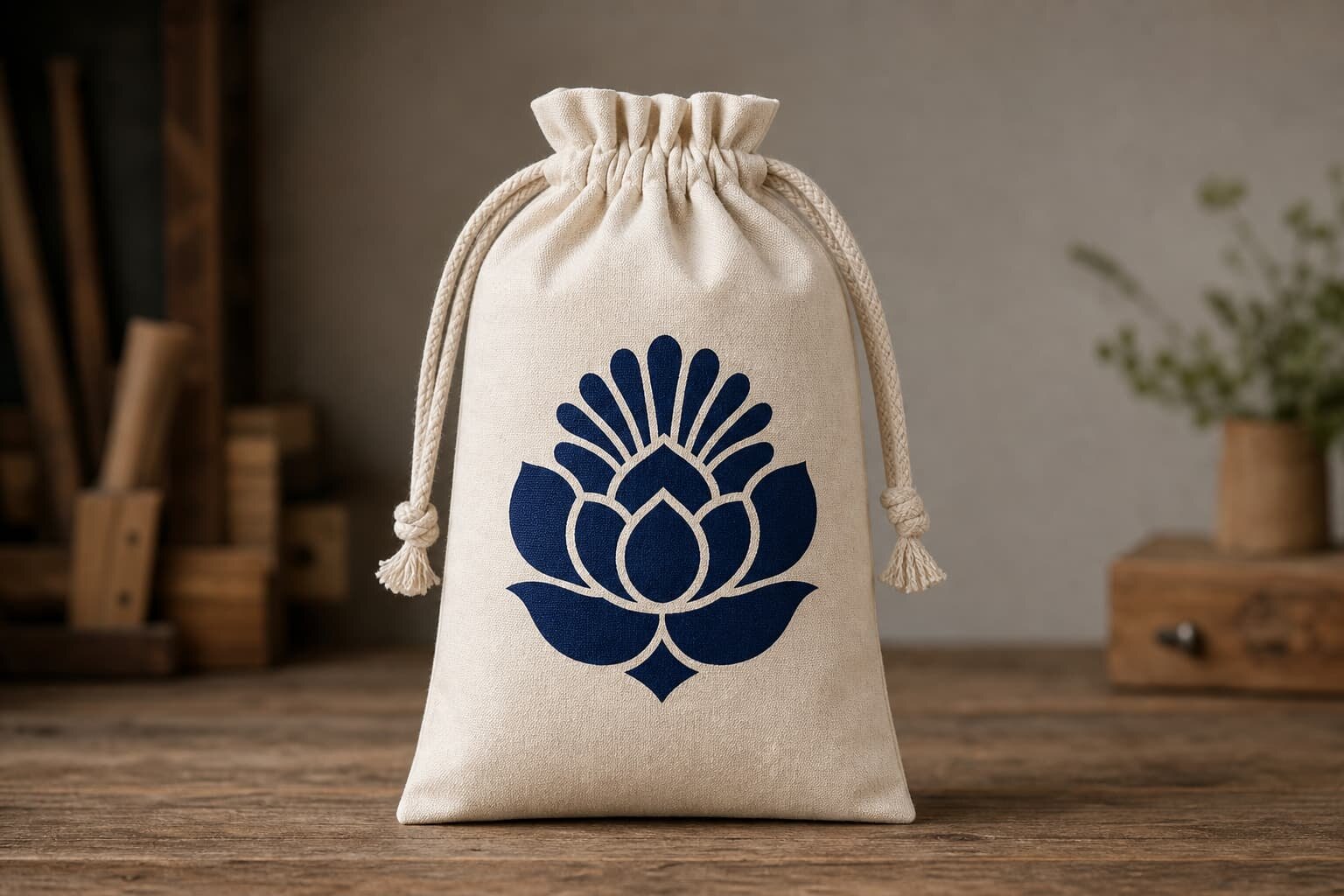
Why the Print Proof Matters More Than the Mockup
For a cotton drawstring pouch, the artwork mockup is only a layout document. It cannot show how ink sits on cotton yarn, how the logo changes across slubs, or whether the print position still looks correct after the drawstring channel is folded and sewn. Many purchasing problems start when a buyer approves a clean digital image and assumes the factory will automatically match that appearance on real fabric.
A useful custom logo print proof should answer three commercial questions before bulk production starts: does the logo look acceptable on the selected cotton fabric, can the factory repeat it at scale, and are the agreed tolerances clear enough for inspection? If the proof does not answer these points, the buyer is still carrying the production risk even if the artwork file is correct.
- Use the mockup to confirm size, placement, and rough visual direction.
- Use the physical print proof to confirm fabric behavior, ink coverage, edge sharpness, and color.
- Use the signed pre-production sample as the factory reference during bulk QC.
- Do not release bulk printing only from a JPEG layout unless the order is very low risk.
Start With the Pouch Specification Before Checking the Logo
Logo proofing is difficult when the pouch specification is not stable. A 10 x 15 cm cotton pouch in 4 oz fabric will not print like a 20 x 30 cm pouch in 8 oz canvas. The same logo may look too large on one size and too small on another. Before asking the factory for a custom logo print proof, confirm the finished size, fabric weight, fabric color, drawcord material, and whether the pouch is single drawstring or double drawstring.
For most cotton drawstring pouches, buyers should discuss fabric in both ounce and GSM terms. Common lightweight pouches may be around 4 oz to 5 oz, while more structured retail packaging often uses 6 oz or 8 oz cotton, roughly about 140 to 270 GSM depending on the mill and weave. Heavier fabric generally gives a better print surface, but it also increases unit cost, carton weight, and freight volume.
- Define size as finished width x finished height, not only cutting size.
- State whether the height includes the drawstring channel or only the usable packing area.
- Ask whether natural cotton specks, seed marks, and slubs are acceptable.
- Confirm shrinkage expectation if the pouch is washed, dyed, or pressed after sewing.
- Avoid changing fabric weight after the print proof unless a new proof is made.
Choose the Print Method Based on Artwork and Order Logic
Screen print is usually the safest option for cotton drawstring pouches with a simple logo, solid text, or one to three spot colors. It is cost-effective when the order quantity is high enough to absorb screen setup, and it gives a strong, repeatable result on natural or dyed cotton. For fine lines, small legal text, or very detailed icons, the factory should confirm the minimum line thickness they can hold on the chosen fabric.
Digital print and heat transfer can be useful for short runs, multi-color artwork, gradients, or SKU programs where each design quantity is low. However, these methods must be checked carefully for hand feel, edge definition, and long-term adhesion. A transfer that looks sharp on the table may feel too plastic for a natural cotton gift pouch. A digital print may look muted if the base fabric is unbleached or heavily textured.
- Screen print fits solid logos, repeat bulk orders, and clear Pantone control.
- Digital print fits complex artwork, lower MOQ, and multi-design programs.
- Heat transfer fits sharp multi-color graphics but may change the hand feel.
- Embroidery is possible on heavier pouches but can distort light cotton and raise cost.
- Woven labels or side labels are better when the logo must remain consistent across many fabric colors.
Set Practical Logo Size and Placement Rules
A common mistake is approving the logo by eye without measurements. On a small drawstring pouch, a 5 mm placement shift can be visible, especially when the logo sits close to the drawstring channel. The proof should show the print width and height in millimeters, the distance from the top finished edge or channel seam, and the distance from both side seams. If the pouch has rounded bottom corners or a boxed bottom, the usable print zone should also be marked.
The buyer should also decide whether the logo is measured from the top edge of the pouch or from the bottom of the drawstring channel. This matters because factories fold and stitch the top channel before or after printing depending on their workflow. If the logo is printed on flat panels before sewing, the sewing tolerance can change the final visual position. For retail buyers, the approved sample should be measured after sewing, not only on the flat fabric panel.
- For small pouches, avoid placing the logo too near the cord channel.
- Leave enough clear space from side seams to prevent print distortion.
- Check whether the product inside will stretch the pouch and change logo appearance.
- Ask the factory to mark the printable area if the pouch has gusset, curved corners, or thick seams.
- Confirm whether each pouch size needs a resized logo or one common logo size.
Control Color Without Over-Specifying the Impossible
Pantone references are useful, but cotton is not coated paper. Natural cotton has a warm base tone, and unbleached fabric can make light colors look dull or yellowed. A buyer who expects exact coated-paper Pantone matching on a natural cotton pouch will create avoidable disputes. Instead, ask the factory to provide a closest achievable ink match on the selected fabric and approve a physical reference under consistent lighting.
Color control should be strict enough for brand protection but realistic enough for production. For a black logo on natural cotton, the main checks are ink density, edge sharpness, and curing. For brand colors such as red, blue, green, or metallic-looking shades, the buyer should decide whether a slight shade difference is acceptable. Metallic ink, fluorescent ink, and very pale ink on unbleached cotton require special confirmation and may increase MOQ or setup cost.
- Provide Pantone Solid Coated or Uncoated reference, but judge final color on fabric.
- Keep one approved physical sample for factory and inspection comparison.
- Check color in daylight or D65 light, not only under warm warehouse lighting.
- Ask if the factory uses mixed ink per order or standard stocked ink.
- Avoid approving color from phone photos because camera correction can mislead both sides.
MOQ Logic: Why the Proof May Cost More Than Expected
For custom cotton drawstring pouches, MOQ is not only about sewing quantity. It is affected by fabric procurement, dyeing, drawcord color, print setup, and packing method. A natural cotton pouch with black screen print may have a lower MOQ because the factory can use regular fabric and common ink. A dyed pouch with custom cord color and two-sided print may need a higher MOQ because several material processes must be opened.
Buyers should separate sample MOQ, production MOQ, and economic MOQ. A factory may be able to make a few samples, but the unit cost will not represent mass production. The economic MOQ is the point where setup costs, screen charges, fabric wastage, and cutting efficiency are spread over enough units. When comparing supplier quotes, check whether the lower MOQ comes with higher unit cost, substitute fabric, simplified packing, or omitted proofing steps.
- Natural cotton with one-color logo usually has the simplest MOQ structure.
- Custom dyed fabric often requires higher MOQ because dye lots are booked in batches.
- Multiple print colors add screens, setup time, and registration risk.
- Several pouch sizes under one order may not share the same MOQ logic.
- Ask the supplier to quote both your target quantity and the next efficient quantity break.
What a Good Pre-Production Sample Should Prove
A useful pre-production sample should be made with the intended bulk fabric, intended print method, intended cord, and final sewing construction. If the proof uses substitute fabric or a different cord, it can still help with layout, but it should not be treated as full production approval. The buyer should ask the factory to label the sample clearly, including fabric weight, print method, print color, date, and any known differences from bulk.
When the sample arrives, do not only review the front view. Open and close the pouch several times, put in the intended product or a similar weight, and check whether the logo wrinkles, stretches, or hides under the gathered top. For small packaging pouches used for jewelry, cosmetics, tea, candles, or accessories, the product shape can change the visible panel more than expected.
- Measure finished width and height with the pouch laid flat.
- Check logo size, logo position, and print straightness against the artwork sheet.
- Rub the printed area lightly to check curing and ink transfer.
- Inspect stitching around the drawstring channel and side seams.
- Test closing function with the actual or estimated product inside.
- Photograph and sign the approved sample for purchasing and QC records.
Avoid Production Mistakes Before Bulk Printing Starts
The most expensive mistake is discovering a logo issue after fabric panels are already printed. On many drawstring pouch orders, printing happens before final sewing because flat panels are easier to print. If the print is wrong at that stage, the factory may have hundreds or thousands of panels that cannot be reused. That is why the buyer should lock artwork, size, color, and placement before the bulk printing date, not during sewing.
Another common mistake is changing only one part of the specification after sample approval. For example, switching from 6 oz to 4 oz fabric may reduce cost but also reduce print opacity. Changing from natural cotton cord to polyester cord may improve color consistency but change the product appearance. Moving from individual polybag packing to bulk bundle packing may create creases across the logo. Any change touching fabric, print, or packing should trigger a risk review.
- Do not approve bulk printing until the purchase order matches the signed sample.
- Check that the factory uses the latest artwork version, not an old email attachment.
- Confirm whether logo direction changes for double-sided or two-panel printing.
- Ask for a first-article photo from bulk printing before the full batch continues.
- Keep approval comments specific, such as increase logo width to 70 mm, not make it bigger.
Packing Can Damage a Good Print Proof
Packing is often treated as a shipping detail, but it can affect the final appearance of printed cotton drawstring pouches. If pouches are folded tightly across the logo before the ink is fully cured, the print may crease, stick, or show pressure marks. If natural cotton pouches are packed in a humid environment, fabric odor, mildew risk, and carton softness become real concerns for importers.
The packing method should match the sales channel. Retail-ready pouches may need individual polybags, barcode labels, or sorted SKU cartons. Promotional or component packaging pouches may be bulk packed in bundles of 25, 50, or 100 pieces. For buyers trying to reduce plastic, paper bands or master polybags can be discussed, but the factory should still protect the printed surface from dirt and moisture during export handling.
- Confirm whether pouches are packed flat, folded once, or bundled.
- Avoid fold lines directly across large printed logos if appearance is critical.
- Ask for carton quantity, carton size, gross weight, and net weight in the quote.
- Confirm inner packing by SKU, color, size, or logo version.
- Use carton marks that match the purchase order, item code, quantity, and destination requirements.
Compare Supplier Quotes Using the Same Data
A low quote is not useful if it excludes the proofing work needed to prevent rejection. When comparing suppliers, request the same specification from each factory: pouch size, fabric GSM or oz, fabric color, drawcord type, print method, number of print colors, print size, sides printed, packing method, sample terms, mass production lead time, and carton data. Without these details, the cheapest price may simply be a different product.
Also check how the supplier handles revisions. A professional factory should explain what is included in the first sample, what costs extra, and how much time is needed for a revised proof. This matters when the launch date is fixed. If the supplier quotes only a very short lead time without allowing proof approval time, the buyer may face a choice between delaying shipment or accepting an unverified logo.
- Separate unit price, setup charges, sample charges, and shipping charges.
- Ask whether the quote includes one-sided or two-sided printing.
- Confirm if the quoted lead time starts after deposit, artwork approval, or sample approval.
- Check if overproduction or underproduction tolerance is included.
- Request carton measurements early if freight cost is part of the buying decision.
- Make sure payment terms and quote validity are written, not assumed.
Specification comparison for buyers
| Spec decision | Recommended option | When it fits | Buyer risk to check |
|---|---|---|---|
| Fabric weight for logo clarity | 6 oz or 8 oz cotton, usually about 170-270 GSM depending on mill standard | Good for gift packaging, cosmetics, accessories, jewelry, candles, and retail add-ons | Very light 4 oz fabric may show weave gaps, seam puckering, and print-through on dark ink |
| Print method for simple logo | Screen print, 1-2 spot colors | Best for bulk orders with solid brand marks and repeatable color control | Confirm ink coverage, curing, and Pantone tolerance before approving the pre-production sample |
| Print method for gradients or photos | Digital direct print or heat transfer, depending on fabric and artwork | Useful for short runs, multiple SKUs, or detailed artwork | Check hand feel, edge sharpness, wash/rub resistance, and whether the base fabric tone changes color |
| Logo position | Centered on front panel with measured distance from top edge and side seams | Most common for retail packaging pouches and promotional gift bags | Drawstring channel shrinkage and sewing tolerance can make a logo look too high if the proof is not measured |
| Drawcord choice | Cotton cord for natural look, polyester cord for cleaner color consistency | Cotton cord fits organic or eco-positioned packaging; polyester fits color-matched brand programs | Cotton cord may have more shade variation and lint; polyester may look less natural beside unbleached fabric |
| Sample approval stage | Printed pre-production sample using bulk fabric and intended ink | Required before larger import orders or retail launch programs | A digital mockup alone cannot prove ink absorption, seam distortion, or real logo scale |
Buyer checklist before sampling
- Confirm pouch finished size with tolerance, not only flat cutting size.
- Specify fabric construction, weight, color, and whether natural cotton slubs are acceptable.
- Send vector artwork with Pantone references, print size in millimeters, and placement from top and side edges.
- State print method preference or ask the factory to recommend based on artwork, order quantity, and fabric color.
- Require one physical print proof or pre-production sample before bulk printing.
- Check print color under daylight or D65 light, not only under warm office lighting.
- Rub the print surface with dry and slightly damp white cloth to identify weak curing or ink transfer.
- Measure logo position after the drawstring channel is sewn, because top folding changes the visible panel height.
- Approve drawcord material, cord diameter, knot style, and cord length after closing the pouch.
- Confirm unit packing, carton quantity, carton marks, and whether pouches are packed flat, bundled, or individually polybagged.
Factory quote questions to send
- What fabric weight and construction are included in your quote, and is the GSM measured before or after washing or finishing?
- Is the quoted fabric natural, bleached, dyed, organic, recycled, or conventional cotton, and what shade tolerance should we expect?
- Which print method do you recommend for this artwork, and why is it better than screen print, transfer, or digital print for this order?
- Does the price include screen charges, plate charges, color mixing, sample printing, and logo setup?
- What is your MOQ by pouch size, fabric color, print color count, and drawcord type?
- Will the proof be made with bulk fabric, bulk drawcord, and production ink, or only substitute materials?
- What print size tolerance, color tolerance, and placement tolerance do you normally guarantee?
- How many extra days are needed if the first print proof is rejected and a second proof is required?
- How will pouches be packed inside the export carton, and can the packing method prevent creasing over the printed logo?
- What quote validity, payment terms, sample cost, mass production lead time, and shipping carton data are included?
Quality-control points to confirm
- Fabric GSM and hand feel match the approved sample and purchase order.
- Finished pouch size stays within agreed tolerance after sewing and pressing.
- Logo size, placement, and orientation match the signed proof sample.
- Print color is checked against Pantone reference or approved physical sample under controlled light.
- Ink surface is cured properly, with no tackiness, cracking, pinholes, or visible smearing.
- Drawstring channel is even, with clean stitching and no cord trapped in the seam.
- Cord length is consistent, knots are secure, and the pouch closes without excessive force.
- Side seams and bottom corners are reinforced enough for the intended product weight.
- Loose threads, oil marks, fabric stains, and print contamination are removed before packing.
- Packing quantity, carton marks, gross weight, net weight, and carton size match the confirmed shipping data.