1. Why museum shop pouch costs vary more than the product looks
A cotton drawstring pouch appears simple: two fabric panels, a channel, a cord, and a print. In procurement terms, however, a museum shop pouch can range from economical counter packaging to a premium reusable retail item. A 10 x 14 cm natural 5 oz cotton pouch with one small black logo is not the same product as a 20 x 30 cm dyed 10 oz pouch with two-sided cotton drawcord, full-front exhibition artwork, individual barcode packing, and strict placement tolerances.
Museum shops also add brand and approval complexity. The pouch may carry an institution name, exhibit title, artist credit, sponsor mark, collection icon, or licensing text. It may need to fit a conservation-friendly story, a children’s activity program, a donor gift, or a temporary exhibition launch. These requirements affect fabric finish, print method, color control, packing, and inspection.
The main sourcing risk is incomplete RFQ language. If a buyer asks for “natural cotton drawstring pouch, printed, 3,000 pcs,” suppliers may quote different fabric weights, different print sizes, different cords, different packing, and different tolerance assumptions. A low quote may simply be based on a lighter cloth, smaller print area, loose bulk packing, or no pre-production sample. A reliable cost breakdown makes every cost driver visible before supplier comparison.
- Compare quotes only after normalizing finished size, GSM, fabric finish, cord, print area, packing, MOQ, inspection level, and Incoterm.
- Small pouches are often cost-sensitive to setup, printing, handling, and packing; large pouches are more sensitive to fabric yield, cord length, carton size, and freight.
- Museum artwork often includes small text or fine lines, so print feasibility should be checked before the purchase order is placed.
- Treat the pouch as retail presentation and inventory-handling equipment, not only as a low-value bag.
2. Start the cost breakdown with finished size and usable space
Finished size is the first specification because it drives fabric consumption, cutting yield, cord length, sewing time, print layout, packing density, and carton volume. Common museum shop ranges include 8 x 10 cm for coins, charms, small jewelry, pins, and tokens; 10 x 14 cm for soaps, small ornaments, small gift items, and boxed keepsakes; 12 x 16 cm or 15 x 20 cm for postcards, activity pieces, ceramic ornaments, and small gift sets; and 20 x 30 cm for scarves, folded textile items, catalog gifts, or larger bundles.
The RFQ should say finished width x finished height, measured flat after sewing and pressing. This is not the same as cut size. The side seams and bottom seam consume width and height, and the top folded channel reduces usable internal height. If the buyer only provides the item dimensions, the supplier may quote a pouch that technically holds the item but cannot close comfortably or looks strained when displayed.
Usable space is especially important for museum shops because many products are rigid or fragile. A flat postcard needs less clearance than a boxed glass ornament or a ceramic tile. A bulky item also changes the visual center of the pouch once filled, which can affect logo placement. For product-fit orders, a physical fit test with the real item or a size dummy should be part of sample approval.
- State finished size as W x H, measured flat after sewing, and define tolerance before sampling.
- For small pouches, a common tolerance target is around +/-5 mm; for larger pouches, +/-10 mm may be acceptable if agreed.
- For flat paper goods, allow practical clearance of about 10-20 mm depending on ease of insertion and fabric stiffness.
- For boxed or fragile items, send product dimensions, weight, and closure requirements; request a sample fit test.
- If a gusset, boxed bottom, lining, or reinforced seam is required, specify it separately because it changes cutting, sewing, and cost.
3. Fabric GSM, ounce weight, weave, and finish decide the material baseline
Fabric is usually the largest visible quality driver. Buyers often use ounce weight and GSM interchangeably, but they should understand the approximate conversion. A 4 oz cotton is about 135 gsm, 5 oz is about 170 gsm, 6 oz is about 200 gsm, 8 oz is about 270 gsm, and 10 oz is about 340 gsm. Exact values vary by supplier and fabric construction, so the quote should identify the actual fabric weight and the acceptable variation.
For many museum shop souvenir pouches, 5-6 oz cotton is a practical middle range: substantial enough to feel reusable, but not so heavy that it becomes expensive and bulky. A 4 oz fabric can work for very light contents, but it may be semi-transparent, wrinkle more easily, and show print distortion. An 8-10 oz cotton gives a stronger retail feel for paid merchandise, donor gifts, or heavier contents, but it increases fabric cost, sewing resistance, carton weight, and freight impact.
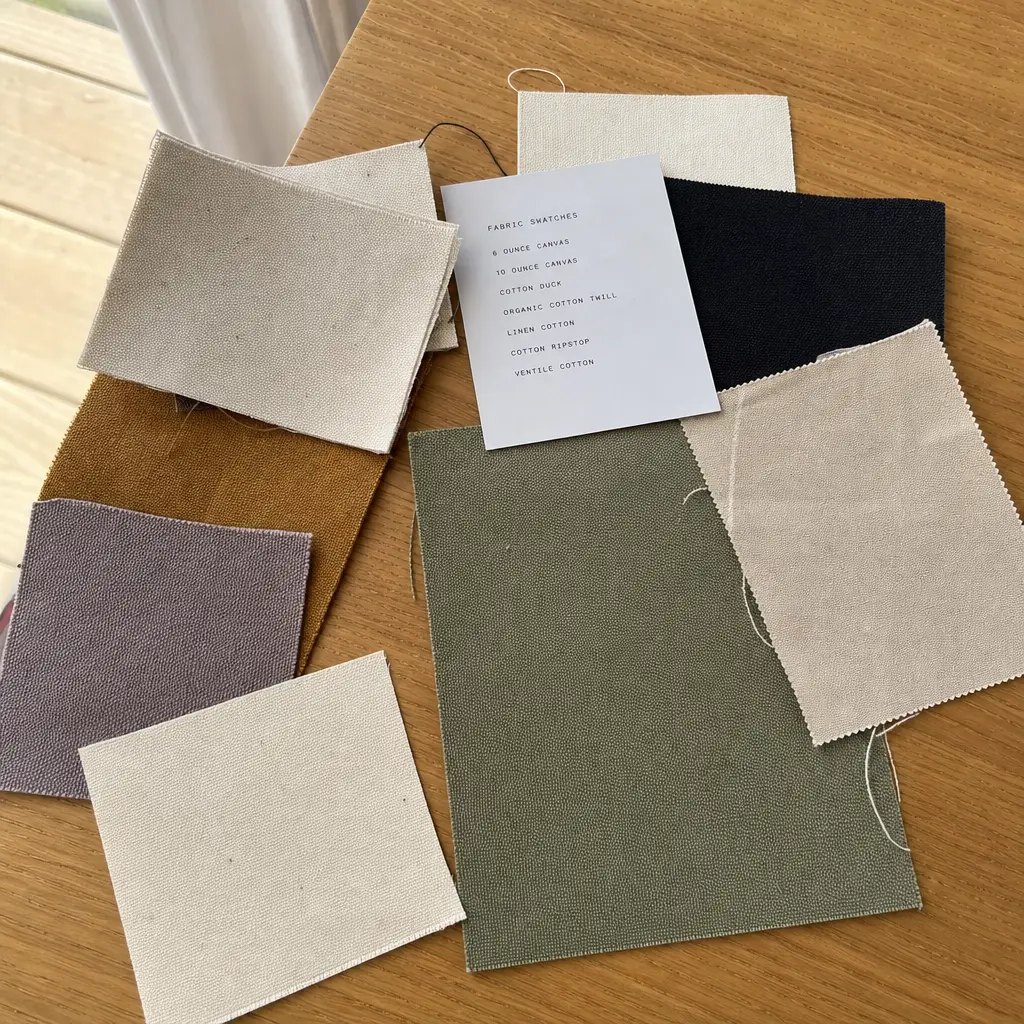
Finish matters as much as weight. Natural unbleached cotton suits heritage, archaeology, botanical, craft, and local-history collections, but it normally has seed specks, slubs, neps, and shade variation. Bleached cotton gives a cleaner background and stronger contrast. Dyed cotton supports exhibition palettes or brand color systems but usually needs lab dip approval and shade tolerance. Organic, recycled, or certified cotton should be treated as a separate specification with document requirements, not as a vague “eco” request.
- Ask whether the quoted fabric is sheeting, canvas, twill, or another weave, because hand feel and opacity differ at the same GSM.
- Approve a physical swatch for fabric weight, shade, texture, opacity, and print suitability before bulk cutting.
- Define whether natural cotton seed specks and slubs are acceptable characteristics or defects.
- For dyed cotton, approve lab dips and state shade tolerance, such as visual match to an approved swatch under consistent light.
- If certification is required, specify the exact certification and document scope needed for procurement or retail claims.
4. Printing: logos, exhibition artwork, and the real cost of detail
Printing can be a minor cost or a major cost driver. Screen printing is usually efficient for one to three solid colors, simple museum logos, collection icons, exhibit titles, and repeat programs. It normally carries setup charges by color and design, so it becomes more efficient at higher quantities. A small one-color logo and a large full-front artwork do not have the same ink use, handling time, or rejection risk.
Museum artwork often includes fine linework, serif type, dates, credit lines, sponsor logos, gradients, or color-sensitive brand elements. Cotton is not paper: the weave, absorbency, and natural base color can soften detail and shift perceived color. A Pantone reference printed on natural cotton will not look identical to the same reference on coated paper. Heat transfer or digital printing may handle gradients or multicolor artwork better, but these methods should be tested for hand feel, edge appearance, cracking, adhesion, and rub resistance.
The best control point is a print strike-off on the actual fabric. For licensed art or curator-approved designs, do not rely only on a digital proof. A physical strike-off shows ink spread, line clarity, actual color, coverage, and texture. It also gives the QC team a measurable reference for bulk inspection.
- Define print method, color count, artwork size, placement from finished edges, and maximum coverage in the RFQ.
- Ask whether screen charges are per color, per artwork, and per reorder.
- For small text, confirm minimum line thickness and minimum readable text height with the printer before approval.
- Use heat transfer or digital print only after checking hand feel, edge finish, rub performance, and durability expectations.
- Measure print placement from finished edges; typical placement tolerance may be +/-5 mm to +/-10 mm depending on pouch size and artwork.
5. Drawcord and construction details that create hidden labor
The drawcord affects both cost and user experience. Cotton cord gives a natural look and pairs well with unbleached cotton, making it popular for heritage and sustainable-positioned ranges. Polyester cord is smoother, often has more stock colors, and can be consistent for repeated use. Cord diameter must match pouch size and channel width. A 3 mm cord may suit small pouches, while medium and larger pouches may need 4-6 mm cord for proportion and function, subject to channel design.
One-side draw is usually simpler and more economical. Two-side draw uses more cord and handling but closes more evenly, especially on medium and large pouches. Cord ends may be knotted, heat-sealed if synthetic, tipped, or finished with metal or plastic ends. Tips can look premium but add component cost, labor, and potential safety or compliance review for children’s items.
Construction should not be inferred from a photo. A flat unlined pouch with a folded channel is the simplest build. French seams, lining, gussets, boxed bottoms, bartacks, side labels, hang loops, care labels, and retail tags all add operations. Museum buyers should decide which details are worth paying for and show them in a drawing.
- Specify one-side draw or two-side draw; do not leave closure style to the supplier.
- State cord material, diameter, color, end finish, and whether cord color must match fabric or print.
- Define folded channel width so the cord runs freely without making the top bulky.
- If side labels or care labels are required, show exact placement and label dimensions.
- For children’s activity kits, review cord length and small-part components against the buyer’s applicable safety requirements.
6. MOQ and price breaks: why design splits raise the unit price
MOQ is connected to fabric purchasing, dyeing lots, cutting efficiency, print setup, production scheduling, and packing control. A museum may plan a 5,000-piece order, but if it is split into five sizes, three fabric colors, two cord colors, and ten artworks, the factory is not producing one efficient batch. It is producing many small custom variations, each with separate setup and control requirements.
The most effective way to reduce pouch cost is to consolidate the base specification before multiplying artwork. Retail, membership, education, events, and exhibition teams may be able to share one natural cotton base, one fabric weight, one cord type, and one or two sizes. Different print designs may still carry setup charges, but cutting and sewing become more predictable.
Buyers should request MOQ at the right level. A supplier’s “MOQ 1,000 pcs” may mean 1,000 per size, 1,000 per fabric color, or 1,000 per print design. If this is not clarified, the final quote may change after artwork is submitted. Price breaks should be requested for the same specification so procurement can see the real value of consolidating volume.
- Ask for MOQ per finished size, per fabric color, per cord color, per artwork, and per packing method.
- Request price breaks for exactly the same spec at 1,000, 3,000, 5,000, and 10,000 pieces.
- Keep artwork changes separate from base pouch cost in the quote comparison.
- Combine department needs where possible to improve cutting, sewing, and packing efficiency.
- Confirm whether setup charges repeat on reorders or only when screens, artwork, or colors change.
7. What a professional supplier quote should show line by line
A useful B2B quote is more than a unit price. It should show the finished size, fabric weight, fabric finish, drawcord material, construction, print method, print size, color count, packing method, MOQ, sample cost, setup cost, lead time, Incoterm, payment term, and quote validity. If these details are missing, the buyer cannot tell whether suppliers are quoting equivalent products.
Separate recurring unit cost from one-time or order-specific charges. Screen setup, artwork adjustment, lab dip, strike-off, pre-production sample, courier, certification support, and barcode setup may not repeat in the same way on reorders. Keeping them separate helps the museum evaluate first order cost versus replenishment cost.
The quote should also support landed-cost planning. Heavier GSM, individual packing, and bulky cartons may be acceptable for a paid premium pouch, but not for a low-cost checkout bag. Carton dimensions, gross weight, and pieces per carton allow the buyer or distributor to estimate freight, storage, receiving labor, and allocation workload.
- Include unit price by quantity break for the same finished size, GSM, print, cord, packing, and trade term.
- List sample, lab dip, strike-off, screen, courier, barcode, and certification documentation charges separately.
- State production lead time from final approval, not from inquiry date.
- Show packing: pieces per inner bag, pieces per carton, carton dimensions, net weight, gross weight, and carton marks.
- Clarify Incoterm, loading port, destination assumptions, payment term, quote validity, and excluded taxes or duties.
8. Sample approval: verify fit, function, print, and repeatability
A cotton drawstring pouch sample should be approved for more than appearance. It needs to confirm finished size, usable space, fabric hand feel, opacity, drawcord function, seam quality, print clarity, placement, and packing result. For museum shops, a sample that looks good empty may fail once it is filled with a ceramic ornament, boxed jewelry set, candle, book, or children’s kit.
Different samples serve different purposes. A reference sample shows general construction or workmanship. A fabric swatch confirms weight, texture, and shade. A print strike-off shows artwork and ink behavior. A pre-production sample should use the actual fabric, cord, print method, dimensions, and packing method intended for bulk production. This pre-production sample should be the control sample for inspection.
Approval should be written and traceable. Record the sample date, material, finished measurements, artwork version, print colors, placement, cord, packing, and any accepted deviations. Ideally, one sealed approved sample remains with the factory and one is kept by the buyer or inspection team for comparison against bulk goods.
- Measure width at top, middle, and bottom if symmetry matters.
- Measure total height and usable height below the channel separately.
- Open and close the drawstring at least 20 times to test friction, blocked channels, cord shedding, and knot security.
- Fit the real merchandise or a size dummy inside and check closure, seam stress, and presentation.
- Rub the printed area with dry and slightly damp white cloth to check obvious ink transfer.
- Approve a packing mock-up if folding, wrinkles, barcode position, or inner-bag count matters.
9. Quality control standards for museum retail orders
Quality control should match the pouch’s purpose. A free packaging pouch may not need the same finish standard as a paid reusable item, but it should still meet basic requirements: correct size, usable closure, clean seams, accurate print, correct counts, and no stains or mixed designs. Museum shops are brand-sensitive, and poor packaging can reduce the perceived value of the object inside.
Before production, define defect categories. Critical issues may include wrong artwork, unsafe components, missing sponsor marks, or contamination. Major issues may include blocked drawstring channels, open seams, wrong size outside tolerance, serious print misplacement, or incorrect packing. Minor issues may include small loose threads or slight natural shade variation within the approved range. Defect classification prevents disputes after the goods are finished.
For larger orders, buyers may use an AQL-based final inspection or another agreed sampling plan. The exact AQL level depends on buyer policy and product risk, but the key is to agree it before shipment. Exhibition-linked orders should be inspected early enough to allow sorting, rework, or replacement before launch dates.
- Measure finished size after sewing and pressing against the agreed tolerance.
- Check seam strength at corners, side seams, and the channel opening for skipped stitches or open seams.
- Inspect drawcord function for blocked channels, trapped cords, uneven lengths, and knots pulling through.
- Verify print placement, color, registration, fine text, ink coverage, smudges, cracking, and rub resistance.
- Compare fabric shade and natural markings against the approved swatch and sample range.
- Confirm SKU counts, inner-bag counts, carton counts, carton marks, and destination allocation before shipping.
10. Packing, labeling, and receiving control for museum operations
Packing is a real cost item and a practical receiving issue. Bulk packing is usually the most economical choice for pouches used behind the counter, in gift assembly, or in backroom replenishment. A common arrangement is counted inner bags by size and design, packed into export cartons. The exact inner quantity should match how the museum replenishes stock; 50 or 100 pieces per inner bag is often easier to control than one loose mixed carton.
Individual packing adds material and labor, but it may be justified when the pouch is sold as a product, must remain clean in distribution, needs barcode control, or goes through a third-party warehouse. Paper bands, belly bands, glassine bags, recyclable bags, or plastic-free packing can support retail presentation, but they must be quoted and sampled because they change folding, carton density, and handling time.
Carton marking matters when several exhibitions, departments, or locations share one shipment. Each carton should identify purchase order, item code, design name, pouch size, fabric color, quantity, carton number, and destination if applicable. Mixed designs should be separated by inner bag and carton label, not by memory or a handwritten note buried inside the carton.
- Define pieces per inner bag and pieces per export carton before production packing starts.
- Request carton dimensions, net weight, and gross weight for freight and warehouse planning.
- Require clear carton marks for PO, SKU, design, size, color, quantity, and carton sequence.
- If barcodes are needed, provide barcode files, placement rules, scan requirements, and approval timing.
- Ask for final packing photos when one shipment contains multiple designs, sizes, or destinations.
- Include packing method in the approved sample or packing mock-up, not only in email text.
Specification comparison for buyers
| Cost driver | Typical specification choices | Cost impact for museum shops | Quote or QC detail to lock |
|---|---|---|---|
| Finished size | Common small ranges include 8 x 10 cm, 10 x 14 cm, 12 x 16 cm, 15 x 20 cm, 20 x 30 cm, measured flat after sewing | Larger sizes increase fabric consumption, cord length, sewing time, carton volume, and sometimes print area; very small sizes still carry handling and setup costs | State finished width x finished height, usable height below drawstring channel, and tolerance, such as +/-5 mm for small pouches or +/-10 mm for larger pouches if agreed |
| Fabric weight | Approx. 4 oz/135 gsm, 5 oz/170 gsm, 6 oz/200 gsm, 8 oz/270 gsm, 10 oz/340 gsm cotton canvas or sheeting, depending on weave | 5-6 oz is often a balanced souvenir range; 8-10 oz feels more premium but increases material cost, sewing resistance, carton weight, and freight | Ask whether the quote is in oz/yd² or gsm, confirm actual fabric weight tolerance, and approve a physical swatch before bulk cutting |
| Fabric finish | Natural unbleached, bleached, dyed to standard color, dyed to Pantone reference, organic or certified cotton if required | Natural cotton is usually simpler than custom dyeing; dyed or certified options may require lab dips, minimum fabric lots, longer lead time, and document control | Define acceptable seed specks, slubs, shade variation, certification scope, lab dip approval, and whether thread/cord must match fabric |
| Construction | Flat pouch with folded channel; one-side draw or two-side draw; optional gusset, boxed bottom, lining, side label, care label, hang loop | Flat unlined construction is lowest complexity; gussets, labels, lining, French seams, bartacks, and tips add operations and inspection points | Attach a technical drawing with channel width, seam type, seam allowance target, label placement, cord path, and draw direction |
| Drawcord | Cotton cord, polyester cord, braided cord, flat tape; common diameters often fall around 3-6 mm depending on pouch size | Cotton supports natural positioning; polyester is smoother and available in more colors; thicker cord costs more and needs a wider channel | Confirm material, diameter, color source, length, knot style, tipping, pull style, and function after 20 open-close cycles |
| Print method | 1-3 color screen print, heat transfer, digital print, embroidery, woven label | Screen print is efficient for solid logos; complex exhibition art may need transfer or digital print; large coverage and extra colors add cost | Quote maximum print area, color count, setup per color/design, artwork line limits, placement tolerance, strike-off requirement, and rub/crocking checks |
| MOQ structure | MOQ per size, fabric color, cord color, artwork, packing style, and shipment destination | A total order of 5,000 pcs can become expensive if split into many small designs or colors; base-spec consolidation reduces setup duplication | Request price breaks for the same spec at 1,000, 3,000, 5,000, and 10,000 pcs and list setup charges separately |
| Packing | Bulk inner bags, individual bags, paper bands, barcode labels, retail stickers, export cartons | Individual packing improves cleanliness and SKU control but adds labor, material, carton volume, and receiving work | Lock pieces per inner bag, carton quantity, carton dimensions, gross/net weight, carton marks, and design separation |
| Inspection level | In-line check, final random inspection, AQL-based inspection, 100% sorting for critical artwork if justified | Stricter inspection adds time and may affect ship date, but reduces risk for exhibition launches and brand-sensitive retail floors | Agree defect classifications, sampling plan, measurement points, shade standard, print placement tolerance, and rework rules before production |
Buyer checklist before sampling
- State finished size in width x height measured flat after sewing; include usable internal height below the drawstring channel if the pouch must close around an item.
- Provide the merchandise dimensions, thickness, weight, and any fragile points if the pouch must hold a boxed ornament, ceramic tile, candle, jewelry case, book, or activity kit.
- Specify fabric weight using gsm and/or oz/yd², not only words like light, medium, or premium; request a fabric swatch for the approved weight and finish.
- Choose natural unbleached, bleached, dyed, organic, recycled-content, or certified cotton as separate quote options instead of combining them under one vague sustainability request.
- Define acceptable natural-cotton characteristics such as seed specks, slubs, neps, shade variation, and hand-feel variation before bulk production.
- State cord material, diameter, color, draw style, knot/tip finish, and whether cord ends must be equal length after closure.
- Supply vector artwork when possible; include Pantone or other color references, print size, placement from finished edges, and minimum legibility requirements for dates, sponsor marks, or museum names.
- Ask the factory to separate unit price from screen charges, lab dips, strike-offs, pre-production samples, courier, certification documentation, barcode setup, and special packing charges.
- Request identical price breaks for the same specification at practical quantities such as 1,000, 3,000, 5,000, and 10,000 pieces, with MOQ stated per size, color, and artwork.
- Confirm print method, color count, and maximum print area in the RFQ; request a physical strike-off on the actual fabric before approving artwork.
Factory quote questions to send
- Is the quoted size the finished size after sewing and pressing, or the cut panel size before sewing? What measurement tolerance is included?
- What fabric weight is included in the quoted price in gsm and/or oz/yd², and what is the allowable fabric weight variation?
- Is the fabric natural unbleached, bleached, greige, dyed to a standard color, or dyed to a buyer reference? Is lab dip approval included for dyed fabric?
- What is the cotton weave or fabric type, such as sheeting, plain weave canvas, or twill, and can you send a swatch from the same fabric lot or approved bulk source?
- What is the MOQ per finished size, per fabric color, per cord color, per print design, and per packing method?
- What drawcord material, diameter, color, and length are included? Is the closure one-side draw or two-side draw? How are cord ends finished?
- Which print method is included, how many colors are included, what maximum print area is priced, and what is the cost for extra colors or larger coverage?
- Are screen setup, artwork adjustment, strike-off, pre-production sample, lab dip, certification support, barcode work, and courier fees included or charged separately?
- What is the expected production lead time after approval of fabric, artwork, strike-off, and pre-production sample? Which steps are on the critical path?
- What packing is included: loose bulk, counted inner bags, individual bags, paper bands, retail stickers, barcodes, or other packaging?
Quality-control points to confirm
- Measure finished dimensions flat after sewing and pressing, not from cut panels. Typical agreed tolerances may be +/-5 mm for small pouches and +/-10 mm for larger pouches, but the buyer and supplier should confirm this in writing.
- Check usable internal space below the drawstring channel using the real merchandise or a size dummy when the pouch is intended for boxed souvenirs, ornaments, candles, jewelry, books, scarves, or activity packs.
- Verify fabric weight against the approved specification by supplier certificate or fabric check; confirm that hand feel, opacity, shade, seed specks, and slubs match the approved sample range.
- Inspect the drawstring channel for clear openings, no skipped stitches, no trapped cord ends, no blocked corners, and a channel width that allows smooth movement.
- Run the drawcord open-close function repeatedly on random samples; confirm that cord diameter, knot size, cord length, and one-side or two-side pull construction work without jamming or fraying.
- Check seams for consistent allowance, secure backstitching, no open seams, no visible raw edges unless specified, no broken stitches, and no loose threads beyond the trimming standard, such as no loose threads longer than 5 mm if agreed.
- Measure print placement from finished pouch edges, not from the cut panel. Use a ruler or template where sponsor logos, exhibition titles, or centered artwork must be visually consistent.
- Inspect print quality for ink spread, pinholes, registration, cracking, smudging, loss of fine text, and color deviation against the approved strike-off.
- Perform basic dry and damp rub checks with a white cloth for visible crocking or ink transfer, especially on dyed fabrics, dark print colors, and heat-transfer artwork.
- Compare natural or dyed fabric shade under consistent lighting against the approved swatch; define beforehand whether normal natural cotton specks and slubs are acceptable or rejectable.