Make Packing Part of the Product Spec
A cotton drawstring pouch looks simple until a bulk order reaches freight booking or warehouse receiving. For coffee roasters, the visible choices are usually decided first: natural cotton or black cotton, logo size, cord color, and whether the pouch feels right for a sample set, retail shelf, or gift box. Those choices matter, but the carton plan decides how the order ships, how it is received, and whether the landed cost estimate is trustworthy.
A useful cotton drawstring pouches for coffee roasters carton packing plan should be written before the purchase order is approved. It should cover folding method, inner pack quantity, export carton size, carton strength, carton marks, gross weight, net weight, cube, pallet pattern, and count checks. Without this, two suppliers may quote the same pouch at different apparent prices while making completely different packing assumptions.
The goal is not to pack the maximum number of pouches into every carton. The goal is to reach a repeatable balance: efficient cube, manageable carton weight, protected print panels, accurate counts, and receiving labels that match the buyer's 3PL process. A slightly lower unit price can disappear if cartons are overweight, loosely packed, mislabeled, or too weak for the route.
- Treat carton count, inner packs, and carton marks as quoted specifications, not shipping afterthoughts.
- Ask for carton dimensions, gross weight, net weight, and cube by SKU before approving the supplier.
- Keep the carton plan consistent on reorders unless pouch size, GSM, cord, print, or label requirements change.
- Check whether the shipment will move by courier, air, LCL, FCL, or domestic pallet delivery because each route values cube and handling differently.
Start With the Roaster Use Case
Coffee roasters use cotton drawstring pouches in several ways. A pouch for sample cards and a brew guide has different needs from a pouch that wraps a mug, a scoop, a tin, or a holiday gift kit. A lightweight pouch for an event giveaway may prioritize cost and quick counting, while a retail merch pouch may need cleaner sewing, sharper print, and individual barcode handling.
The RFQ should name the real contents. Width and height are not enough when the pouch must close around a rigid item. Usable volume changes after seam allowance, channel depth, cord thickness, fabric stiffness, and folding memory are considered. If staff must fill the pouch in a cafe or warehouse, the opening must be easy to load, the cord must pull smoothly, and the pouch should close without forcing the fabric into an awkward shape.
For flat or soft contents, a standard flat sample may be enough. For rigid contents, ask for filled photos or a fit sample before bulk cutting. The supplier can test with the actual product or with a substitute matching the outer dimensions. This avoids the common failure where the pouch matches the drawing but cannot close neatly around the buyer's real kit.
- For coffee sample or accessory pouches, prioritize clean count control, print legibility, and economical carton cube.
- For gift sets, approve the pouch filled and closed, not only flat on a table.
- For retail merchandise, confirm whether UPC labels, swing tags, or individual bags are required.
- For cafe filling, test closure speed and cord feel because small friction issues become labor issues.
- For subscription inserts, check whether the filled pouch affects the final kit carton or mailer size.
Turn Size Into a Drawing
Size language often causes preventable disputes. One factory may measure before the drawstring channel is sewn; another may measure finished flat size from seam to seam; another may quote a nominal size that changes after washing. The purchase order should state finished width and height measured flat after sewing, plus channel height, seam allowance expectation, print placement, cord exit position, and any side label or hangtag location.
Tolerances should match the use case. For many small sewn pouches, plus or minus 0.25 in is practical. For larger non-fitted pouches, plus or minus 0.5 in may be workable. If the pouch must fit a rigid tin, mug, filter box, or exact retail tray, tighter control may be needed, but it should be justified and quoted because tighter control can affect cutting, sewing speed, inspection time, and rejects.
A simple production drawing is enough if it is clear. Mark the safe print area, distance from side seam, distance from bottom seam, and distance from the drawstring channel. If there is a sewn label, care label, barcode sticker, or tag, show it before carton planning begins. Small add-ons can change fold thickness and reduce pieces per carton.
- Use finished width x finished height, measured flat after sewing, as the master size definition.
- Show channel height and cord exit points instead of relying on sample photos only.
- Mark print size and print position with measurements from fixed edges.
- State whether the pouch will be washed or softened before final measurement.
- Use the same drawing for quote comparison, sampling, QC, and reorder approval.
Choose Fabric by Function
For many coffee roaster programs, 170 to 230 GSM cotton is a realistic working range, but it should not be treated as a universal answer. A 170 to 190 GSM plain weave can work well for lightweight accessories, sample cards, small brew guides, or promotional inserts where softness and packing efficiency matter. A 210 to 230 GSM fabric gives more body for retail merchandise or gift packaging, but it increases carton weight and reduces pieces per carton.
Heavier fabric can feel more premium, yet it is not always commercially better. If the pouch is only a secondary wrap for a boxed item, overbuilding may add cost without improving the customer experience. If the pouch is sold or reused, heavier fabric, stronger seams, and a better cord may be worth the added cube. The right decision depends on the fill item, retail role, route, and receiving limits.
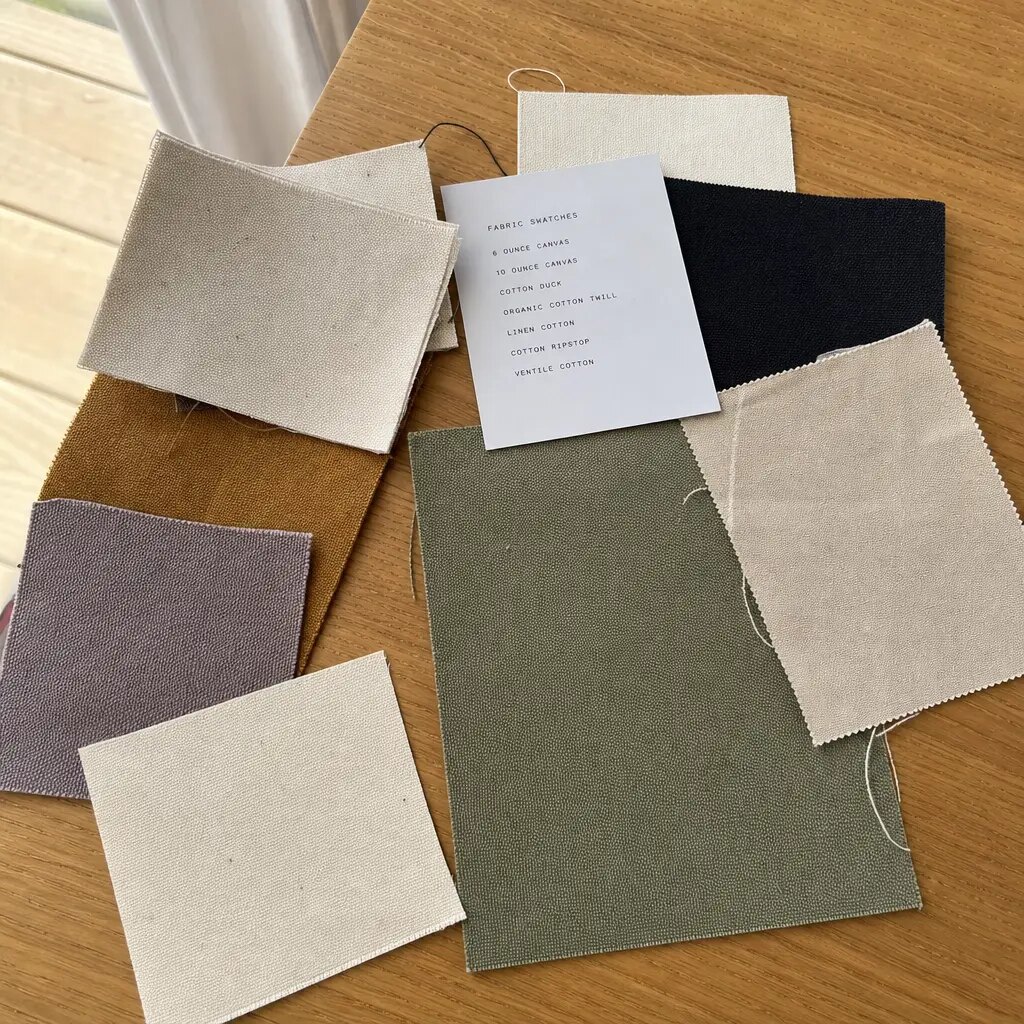
Natural cotton needs an approved visual standard. Seed specks and mild flecking may support an unbleached look, but the buyer should define what is acceptable. Dyed or black cotton needs shade control and may need different print handling. Washed or softened fabric can change shrinkage and handfeel, so the supplier should confirm whether measurements are taken before or after finishing.
- Use lighter fabric when the pouch is a secondary package and freight cube matters.
- Use heavier fabric when the pouch is part of the retail value or will be handled repeatedly.
- Approve natural fleck level and shade before bulk production.
- Ask for GSM tolerance in writing; plus or minus 5 percent is common only when agreed.
- For washed finishes, confirm shrinkage, handfeel, and final measurement stage.
Match Print to Cotton and Folding
Screen printing is usually the most practical print method for simple coffee roaster logos on cotton drawstring pouches. It handles one-color and two-color marks efficiently and is repeatable for reorders. Heat transfer may be useful for fine detail, small text, or artwork that screen print cannot hold, but buyers should consider handfeel, cure, fold behavior, and the risk of blocking if pouches are packed too soon.
Artwork must be planned around sewing and packing. A logo too close to the drawstring channel may crease when the pouch is closed or folded. A large printed area may rub against adjacent pouches inside a tight inner bag. Small type may fill in if the fabric weave is loose or the ink deposit is too heavy. Dark fabrics may need an underbase, which can change cost and feel.
Ask for a printed strike-off when artwork detail is important. The approval should show print size, placement, color, line clarity, ink coverage, and behavior after folding. For bulk orders, print cure should be checked before inner packing begins. A print that looks fine in a flat photo but transfers ink or cracks after compression is not production-ready.
- Use screen print for most simple roaster marks and seasonal artwork.
- Keep print away from seams, channel bulk, and heavy fold pressure.
- Confirm minimum line thickness for the selected fabric and ink.
- For dark fabric, quote underbase cost and approve the added handfeel.
- Run fold and rub checks before the supplier seals inner packs.
Write an RFQ That Can Be Compared
A procurement-ready RFQ separates the real cost drivers: fabric weight, fabric color, finishing, cutting, sewing, cord, print method, print size, print colors, inner bags, export cartons, labels, carton marks, sampling, inspection, and shipment terms. If the buyer asks only for a unit price, each supplier fills in missing details differently. That makes the cheapest offer difficult to trust.
MOQ needs the same precision. A supplier may quote MOQ per size, per fabric color, per artwork, per print color, or per total order. Coffee roasters often buy for seasonal blends, limited gift sets, or several retail locations, so MOQ structure can decide whether a program is commercially workable. A low unit price may rely on larger print setup, unused fabric, or mixed packing that the receiving warehouse does not accept.
The supplier quote should include carton data with the unit price. Ask for pieces per inner bag, pieces per carton, carton dimensions, gross weight, net weight, cube, carton material, carton marks, and pallet estimate. Then compare landed cost per 1,000 pouches, not just the pouch price. This is where packing quality becomes visible in the numbers.
- Quote the same GSM, size, cord, print, and packing assumptions across suppliers.
- Ask whether setup charges are one-time, repeatable, or charged per artwork.
- Require carton data before purchase order approval, especially for LCL, air, or 3PL receiving.
- Separate mixed-SKU permission from mixed-SKU labeling rules.
- Keep the approved RFQ and carton plan as the reorder baseline.
Build the Carton Plan
Inner packs are the bridge between production counting and warehouse receiving. For cotton drawstring pouches, 25 or 50 pieces per inner bag is often practical, but the best count depends on pouch size, GSM, cord bulk, print area, tags, and whether the buyer needs fast receiving counts. Inner bags should be defined as sealed, taped, zip-style, or open-top. If the shipment has multiple SKUs, each inner bag should carry SKU, size, artwork, color, quantity, and PO information.
Export carton counts often land between 200 and 500 pieces, but that is only a starting range. Small flat pouches may pack efficiently at the higher end. Larger pouches, heavier fabric, thick cotton cord, side labels, or individual retail bags may require fewer pieces to avoid bulging cartons or rubbing print panels. The carton should remain liftable, stackable, and strong enough for the route.
Carton marks should match the receiving process. At minimum, buyers usually need PO number, SKU, item description, quantity, carton number, gross weight, net weight, carton dimensions, country of origin, and destination. If a 3PL requires barcode labels, provide the format before production packing starts. Late label changes are easy to request but expensive to fix once cartons are sealed.
- Define pieces per inner bag and pieces per export carton by SKU.
- Use 5-ply export cartons for import routes or multi-handling shipments.
- Set a maximum carton gross weight if the warehouse has manual lifting limits.
- Avoid mixed-SKU cartons unless receiving has approved the process.
- Require packed-carton approval for first orders and spec changes.
Worked Carton and Freight Example
The following example is not a universal standard; it is a planning model a buyer can adapt. Assume a coffee roaster orders 10,000 cotton drawstring pouches for a 12 oz coffee accessory kit. Finished pouch size is 7 x 9 in, natural plain weave cotton, 180 GSM, one-color screen print, 3 mm cotton cord, no individual retail bag, and 50 pieces per inner polybag.
The factory proposes 400 pieces per export carton, packed as 8 inner bags of 50. Carton size is 50 x 40 x 35 cm, or about 19.7 x 15.7 x 13.8 in. Estimated net weight is 15.2 kg per carton, based on about 38 g per pouch including cord. Estimated gross weight is 17.0 kg after inner bags, carton, tape, and labels. Carton cube is 0.070 CBM, calculated as 0.50 x 0.40 x 0.35 m.
For 10,000 pieces, the shipment uses 25 cartons. Total net weight is about 380 kg. Total gross weight is about 425 kg. Total cube is 1.75 CBM before pallets. If the buyer ships by LCL sea freight, freight is likely driven by CBM because the shipment is light for its volume. If the forwarder uses 1 CBM = 1,000 kg for ocean revenue ton, the chargeable measure is 1.75 revenue tons, not 425 kg.
If the same order ships by air using a common volumetric divisor of 6,000 for centimeters, one carton has volumetric weight of 11.67 kg, calculated as 50 x 40 x 35 / 6,000. Actual gross weight is 17.0 kg, so air chargeable weight would likely use actual weight: 25 x 17.0 kg = 425 kg. If the cartons were larger, such as 60 x 45 x 40 cm, volumetric weight would become 18.0 kg per carton and air cost would rise even if the pouch price stayed the same.
For pallet planning, assume a 120 x 100 cm pallet and carton footprint of 50 x 40 cm. One layer can fit 6 cartons using a simple 3 by 2 layout. Four layers equal 24 cartons, with carton stack height of 140 cm plus pallet height. That covers 9,600 pouches on one pallet, with one remaining loose carton or a second partial pallet depending on carrier rules. If the DC limits pallet height to 150 cm including pallet, four layers may be too high after adding pallet height and stretch wrap, so three layers may be required.
This example shows why carton dimensions belong in the quote. A change from 400 to 300 pieces per carton would increase the order from 25 to 34 cartons. If carton size stayed similar, total cube would rise from 1.75 CBM to 2.38 CBM. A buyer comparing suppliers on unit price alone would miss that difference until the freight quote arrives.
- Example spec: 7 x 9 in pouch, 180 GSM cotton, 3 mm cord, 50 pcs per inner bag, 400 pcs per carton.
- Example carton: 50 x 40 x 35 cm, 0.070 CBM, 15.2 kg net, 17.0 kg gross.
- Example order: 10,000 pcs equals 25 cartons, 1.75 CBM, 380 kg net, 425 kg gross.
- Example pallet: 120 x 100 cm pallet fits 6 cartons per layer; pallet height rules decide whether 3 or 4 layers are acceptable.
- Use supplier-specific weights and dimensions for final costing because fabric, cord, fold method, and carton board change the math.
Approve the Packed Carton
A pouch sample confirms fabric, sewing, cord, and print. It does not confirm that the bulk order will be packed correctly. Many bulk problems appear only after folding and compression: print rub, blocked ink, trapped moisture, uneven cord length, wrong inner counts, bulging cartons, split tape seams, or carton dimensions that do not match the freight estimate.
A good approval sequence starts with a blank sample for construction, then a printed sample for artwork, then a pre-production sample for final materials and workmanship. For first orders, larger orders, or multi-SKU programs, add a packed-carton approval. The supplier should show the fold method, inner pack count, carton layout, carton dimensions, gross weight, carton marks, and label position.
Photos are useful, but a short packing video can reveal details a photo misses. It shows whether workers are forcing pouches into the carton, whether prints are rubbing face-to-face, whether inner bags are counted cleanly, and whether the sealed carton holds shape. This small approval step can prevent freight disputes and receiving delays.
- Approve blank construction before print tooling when size or closure is uncertain.
- Approve printed samples before bulk production when logo detail matters.
- Approve one packed carton before shipment when carton cube or receiving labels are important.
- Include tags, cards, inserts, or retail labels in the packed-carton approval if they ship with the pouch.
- Keep approval photos and carton data with the purchase order for reorder comparison.
Inspect What Affects Commerce
Quality control should focus on defects that change the buyer's commercial outcome. The important checks are finished size, fabric weight, print placement, print legibility, seam strength, drawstring function, shade, cleanliness, count accuracy, and carton condition. Natural flecks may be acceptable on unbleached cotton if they were approved. Open seams, unreadable logos, missing cords, mildew odor, oil stains, and carton shortages are not acceptable just because the item is a soft sewn pouch.
Define major and minor defects before production. Major defects may include wrong fabric, wrong size beyond tolerance, severe shade mismatch, missing drawstring, seam failure, stained fabric, unreadable print, incorrect print position, wrong artwork, or wrong carton count. Minor defects may include loose thread ends beyond an agreed length, small natural flecks within the approved range, or slight print variation outside the main logo area.
Inspection should include cartons, not only loose pouches. Randomly measure samples from several cartons, pull the drawstrings, check print against the approved sample, recount inner bags, and verify carton marks against the packing list. Inspect carton strength, tape sealing, crushed corners, moisture marks, and pallet stability. A good pouch in the wrong carton still creates a receiving problem.
- Sample from multiple cartons and multiple layers, not only the easiest top carton.
- Check print cure before accepting compressed inner packs.
- Pull each inspected drawstring several times to catch channel binding and weak knots.
- Recount inner bags and compare carton totals to the packing list.
- Reject or sort cartons with wrong marks when receiving depends on SKU-level labels.
Specification comparison for buyers
| Buying decision | Good starting point | Adjust when | Commercial risk to verify |
|---|---|---|---|
| Pouch use case | Define whether the pouch is for coffee samples, accessories, retail merch, gift kits, event giveaways, or in-store reuse | The pouch must close around a rigid mug, tin, scoop set, boxed grinder part, filter pack, or multi-item kit | A pouch can meet the flat size drawing but fail the actual fill, closure, or shelf presentation |
| Fabric weight | 170 to 190 GSM for light accessory or sample pouches; 210 to 230 GSM for more structured gift or merch pouches | The artwork is large, the pouch is black or dyed, the pouch is repeatedly opened, or the buyer wants a heavier handfeel | Heavier fabric reduces pieces per carton and increases freight cube; lighter fabric can look thin or show contents |
| Fabric type | Plain weave cotton with an approved shade and fleck standard | Canvas-like handfeel, washed finish, dyed fabric, or tighter shade control is required | Unapproved slub, shade drift, shrinkage, or loose weave can change print sharpness and finished size |
| Finished size tolerance | Plus or minus 0.25 in for small pouches; plus or minus 0.5 in for larger simple pouches | The pouch holds a rigid product, fits a display tray, or must align with a kit carton | Loose tolerance can cause closure issues, poor kit fit, and uneven retail presentation |
| Print method | 1-color or 2-color screen print for most roaster logos | Artwork has fine gradients, very small text, photographic detail, or dark fabric needing an underbase | Wrong method can create ink spread, cracking, plastic handfeel, slow cure time, or print rub inside inner packs |
| Cord and closure | 3 to 4 mm cotton cord for a natural look; polyester cord when smoother repeated opening matters | The pouch is filled by store staff, used as reusable merch, or needs faster closure in a packing line | Cord length variation, rough channel sewing, and weak knots slow packing and create visible quality complaints |
| Inner pack | 25 or 50 pcs per labeled inner bag | Pouches are large, heavily printed, tagged, individually bagged, or easily creased | No inner pack can raise dust and count risk; overcompressed inner packs can mark print panels |
| Export carton | 5-ply export carton, normally 200 to 500 pcs depending on pouch bulk and handling limit | Carton gross weight exceeds warehouse policy, cartons are palletized high, or route includes multiple handling points | Weak or oversized cartons lead to corner crush, burst seams, repacking cost, and freight estimate changes |
| Carton data | Require pcs/carton, carton dimensions, net weight, gross weight, cube, marks, and pallet estimate on the quote | Buying multiple SKUs, using a 3PL, quoting LCL/air freight, or calculating landed cost | Without carton math, suppliers cannot be compared on landed cost or receiving efficiency |
Buyer checklist before sampling
- Define the pouch role: coffee sample, accessory pouch, retail merchandise pouch, event giveaway, subscription insert, gift-set wrap, or refillable store-use pouch.
- Send finished pouch size as width x height measured flat after sewing, and include channel height, seam allowance expectation, and closure style.
- Provide the actual fill item dimensions or a dimensionally accurate substitute when the pouch must close around a rigid or multi-item kit.
- Specify fabric composition, weave, target GSM, GSM tolerance, color standard, fleck tolerance, and whether the finish is unwashed, washed, softened, bleached, dyed, or black.
- List print method, artwork size, artwork colors, print position, safe distance from seam and channel, minimum line thickness, and whether print must pass rub or fold checks.
- Define drawstring material, cord diameter, color, pull style, knot style, cord-tip finish, and acceptable cord-length tolerance.
- State inner pack quantity, inner bag material or style, sealed versus open-top packing, and whether each inner pack needs a SKU or barcode label.
- Set carton requirements: pieces per carton, carton dimensions, max gross weight, carton board strength, tape method, carton marks, and mixed-SKU rules.
- Ask for a worked packing estimate with carton cube, net weight, gross weight, cartons per pallet, pallet height, and total shipment cube.
- Require a packed-carton approval photo or video before mass shipment, especially for first orders, large orders, or multi-SKU programs.
Factory quote questions to send
- What finished size are you quoting, and is it measured flat after sewing or at another stage?
- What fabric weight, weave, finish, and GSM tolerance are included in the price?
- How will natural cotton flecks, dyed shade variation, shrinkage, and lot-to-lot color difference be controlled?
- What print method is included, what artwork size is assumed, and what changes if the logo uses two colors or needs an underbase?
- What is the safe print area for this size, including distance from the side seam, bottom seam, drawstring channel, and fold line?
- What cord material, diameter, color, pull style, knot style, and cord-length tolerance are included?
- How many pieces go into each inner bag, how many inner bags go into each export carton, and are inner bags labeled?
- What are the proposed carton dimensions, carton board specification, net weight, gross weight, and cube for each SKU?
- For a sample order quantity such as 10,000 pcs, how many cartons, pallets, total CBM, and estimated chargeable weight should we expect?
- Does the MOQ apply per size, per fabric color, per artwork, per print color, or across the full order?
Quality-control points to confirm
- Confirm fabric GSM against the agreed tolerance before all goods are packed; plus or minus 5 percent is common only when written into the order.
- Measure finished pouch width, height, and channel height from multiple cartons, not only from the first top bundle.
- Check the pouch with the intended fill item when closure, kit fit, or display presentation is commercially important.
- Inspect print for correct position, color, tilt, ghosting, pinholes, bleeding, missing strokes, excessive ink spread, poor cure, blocking, and fold cracking.
- Run a simple dry rub and fold check on printed areas before approving compressed inner packing.
- Inspect side seams, bottom seams, and drawstring channels for open seams, skipped stitches, broken stitches, needle damage, loose threads, and uneven channel width.
- Test drawstrings for smooth pull, even length, secure knots, clean closure, no binding, and no missing or frayed cord ends.
- Check fabric for oil marks, mildew odor, water marks, shade variation beyond standard, heavy slub outside tolerance, broken yarns, and unacceptable contamination.
- Recount random inner bags and export cartons against the packing list before shipment release.
- Verify export cartons for correct marks, carton count, gross weight, tape sealing, corner strength, moisture exposure, crushed panels, and pallet stability.