Why carton packing affects pouch cost
For a wine club, a cotton drawstring pouch is often one small part of a larger member shipment. It may hold a corkscrew, bottle stopper, tasting card, welcome note, gift insert, or branded accessory. Before the member sees it, the pouch has to pass through sewing, decoration, folding, carton packing, freight handling, receiving, storage, and usually a 3PL kitting line. Carton packing therefore belongs in the pouch specification, not in a last-minute email after the unit price is approved.
The expensive problems are usually operational rather than complex. A carton may contain the wrong count. Two artwork versions may be mixed without a map. Printed pouches may be packed before the ink is cured. A label may use the factory's item name instead of the warehouse SKU. A weak carton may bulge on a pallet. The pouch itself may still look acceptable, but the receiving team loses time opening, recounting, relabeling, or quarantining cartons.
A clear RFQ should price the pouch as it will actually arrive: finished, folded, packed, labeled, and ready for warehouse intake. This gives procurement a fair comparison between suppliers and prevents the lowest unit price from hiding extra labor at the 3PL.
- Put inner pack count, master carton count, carton grade, label format, and carton marks on the PO or approved specification sheet.
- Share 3PL receiving rules before production starts, especially barcode and carton-number requirements.
- Treat wrong count, wrong SKU, and wrong carton label as shipment defects, not minor paperwork issues.
Match the pouch to the use case
Start with the item going inside the pouch. A slim corkscrew pouch, a stopper set pouch, and a tasting card holder do not need the same usable opening, fabric body, or carton space. A member-facing gift pouch may justify heavier cotton and a cleaner fold, while an internal kit component may prioritize count accuracy and dense packing.
Measure the real insert or accessory, including its thickest point. For printed cards, test the card size, stack thickness, and whether corners catch on the side seam. For corkscrews or rigid accessories, check the usable opening rather than the flat outside width. Seam allowance and drawstring channels reduce real loading space, so a pouch can meet the nominal size and still slow down a kitting line.
For many wine club accessory programs, 140-180 GSM cotton canvas or twill is a practical starting range to sample, not a universal rule. Lighter fabric can improve carton yield and cost. Mid-weight fabric usually gives a stronger handfeel for gifts. Heavier fabric can look more substantial but may reduce pieces per carton and increase freight. Confirm the choice with physical samples and packed-carton review.
- Specify finished width, finished height, usable opening, and channel height.
- Test fit with the actual insert, not only a drawing.
- Review sample weight, handfeel, print result, fold thickness, and carton yield together.
Define fabric, cord, and construction
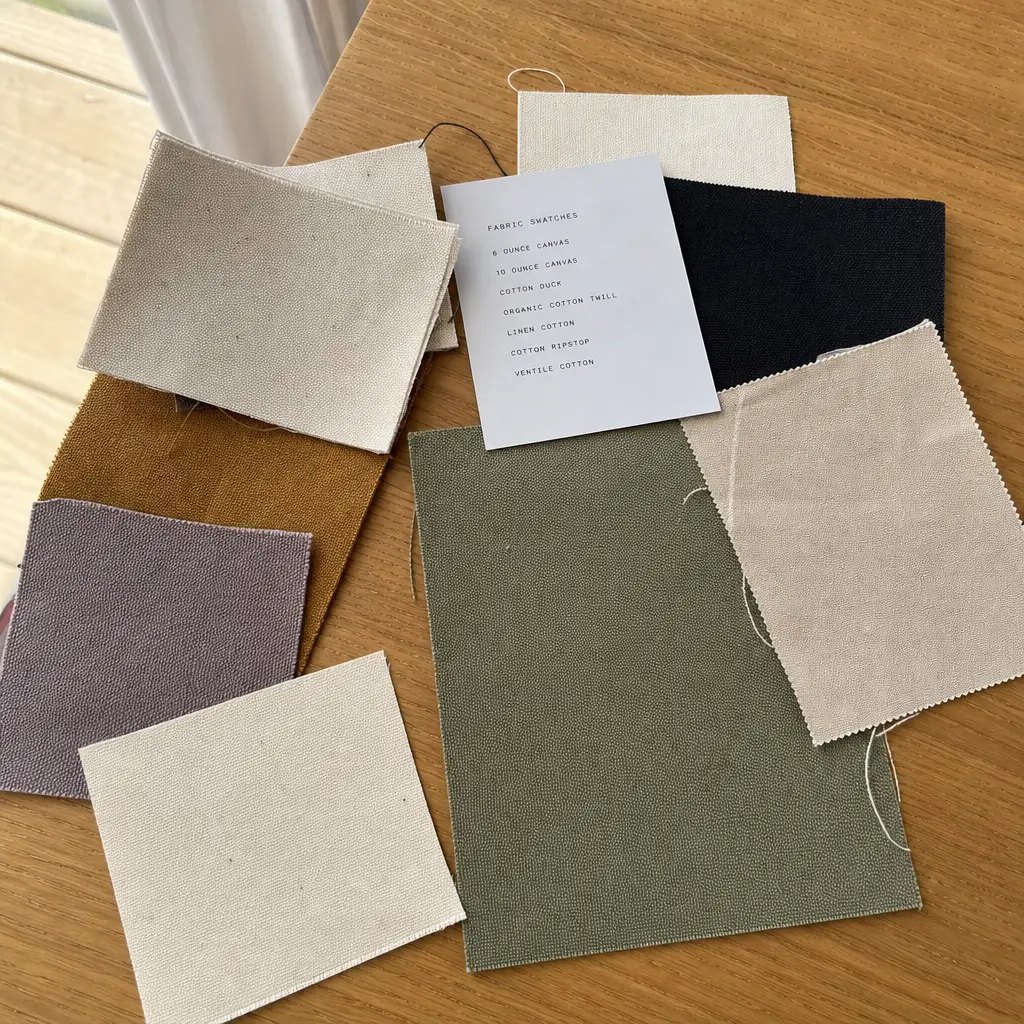
The phrase cotton pouch is too broad for procurement. It can mean muslin, canvas, twill, plain weave cotton, natural cotton, bleached cotton, dyed cotton, or a recycled cotton blend. These fabrics do not print, sew, shrink, fold, or compress the same way. The RFQ should name the fabric construction when possible, target GSM, color, and finish such as natural, bleached, dyed, washed, or pre-shrunk.
GSM tolerance should be written into the quote and confirmed by the supplier. A range such as +/- 5% to +/- 8% is often used as a starting point for cotton pouch fabric, but the right limit depends on fabric source, finishing, and order size. Keep an approved swatch or signed sample as the handfeel and shade standard. Natural cotton flecks may be acceptable if agreed, while oil marks, holes, stains, heavy slubs, and contamination should be treated as defects.
Cord details also need written control. Specify cotton cord, polyester cord, braided cord, flat tape, or another material; cord diameter; finished cord length; channel height; and knot method. A 3-5 mm cord is common for many small and medium pouches, but the pouch scale and channel construction should drive the final decision.
- Ask the supplier to quote the actual fabric construction, not only the word cotton.
- Control cord length and knot security so bundles do not tangle and finished pouches look consistent.
- Reject open seams, skipped stitches, broken stitches, loose thread loops, and channels that stop smooth drawstring movement.
Choose decoration that survives packing
Decoration must survive folding, stacking, and carton compression. A logo can look clean on a flat sample but scuff, crack, block, or transfer when packed too soon or folded across the wrong area. Digital artwork approval is useful for layout, but it does not replace a physical strike-off on the actual fabric.
One-color screen print is often practical for winery logos and club marks, especially when the artwork avoids tiny type and thin lines. Multi-color screen print needs registration control. Heat transfer can hold finer detail, but buyers should check handfeel, edge lift, cracking, and bending at the fold. Woven labels can support premium repeat programs, but they add checks for orientation, stitch quality, fray, and placement.
Placement should be measured from fixed reference points, such as centered horizontally with the top of the logo a defined distance below the drawstring channel. If brand color matters, use a Pantone reference, approved physical standard, or signed strike-off. Printed pouches should be dry and cured before folding or stacking so they do not transfer ink to neighboring pieces.
- Approve decoration on the actual fabric color and finish.
- Set logo placement tolerance, commonly +/- 3-5 mm unless tighter control is required.
- Inspect the logo after folding and stacking, because that is closer to the warehouse and member experience.
Select the right inner packing
Inner packing should match the receiving and kitting workflow. Loose bulk packing uses less material and may reduce packing labor, but it makes counting slower and increases wrinkle or scuff risk. Bundled inner packs, often 25, 50, or 100 pieces, help warehouses verify counts faster. Individual polybags protect presentation but add material, labor, carton volume, and disposal considerations.
The best choice depends on the pouch use. A blank internal accessory pouch may be fine in bundled packs. A light natural cotton pouch with a dark print may need face-to-face stacking control or individual protection. A premium gift pouch that will be handled directly by the member may need a cleaner fold and more protection than a component that stays inside a kit.
Write the exact method into the specification. If bundles are used, define pieces per bundle, bag type, sealing method, and inner label. If individual polybags are used, define polybag size, venting if required, warning text if required, barcode label if required, and fold orientation. If loose packing is accepted, state that it is approved and still require exact carton count.
- Choose loose, bundled, or individual packing before comparing quotes.
- Match inner pack quantities to how the warehouse counts and stages components.
- Confirm whether added packing changes pieces per carton and freight estimate.
Build the master carton specification
The master carton specification should be complete enough for production, QC, freight, and receiving teams to use without interpretation. Include SKU, pouch description, finished size, color, artwork version, pieces per inner pack, inner packs per carton, total pieces per carton, carton dimensions, board grade or ply, gross weight, net weight, carton mark, barcode label, and pallet requirement if applicable.
Single-SKU cartons are the safest default for wine club fulfillment. One carton should contain one pouch size, one fabric color, one cord color, one artwork version, and one count. This reduces receiving errors and makes picking easier during kit assembly. Mixed cartons should be used only when there is a written carton map and the outside label clearly states the contents.
Cartons should be designed for a clean fill, not maximum compression. Overfilled cartons bulge, strain tape seams, and can crush the top layer. Underfilled cartons shift and waste freight space. Ask the supplier for carton dimensions, board grade or ply, estimated gross weight, and total carton count before PO release. If the receiving site handles cartons manually, confirm its weight limit rather than assuming a standard; many buyers use 15-20 kg as a practical planning range when no special equipment is involved.
- Require single-SKU cartons unless a mixed-carton map is approved.
- Define total pieces per carton and whether final partial cartons are allowed.
- Avoid vague terms such as standard export carton unless the supplier defines the board, size, count, and tape method.
Compare quotes on the same basis
Two pouch quotes can look similar while including different services. One supplier may include bundled inner packs, single-SKU cartons, barcode labels, and stronger corrugated cartons. Another may price loose packing, mixed cartons, light board, and no barcode work. Procurement should compare the packed and labeled cost, not only the sewn pouch unit cost.
Give every supplier the same finished size, fabric target, cord specification, decoration method, inner pack count, master carton count, carton label fields, sample requirement, and inspection requirement. Then ask each supplier to list exceptions in writing. A useful quote should show unit price, setup charges, sample charges, packing material charges, label charges, MOQ, lead time, carton details, total carton quantity, and excluded services.
Carton yield belongs in the commercial review. Heavier fabric, larger sizes, fuller cords, and individual polybags can reduce pieces per carton and increase freight. Lighter fabric can improve density but may weaken perceived value. Ask for pieces per carton, carton dimensions, gross weight, and estimated carton count so logistics can estimate landed cost before the order is committed.
- Compare export-ready, labeled, packed cost.
- Request separate lines for setup, labels, special packing, palletization, and inspection support.
- Keep final carton dimensions, carton count, and gross weight in the approved order record for reorders.
Manage MOQ, SKU splits, and overage
MOQ is rarely just one number. Minimums can apply by fabric color, pouch size, cord color, artwork, decoration method, label type, and packing configuration. A blank natural cotton pouch may carry a lower MOQ than a dyed pouch with custom print, individual polybag, barcode label, and special carton mark.
Ask for MOQ and price breaks by SKU, not only by total order quantity. A 10,000-piece program can become several small production lots if it includes multiple colors, two sizes, three club tiers, and separate artwork versions. Each split can require separate cutting, printing setup, carton labels, packing records, and inspection checks. More variants also create more chances for mixed cartons or wrong labels.
Define overage and shortage tolerance before PO release. Suppliers may ask for a production tolerance for sewn goods, but carton count should be handled separately. A master carton should not be short unless it is a clearly marked final partial carton and the buyer has approved that treatment. If exact quantity by SKU is required, state it clearly and ask the factory to confirm feasibility.
- Request MOQ by color, size, artwork, cord, and packing method.
- Simplify variants when the marketing benefit does not justify the handling risk.
- Require exact carton counts except for an approved final partial carton.
Approve samples and packed proof
A flat pouch sample is necessary, but it does not prove that the shipment will receive cleanly. It can show fabric handfeel, sewing quality, logo scale, and drawstring function. It does not prove inner pack count, master carton count, carton fill, label placement, barcode scanability, compression behavior, or how the pouch looks after storage in a carton.
For new suppliers, complex SKU splits, printed pouches, or 3PL receiving programs, approve more than the pouch. Request a pre-production sample made with actual fabric, cord, decoration, and finished construction. For the packing plan, request a packed carton sample or a complete photo set showing folded pouches, inner packs, open carton fill, sealed carton, carton label, barcode label, and gross weight reading.
Version control prevents avoidable errors. The approved pouch sample, artwork file, measurement sheet, carton mark template, packing instruction, and PO should share a revision date or version number. For seasonal wine club drops, archive the final approved specification so the next order does not rely on memory.
- Test the sample with the actual insert or accessory.
- Scan barcode labels before bulk label printing if the 3PL requires barcoded receiving.
- Record sample and packing approvals with revision numbers.
Inspect before shipment release
Quality control works best in stages: product inspection before packing, in-process packing checks, and final carton inspection. This structure catches pouch defects before sealed cartons hide them and catches packing errors before they repeat across the shipment.
Before packing, inspect fabric, measurements, sewing, cord, and decoration. Measure finished width, height, channel height, and usable opening after sewing. Check GSM against the approved range. Open and close the drawstring several times. Review print color, opacity, edge clarity, placement, curing, and transfer risk. For woven labels, check alignment, stitching, orientation, and fray.
During packing, confirm pieces per inner pack, inner packs per carton, and total pieces per carton. Verify that cartons remain single-SKU unless a written mixed-carton map has been approved. After sealing, check carton marks, barcode scanability, tape method, carton condition, gross weight, and packing list accuracy. Gross weight is a useful warning check for short counts or mixed contents, but it does not replace physical counting.
Buyers can use an AQL-based plan for workmanship and a stricter rule for critical packing failures. Wrong SKU, wrong carton count, wrong barcode, and unapproved mixed cartons should trigger shipment hold or expanded inspection because they affect receiving and fulfillment directly.
- Inspect product quality before cartons are sealed.
- Open random sealed cartons during final inspection.
- Hold shipment for wrong SKU, wrong carton count, wrong barcode, or unapproved mixed cartons.
Specification comparison for buyers
| Packing option | Best fit for wine club orders | What to specify in the RFQ | Main buyer risk |
|---|---|---|---|
| Loose bulk in master cartons | Low-cost blank pouches where wrinkles and manual counting are acceptable | Single SKU per carton, exact pieces per carton, carton dimensions, gross weight, and whether cartons are lined | Fast to pack but slower to receive; higher risk of wrinkles, scuffing, count disputes, and mixed contents |
| Bundled inner packs | Most accessory, welcome kit, and 3PL kitting programs | Pieces per bundle, bundles per carton, inner bag label, sealing method, and total pieces per master carton | If bundle count is wrong, the error repeats across receiving and kit assembly |
| Individual polybags | Light-colored, premium printed, dust-sensitive, or consumer-ready pouches | Polybag size, venting if required, warning text if required, barcode or SKU label, and orientation of folded pouch | Adds material, labor, carton volume, and disposal concerns; may lower pieces per carton |
| Single-SKU cartons | Preferred default for wine club fulfillment and repeat replenishment | One size, color, cord, artwork, and count per carton; carton number sequence and matching packing list | Requires more carton planning when there are many variants, but reduces receiving and picking errors |
| Approved mixed cartons | Small SKU splits, sample allocations, or pre-planned kit staging | Written carton map, exact SKU quantities, external mixed-carton label, and packing list line detail | Unmapped mixed cartons force warehouse teams to open, sort, and recount inventory |
| Export carton with warehouse labels | Direct-to-3PL or import shipments where receiving speed matters | Carton board grade or ply, tape method, label fields, barcode format, gross/net weight, dimensions, and pallet label rules | Weak cartons or incorrect labels can delay receiving even when the pouches are acceptable |
Buyer checklist before sampling
- Define the use case: corkscrew pouch, stopper pouch, tasting card holder, welcome kit component, bottle accessory bag, retail gift pouch, or internal kitting pouch.
- Give the supplier finished pouch width, finished height, usable opening, drawstring channel height, fabric construction, target GSM, cord material, cord diameter, and decoration method.
- State practical tolerances as starting points to confirm with the supplier, such as finished size +/- 5 mm, logo placement +/- 3-5 mm, and GSM +/- 5% to +/- 8%.
- Ask for pricing by SKU, including pouch size, fabric color, cord color, artwork version, inner packing method, carton count, and carton label requirement.
- Choose the packing method before quote comparison: loose bulk, bundled inner packs, individual polybags, single-SKU cartons, or approved mixed cartons.
- Define pieces per inner pack, inner packs per master carton, total pieces per carton, and whether a final partial carton is allowed.
- Require single-SKU cartons unless a mixed-carton map is approved in writing with SKU, quantity, and external label format.
- Request carton dimensions, board grade or ply, estimated gross weight, net weight, tape method, total carton count, and stacking guidance as supplier-provided estimates to verify.
- Provide final carton mark fields required by the warehouse: PO number, SKU, item description, pouch size, color, quantity, carton number, gross weight, net weight, dimensions, origin, and barcode data if required.
- Approve a pre-production sample using actual fabric, cord, decoration, finished size, fold method, and packing method before bulk production.
Factory quote questions to send
- Are you quoting finished pouch dimensions after sewing, or cut-panel dimensions before sewing? What tolerance applies to width, height, channel height, and usable opening?
- What fabric construction is included: cotton canvas, cotton twill, muslin, recycled cotton blend, or another material? What target GSM and GSM tolerance are you quoting?
- Is the fabric natural, bleached, dyed, washed, pre-shrunk, or otherwise finished? How will shade variation and shrinkage be controlled for repeat orders?
- What cord material, cord diameter, finished cord length, knot method, and drawstring channel construction are included in the unit price?
- Which decoration method is priced: one-color screen print, multi-color screen print, heat transfer, woven label, embroidery, or blank pouch?
- What setup charges are separate: screen charge, film charge, transfer setup, label tooling, artwork adjustment, sample fee, repeat setup, or barcode label setup?
- What logo placement tolerance, print color control, curing check, rub check, or adhesion check will you use before packing?
- How many pieces are packed per inner pack, how many inner packs go into each master carton, and how many total pieces are packed per carton?
- Are cartons single-SKU by default, or does the price assume mixed sizes, colors, cords, or artwork versions in the same carton?
- What master carton dimensions, board grade or ply, estimated gross weight, estimated net weight, carton quantity, tape method, and carton label method are included?
Quality-control points to confirm
- Fabric GSM is checked against the approved specification and tolerance, with no unacceptable shade variation, contamination, oil marks, heavy slubs, holes, or inconsistent handfeel across sampled cartons.
- Finished pouch width, height, drawstring channel height, and usable opening are measured after sewing using the approved measurement diagram and agreed tolerance.
- Seams are straight and secure, with no open seams, skipped stitches, loose thread loops, broken stitches, severe puckering, or missing back-tacks where reinforcement is required.
- Drawstring cord material, diameter, finished length, knot security, and movement through the channel match the approved sample and do not snag during repeated opening and closing.
- Logo size, color, placement, opacity, registration, and edge clarity match the approved strike-off or signed standard, with no smearing, cracking, blocking, print-through, or major off-center decoration.
- Printed or transferred pouches are fully dry and cured before folding, stacking, or carton packing, so ink or adhesive does not transfer to neighboring pouches or inner bags.
- Woven labels, if used, are aligned, securely stitched, correctly oriented, and free from frayed edges that affect presentation.
- Inner pack quantity matches the packing instruction; each inner pack is sealed, vented, labeled, or left open exactly as approved by the buyer.
- Master cartons contain the approved SKU and count, with no mixed color, size, cord, or artwork version unless the written mixed-carton map is followed.
- Carton marks, PO labels, barcode labels, carton numbers, gross weight, net weight, dimensions, and origin marking match the buyer's final template and packing list.