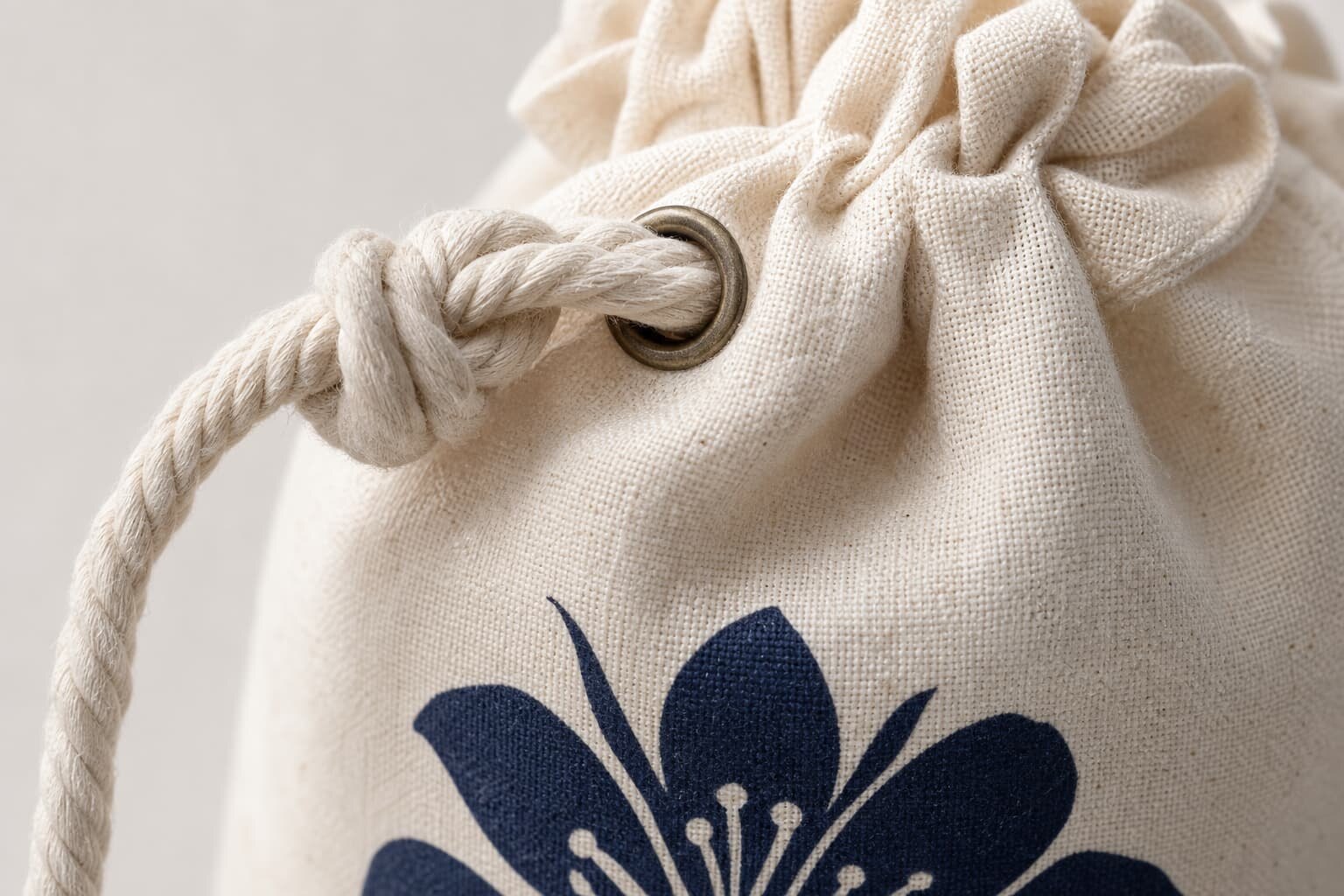
Why Bulk Quotes Often Change After Sampling
A cotton drawstring pouch looks simple, but factory quotes can move quickly when the RFQ does not define the construction. Two suppliers may both quote a 10 x 15 cm natural cotton pouch, but one may use thin plain cotton, narrow cord, loose packing, and a smaller print area while another includes heavier cotton canvas, stronger seams, inner bags, and a more controlled print process. The first quote looks cheaper until the buyer requests a better sample.
The main buying problem is not finding the lowest unit price. It is making every supplier price the same pouch so procurement can compare offers without hidden assumptions. A useful RFQ should remove guesswork around fabric weight, finished size, artwork, cord, packing, MOQ, and lead time. If those points are not fixed before sampling, the sample approval stage becomes a second negotiation.
- Do not request only a photo and size; request fabric weight, cord type, print method, and packing basis.
- Ask whether the quotation is based on finished size or cut fabric size before sewing.
- Separate one-time setup costs from unit price so repeat order economics are clear.
- Use the same RFQ sheet for every supplier to avoid comparing different constructions.
Define the Finished Size Before You Discuss Price
For drawstring pouches, size is not only width and height. The usable inside height is reduced by the drawstring channel, top fold, bottom seam, and natural fabric thickness. A buyer who needs to pack a candle, jewelry box, soap bar, charger, or promotional kit should measure the real product and allow space for the closure to gather. If the pouch is too short, the cord will close over the product instead of above it, which looks poor and may strain the seam.
Factories may quote from a finished flat size, a cut panel size, or a general catalogue size. For bulk quotes, always write the required finished size after sewing, such as 15 cm width x 20 cm height finished flat, with a tolerance. If the pouch must fit retail packaging, define the minimum usable internal size as well. This avoids a common dispute where the pouch technically matches the quoted size but fails the buyer's product fit test.
- Send product dimensions and product weight, not only the pouch size.
- State whether the pouch should close fully when the product is inside.
- Allow extra height for the drawstring channel and fabric gathering at the top.
- Confirm whether tolerance is plus or minus 0.5 cm, 1 cm, or another agreed range.
- Ask for one fit sample if the product has sharp corners, a rigid box, or a heavy item.
Choose Fabric Weight by Use, Not by Habit
Cotton pouch fabric is commonly discussed by GSM or ounce weight. Lightweight cotton can be suitable for low-cost event giveaways, dust bags, and small dry products. Heavier cotton or cotton canvas gives better body, stronger seams, and a more retail-ready feel. The right choice depends on the product inside, how long the pouch must be reused, and whether the printed logo should look crisp on the fabric surface.
As a practical starting point, many buyers consider 4 oz to 5 oz cotton for budget packaging, 6 oz to 8 oz for standard branded pouches, and heavier canvas for premium or repeated-use applications. However, GSM alone does not guarantee performance. Yarn count, weave density, finishing, washing, and natural slub all affect handfeel and print result. Request a fabric swatch or sample pouch rather than approving by a number only.
- Use lighter cotton when the pouch is mainly a dust cover and low freight weight matters.
- Use mid-weight cotton when the pouch must support branded presentation and moderate reuse.
- Use heavier canvas when the pouch carries hardware, glass, candles, tools, or dense gift items.
- Ask whether the fabric is bleached, unbleached natural, dyed, washed, or shrink-controlled.
- Do not assume two 6 oz fabrics from different mills will feel identical.
Printing Method Changes Cost and Risk
The print method should be chosen before the bulk quote is finalized. Screen printing is usually efficient for solid logos, simple text, and one to three color artwork. It can give a clean result on cotton if the fabric surface is stable and the ink is correctly cured. Heat transfer may fit gradients, small detail, or shorter artwork runs, but the handfeel, edge durability, and fabric compatibility should be checked. Embroidery is possible for some pouches, but it may pull light fabric and raise cost.
Artwork affects price through setup, color count, print area, registration time, and reject risk. A large solid ink block on natural cotton is not the same as a small one-color logo. Fine lines can fill in on textured fabric. Light ink on dark dyed cotton may need an underbase. If the buyer wants exact brand color, the RFQ should include Pantone references and clarify whether a reasonable fabric-print tolerance is acceptable.
- Send vector artwork when possible, not only a low-resolution JPG.
- Specify print size in centimeters and print location from the pouch edges.
- Ask for the maximum print area included in the quoted unit price.
- Request a print close-up photo during sampling and before bulk packing.
- Approve ink color on the real fabric, not on a screen image only.
Understand MOQ Logic Before Comparing Suppliers
Minimum order quantity for cotton drawstring pouches is not always a simple total piece count. It may depend on fabric color, fabric purchase minimum, print setup, cord color, cutting efficiency, and factory line changeover. A supplier may accept a smaller total quantity if the pouch uses stock natural cotton and one logo, but require a higher MOQ for custom dyed fabric, multiple sizes, or several printed designs.
Procurement teams should ask suppliers to break MOQ down clearly. If an order contains three sizes and four artwork versions, the factory needs to know whether each combination reaches a practical production volume. Without this, the first quote may be based on one design only, then revised after artwork is separated. For distributors and retail buyers, quantity breaks are also useful because the best unit price may appear only when cutting, printing, and packing become efficient.
- Ask for MOQ per size, per fabric color, per artwork, and per print method.
- Request quantity breaks such as 1,000, 3,000, 5,000, and 10,000 pieces when relevant.
- Separate repeat-order MOQ from first-order MOQ if screen setup already exists.
- Check whether mixed sizes can share the same fabric lot and cord stock.
- Confirm whether overrun or underrun tolerance applies to custom production.
Build a Quote Sheet That Exposes Real Cost Drivers
A good bulk quote is more than a unit price. It should show what is included and what is excluded. For cotton drawstring pouches, the main cost drivers are fabric weight, pouch size, cutting yield, sewing complexity, cord material, print method, print colors, packing method, inspection requirement, and shipping term. If these are not visible, the buyer cannot understand why one supplier is cheaper or where a cost reduction is possible.
Use a structured quote sheet when buying from several factories. Ask each supplier to fill in the same fields and avoid accepting vague notes such as standard packing or normal cotton. Standard to one factory may mean very different things to another. If procurement needs to reduce cost, a clear sheet allows practical adjustment, such as reducing print size, changing from custom dyed fabric to natural cotton, or increasing carton quantity, without weakening the pouch blindly.
- Include unit price by quantity break and list any sample, screen, mold, artwork, or testing charges separately.
- Request Incoterms, port, carton data, and estimated CBM so freight cost can be compared.
- Ask whether the price includes hangtags, barcode labels, inner polybags, or retail packaging if required.
- Record fabric GSM, cord diameter, stitch type, and packing count in the quote sheet.
- Keep supplier assumptions in writing so the purchase order can match the approved quote.
Sampling Should Prove Construction, Not Just Appearance
A pre-production sample should verify the parts of the pouch that are most likely to cause bulk issues. The buyer should check finished size, fabric weight, seam strength, cord movement, print color, print placement, and packing presentation. A nice-looking sample made from available stock fabric is useful for style review, but it may not prove the final production if the bulk order will use a different fabric lot or dyed material.
For serious bulk orders, ask the factory to mark whether the sample is a reference sample, sales sample, or pre-production sample. A pre-production sample should use the intended fabric, cord, print method, and packing as closely as possible. If a substitute is used, the difference should be written down. This is especially important for natural cotton, where shade, specks, and texture may vary.
- Measure at least three sample points: width, total height, and usable height below the drawstring channel.
- Pull the cord several times to check smooth closure and whether the channel twists.
- Check the inside seam and bottom corners, not only the front print.
- Rub the print lightly after curing to check obvious transfer or poor adhesion.
- Photograph and seal the approved sample before bulk production starts.
Packing Decisions Affect Wrinkles, Counting, and Freight
Packing is often treated as a small detail, but it changes both presentation and landed cost. Cotton pouches can be bulk packed loose, folded in bundles, packed by inner polybag quantity, or prepared as retail-ready units with labels or barcodes. Loose packing may be cheaper but can create wrinkles, mixed counts, and more handling work at the buyer's warehouse. Retail packing improves receiving control but adds material, labor, and carton volume.
Before confirming a quote, ask for pieces per inner bag, pieces per carton, carton dimensions, gross weight, net weight, and estimated cubic meters. This helps the logistics team compare air, sea, courier, or consolidation options. For printed pouches, confirm whether the print surfaces touch each other in the carton and whether the ink is fully cured before packing. Poor packing can mark the logo even when the print process itself was correct.
- Use flat packing when print appearance and warehouse counting matter.
- Use inner polybag quantities that match the buyer's picking or distribution unit.
- Avoid over-compressed cartons for heavier canvas pouches or raised print areas.
- Specify carton marks, purchase order number, item code, size, color, and quantity.
- Request a packed carton photo or packing sample before final shipment.
Lead Time Should Be Split Into Milestones
A single lead time number can hide several steps. Cotton drawstring pouch production may include artwork checking, fabric sourcing, fabric dyeing or bleaching, sample making, sample approval, material booking, cutting, printing, sewing, trimming, packing, inspection, and export handling. If the buyer approves artwork late or changes the print after sampling, the production clock may restart.
For better planning, ask suppliers to quote lead time by milestone. This is especially important for seasonal retail programs, event campaigns, subscription boxes, and product launches where the pouch is part of a larger assembly. Procurement should also ask about factory holiday periods and material availability before placing the purchase order. A realistic schedule is more useful than a fast promise that leaves no inspection or rework buffer.
- Confirm sample lead time after artwork and fabric details are approved.
- Confirm bulk production time after deposit, sample approval, and material readiness.
- Add time for buyer inspection, carton correction, or document checking.
- Check whether custom dyed fabric requires additional lab dip or color approval time.
- Do not book final delivery dates before carton data and production status are confirmed.
Common Quote Mistakes That Create Production Claims
Most cotton drawstring pouch claims start from unclear expectations rather than difficult manufacturing. The buyer expected a thicker pouch, the factory quoted a lighter fabric. The buyer expected exact logo color, but Pantone and tolerance were not defined. The buyer expected the pouch to fit a boxed product, but only outside pouch dimensions were discussed. These problems are preventable if the RFQ describes function, appearance, and inspection criteria.
A practical way to reduce claims is to convert buyer preferences into measurable acceptance points. Instead of saying good stitching, define no open seams, no skipped stitches over a certain visible length, trimmed loose threads, and secure bottom corners. Instead of saying centered print, define placement tolerance from the top or side seam. The goal is not to overcomplicate a simple product, but to remove the unclear areas that cause arguments at shipment time.
- Do not approve bulk production from a photo only when color, fabric handfeel, or print durability matters.
- Do not compare quotes unless fabric GSM and pouch size basis are the same.
- Do not ignore cord length; short cords make opening difficult and long cords look untidy.
- Do not leave packing undefined if the pouch is part of a retail or kitting program.
- Do not rely on the word eco without specifying cotton type, finish, labeling, and documentation needs.
Specification comparison for buyers
| Spec decision | Recommended option | When it fits | Buyer risk to check |
|---|---|---|---|
| Fabric weight | 5 oz to 8 oz cotton for most retail and promo pouches | Cosmetics, candles, accessories, small gift packaging, event kits | Too light may show product corners and feel cheap; too heavy may increase freight and reduce drawstring closure flexibility |
| Fabric construction | Plain weave cotton or cotton canvas depending on handfeel target | Plain weave for soft budget pouches; canvas for stronger reusable packaging | Suppliers may quote different yarn counts under the same GSM, so request fabric photo, handfeel note, and sample |
| Closure cord | Cotton cord for natural look; polyester cord for lower lint and smoother pull | Cotton cord suits eco-style branding; polyester suits repeated opening and color matching | Cord diameter and knot security affect pull strength and final opening size |
| Printing method | Screen print for solid logos; heat transfer for gradients or fine detail | Screen print fits 1 to 3 color branding; transfer fits photographic artwork or small runs | Ink cracking, show-through, registration tolerance, and print placement must be approved on a physical sample |
| MOQ logic | Quote by size, fabric, print method, and colorway instead of one combined total | Useful when buying several pouch sizes for one campaign or product family | Combining sizes can hide setup costs and cause later price changes after artwork separation |
| Packing method | Flat packed in export cartons with inner polybag count agreed | Best for retail-ready pouches, ecommerce kitting, distributor stock, and warehouse receiving | Loose packing may wrinkle printed areas; over-compression may mark drawstrings or distort corners |
| Sample approval | Pre-production sample using bulk-intended fabric, cord, print, and packing | Needed before repeat orders, new artwork, new GSM, or size changes | A sample made from stock fabric may not represent final shrinkage, color, or print absorption |
| Lead time basis | Confirm sample days, material booking days, production days, and inspection window separately | Helps procurement plan launch dates and freight booking | A single lead time number often excludes artwork approval, fabric dyeing, holiday closure, and rework time |
Buyer checklist before sampling
- State finished pouch size as width x height, and clarify whether tolerance is before or after sewing and pressing.
- Confirm fabric type, GSM or ounce weight, color, shrinkage concern, and whether the pouch will be washed or unwashed.
- Send product weight, product dimensions, and intended use so the factory can judge fabric strength and closure size.
- Provide artwork files with Pantone references, print size, print location, and whether exact color matching is required.
- Ask suppliers to quote by quantity break, size, fabric, print method, cord type, packing method, and Incoterms.
- Request sample photos showing front, back, inside seam, drawstring channel, cord knot, print close-up, and packed unit.
- Define acceptable measurement tolerance, print position tolerance, color tolerance, loose thread standard, and carton marking.
- Check whether MOQ applies per size, per print design, per fabric color, or per total order value.
- Ask for carton dimensions, gross weight, net weight, pieces per carton, and estimated CBM before confirming freight mode.
- Keep one approved sealed sample and one approved packing reference for bulk inspection comparison.
Factory quote questions to send
- What fabric construction, GSM, and shrinkage range are you quoting for this cotton drawstring pouch?
- Is the quoted size the cut size or the finished sewn size after hemming and drawstring channel construction?
- What cord material, cord diameter, and cord color are included in the quotation?
- Does the MOQ apply per size, per artwork, per fabric color, or per purchase order total?
- Which print method is included, and what is the maximum print area for the quoted price?
- Are screen setup charges, sample charges, artwork separation charges, and packing charges included or listed separately?
- Will the pre-production sample use the same fabric lot, cord, and ink process planned for bulk production?
- What are the estimated sample lead time, material preparation time, bulk production time, and final inspection window?
- What packing method, inner quantity, carton quantity, carton size, and carton marking are included?
- What inspection standard and tolerance will you accept for size, print position, color, stitching, and drawstring function?
Quality-control points to confirm
- Measure finished pouch width and height on flat units, including enough samples from the beginning, middle, and end of production.
- Check fabric weight against the approved specification and compare handfeel with the sealed sample.
- Inspect drawstring channel width, cord movement, cord length, knot security, and whether both sides close evenly.
- Review stitching density, seam allowance, bottom corner strength, loose threads, skipped stitches, and broken needle marks.
- Check print adhesion, color consistency, registration, curing, cracking, bleeding, and placement tolerance.
- Confirm natural cotton shade or dyed fabric shade under consistent lighting, especially across multiple production lots.
- Verify packing count, folding method, inner bag quantity, carton strength, carton marks, and barcode or label placement if required.
- Perform a practical fit test using the buyer's actual product or a same-size dummy to confirm closure and presentation.