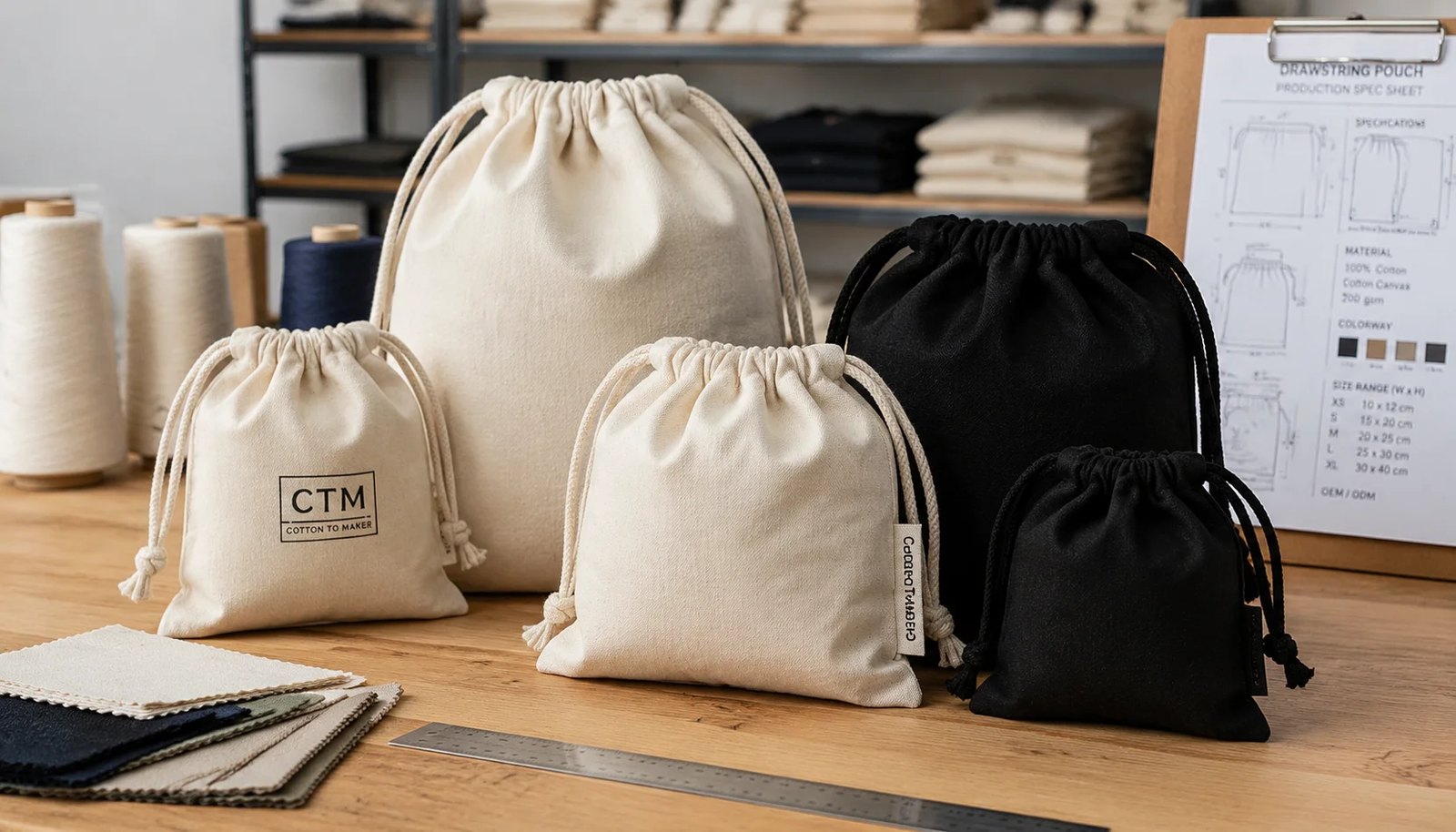
Why similar pouch quotes produce very different landed results
A cotton pouch quote can look simple: one size, one logo, one unit price. In practice, museum shop buyers are often comparing different products hiding under the same short description. One supplier may be quoting 200 GSM cloth, self-fabric ties, loose carton packing, and a small print. Another may be pricing 260 GSM cotton, braided cord, tighter size control, and barcode-ready packing. The first quote looks cheaper, but it may not support the same shelf appearance, packing workflow, or repeat-order consistency.
This matters because pouches in museum retail sit between packaging and merchandise. They may hold jewelry, ornaments, stationery, coins, soaps, or exhibition gifts, but they also shape perceived value. If the fabric feels limp, the logo sits crooked, or the opening channel catches when store staff pack units, the issue is not cosmetic only. It affects presentation, labor, and customer impression.
The practical buying move is to compare quotes by specification layer, not by headline price. Break the request into fabric weight, pouch dimensions, cord type, print method, sample route, packing, and shipment assumptions. Ask each supplier to quote the same baseline first. Let alternatives sit as optional lines rather than replacing the base specification.
Treat missing detail as risk. If a quotation does not state GSM, tolerance, sample stage, or carton count, the factory will still make those choices later. The difference is that the buyer loses leverage once production starts.
- Compare the same size, GSM, print area, cord, and packing format before reviewing unit price
- Ask suppliers to separate setup charges, sample fees, and retail-label labor from base product cost
- Request carton dimensions and units per carton early so freight is visible, not guessed later
- Use one comparison sheet internally so merchandising, procurement, and operations review the same assumptions
Start with the use case and shelf standard
The fastest way to get a weak quote is to ask for a museum pouch without explaining what it needs to do. A pouch for a boxed ornament is not the same as a pouch for postcards, a brass token, or a small book accessory. The filled weight, edge profile, and expected customer reuse all influence the right fabric and build.
Museum shops also vary in visual expectation. Some need a low-cost souvenir pouch that works as simple branded packaging. Others need a more giftable item that stands on its own as part of the purchase experience. If the pouch will sit front-facing beside premium exhibition merchandise, the hand feel and print neatness matter more than they do for a backroom replenishment pack.
A short application note improves quote accuracy immediately. For example: pouch for a ceramic ornament, filled weight about 180 g, sold as premium gift packaging, inserted in store, natural cotton base, one-color front logo. That tells the supplier more than a generic product name ever will.
Use case also informs operational details. If staff will insert products by hand, the opening width and cord movement matter. If the item is packed at source, the buyer should specify filled dimensions rather than relying on a flat sample that may become too tight once loaded.
- State what the pouch will hold and the approximate filled weight range
- Note whether the pouch is primary packaging, secondary packaging, or a sellable accessory
- Explain whether customer reuse is expected, because that often justifies heavier cloth and cleaner sewing
- Describe the shelf standard: budget souvenir, everyday gift-shop item, or premium exhibition packaging
Working fabric ranges and what they usually mean
For many museum shop programs, 220 to 280 GSM is the most practical band for a cotton drawstring pouch. It gives enough body for retail display, holds print reasonably well, and does not push freight weight as quickly as very heavy canvas. Within that band, 240 to 260 GSM is often a balanced comparison point for jewelry, stationery, small boxed gifts, and general souvenir packaging.
Below that range, 180 to 210 GSM can work for budget programs or lightweight contents. The tradeoff is that the pouch may look softer, wrinkle more readily, and feel less substantial in the hand. That can be acceptable when the pouch is mainly functional and the product inside carries the value. It is less effective when the pouch itself helps justify price perception.
Above that range, roughly 300 to 340 GSM creates a more premium feel and better structure for keepsake packaging. Buyers should still watch the commercial consequences. Heavier cloth increases material cost, raises carton weight, and makes the drawstring channel thicker. On some sizes, that can affect how smoothly the pouch closes unless the cord and channel dimensions are chosen carefully.
Natural cotton introduces a separate approval point: appearance. Flecks, slubs, and lot-to-lot shade variation can be normal. They are not automatically defects, but the buyer should decide what is acceptable before bulk production. For black or custom-dyed fabric, confirm whether stock shades are available or whether dyeing to order changes MOQ and lead time.
- 180 to 210 GSM: suitable for lighter-duty or lower-price programs
- 220 to 280 GSM: common working range for museum retail balance
- 300 to 340 GSM: stronger premium feel with higher freight and sewing impact
- Ask for GSM tolerance in writing so lighter substitution is not left open
- Approve natural-cotton appearance, not just the written fabric description
Print and branding choices buyers can compare quickly
The best print method follows the artwork and reorder plan. For one-color institutional marks or simple two-color graphics, screen print is usually the clearest commercial choice. It remains common because it is scalable, easy to cost across medium and larger runs, and practical for repeat orders where the museum wants a stable logo result.
Digital print is more useful when the design includes gradients, multi-color exhibition art, or short-run graphics that would be inefficient to separate into multiple screens. It can be the right answer for event-driven merchandise, but buyers should ask harder questions about repeat matching if the design may be reordered later.
Branding does not always need to sit on the front panel. A side label, small hem label, or understated one-color mark can be enough, especially when the institution wants a quieter presentation. Those choices can also reduce the risk of large print-area defects and keep the pouch more versatile across product lines.
What matters most is that the quote defines the branding route clearly: front or back, print area size, color count, reference colors, and whether a strike-off is included. Without that, suppliers may price very different levels of work under the same description.
- Screen print: usually best for simple repeat branding and larger volumes
- Digital print: better for art-heavy or shorter-run exhibition programs
- Side label or small woven label: useful when front branding should remain subtle
- Large print areas need closer review for cure, rub resistance, and packing marks
Construction choices that affect both price and defect risk
Construction is where many quotes remain too vague. Buyers usually specify size and print but leave top fold, channel style, and seam reinforcement open. That creates room for inconsistency later, especially when comparing multiple suppliers.
Start with the finished dimensions measured flat. Then clarify whether the pouch is straight-bottom or gusseted. Most museum shop pouches are straight-bottom, but a gusset can help if the item is boxed or needs a wider base. Next, define the closure as single pull or double pull. Double-pull closures are common for a fuller retail look, though they add cord handling and some labor.
Cord choice matters more than it first appears. Self-fabric ties, plain cotton cord, or braided cord each change appearance and handling. A slightly better cord often improves perceived quality more than small upgrades in hidden construction, but it must still fit the budget and sustainability position. Ask for cord material and approximate thickness, not just cotton string.
For heavier contents or repeated use, ask whether the channel opening and seam start-stop points are backstitched. This is a modest detail with practical value. It reduces the chance of seam stress failure at the points customers handle most.
- Define straight-bottom versus gusseted shape based on the item inside
- Specify single-pull or double-pull closure before quoting
- Ask for cord material, color, and approximate diameter
- Request backstitch reinforcement at stress points for heavier or frequently reused pouches
- Include thread trimming and even channel sewing in the approval standard
MOQ, setup, and sample costs: where small programs go off track
Museum assortments often require multiple sizes and moderate quantities rather than one large single SKU. That is why MOQ structure matters more than many buyers expect. The question is not just the total minimum order. It is whether the supplier applies minimums by size, by fabric color, by artwork version, or by packing variant.
A realistic market view is that simple custom pouch programs often start somewhere in the low hundreds to around one thousand pieces per size, depending on material availability and print setup. Some suppliers can work below that for trials, but buyers should expect the unit cost to rise and supporting charges to matter more. Low-MOQ offers are not automatically bad; they just need cleaner cost breakdowns.
Sample fees follow the same logic. A plain dummy sample may be inexpensive and fast. A printed pre-production sample in actual bulk materials usually costs more and takes longer, but it is the more useful approval point. Buyers should ask whether sample fees are refundable or credited once a bulk order is placed, rather than assuming they are included.
The main mistake is comparing a low MOQ offer that excludes setup, sample, and packing labor against a higher MOQ offer that includes them. Once those lines are normalized, the apparent price gap often narrows.
- Ask for MOQ by size, fabric color, artwork, and retail-packing variant
- Expect lower quantities to raise unit cost because setup is spread over fewer units
- Separate sample fee, screen charge, and barcode or ticket application from product cost
- Model dead-stock risk alongside unit price for exhibition or seasonal programs
Lead-time bands and the approval checkpoints that move them
Lead time on pouches is usually not long in absolute terms, but small delays accumulate when approval stages are unclear. A practical way to buy is to think in bands rather than single dates. Sampling may take about 3 to 7 days for a basic dummy sample and around 5 to 10 days for a printed pre-production sample, depending on artwork and material availability. Bulk production for standard orders often sits in a broad band of roughly 20 to 35 days after final approval, with shipping booking added separately.
These are working bands, not promises. Actual timing depends on whether fabric is stock or made to order, whether printing is straightforward, and whether the buyer is asking for mixed sizes or retail-ready packing. The key point is that approvals should be sequenced so they do not reopen settled decisions. If artwork, fabric weight, and packing are all still shifting after sample approval, the nominal production lead time is no longer meaningful.
Museum buyers should build explicit approval checkpoints into the purchase flow. One for fabric and appearance, one for logo or strike-off where relevant, one for the pre-production sample, and one for carton and label data before mass packing. That sequence reduces the common problem where goods are correct in product terms but late because carton markings were approved too late.
If a supplier offers an unusually short lead time, ask what assumptions sit behind it. They may be relying on stock cloth, simplified packing, or immediate artwork release. Those conditions can be acceptable, but they need to be visible in the quote.
- Use lead-time bands, not a single date detached from approvals
- Confirm whether fabric is stock or made to order before accepting production timing
- Freeze artwork, cord, and packing before bulk release
- Approve carton marks and barcode format before final packing begins
Build an RFQ that forces like-for-like pricing
A strong RFQ for a cotton drawstring pouch bulk quote does not need to be long, but it does need to be precise. The goal is to remove interpretation gaps so suppliers price the same object. Start with a short application note, then list physical specification, branding specification, quantity by SKU, packing requirement, and delivery assumption.
For museum teams, a compact spec table works well because it can be reviewed across buying, merchandising, and operations without rewriting the same details in email. If multiple sizes are required, show them in one table with estimated quantities rather than sending fragmented requests. Ask suppliers to answer against the same table and to list alternatives separately.
Add quote questions that uncover exclusions. Ask whether setup charges are included, whether sample fees are credited back, whether labeling is done at source, and whether carton dimensions are estimates or confirmed standards. This turns the quote into a workable comparison rather than a preliminary number that changes later.
Also state what you expect to approve before production starts. That gives both sides a clear release point and reduces the chance of disputes over what the sample was supposed to represent.
- Use one baseline specification for all suppliers
- Separate mandatory spec from optional alternatives
- Require price lines for setup, sample, packing, and any labeling extras
- Include approval milestones directly in the RFQ
QC framework: what to inspect, when to inspect, and who owns it
Good pouch QC is not only a final inspection exercise. It works better when ownership is divided across stages. At fabric stage, someone should confirm the base cloth matches the approved weight and appearance. Before print runs, the approved artwork and color reference should be checked against the intended fabric. During sewing, inline checks should confirm size and channel consistency. Final inspection then verifies finished appearance, count, and packing accuracy.
For buyers who use AQL, a practical approach is to agree that final random inspection follows the buyer's normal AQL plan and defect definitions rather than leaving pass-fail language generic. For simple textile accessories, the exact AQL level may vary by buyer policy, but the important point is to identify critical, major, and minor defects in advance. For example, wrong SKU label or missing print would usually sit at a higher severity than a small natural slub outside the logo area.
Count control deserves more attention than it often gets. For mixed-size museum orders, receiving errors can create immediate internal cost even if sewing quality is acceptable. Carton count variance, assortment errors, and wrong destination labels should be checked before shipment release. When the order is split across stores or fulfillment partners, these controls are part of product quality, not separate logistics housekeeping.
Carton integrity checks are also worth specifying. If the pouches are retail-ready or barcode-managed, ask for carton labeling format, tape security, and basic drop resistance appropriate for export handling. This is especially relevant when lighter cotton products are packed in high-count cartons that can shift internally.
- Assign QC checkpoints to fabric, pre-print, inline sewing, and final inspection stages
- Define defect examples by severity before final inspection starts
- Use count-control checks for mixed-size or multi-destination programs
- Include carton label accuracy and carton integrity in the inspection scope
Packing decisions that affect freight, warehouse handling, and store labor
Packing is often treated as an afterthought, but it changes landed cost and operational ease. Bulk packing by size is usually the most efficient choice when museum staff can add tickets or labels locally. It keeps labor down, reduces packaging material, and usually gives a tighter carton cube.
Retail-ready packing has a place when the order is going to multiple stores, third-party fulfillment, or barcode-based receiving. In those cases, source labeling can save labor later. The buyer should still test whether full polybagging is necessary. A barcode sticker on an inner pack or a simple belly band may achieve the workflow goal with less material and less carton volume.
Ask suppliers for estimated carton dimensions and gross weight based on the quoted quantity mix. This helps compare not only product cost but freight exposure. A heavier GSM or individual packing program may look manageable at unit level and then become expensive in carton volume.
Packing instructions should also state count tolerances, inner-pack rules, carton mark format, and destination labeling. These details are mundane, but they are exactly where receiving friction shows up once goods arrive.
- Bulk by size usually gives the lowest landed handling cost
- Retail-ready packing should match a real receiving or fulfillment need
- Carton size and gross weight should be requested during quote stage
- Barcode placement and destination labels need approval before final packing
Specification comparison for buyers
| Option area | Typical range or choice | Cost and lead-time effect | QC or buying note |
|---|---|---|---|
| MOQ for plain stock-style pouch with simple print | Often 300 to 1,000 pcs per size depending on fabric availability and print setup | Lower MOQ usually raises unit price because setup and handling are spread over fewer units | Confirm MOQ by size, color, and artwork version instead of relying on one total order minimum |
| MOQ for mixed-size program sharing one fabric and one logo | Often easier to split across 2 to 4 sizes when the same fabric, print color, and packing method are used | Can reduce dead stock, but separate labeling or barcode variants may add labor charges | Ask whether split MOQ still keeps one screen setup charge or triggers charges per size |
| Sample route: blank swatch or dummy sample | Low cost or sometimes free with courier collected separately | Fastest way to confirm fabric hand feel and rough size; usually 3 to 7 days | Useful for screening suppliers, but not enough to lock production standard |
| Sample route: printed pre-production sample in bulk materials | Common sample fee range is modest to moderate and is sometimes credited against bulk order | Usually adds about 5 to 10 days before bulk release | Best approval point for fabric, logo placement, cord, stitching, and packing |
| Fabric weight: 180 to 210 GSM | Lower material cost and lighter freight | Usually shortest sourcing route when stock cloth is available | Can feel soft or flat on shelf; ask whether this is suitable for premium museum retail |
| Fabric weight: 220 to 280 GSM | Balanced commercial option for many souvenir and gift-shop programs | Moderate material cost and manageable freight weight | Usually the safest comparison baseline when the pouch needs both presentation and durability |
| Fabric weight: 300 to 340 GSM | Higher unit price and higher carton weight | May add some sewing time and slightly slower sampling if the opening channel is bulky | Good for premium keepsake packaging, but confirm that the cord still pulls smoothly |
| Print method: one-color screen print | Usually the most stable cost for repeat orders | Often efficient once screens are made; common production route for larger runs | Request Pantone reference, placement tolerance, and rub-check standard on cotton texture |
| Print method: digital print on light cotton | Better for multicolor or exhibition artwork in smaller runs | Higher unit cost at volume but avoids multiple screen setups | Ask how repeat orders will be color-matched and whether strike-off approval is available |
Buyer checklist before sampling
- State finished pouch size as width x height, measured flat, and note the acceptable size tolerance
- Specify fabric composition and target weight, for example 100% cotton at 240 to 260 GSM
- Describe what the pouch will hold, including approximate filled weight and whether edges are sharp or boxed
- State fabric color clearly: natural, bleached, black, or dyed shade with reference if needed
- Define drawstring style: single pull or double pull, plus cord material and color
- Provide artwork file type, print area in millimeters, number of print colors, and Pantone references where relevant
- Confirm whether branding is front only, back only, both sides, side label, or no print
- Ask for MOQ by size, by color, and by artwork version, not only one total quantity
- Request sample stages separately: fabric swatch, print strike-off, and pre-production sample
- Define packing at unit, inner pack, and carton level, including barcode, SKU labels, and destination marks
Factory quote questions to send
- What fabric weight are you quoting, and what production tolerance do you control against?
- Is the quoted fabric stock material or made to order, and does that change MOQ or lead time?
- What MOQ applies per size, per fabric color, and per artwork version?
- Are screen charges, sample fees, Pantone matching, and barcode application included or listed separately?
- What cord material, diameter, and color are included in the base price?
- Will printing be arranged internally by your team or through a partner, and who owns print quality approval?
- What is the standard seam construction, and are channel openings and side seams backstitched?
- Can you provide estimated carton size, gross weight, and units per carton for the quoted quantity?
- What lead time band should we expect for sampling, pre-production approval, bulk production, and shipment booking?
- What inspection stages do you support: fabric check, pre-print approval, inline inspection, and final random inspection?
Quality-control points to confirm
- Use an approved reference for fabric weight and appearance, and confirm GSM within agreed tolerance before cutting
- Check finished width and height against the approved specification with recorded sample measurements from production
- Verify print placement from centerline and bottom margin using the agreed tolerance in millimeters
- Compare print color to approved strike-off or signed sample under neutral lighting
- Reject obvious smudging, ghosting, severe pinholes in critical artwork, or ink transfer onto adjacent units
- Check that the drawstring channel is even and cords move without snagging or twisting
- Inspect cord length consistency, secure knots, and clean end finishing without fray damage
- Inspect side seams and bottom seams for skipped stitches, seam puckering, and weak reinforcement at stress points
- Use count-control checks during packing so carton quantity matches the packing list within agreed variance
- Verify carton labels, barcode placement, assortment accuracy, and basic carton integrity including drop and tape security