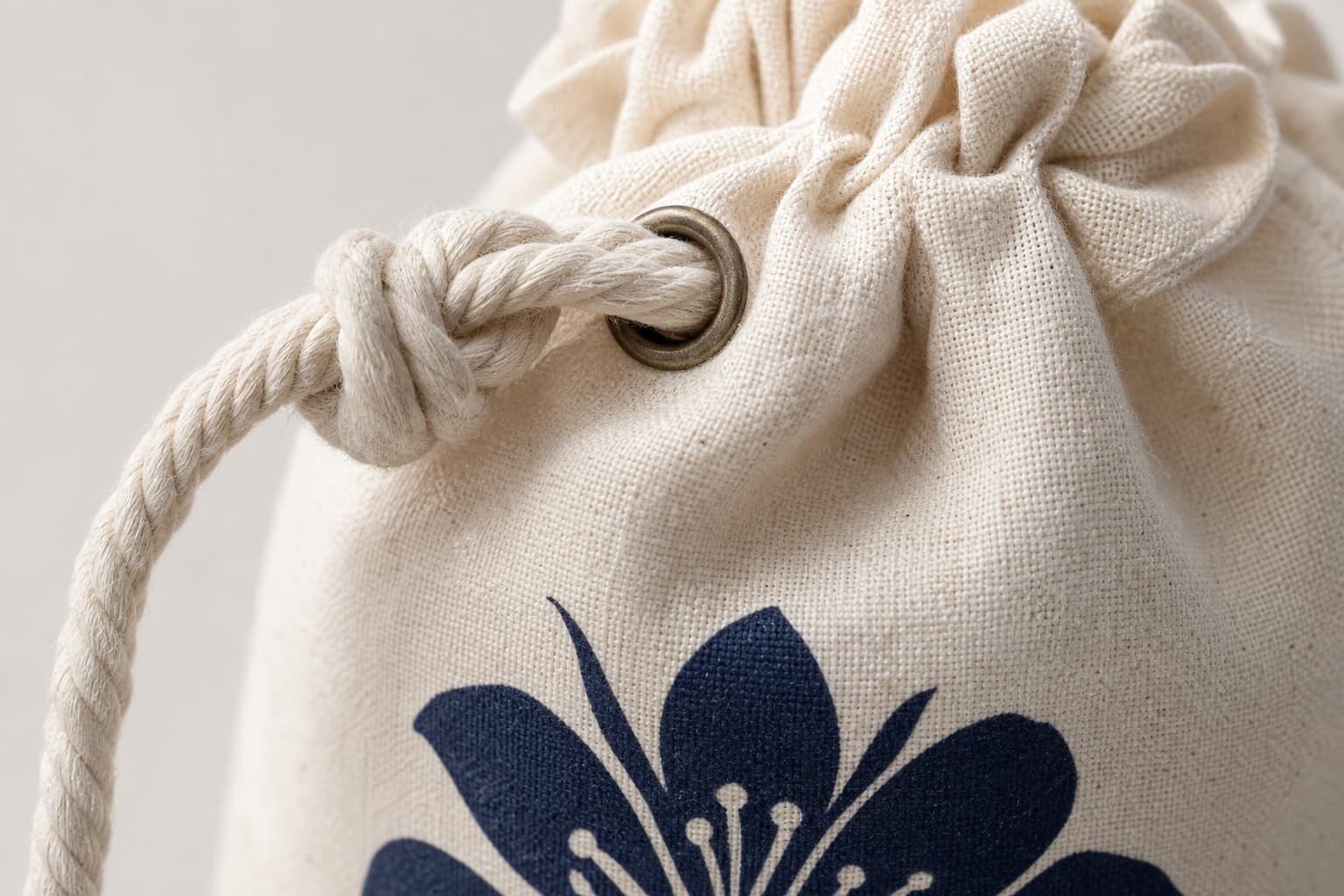
Start the RFQ with the pouch job, not only the pouch size
A cotton drawstring pouch can be a low-cost dust bag, a retail gift pouch, a refill package, a cosmetics set bag, a jewelry pouch, or a promotional giveaway. These uses look similar in a photo but need different fabric, construction, print, and packing standards. If the RFQ only says 10 x 15 cm cotton pouch with logo, suppliers will quote different assumptions and the cheapest quote may not match the final use.
Before asking for price, tell the factory what the pouch must protect, how it will be packed, and how the consumer will handle it. A pouch for a glass bottle accessory needs more strength than a pouch for a paper insert. A pouch sold in a retail kit needs cleaner sewing and better logo position than a pouch hidden inside a shipping box. This context helps the factory quote the correct fabric and prevents expensive changes after sampling.
- Product weight going inside the pouch, including the heaviest packed SKU.
- Retail, ecommerce, gift, dust protection, subscription box, or event giveaway use.
- Expected handling: single use, repeated opening, travel storage, or display packaging.
- Any contact concern: cosmetics, food-contact outer packaging, jewelry, electronics, or textiles.
- Whether the pouch is visible to the consumer before purchase or only after unboxing.
Specify finished size and tolerance like a production drawing
Most size disputes come from buyers and factories measuring different things. The buyer may mean internal usable space, while the factory quotes finished external size. Cotton fabric also loses usable height in the top drawstring channel and seam allowance. For small pouches, a 5 mm difference can decide whether the product fits smoothly or looks forced.
State width x height as finished flat size after sewing, then add the internal item size and required clearance. For example, if the item is 80 x 120 mm and the pouch needs easy loading, the finished pouch may need to be wider and taller than the product by a practical margin. Ask the supplier to confirm the cut size, finished size, top channel height, and tolerance before sample making.
- Finished flat size: width x height in cm or mm after sewing.
- Usable height below drawcord channel if the product must sit fully under the closure.
- Tolerance request, such as +/-5 mm for small pouches or +/-10 mm for larger pouches.
- Orientation of logo from bottom edge or center point, not only visually centered.
- Sample measurement method: flat, unfilled, relaxed fabric, measured seam to seam.
Choose cotton fabric weight by function, not by habit
Fabric GSM or ounce weight affects hand feel, opacity, printing result, sewing speed, freight cost, and pouch closing performance. Lightweight cotton can be suitable for simple gift wrapping or jewelry packaging, but it may show dark products through the fabric and wrinkle easily. Heavier canvas feels more substantial and protects better, but it costs more, makes the drawstring mouth bulkier, and can reduce carton efficiency.
For many cotton drawstring pouch bulk orders, the practical range is 4 oz to 8 oz cotton, depending on size and use. Small cosmetic or jewelry pouches often use lighter cotton because the pouch must close cleanly. Larger accessory pouches or retail kits may need 6 oz or 8 oz for better structure. If a supplier quotes without GSM, the quote is incomplete.
- 4 oz cotton: light gift pouch, small jewelry pouch, low-cost event packaging.
- 5 oz to 6 oz cotton: common balance for brand packaging, refill pouches, and medium gift bags.
- 8 oz cotton canvas: better structure for heavier items, reusable kits, or premium packaging.
- Natural cotton: good eco-style appearance but shade and speck variation must be accepted.
- Dyed cotton: better brand color control but may require lab dip, dye MOQ, and colorfastness testing.
Define drawstring and channel construction before price comparison
The drawstring system is often treated as a small detail, but it controls the user experience. A thin cord in a tight channel makes the pouch difficult to open. A thick cord on a small pouch can look oversized and reduce the usable opening. Cotton cord gives a natural feel, while polyester cord usually slides better and offers more stable dyed colors.
Ask the factory to describe the top construction, not just the cord. A double-fold channel with clean side openings is common, but the sewing quality around the openings matters. Loose threads, raw edges, or weak side seams can cause fraying after repeated opening. If the pouch is for retail presentation, the cord length and knot position should also be consistent.
- Cord material: cotton, polyester, recycled polyester, or blend.
- Cord diameter or width, especially for small pouches where scale matters.
- Single draw from one side or double draw from both sides.
- Cord color matched to fabric, logo, or brand Pantone where needed.
- Top channel width and reinforcement method at side openings.
- Knot type, cord end finish, and whether fraying is acceptable.
Select the logo method by artwork, fabric, and order quantity
Logo printing on cotton drawstring pouches is not a decoration afterthought. It changes setup cost, sampling time, rejection risk, and production sequence. Screen print is usually efficient for solid one-color or two-color logos and larger bulk orders. Heat transfer can handle fine details or gradients better, but buyers should check hand feel, edge durability, and suitability for the fabric texture.
Embroidery and woven labels can give a premium result, but they are not always suitable for very small pouches or tight budgets. Embroidery can pucker lightweight cotton, and labels need placement tolerance. When comparing quotes, make sure each supplier is quoting the same logo size, color count, and method. A cheaper quote may exclude screen setup, film charge, label weaving, or logo proofing.
- Screen print: good for solid logos, simple artwork, and repeatable bulk production.
- Heat transfer: useful for small detail, multi-color artwork, or artwork with gradients.
- Embroidery: better for heavier fabric, but check puckering and back-thread appearance.
- Woven label: clean branding option when the front face should remain simple.
- Printed side label: useful for compliance text, size, brand mark, or care information.
Build MOQ logic around the real production drivers
A cotton drawstring pouch MOQ is not only a factory policy. It comes from fabric sourcing, dyeing, cutting efficiency, print setup, label production, and packing labor. If the order uses stock natural cotton and one simple print, the MOQ can be more flexible. If it uses custom dyed fabric, multiple sizes, different logo colors, and individual retail packing, the practical MOQ increases.
For procurement teams, the best RFQ format separates total annual demand from first order quantity and SKU breakdown. This lets the factory suggest realistic price tiers. If you ask for 10,000 pieces but split them across five colors, three sizes, and two logo versions, each variation may behave like a smaller production run. That affects unit price, defect risk, and lead time.
- MOQ per fabric color when fabric must be dyed or specially sourced.
- MOQ per pouch size because cutting patterns and sewing setup differ.
- MOQ per logo artwork or print color when screens or transfers are required.
- MOQ per label design if woven labels, printed labels, or barcode labels change.
- MOQ per packing style when retail packing, insert cards, or SKU bundles differ.
- Price breaks at realistic tiers such as 1,000, 3,000, 5,000, and 10,000 pieces.
Ask for quote data that lets you compare suppliers fairly
A useful factory quote should do more than show a unit price. It should explain what is included and what is excluded. Cotton pouches often have small unit values, so missing setup fees, packing charges, or carton data can distort landed cost. Procurement teams should request a structured quotation table instead of accepting a short message with only FOB price.
The most common quote comparison mistake is comparing different specifications as if they are equal. One factory may quote 4 oz natural cotton with one-color screen print and bulk packing. Another may quote 6 oz cotton, individual paper banding, and barcode labels. The second quote may look higher but could be closer to the actual retail requirement. Your RFQ should force all suppliers to quote the same base version plus optional add-ons.
- Unit price by quantity tier and trade term, such as EXW, FOB, CIF, or DDP if available.
- Fabric specification included in the quote: composition, GSM, color, and finish.
- Logo method, logo size, number of colors, setup cost, and repeat order setup policy.
- Sample cost, sample lead time, revision cost, and whether sample charge is refundable.
- Packing included in price and optional packing upgrades listed separately.
- Carton size, carton quantity, gross weight, net weight, and estimated CBM.
- Lead time after artwork approval, sample approval, deposit, and final packing confirmation.
Use sampling to lock the production standard, not to admire one nice pouch
A sample is useful only if it represents the bulk production method. Many problems start when the sample uses substitute fabric, hand-cut panels, different cord, or a print process that is not the same as bulk. The buyer approves a good-looking sample, then the mass production feels different. To avoid this, the RFQ should ask what materials and methods will be used for the sample.
For custom cotton drawstring pouches, a pre-production sample should confirm finished size, fabric weight, drawstring function, logo placement, print quality, and packing. If the order has tight color requirements, approve fabric swatches or lab dips before making the full sample. Keep the signed sample as the inspection reference, and make sure the factory keeps an identical sealed sample.
- Check pouch size after sewing and compare it with the agreed tolerance.
- Confirm fabric GSM, color, weave texture, opacity, and shrinkage expectation.
- Open and close the drawstring repeatedly to check sliding and channel space.
- Rub the printed logo lightly and check cracking, smearing, or poor ink coverage.
- Inspect inside seams, top channel, side openings, loose threads, and seam strength.
- Review actual packing method if carton efficiency or retail presentation matters.
Prevent packing and carton problems before production starts
Packing is where many low-cost pouch orders lose time. If the buyer does not define inner quantity, SKU separation, barcode placement, and carton marks, the factory may choose the simplest method for production, not the best method for receiving. This creates warehouse counting problems, mixed SKU cartons, or relabeling work after arrival.
Cotton pouches also react to compression. If printed pouches are packed too tightly before ink is fully cured, logos can transfer or crease. If natural cotton is stored in a humid area or packed in weak cartons, cartons may deform during transit. For export orders, ask for carton dimensions and gross weight during quotation so the freight forwarder can estimate cost early.
- Bulk flat packing for low-cost distribution or when the buyer will repack locally.
- Inner polybag by 50 or 100 pieces when count control and moisture protection matter.
- Paper band or kraft sleeve when the buyer wants less plastic in retail preparation.
- Individual bag with barcode when pouches are sold separately or received as retail SKUs.
- Carton marks including PO number, SKU, size, color, quantity, gross weight, and carton number.
Set lead time around approvals and production sequence
Lead time for cotton drawstring pouch bulk orders is not only sewing time. It includes fabric preparation, logo artwork proofing, sample making, buyer approval, material booking, cutting, printing, curing, sewing, trimming, inspection, packing, and export document preparation. If dyed fabric, woven labels, or special packing is required, those items can become the critical path.
A practical RFQ asks the factory to separate sample lead time from bulk lead time and to state when the clock starts. Some factories start bulk lead time after deposit, while others start after final artwork, sample approval, and packing confirmation. Procurement teams should align internal approval steps before placing the order, because slow artwork confirmation can be mistaken for supplier delay.
- Artwork proof approval date.
- Fabric swatch or lab dip approval date when color is custom.
- Pre-production sample approval date.
- Deposit or payment confirmation date.
- Bulk material ready date.
- Printing, sewing, packing, inspection, and cargo ready date.
- Final inspection booking window before shipment.
Specification comparison for buyers
| Spec decision | Recommended option | When it fits | Buyer risk to check |
|---|---|---|---|
| Fabric weight | 4 oz to 6 oz cotton for small gift pouches; 8 oz cotton canvas for heavier retail kits | Jewelry, cosmetics, accessories, refill packs, event merchandise, or lightweight product protection | Too light may show contents and feel cheap; too heavy may increase unit cost, freight, and drawstring bulk |
| Fabric finish | Natural unbleached cotton for eco-style programs; dyed cotton for retail color matching | Natural brand packaging, organic-look gifting, subscription boxes, or color-coded SKU programs | Natural shade varies by cotton lot; dyed fabric needs lab dip approval and colorfastness checks |
| Drawcord type | Cotton cord for natural look; polyester cord for smoother sliding and stronger color consistency | Cotton cord suits plastic-free packaging; polyester cord suits repeated retail use or bright colors | Cord diameter, shrinkage, and color bleeding can affect closure function and appearance |
| Logo method | Screen print for solid logos; heat transfer for fine detail; woven label for premium low-ink branding | Screen print fits most bulk orders with 1 to 3 colors; label works when the pouch is reused often | Print cracking, show-through, registration shift, label placement tolerance, and ink compliance |
| Top construction | Double-fold channel with reinforced side openings | Most cotton drawstring pouch orders where the buyer needs reliable opening and closing | Raw edges inside the channel can fray; tight channels slow packing and frustrate end users |
| Packing method | Flat packed by inner polybag or paper band, then export carton by size and SKU | Distributors, retail buyers, and brand owners needing count control and carton efficiency | Random mixed packing causes receiving errors; over-compression can crease printed logos |
| MOQ logic | MOQ based on fabric color, pouch size, logo colors, and packing style, not only total pieces | Multi-SKU launches, seasonal gift sets, promotional packaging, and distributor replenishment | Low total MOQ may hide separate setup charges or fabric dye minimums |
| Sample approval | Pre-production sample using bulk fabric, approved logo artwork, actual cord, and real packing method | Any order with custom size, custom logo, dyed fabric, retail barcode, or strict brand presentation | A nice prototype made from substitute fabric does not prove bulk production will match |
Buyer checklist before sampling
- State pouch use case: product packaging, giveaway, dust bag, retail kit, refill pouch, or gift bag.
- Confirm finished size in width x height, measured after sewing, with tolerance requested in millimeters.
- Specify fabric material, weave, color, and GSM or ounce weight instead of only saying cotton pouch.
- Define whether fabric must be natural, bleached, dyed, organic, recycled blend, or standard conventional cotton.
- Request fabric shrinkage, colorfastness, and print adhesion expectations when the pouch may be washed or reused.
- Provide logo artwork in vector format with Pantone references and final printed size in width x height.
- Choose logo method: screen print, heat transfer, embroidery, woven label, printed label, or no logo.
- Define drawcord material, diameter, color, tip finish, and whether one-side or two-side draw closure is required.
- Specify top channel construction, seam type, thread color, and reinforcement at drawcord openings.
- Confirm MOQ by size, color, print design, and packing variation, not only total order quantity.
Factory quote questions to send
- What fabric composition, weave, GSM, and color standard are included in the quoted price?
- Is the quoted size finished size after sewing, and what size tolerance do you apply in bulk production?
- What is the MOQ per size, per fabric color, per logo artwork, and per packing method?
- Which logo method is quoted, how many colors are included, and what setup charges apply?
- Will the pre-production sample be made with actual bulk fabric, actual cord, and actual logo process?
- What are the expected sample lead time and bulk lead time after sample approval and deposit?
- What packing is included in the unit price, and what costs extra, such as barcode label, insert card, or individual bag?
- What carton dimensions, gross weight, and CBM estimate should we use for freight calculation?
- What defects are treated as critical, major, and minor during final inspection?
- How do you control natural cotton shade variation or dyed color difference between production lots?
Quality-control points to confirm
- Measure finished pouch width and height from a flat, unfilled pouch after sewing, not from cut fabric panels.
- Check fabric GSM with a cutter scale or supplier test report when the hand feel is part of the approved sample.
- Compare natural cotton shade, dyed fabric color, cord color, and thread color against approved reference samples.
- Inspect drawcord sliding performance after opening and closing the pouch several times.
- Check seam allowance, top channel width, bar tack or reinforcement, and loose thread trimming.
- Test print position, print size, Pantone match, ink coverage, edge sharpness, and rubbing resistance.
- Confirm the logo is not distorted by seam puckering, fabric slub, or over-compressed packing.
- Verify carton count, inner pack count, SKU separation, barcode placement, carton marks, and export carton strength.
- Review random samples from beginning, middle, and end of production instead of only top-layer pieces.
- Keep one approved pre-production sample and one sealed production sample for claim comparison.