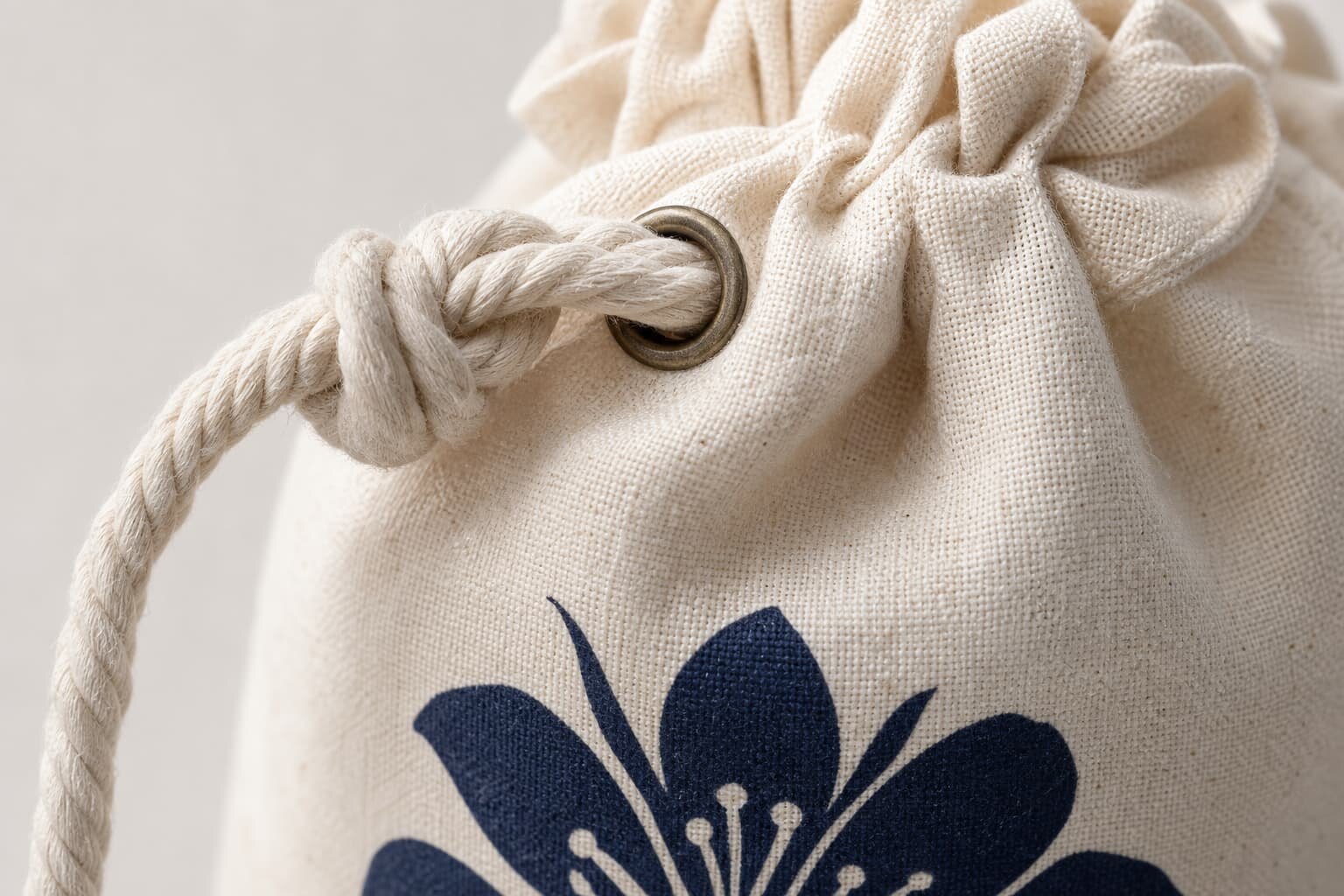
Start With the Buying Problem, Not Just the Bag Name
A cotton drawstring pouch bulk order looks simple until procurement tries to compare quotes from three factories. One supplier quotes 120 GSM natural cotton with single-side drawstring, another quotes 200 GSM bleached cotton with cotton tape, and a third leaves the fabric unspecified. All three may call the product a cotton drawstring pouch, but they are not quoting the same bag. The buyer then sees a price gap without knowing whether it comes from fabric, print, construction, packing, or margin.
The first job of the RFQ is to define the commercial use of the pouch. A pouch used as disposable event packaging can accept lighter fabric and simpler stitching. A pouch sold with cosmetics, jewelry, tea, or accessories needs better fabric handfeel, cleaner print, and stronger drawstring operation. If the pouch is part of a retail unboxing experience, the buyer should specify appearance standards more tightly than for an internal parts bag.
- For low-cost giveaway packaging, start with 100-120 GSM cotton and simple one-color screen print.
- For retail gift packaging, consider 140-180 GSM cotton with tighter print and cleaner sewing requirements.
- For reusable accessory pouches, evaluate 180-220 GSM cotton, stronger cord, and improved seam finishing.
- For very small pouches, do not over-specify thick fabric because the drawstring channel may become bulky.
- For export distribution, define carton packing early because carton cube affects landed cost.
Define Size by Function and Finished Measurement
Many pouch disputes start with size language. Factories often think in cutting size, while buyers care about the finished usable size after sewing, seam allowance, bottom corners, and drawstring channel. If a buyer requests 10 x 15 cm without saying whether that is finished flat size or internal usable space, the delivered pouch may be technically close to the factory's interpretation but too small for the product.
For a bulk order, test the actual product inside the pouch before approving production. A pouch for soap, sunglasses, chargers, jewelry boxes, or hotel amenities should allow enough clearance so the item can slide in without stretching the seams. For items with hard corners, add extra allowance because cotton does not behave like a rigid carton. If the pouch must hang or stand in retail presentation, also check how the product weight changes the shape after the drawstring is closed.
- State dimensions as finished flat width x finished flat height, measured before filling.
- Add whether height includes the drawstring channel or only usable body height.
- Provide product dimensions and weight if the factory needs to suggest pouch size.
- Set a realistic tolerance such as +/-5 mm for small pouches or +/-10 mm for larger pouches.
- Ask for one size set sample if ordering several sizes with the same construction.
Choose GSM Based on Use, Print, and Freight
Fabric weight is one of the largest cost and performance variables in a cotton drawstring pouch bulk order. A 100 GSM pouch and a 220 GSM pouch may look similar in a small photo, but they handle very differently. Lighter cotton folds easily and lowers material cost, but it may feel thin, show the product outline, and reduce the perceived value of a premium retail item. Heavier cotton gives better handfeel and durability, but it increases material consumption, sewing resistance, carton weight, and shipping cube.
Buyers should not choose GSM only by copying a competitor or asking for the heaviest option. The correct fabric weight depends on pouch size, product weight, print coverage, and whether the pouch is reusable. For large-format pouches, 180 GSM may be enough because the surface area already gives structure. For tiny jewelry pouches, 200 GSM can make the top channel stiff and difficult to close. A fabric swatch book and one sample in the target size will prevent many wrong decisions.
- 100-120 GSM: suitable for budget packaging, lightweight gift inserts, and event use.
- 140-160 GSM: balanced option for many retail packaging and promotional pouch orders.
- 180-220 GSM: stronger handfeel for reusable pouches, premium sets, or heavier contents.
- Natural cotton: visible seed flecks and warmer shade; good for eco-style presentation.
- Bleached white cotton: cleaner background for color printing but easier to soil in handling.
Match the Drawstring and Channel to the Fabric
The drawstring is a small component, but buyers notice it every time they open the pouch. If the cord is too thin for a heavy pouch, it feels cheap and may bite into the fabric channel. If the cord is too thick for a small pouch, the channel becomes crowded and the pouch will not close smoothly. Cotton cord gives a natural look, while polyester cord can slide more easily and may be cheaper or more color stable. Flat cotton tape can look premium, but it needs enough channel height.
Factories may quote different closures unless the RFQ is specific. A one-side drawstring is simple and common for low-cost pouches. A two-side pull closure uses cords from both sides and feels more balanced, especially on medium or larger sizes. Buyers should also confirm whether knots, cord ends, metal aglets, plastic tips, or no tips are expected. Small finishing details can change labor cost and lead time.
- For 100-140 GSM pouches, a lighter cotton cord usually works if the channel is not too narrow.
- For 180-220 GSM pouches, specify stronger cord or tape and test repeated open-close cycles.
- For premium retail pouches, ask the factory to show cord color against the fabric swatch.
- For children-related use, avoid loose small decorative parts unless your compliance team approves.
- For warehouse counting, make sure knots and cord ends do not tangle badly in bulk packing.
Select the Print Method Before Comparing Prices
Logo application is another reason quote comparisons become unreliable. Screen printing is usually the practical choice for solid one-color or two-color logos on cotton pouches. It gives a direct print feel and can be cost-efficient in bulk, but very fine details may fill in on coarse cotton, and each color may require setup. Heat transfer can handle sharper detail, gradients, or small multi-color artwork, but the handfeel can be less natural and the buyer should check adhesion and edge appearance.
Embroidery is possible on some pouch designs, but it can distort light fabric and becomes expensive on small pieces. Woven labels or side labels are useful for repeat branding when the buyer wants a consistent mark across fabric colors and print runs. If the pouch is used for premium packaging, the buyer should approve the print size and position on a physical sample, not only a digital layout. On a small pouch, a 5 mm position shift can make the logo look off-center.
- Send vector artwork in AI, EPS, or PDF format, plus a PNG preview to avoid file confusion.
- State print size in millimeters and position from top, bottom, or side seam.
- Use Pantone references when color matters, but allow reasonable tolerance on natural cotton.
- Ask for print rub or tape test if the pouch may contact light-colored products.
- Confirm whether the print cost includes screen setup, plate charge, or only running cost.
Understand MOQ Logic Before Negotiating
MOQ is not only a sales rule. For cotton drawstring pouches, the practical MOQ can come from fabric purchasing, dyeing, printing setup, cutting efficiency, sewing line arrangement, and packing labor. A factory may accept a lower total order if the buyer uses stock natural cotton and one print color. The same factory may require a higher MOQ for custom dyed cotton, several sizes, or many artwork versions because each variation creates setup time and production risk.
Procurement teams should ask what the MOQ applies to. A quote for 10,000 pieces may be based on one size, one fabric color, and one artwork. If the buyer later splits the order into five designs of 2,000 pieces each, the cost structure changes. Small SKUs also increase risk of mixed packing, wrong labels, and slower inspection. It is better to disclose the SKU breakdown at RFQ stage than to negotiate a low headline price that cannot survive final order details.
- Clarify MOQ per size, per color, per artwork, and per shipment.
- Ask for price breaks at practical levels such as 1,000, 3,000, 5,000, 10,000, and 20,000 pieces.
- Separate one-time setup costs from unit price so repeat orders are easier to compare.
- If quantity is low, consider stock fabric colors and standard cord to reduce setup pressure.
- If there are many SKUs, request a packing and labeling plan before approving the order.
Build a Quote Sheet That Exposes Hidden Cost
A useful factory quote should show more than a unit price. For a cotton drawstring pouch bulk order, the buyer needs to know the fabric, GSM, size basis, print method, closure, packing, lead time, and incoterm. Without these data points, the cheapest quote may simply be missing key requirements. A clean quote sheet also helps internal teams compare landed cost instead of arguing over incomplete supplier emails.
Ask the supplier to itemize cost drivers when the order has multiple options. For example, compare 140 GSM versus 180 GSM, natural cotton versus dyed cotton, screen print versus woven label, and bulk packing versus individual polybag. The buyer does not need a full factory cost book, but needs enough structure to decide where to save money without damaging the product experience.
- Unit price should state currency, incoterm, port, quote validity, and quantity basis.
- Specification line should include finished size, GSM, fabric color, cord type, and print method.
- Extra charges should list screen, plate, label mold, sample, courier, polybag, or carton mark fees.
- Packing data should include pieces per inner bag, pieces per carton, carton size, and gross weight.
- Lead time should separate sample time, approval waiting time, production time, and shipping handover.
Approve Samples Like a Production Buyer
A sample is not only for appearance. It is the buyer's chance to confirm that the factory understands the finished size, fabric handfeel, drawstring operation, logo scale, stitching, and packing concept. Sample-room material can differ from bulk material, so the buyer should ask whether the sample uses actual bulk fabric or available similar fabric. If not, the approval should be conditional until a pre-production sample is made from bulk materials.
For repeat orders, keep an approved reference sample with date, version, and signature or clear approval record. Photos are useful for communication but not enough for judging cotton shade, fabric thickness, print handfeel, or odor. If multiple internal teams approve the pouch, consolidate comments before sending them to the factory. Conflicting feedback creates re-sampling delays and increases the risk that production follows the wrong version.
- Check flat finished size and usable body height with the product inside.
- Compare GSM and fabric shade against the approved swatch.
- Open and close the drawstring at least 20 times to feel channel friction.
- Inspect print edges, color, position, curing, and rub resistance.
- Review seam allowance, backstitching, loose thread, and top channel alignment.
- Confirm sample label or version number so the factory and buyer discuss the same piece.
Plan Packing, Carton Cube, and Warehouse Handling
Cotton pouches are flexible, so packing method changes carton size and product appearance. Very tight compression may lower freight cube but can crease the fabric and leave marks on the print. Loose packing protects shape but increases carton volume. For most bulk orders, flat packing in counted inner bundles works well. If the buyer's warehouse requires fast receiving, inner polybags of 50 or 100 pieces can reduce counting errors, but they add material and labor.
Carton data should be confirmed before freight booking. Import buyers need carton dimensions, gross weight, net weight, carton quantity, and carton marks. If pouches are packed by multiple designs or sizes, the factory should provide a SKU packing plan. Mixed cartons may reduce shipping volume but can create receiving mistakes if carton labels are not clear. For retail programs with barcode labels, label position and scan quality should be tested before mass packing.
- Define whether pouches are packed flat, folded, or rolled.
- State inner bundle count and whether an inner polybag is required.
- Ask for maximum carton weight suitable for your warehouse handling rules.
- Approve carton marks with PO number, SKU, quantity, gross weight, net weight, and country of origin if required.
- For printed pouches, avoid packing before ink is fully cured or dry.
- For sea shipment, ask the factory to control moisture and avoid damp cartons.
Set Lead Time and Inspection Criteria Before Deposit
Lead time should be counted from the right starting point. Factories usually count production time after deposit, artwork confirmation, and sample approval, not from the first inquiry. Custom dyed fabric, special cord, multi-color print, or many SKU splits can add time. Peak season can also affect fabric purchasing, printing line availability, and sewing capacity. Buyers should ask for a realistic schedule with sample date, material ready date, production start, packing date, and shipment handover.
Inspection criteria should be agreed before the goods are made. Cotton drawstring pouches can have common defects such as stains, oil marks, loose threads, uneven channel width, twisted cord, print offset, poor curing, fabric shade variation, and wrong carton quantity. The buyer should define critical defects that block shipment and minor defects that are acceptable within an agreed limit. This prevents last-minute arguments when the inspection report arrives.
- Critical defects: wrong size, wrong artwork, wrong fabric, unsafe contamination, missing drawstring, or severe print failure.
- Major defects: visible stain, broken seam, blocked channel, poor print adhesion, mixed SKU, or wrong packing count.
- Minor defects: small thread end, slight natural cotton fleck, or small sewing variation within tolerance.
- Ask for inline photos before full production is completed, especially for new artwork or new size.
- Require final inspection after packing but before shipment release.
- Keep a retained sample at the factory for dispute checking if repeat orders are expected.
Specification comparison for buyers
| Spec decision | Recommended option | When it fits | Buyer risk to check |
|---|---|---|---|
| Fabric weight | 120-160 GSM cotton for light retail packaging; 180-220 GSM for reusable gift or accessory pouches | Jewelry, cosmetics, tea, hotel amenity, small apparel accessories, promotional kits | Very low GSM may show product shape, wrinkle heavily, and reduce print opacity; very high GSM increases cube and freight cost |
| Cotton type | Natural unbleached cotton for eco-style packaging; bleached white cotton when accurate print color is important | Natural look brands, organic-style products, retail gift sets, event packaging | Natural cotton has seed flecks and shade variation; white cotton may need better dirt control during sewing and packing |
| Closure cord | Cotton cord or flat cotton tape matched to pouch weight | Premium reusable pouch or brand gift packaging | Thin cord on heavy fabric can cut into the channel; polyester cord may not match a natural cotton positioning |
| Print method | Screen print for 1-3 solid colors; heat transfer for detailed small artwork; woven label for low-risk repeat branding | Logo pouches, care kits, small packaging bags, corporate gift sets | Fine lines can fill in on coarse cotton; transfer prints may feel less natural; labels need seam placement approval |
| Construction | Double-fold drawstring channel with clean side seam backstitching | Most export retail and gift packaging orders | Single thin fold or weak backstitch can fail when buyers pull the drawstring repeatedly |
| Packing | Flat bulk packing in export carton; inner polybag by 50 or 100 pcs if warehouse counting is required | Distributor and retail replenishment orders | Over-compression can crease print; loose packing can change carton cube and freight estimate |
| Sampling | Pre-production sample using bulk fabric, bulk cord, approved print method, and final packing reference | Orders where color, logo position, or size tolerance affects retail presentation | Photo-only approval cannot confirm handfeel, channel friction, print rub, or real finished size |
Buyer checklist before sampling
- Confirm finished pouch size as usable inside size or flat outside size, and state the tolerance you will accept.
- Specify fabric composition, cotton type, GSM, color, and whether natural seed flecks are acceptable.
- Define drawstring material, cord diameter or tape width, color, and whether one-side or two-side pull is required.
- Send artwork as vector file and include print size, Pantone or color reference, position from pouch edges, and print method preference.
- Ask whether the quoted MOQ applies per size, per fabric color, per artwork, or per shipment.
- Require a pre-production sample made with bulk fabric, bulk cord, actual print, and final stitching method.
- Confirm packing count per inner bag, carton quantity, carton dimensions, carton weight, and carton mark requirements.
- Set inspection points for size, fabric weight, drawstring function, print adhesion, print position, stitching strength, stains, and mixed designs.
- Ask the factory to separate sample lead time, production lead time, and transit handover date in the quotation.
- Request quote validity, payment term, incoterm, port, HS code suggestion, and any cost changes by quantity break.
Factory quote questions to send
- What GSM and fabric construction are included in this quote, and can you send a fabric swatch before sample approval?
- Is the price based on finished size or cutting size, and what size tolerance will you guarantee after sewing?
- Does the MOQ apply per SKU, per artwork, per pouch color, or only to the total order quantity?
- Which print method do you recommend for this artwork on cotton, and what are the limitations for fine lines, gradients, and color matching?
- Are drawstrings cotton, polyester, or mixed material, and what diameter or tape width is included?
- Will the pre-production sample use bulk fabric and bulk cord, or available sample-room material only?
- How many pieces per carton are quoted, and what carton dimensions and gross weight should we use for freight planning?
- What inspection standard do you use for stains, loose threads, print offset, channel defects, and drawstring slipping?
- What is the production lead time after sample approval and deposit, and does it change during peak season?
- Please itemize any extra charges for setup, screen, transfer plate, woven label, barcode label, individual polybag, or carton marking.
Quality-control points to confirm
- Measure finished flat width and height after sewing, not only the fabric cutting size.
- Check GSM with a fabric cutter or compare approved swatch against bulk roll before cutting.
- Pull the drawstring open and closed repeatedly to confirm the channel is smooth and not too tight.
- Inspect print position against an approved reference, especially for small pouches where 5 mm looks obvious.
- Rub test printed areas after drying or curing to check ink adhesion and transfer risk.
- Check seam allowance, backstitching at stress points, and loose threads inside the pouch.
- Review natural cotton shade and seed fleck level under normal light before mass packing.
- Confirm carton quantity and weight match the packing list so warehouse receiving is not delayed.
- Open random cartons to verify SKU separation, inner bag count, and carton marks.
- Check for odor, moisture, mildew risk, and dirt marks before shipment release.