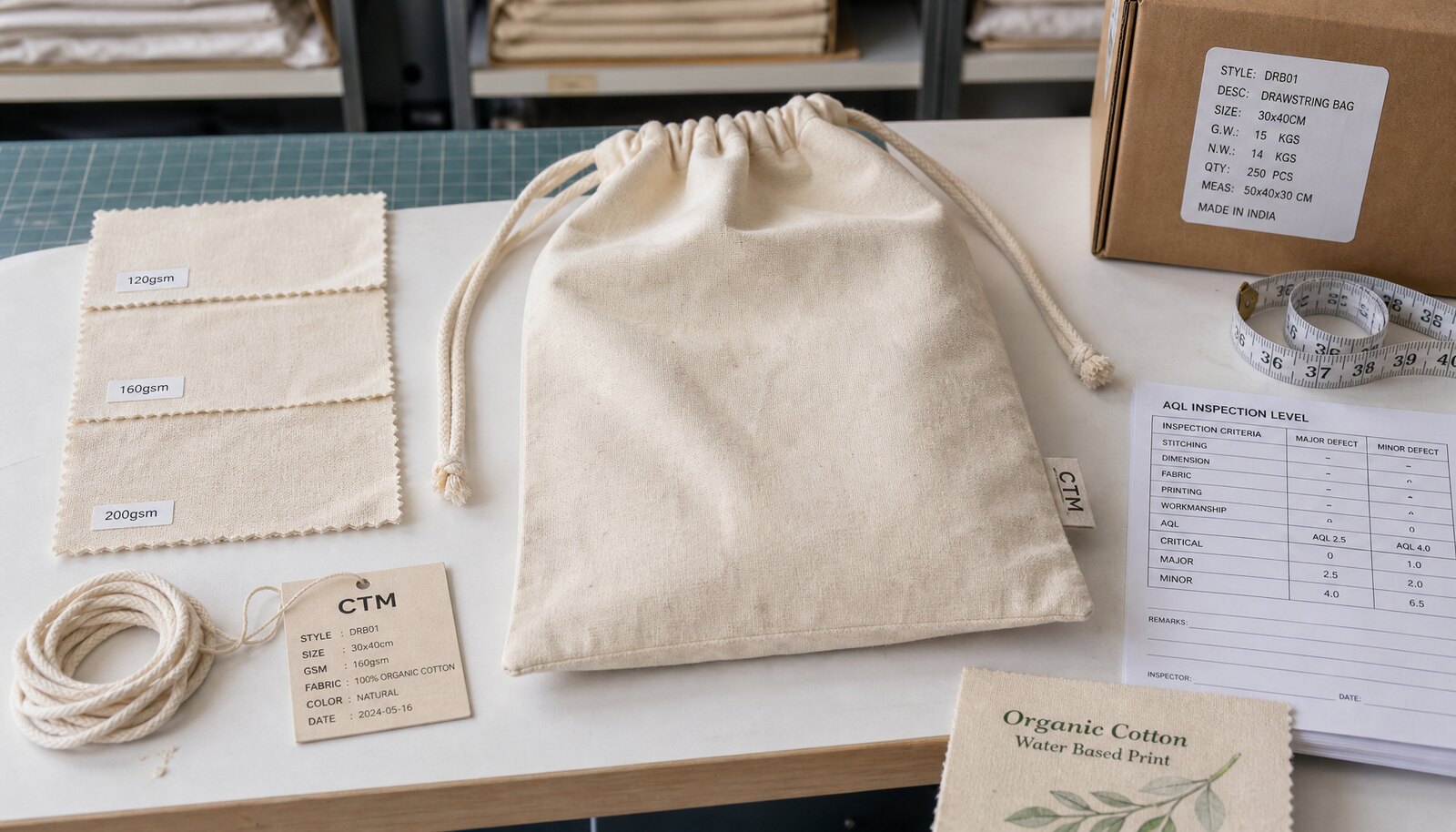
Start with the gift program, not just the bag size
A cotton drawstring bag for a gift program is both packaging and a brand touchpoint. Procurement teams should first define what the bag must do: protect a product, improve unboxing, carry a promotional message, support an organic brand claim, or replace disposable packaging. Those goals affect fabric weight, closure type, logo method, packing, inspection level, and ultimately MOQ pricing.
Gift buyers often ask for “a cotton pouch” and then compare prices that are not comparable. One supplier may quote a thin 100gsm natural muslin bag with one-color print and bulk packing, while another quotes 160gsm cotton, double drawstring, color-matched logo, and retail bundles. The cheaper line may not be a saving; it may simply be a different product.
A useful procurement file should define the bag in terms a factory can produce and an inspector can check. Include finished dimensions, fabric GSM, organic cotton evidence required, cord type, print size, number of colors, packing count, carton marks, and delivery point. Then ask each supplier to confirm any assumptions before quoting.
- Record the product inserted into the bag and its approximate weight, size, edges, and risk of staining or snagging.
- Specify whether the bag is disposable event packaging, premium gift packaging, or a reusable keepsake.
- State whether the buyer needs natural cotton appearance, bright white fabric, dyed fabric, or a brand-specific color.
- Separate “must have” requirements from “nice to have” options so suppliers can quote alternates without changing the base spec.
- Attach artwork at actual size and include a note if placement affects the presentation of the gift inside.
Choose cotton fabric with GSM, finish, and evidence in mind
Fabric is the largest driver of feel and cost. For cotton drawstring gift bags, lighter fabrics around 100-120gsm are common for small promotional inserts or low-weight items, but they can appear translucent and may not create a premium presentation. Mid-weight 140-160gsm cotton is often a practical range for general gift packaging because it balances hand feel, printability, and cost. Heavier 180-240gsm canvas-style fabric increases structure and perceived value, but it uses more material, may reduce carton count, and can change the sewing cost.
Organic cotton should be treated as a documented specification, not a vague marketing adjective. The buyer must decide what evidence is needed: a supplier declaration, fabric certificate, scope certificate, transaction certificate, or specific labeling approval. Requirements vary by buyer policy and market, so the purchase order should state the exact documentation expected before the supplier prices the order.
Finish also matters. Natural unbleached cotton can show cottonseed flecks and shade variation, which many organic brands accept as part of the look. Bleached white fabric creates a cleaner background for printing but may not match a natural eco aesthetic. Dyed fabric needs shade tolerance, lab-dip approval, and may require higher MOQ because the mill or dye house has minimum batch quantities.
- Ask for GSM stated as a range, not just a fabric name such as muslin or canvas.
- Confirm whether the quoted fabric is stock fabric or custom woven, dyed, or finished for the order.
- Use a light-box or backlight photo if transparency is a concern for premium gifts.
- Approve natural cotton flecks or reject them in writing; do not leave appearance standards to interpretation.
- Require the supplier to notify the buyer if bulk fabric differs from the sample fabric source.
Specify drawstring construction and sewing details
The drawstring system is a small detail that strongly affects user experience. A single cord may be economical, but a double-cord closure is easier to pull evenly and often looks better for gift presentation. Round cotton cord, flat cotton tape, self-fabric cord, and custom-dyed trims all have different MOQ and cost implications. If the bag will hold candles, glassware, cosmetics, or heavier kits, the cord channel and side seams need more attention than a lightweight jewelry pouch.
Construction should be measurable. A procurement specification can include seam type, stitch density, seam allowance, drawstring-channel height, cord diameter or tape width, knot method, and whether side openings are reinforced. It should also state whether raw internal seams are acceptable or whether overlocked, French seam, or bound seam construction is required. Cleaner internal construction costs more but can matter for premium gifts.
Buyers should avoid approving samples only from the front view. The weak points on drawstring bags are usually the side seam near the cord exit, the channel stitching, and the bottom corners. Close-up photos and a simple pull check can catch many problems before bulk sewing begins.
- Define single drawstring or double drawstring before requesting MOQ pricing.
- State cord diameter, tape width, color, material, and whether custom dyeing is required.
- Set stitch-density guidance, such as stitches per inch or stitches per centimeter, if appearance and strength matter.
- Check that cord ends are knotted, sewn, heat-sealed if synthetic, or finished in a buyer-approved way.
- For heavier gifts, request a basic load check using the actual inserted product or an equivalent weight.
Match decoration method to fabric and gift positioning
Decoration is not only a logo decision. It changes setup cost, minimum quantity, sampling time, defect risk, and inspection criteria. Screen printing is typically suitable for simple artwork and larger quantities, especially when colors are limited. Heat transfers can reproduce more detail but may feel less natural on cotton and should be checked for adhesion and cracking. Embroidery adds texture and perceived value but can pucker lightweight fabric. Woven labels or cotton labels avoid ink issues, but they add trim sourcing and sewing steps.
For organic cotton bags, the decoration method should also align with the brand message. A heavy plastisol-like print may conflict with a natural product story, while water-based ink or a subtle label may better suit some gift programs. The correct choice depends on artwork, budget, quantity, and performance requirements; the supplier should explain why a method is recommended for the chosen fabric.
Artwork approval should include actual print size and placement tolerance. A logo that is 3mm off-center may be acceptable on a large apparel bag but obvious on a small jewelry pouch. Procurement should write the standard before production starts, not after receiving a batch that looks inconsistent.
- Request a print strike-off or embroidery sample on the same GSM and color as the bulk fabric.
- Specify Pantone, CMYK, thread reference, or buyer-approved color standard where applicable.
- Set logo placement tolerance by bag size; small pouches often need tighter visual control.
- Ask whether ink needs curing time and whether folding immediately after printing can mark the fabric.
- Confirm whether the logo must survive washing, rubbing, or only normal gift handling.
Understand MOQ drivers and realistic price breaks
MOQ pricing for cotton drawstring bags is not a single universal number. A supplier’s minimum may be driven by fabric roll quantity, dye-lot minimums, print setup, embroidery digitizing, cord sourcing, label MOQ, carton packing labor, or the number of SKUs. A natural stock cotton bag with one-color print can usually be quoted at a lower minimum than a custom-dyed organic cotton bag with custom cord, sewn label, and individual retail packing.
For quote comparison, ask suppliers to show price breaks rather than only one quantity. An example quote table might show 500 units with a higher unit price and full setup fee, 1,000 units with improved sewing and print efficiency, 2,500 units with better material purchasing, and 5,000 units with lower amortized setup. These are examples for quote structure, not guaranteed market prices; the actual numbers depend on size, GSM, logo, country, season, and supplier capacity.
Price breaks should be analyzed using total order cost. If a screen setup is 80 dollars and the unit price is 0.95 dollars at 500 pieces, the setup adds 0.16 dollars per bag before freight and inspection. At 2,500 pieces, the same setup adds 0.032 dollars per bag. This simple amortization helps a buyer decide whether the lower unit price at a larger quantity is worth the inventory commitment.
- Ask for MOQ per size, per color, per artwork, and per packing type.
- Separate setup charges from unit price so the buyer can calculate true per-piece cost.
- Request alternates: stock fabric versus custom dyed, 120gsm versus 160gsm, screen print versus label.
- Check whether a mixed-size order can share fabric MOQ or whether each size has its own minimum.
- Require quote validity dates because cotton, freight, and labor assumptions can change.
Build quote math that supports a defensible sourcing decision
A procurement buyer should compare suppliers on the same cost base. Factory unit price is only one line. The decision should include setup fees, sample cost, organic documentation cost if required, artwork proofing, labels, packing materials, cartons, inspection, inland transportation, international freight, duty or tax assumptions, and any expected buffer for rejects or overage.
A simple landed-cost calculation can prevent misleading decisions. For example, if a supplier quotes 1,000 bags at 1.10 dollars each, plus 90 dollars print setup, 45 dollars sample fee, 70 dollars special packing, and 120 dollars inland freight to port, the pre-freight effective cost is 1.425 dollars per bag before international freight, duty, or receiving costs. Another supplier quoting 1.22 dollars with setup included and standard carton labeling included may be closer than it first appears.
Buyers should also value schedule risk. A low price based on custom dyed fabric may not help if the gift event date is fixed and lab-dip approval consumes two weeks. For time-sensitive campaigns, stock natural cotton with a slightly higher unit price may be commercially safer than a custom option with a fragile timeline.
- Create a worksheet with unit price, fixed charges, variable packing charges, inspection, logistics, and expected landed cost per unit.
- Mark whether each cost is included, excluded, estimated, or to be confirmed.
- Compare suppliers after normalizing fabric GSM, bag size, logo method, packing, and inspection plan.
- Include the cost of delay when bags are tied to a launch, retail promotion, conference, or seasonal gift window.
- Keep the quote version linked to the approved specification version so later changes are traceable.
Evaluate suppliers using evidence, not only responsiveness
Fast replies are helpful, but procurement decisions should depend on evidence. A qualified cotton drawstring bag supplier should be able to explain fabric options, MOQ drivers, production steps, sampling plan, inspection tolerances, packing method, and documentation limits. If a supplier cannot identify whether the quoted cotton is stock or custom, or cannot state the GSM, the buyer is not comparing a controlled specification.
Evidence standards should be proportional to risk. For a repeat order with the same bag and same supplier, photos and retained samples may be enough. For a new organic cotton gift program, the buyer should request certificates or declarations appropriate to the claim, fabric swatches, print tests, pre-production samples, and a written inspection plan. The goal is not paperwork for its own sake; it is to reduce mismatch between the quote, sample, and bulk shipment.
Supplier selection should also consider communication discipline. Good suppliers confirm assumptions, flag cost drivers, state lead-time dependencies, and ask for missing artwork or packing details early. Weak suppliers often quote quickly with many exclusions, then add cost after sample approval or production start.
- Ask suppliers to identify which parts of the quote are based on approved specs and which are assumptions.
- Request photos of similar construction details, not as proof of your order, but as evidence of capability.
- Check whether the supplier can provide fabric swatches before final price lock.
- Require a deviation process: no substitution of GSM, cord, label, packing, or logo method without written approval.
- Prefer suppliers who explain limits clearly over those who simply agree to every requirement without evidence.
Control samples before bulk production
Sampling should create a production reference, not just a sales image. The first sample may confirm concept, but the pre-production sample should match the intended bulk fabric, cord, logo method, size, and packing as closely as possible. If the sample uses substitute material, the supplier should state that clearly and provide the timeline for a true production-material sample.
The sample file should include measurements, photos, and known deviations. If the buyer accepts a natural cotton shade variation, a small print texture issue, or a cord color that is close but not exact, record it. Written deviation approval prevents the final inspection team from rejecting what the buyer has already accepted, and it prevents the factory from expanding a small exception into a broad production shortcut.
For distributed procurement teams, one retained physical sample is valuable. Keep it labeled with supplier name, date, quote version, fabric GSM, artwork version, and approval status. Photos are useful, but they cannot fully capture fabric hand feel, opacity, cord movement, or print texture.
- Approve sample stages separately: fabric swatch, decoration strike-off, full bag sample, and packing mock-up.
- Label the final approved sample with version number and date.
- Photograph front, back, inside seams, cord channel, logo, label, ruler measurements, and packed presentation.
- List accepted deviations and state whether they apply only to the sample or also to bulk production.
- Do not allow bulk cutting until size, fabric, artwork, and packing are approved or formally waived by the buyer.
Set inspection tolerances and defect thresholds before production
Quality control for cotton drawstring gift bags should be practical and measurable. The inspection plan should define when checks happen, who performs them, how many pieces are checked, what tolerances apply, and which defects trigger rework or rejection. Without these standards, disputes become subjective: the supplier may see a loose thread as normal while the gift buyer sees it as poor presentation.
Common measurable points include finished width and height, drawstring-channel height, cord length, logo size, logo placement, stitch density, seam strength, print color, stain size, and carton count. For many bag orders, dimensional tolerance might be tighter on small pouches and wider on large bags. The buyer should state the actual tolerance needed instead of copying a generic number.
Defect classification is important. Critical defects include wrong logo, unsafe contamination, or a material substitution that violates an organic or compliance claim. Major defects include open seams, severe stains, badly off-center logos, missing cords, incorrect size outside tolerance, or carton mixing that affects fulfillment. Minor defects may include small loose threads or slight wrinkles within the approved appearance standard. AQL levels can be used when appropriate, but the buyer should still define what counts as critical, major, and minor for this product.
- Use ruler photos for dimensions and logo placement; do not rely on visual confirmation alone.
- Check multiple cartons across the shipment, including middle and bottom cartons where practical.
- Record defect counts by type and location, not just pass/fail language.
- Require rework photos after correction and a clear reinspection decision.
- Hold shipment if critical defects are found, if major defects exceed the agreed threshold, or if the supplier changes material without approval.
Do not treat packing as an afterthought
Packing can change both cost and customer experience. A bulk-packed cotton drawstring bag may be suitable for in-house fulfillment, while individual packing, paper bands, hangtags, barcodes, or gift-ready bundles may be necessary for retail or event distribution. Each packing method affects labor, material, carton count, inspection time, and MOQ pricing.
Warehouse receiving depends on accurate carton information. Before production release, the supplier should provide carton quantity, pieces per carton, carton dimensions, gross weight, SKU separation method, and shipping marks. If the buyer needs barcode labels, carton numbers, purchase order references, or destination labels, those must be included in the quote and checked at inspection.
Moisture and compression should also be considered. Cotton can absorb odor or moisture if stored poorly. Overpacked cartons can crush folded presentation, while underfilled cartons increase freight inefficiency. The packing specification should protect the product and support the buyer’s receiving process.
- Define fold style: flat, folded in half, rolled, or inserted into a master gift kit.
- Specify bundle count or individual packing and whether plastic-free packing is required.
- Confirm carton count and maximum carton gross weight acceptable to the warehouse.
- Check that SKU, color, size, and artwork variations are separated and labeled correctly.
- Photograph packed cartons, inner packing, labels, and shipping marks before balance payment or shipment release.
Specification comparison for buyers
| Buying decision | Typical options | Procurement tradeoff | Evidence to request before approval |
|---|---|---|---|
| Fabric weight and weave | Natural cotton muslin 100-120gsm; plain-weave cotton 140-160gsm; heavier canvas 180-240gsm | Lower GSM reduces unit cost and freight weight but may look transparent, wrinkle more, and feel less premium for gifting; heavier canvas improves perceived value but can raise MOQ and sewing cost | Fabric swatch, GSM test or supplier material sheet, close-up photo against light, approved sample with measured finished size |
| Organic cotton claim | Conventional cotton; organic cotton fabric; certified organic transaction documentation where required | Organic cotton can support brand positioning, but buyers must define what proof is required; vague eco wording creates compliance and marketing risk | Certificate scope, transaction certificate if applicable, supplier declaration, labeling wording approved by buyer compliance team |
| Drawstring construction | Single cotton cord; double cord closure; flat cotton tape; self-fabric drawstring; metal-free cord ends | Double cord opens smoothly and feels better for gift packaging; flat tape has a premium look; cheaper cords may fray or pull out if channel stitching is weak | Cord diameter or tape width, pull test result, channel seam photos, knot or stopper detail, approved trim sample |
| Bag size and tolerance | Small jewelry bag; medium cosmetics or candle bag; larger apparel or hamper bag | Small changes in finished size affect fabric yield, carton count, and price; buyers should compare quotes on finished size, not only nominal cut size | Finished measurement chart, tolerance line such as ±5mm small bags or ±10mm larger bags, measurement photos from sample |
| Logo method | Screen print; heat transfer; digital print; embroidery; woven label; cotton label sewn into seam | Screen print is economical for simple spot colors; embroidery raises perceived value but can pucker light fabric; labels avoid ink issues but add sewing and MOQ considerations | Artwork proof, print strike-off or embroidered sample, Pantone or color reference, wash/rub test expectations, placement tolerance |
| Color choice | Natural unbleached; bleached white; dyed fabric; custom Pantone-dyed fabric | Natural stock fabric usually supports lower MOQ and faster lead time; custom dye lots may require higher MOQ and color tolerance approval | Lab dip or stock color swatch, color tolerance standard, fabric booking quantity, note on shade variation between lots |
| MOQ driver | Stock fabric and standard cord; custom fabric color; custom cord; multi-SKU assortment; retail packing | The quoted MOQ is rarely one number; it changes with fabric booking, dyeing, printing setup, trim sourcing, and packing labor | MOQ breakdown by SKU, color, artwork, fabric lot and packing style; setup fees separated from unit price |
| Price-break structure | 500, 1,000, 2,500, 5,000 or 10,000 units depending on customization | Higher volume may lower unit price but can increase inventory risk; a better decision compares total landed cost, not factory unit price alone | Unit price at each quantity, setup fee, sample fee, carton cost, inland freight, export packing, validity period |
| Inspection standard | Factory self-check; buyer remote review; third-party inspection using AQL; 100% sort for critical gift programs | More inspection costs money and time but reduces receiving disputes; high-visibility gift campaigns often need tighter appearance checks than commodity bags | Inspection checklist, AQL level, defect classification, measurement method, photo set, rework and reinspection rules |
Buyer checklist before sampling
- Define the gifting use case: product inserted, presentation level, target recipient, retail or event use, and whether the bag must be kept by the end user.
- Confirm finished bag size, usable internal space, closure style, cord material, seam type, and target load weight before comparing supplier prices.
- Specify cotton type clearly: natural cotton, bleached cotton, dyed cotton, organic cotton fabric, or certified organic cotton documentation required by the buyer.
- Set a GSM range appropriate to the gift value, such as 100-120gsm for light promotional inserts, 140-160gsm for general gift packaging, or 180gsm+ for premium reusable bags.
- Ask suppliers to quote MOQ and price breaks by SKU, fabric color, logo artwork, and packing style rather than providing one blended minimum order quantity.
- Separate quote lines for unit price, screen or plate setup, sample cost, organic-documentation cost if applicable, label cost, individual packing, carton cost, and inland freight.
- Request sample evidence: fabric swatch, pre-production sample, logo strike-off, cord/channel close-ups, inside seam view, measurement photos, and packing mock-up.
- Use a landed-cost worksheet that includes factory price, setup amortization, inspection cost, packaging, freight, duty or import charges where applicable, and expected waste allowance.
- Define inspection tolerances for finished size, logo placement, stitch density, cord pull strength, stains, loose threads, print defects, carton count, and shipping marks.
- Approve one final specification version before bulk cutting, and require written buyer approval for any deviation in fabric weight, shade, logo color, cord, packing, or delivery date.
Factory quote questions to send
- What exact fabric is included in the quote: cotton type, weave, GSM, finish, color, shrinkage expectation, and whether organic cotton evidence is included or excluded?
- Is the MOQ based on total order quantity, per bag size, per fabric color, per logo artwork, per print color, or per packing configuration?
- Please quote price breaks at 500, 1,000, 2,500, 5,000 and 10,000 units, or explain which breaks are not realistic for this specification and why.
- Which costs are one-time charges and which are per-unit charges: print screen, embroidery digitizing, sample, label, hangtag, barcode, polybag, paper band, carton, inspection support, and inland delivery?
- If we use stock natural cotton instead of dyed fabric, how do MOQ, lead time, and price change?
- If we change from 120gsm to 160gsm or 200gsm cotton, what is the estimated effect on unit price, carton weight, and MOQ?
- Which drawstring options are available at this MOQ: round cotton cord, flat cotton tape, self-fabric cord, recycled cotton cord, or custom-dyed cord?
- What decoration method do you recommend for this fabric and logo, and what failure risks should we check during sampling?
- What finished-size tolerance, logo placement tolerance, and shade tolerance will you accept in the purchase order?
- Will the pre-production sample be made from bulk fabric and bulk trims, or from substitute sample-room material?
Quality-control points to confirm
- Verify fabric identity against the approved swatch: color, hand feel, weave appearance, GSM range, stains, slubs, holes, odor, excessive lint, and shade variation between panels or lots.
- Measure finished dimensions on a defined sample size, recording width, height, drawstring-channel height, seam allowance, and usable internal space; compare results against the approved tolerance chart.
- Check drawstring function by opening and closing the bag several times, confirming cord length, smooth movement, knot security, channel stitching, and absence of fraying or sharp cord ends.
- Inspect seams for skipped stitches, broken stitches, open seams, puckering, uneven stitch density, loose threads, and reinforcement at stress points such as the drawstring channel side openings.
- Check logo decoration for correct artwork, size, color, registration, placement, opacity, ink bleed, cracking, scorching, embroidery puckering, loose threads, label alignment, and adhesion where relevant.
- Use measurable placement standards, such as logo centered within ±5mm on small bags or ±10mm on larger bags, unless the buyer has approved a different tolerance.
- Classify defects before inspection: critical defects affecting safety or wrong branding; major defects affecting saleability or gift presentation; minor defects that do not affect use but exceed agreed appearance limits.
- Open cartons across the shipment, not only top cartons, to verify SKU separation, bundle count, individual packing, barcode or carton mark accuracy, moisture protection, and carton strength.
- Record inspection results with photos that show ruler measurements, defect close-ups, carton labels, carton count, packing method, and any reworked areas after correction.
- Do not release shipment when there is unapproved material substitution, incorrect logo, mixed SKU packing, unresolved major defect rate, missing organic documentation required by the order, or carton information that does not match the packing list.