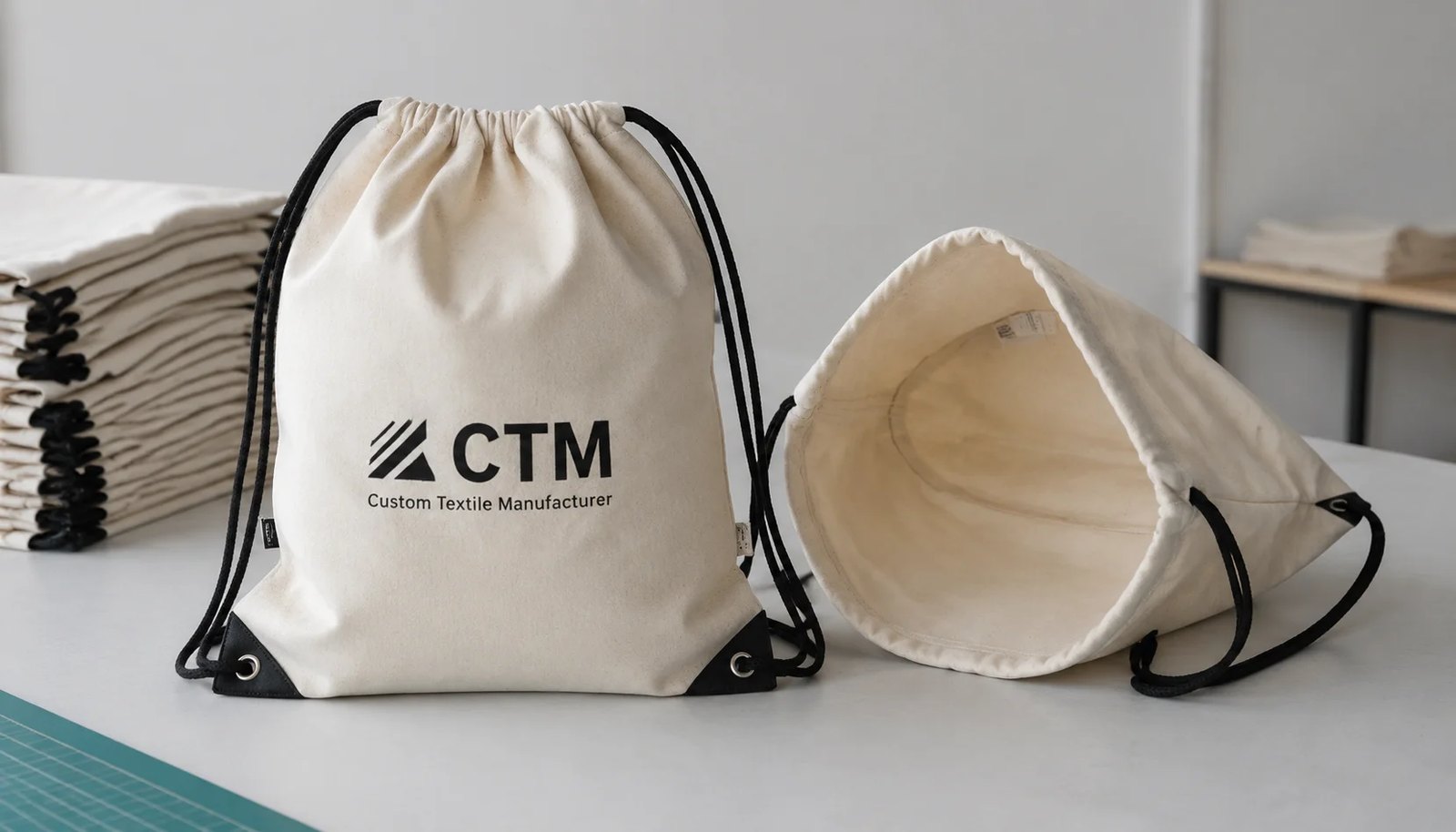
Buying Problem
Cotton drawstring backpacks look simple, but liquor retail programs expose weak specifications quickly. The bag may be handed out with a bottle purchase, used for tasting events, packed with branded accessories, or shipped to stores as a promotional kit. Each use creates a different load, presentation standard, and packing requirement. A cheap lightweight drawstring bag may work for flyers, but it can disappoint when the customer carries a boxed bottle, glassware, or several small retail items.
The main buying problem is not finding a supplier who can make a cotton backpack. It is writing an RFQ that prevents quote gaps. If one supplier prices 5 oz cotton with thin polyester cord and another prices 10 oz cotton canvas with reinforced corners, the unit price comparison is meaningless. Procurement teams need a checklist that turns the product into measurable decisions: fabric weight, size, cord, print method, reinforcement, packing, sample approval, and lead time assumptions.
- Treat the backpack as a carrying product, not only as a printed giveaway.
- Quote against one controlled specification so supplier prices are comparable.
- Link the specification to the merchandise weight and retail presentation standard.
- Record every cost driver before approving the lowest unit price.
Fabric Specification
For liquor retailers, the fabric decision usually starts with cotton muslin, cotton twill, or cotton canvas. Lightweight cotton around 140-180 GSM can be acceptable for short-life event giveaways, but it does not hold shape well and may look thin under strong store lighting. A more practical wholesale specification is 8 oz cotton canvas, roughly around 270 GSM, when the bag must feel reusable and support printed branding. For a sturdier hand, 10 oz canvas, roughly around 340 GSM, gives better structure but increases fabric cost, sewing resistance, and carton weight.
Natural cotton is the fastest and most predictable route because the factory can often source greige or finished stock more easily. Bleached cotton gives a cleaner white print background but can show dirt during handling. Dyed cotton creates a stronger brand color but adds lab dip approval, shade risk, and usually higher MOQ. A buyer should state whether fabric shrinkage, colorfastness, and hand feel matter, especially if the backpack may be kept by customers rather than used once.
- Budget option: 5 oz or 6 oz cotton for light promotional use with no heavy contents.
- Balanced option: 8 oz cotton canvas for most liquor retail gift-with-purchase programs.
- Premium option: 10 oz cotton canvas when the backpack should feel like a durable retail accessory.
- RFQ wording: state both oz and approximate GSM so suppliers do not quote a lighter substitute.
Size And Load
A common drawstring backpack size is around 38 x 42 cm, but liquor retailers should not accept size by habit. If the bag is intended to carry a boxed bottle, gift card sleeve, tasting booklet, or bar tool set, the finished size must be tested with the actual items. A bag that looks generous when flat can become tight once the drawcord closes and the product corners push against the fabric.
Load capacity depends on fabric, seam construction, cord quality, and corner reinforcement. Cotton drawstring backpacks are not rigid bottle carriers, so the buyer should not assume they can replace padded wine bags or bottle totes. However, with 8 oz or 10 oz canvas, strong side seams, and reinforced lower cord points, they can handle typical promotional retail contents much better than thin cotton pouches.
- Provide target contents by weight and dimensions, not only a product name.
- Require a loaded hanging test using the expected retail pack weight.
- Avoid sharp box corners pressing directly into thin fabric without allowance.
- Keep the print area away from high-stress folds caused by bulky contents.
Cord And Reinforcement
Cord quality is one of the easiest places for quotes to diverge. Thin polyester cord is inexpensive and slides smoothly, but it may look inconsistent with a natural cotton body. Cotton rope or flat cotton cord gives a better natural finish and more shoulder comfort, but it costs more and may have shade variation after dyeing. For liquor retail programs positioned around craft, organic, local, or premium products, cord appearance matters because the bag is part of the handover experience.
The lower cord entry points need special attention. The cord pulls downward and outward when the backpack is worn, and the stress collects at the bottom corners. If the factory uses only a simple folded corner with weak stitching, tearing can occur during customer use. A better construction uses reinforced triangular corners, bartack stitching, or an inserted patch depending on the target load and price point.
- Specify cord material, thickness, color, and finished length.
- Approve the way the cord exits the bottom corner before bulk production.
- Use bartacks or reinforced corner stitching for heavier retail contents.
- Check that cord ends are knotted, sealed, or finished consistently.
Logo Printing
Screen printing is usually the most stable choice for cotton drawstring backpacks with solid liquor retail logos, store marks, or campaign graphics. It handles one to four spot colors well, gives predictable cost at volume, and can be matched to Pantone references more clearly than many digital methods. The buyer should control print size, position, ink color, and acceptable hand feel. Heavy ink coverage on cotton can stiffen the panel, so large block prints should be reviewed on the actual fabric before approval.
Heat transfer can be useful for small orders, fine gradients, photographic artwork, or multi-color seasonal graphics. The tradeoff is that transfer film can feel less integrated with cotton and may show edge lines on natural fabric. Digital printing can work for complex artwork, but the result depends heavily on fabric pretreatment, color management, and wash expectations. For a liquor retailer, the best print method is the one that matches the artwork, quantity, and brand feel rather than the cheapest setup charge.
- Use vector artwork for screen printing and define Pantone colors clearly.
- Approve a print strike-off on the selected fabric, not on paper.
- Set print placement tolerance, for example centered within an agreed centimeter range.
- Run rub and fold checks on heavy print areas before bulk approval.
MOQ Logic
MOQ for cotton drawstring backpacks is not one single number. It comes from the fabric source, cutting efficiency, cord procurement, print setup, label production, and packing method. A factory may accept a low quantity if natural cotton stock and standard cord are available, but the same design in dyed cotton with custom cord and woven label may require a much higher MOQ. This is why procurement teams should request MOQ by component, not only by finished bag.
Liquor retailers often run regional campaigns, seasonal promotions, or account-specific artwork. If the total order is large but split into many logos, print setup and production handling become cost drivers. A practical RFQ should state the total quantity, number of artwork versions, quantity per design, and whether the same bag body can be shared across designs. This allows the factory to price the real workflow instead of giving a low headline price that later changes.
- Separate MOQ for fabric color, bag style, logo version, cord color, label, and packing.
- Consolidate bag body specifications when multiple liquor banners need different logos.
- Expect higher cost per unit for small artwork splits because setup and handling repeat.
- Confirm whether overruns or underruns are allowed and how they will be billed.
Sample Approval
A reliable sample process should move from material confirmation to production-ready approval. Start with fabric and cord swatches when color, weight, or hand feel is important. Then approve the logo proof or print strike-off. After that, review a complete pre-production sample with the final fabric, cord, reinforcement, print size, label, and packing method. The sealed sample should become the reference for bulk inspection.
Do not approve a sample only from photos if the order has premium retail expectations. Photos can hide thin fabric, rough hand feel, weak cord, print stiffness, and odor. If timing requires photo approval for an early step, reserve physical approval for the final pre-production sample. For importers and distributors buying for liquor retail accounts, it is also useful to send one sample to the brand owner and keep one sealed reference for inspection.
- Swatch approval: fabric weight, color, texture, cord type, and logo color direction.
- Print approval: size, placement, ink opacity, edge sharpness, and hand feel.
- Construction approval: seam strength, cord channel, bottom reinforcement, and finished dimensions.
- Packing approval: inner pack quantity, carton marking, moisture control, and any retail label.
Quote Data
A useful quote for cotton drawstring backpacks should show more than unit price. The buyer needs enough data to compare landed cost and production risk. At minimum, the quote should list fabric weight, finished size, print method, number of print colors, included packaging, sample charges, setup charges, MOQ, production lead time, carton quantity, carton size, gross weight, and trade terms. Without carton data, a low unit price may become expensive after freight is calculated.
For liquor retailers, packing method can change both cost and store handling. Individual polybags improve presentation and protect natural cotton from dirt, but they add labor, material, and plastic waste. Bulk packing reduces cost and carton volume but requires cleaner warehouse handling. If the bags will be inserted into store kits or handed out at tasting counters, the buyer should specify whether bags must be folded, flat packed, barcode labeled, or packed by store allocation.
- Request CBM and gross weight before comparing supplier quotes.
- List all charges outside the unit price, including screens, samples, labels, and special packing.
- Define Incoterms clearly, such as EXW, FOB, CIF, or DDP when applicable.
- Use carton data to compare true landed cost, not only factory price.
Lead Time Risk
Lead time starts after final sample approval, artwork approval, deposit, and material confirmation, not when the first email is sent. Natural cotton backpacks with standard cord and simple screen print can move faster than dyed fabric or custom accessories, but timing still depends on factory capacity, printing schedule, drying time, sewing line availability, inspection, and export booking. Liquor retail promotions often have fixed launch dates, so the schedule should include approval buffers rather than assuming perfect handoffs.
The highest-risk delays usually come from artwork changes, lab dip rejection, unclear packing instructions, and late barcode or label files. A distributor may also need time for inbound receiving and store allocation after the goods arrive. The sourcing plan should work backward from the retail date and include sample courier time, production days, inspection booking, vessel or airfreight choice, customs clearance, and domestic distribution.
- Freeze artwork before sample approval to avoid reprinting screens or transfer films.
- Approve dyed fabric only after lab dip and bulk shade expectations are documented.
- Book inspection before the final production week if the shipment date is fixed.
- Include warehouse receiving and store distribution time in the retail launch calendar.
Inspection Standards
Inspection should focus on defects that affect retail appearance and carrying function. For cotton backpacks, common issues include stains, fabric slubs beyond the approved level, loose threads, skipped stitches, uneven cord length, weak bottom corners, crooked print, ink smears, poor opacity, and wrong packing quantity. Natural cotton can have some texture variation, but oil marks, mildew odor, obvious dirt, and holes should not pass for retail use.
Acceptance criteria should be written before production, not debated after defects appear. For example, size tolerance can be set around plus or minus 1 cm for a simple cotton backpack unless the buyer needs tighter control. Print position can be measured from the top edge and side seams. Load testing can be performed on a sample set using the intended retail contents or a defined weight. These standards make inspection more objective and reduce disputes between buyer, factory, and third-party QC.
- Classify mildew odor, oil stains, fabric holes, broken seams, and wrong artwork as major defects.
- Measure print alignment from fixed bag edges instead of judging by eye only.
- Test cord and corner strength with the expected loaded weight.
- Open cartons from different production lots to catch shade or packing variation.
Specification comparison for buyers
| Spec decision | Recommended option | When it fits | Buyer risk to check |
|---|---|---|---|
| Fabric weight | 8 oz cotton canvas or 10 oz cotton canvas for better shape | Liquor gift packs, bottle club rewards, and retail events where the bag must feel reusable | Thin 5 oz or 6 oz cotton can reduce unit cost but may show bottle corners, wrinkle heavily, and feel too promotional for premium spirits |
| Bag size | About 38 x 42 cm with enough width for boxed spirits or bundled accessories | General liquor retail use where the same backpack may carry merchandise, samples, catalogs, or event items | Oversized bags increase fabric consumption and carton volume; undersized bags may fail when customers carry a bottle plus receipt folder or gift insert |
| Cord material | Thick cotton rope or flat cotton cord with bartack reinforcement | Retail programs that want a natural look and better shoulder comfort than thin polyester cord | Cheap round cord can cut into shoulders, pull through the channel, or mismatch the cotton body color after dyeing |
| Print method | Screen print for solid logos; heat transfer only for complex gradients or small-color runs | Store logos, distillery artwork, loyalty club designs, and holiday promotional marks | Heavy ink coverage on cotton can crack or stiffen the panel; transfer films may feel less natural and need wash/rub testing |
| Color route | Natural cotton for fastest lead time; dyed cotton only with lab dip approval | Natural bags suit craft spirits, organic positioning, and lower MOQ campaigns | Dyed fabric can shift between lots; dark colors need print opacity control and may require higher MOQ |
| MOQ logic | Base MOQ around available greige cotton, cord stock, and print setup rather than only bag count | Importers consolidating several store banners or distributors buying for multiple liquor retail accounts | A low MOQ quote may use whatever fabric is on hand, leading to shade, weight, or shrinkage inconsistency across repeat orders |
| Closure and reinforcement | Standard drawstring closure with reinforced bottom corners and top channel stitching | Backpacks expected to carry heavier retail items or event samples | Without reinforcement, cord stress concentrates at the lower corner and can tear when a customer carries bottled products |
| Packing method | Individual polybag only if retail presentation needs it; otherwise bulk inner packs with moisture control | Distributor warehouses, store replenishment cartons, and event-kit assembly | Overpacking adds labor, plastic, and carton space; underpacking risks cotton staining, mildew odor, or carton abrasion |
| Supplier evidence | Factory sample photos, material swatches, print proof, carton data, and previous production-style QC records | Procurement teams comparing quotes from factories, traders, and promotional product vendors | A quote with only a unit price usually hides fabric substitution, print setup gaps, carton count errors, and unclear responsibility for defects |
Buyer checklist before sampling
- Define the real use case: bottle gift bag, loyalty backpack, staff event kit, tasting-room purchase gift, or distributor promotion.
- Specify finished bag size in centimeters, not only approximate capacity.
- State cotton fabric weight by oz or GSM and require tolerance, for example 8 oz cotton canvas around 270 GSM with an agreed tolerance.
- Confirm whether natural, bleached, dyed, or printed fabric is required because each route changes MOQ, shade control, and lead time.
- Choose cord type, cord diameter or width, color, and reinforcement method at the bottom corners.
- Provide artwork as vector file and list print size, print position, Pantone references, and required print hand feel.
- Set sample approval steps: material swatch, logo proof, pre-production sample, and sealed sample before bulk cutting.
- Require load testing suitable for the intended merchandise, especially if bottles or boxed spirits may be carried.
- Request carton dimensions, gross weight, net weight, pieces per carton, and packing method before comparing landed cost.
- Clarify labeling, barcode, hangtag, warning label, or country-of-origin marking requirements before quotation.
Factory quote questions to send
- What cotton fabric weight and construction are included in the quote, and what tolerance will be accepted in bulk?
- Is the quoted fabric made from available stock, newly woven greige fabric, or dyed-to-order material?
- What is the minimum order quantity for the bag body, cord color, printed logo, dyed fabric, and any label or hangtag?
- Which print method is quoted, how many colors are included, and what is the maximum print size before the price changes?
- Can the factory provide a fabric swatch, print strike-off, and pre-production sample before bulk cutting?
- What reinforcement is used at the lower drawstring corners, and has the bag been tested with the intended load?
- What are the estimated pieces per carton, carton size, gross weight, and CBM for the quoted quantity?
- How many production days are required after sample approval, and what steps can delay the schedule?
- Are screen charges, sample charges, bank charges, export cartons, moisture protection, and local port delivery included?
- What inspection standard will be used for stains, broken stitches, print defects, size tolerance, and packing errors?
Quality-control points to confirm
- Fabric weight should match the approved swatch within the agreed tolerance, with no obvious mixed lots in shade or texture.
- Finished size should stay within practical tolerance, commonly about plus or minus 1 cm unless the design requires tighter control.
- Print position should be centered within the approved tolerance and should not tilt noticeably across a carton sample.
- Ink adhesion should pass a simple rub test and should not crack, peel, or transfer under normal handling.
- Top channel stitching should be straight enough for smooth cord movement and should not catch or bunch.
- Lower corner reinforcement should resist tearing during a loaded pull test using the buyer's expected product weight.
- Cord length should be consistent so the backpack hangs evenly on both shoulders.
- Loose threads, oil marks, dirt, fabric holes, and mildew odor should be treated as major defects for retail programs.
- Cartons should be dry, correctly marked, and strong enough for warehouse stacking and international transit.
- Final packed quantity should match the packing list by carton and inner pack, not only by total order quantity.