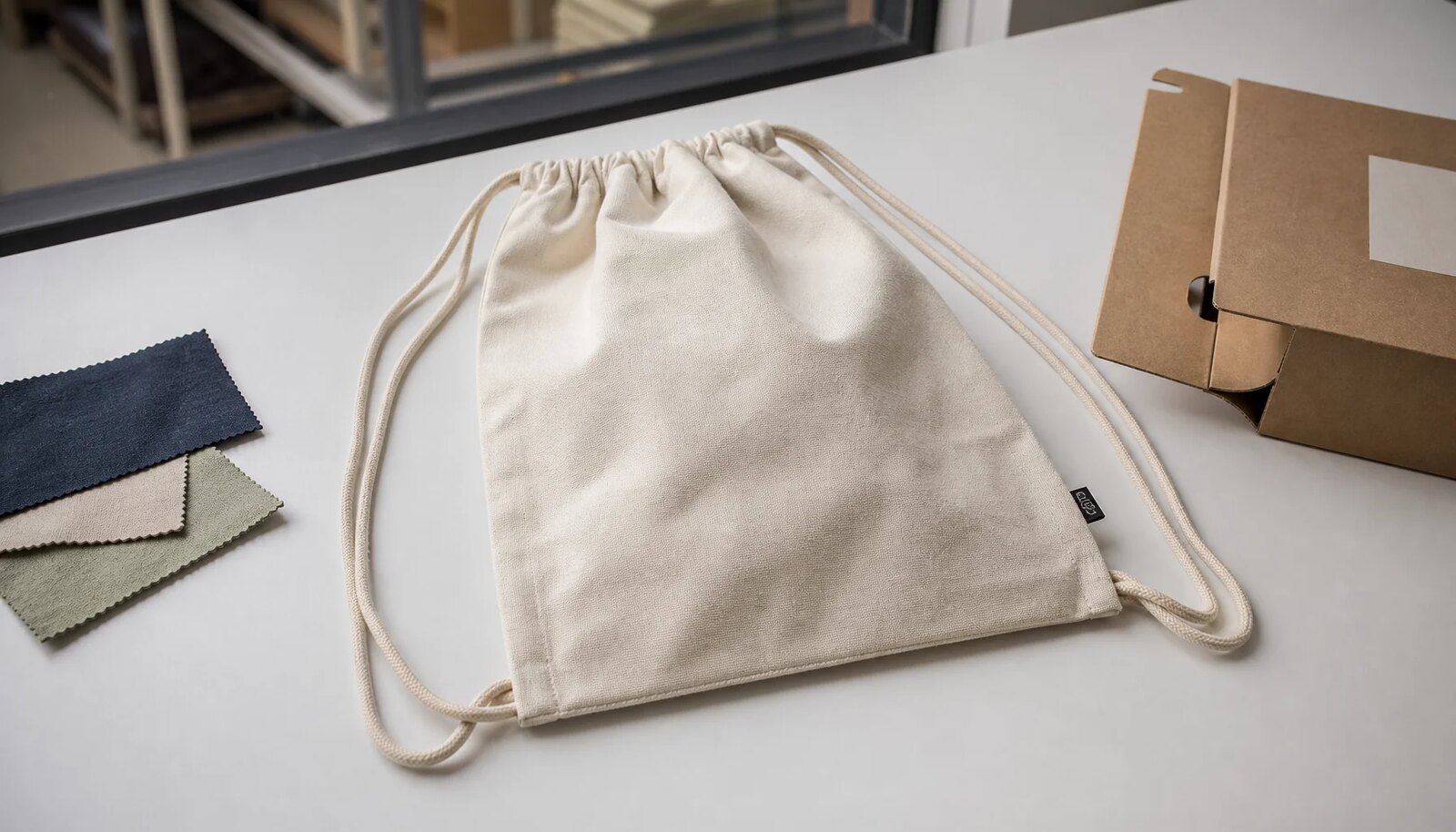
Start With the Retail Job
A cotton drawstring backpack sold in a hotel shop has to do more than hold a logo. It sits beside resort apparel, caps, towels, skincare, snacks, and small travel accessories. Guests may buy it for a beach day, spa visit, city walk, event materials, or as an easy souvenir. Each use changes the correct fabric weight, size, cord comfort, decoration method, retail packing, and landed cost target.
Begin the buying process with the shelf role, not the bag shape. A resort shop may be able to support 240 GSM or 280 GSM cotton canvas, a better cord, and a hangtag because the product is part of the guest experience. A compact city hotel kiosk may need a lighter fold, simple neutral color, and a crisp one-color logo. A conference hotel may care most about repeatable stock colors, carton labels by event, and short replenishment windows.
This is where B2B procurement discipline matters. If the RFQ says only “good quality cotton drawstring backpack,” every supplier will fill in the blanks differently. One may quote 160 GSM natural cotton in bulk cartons. Another may quote 240 GSM dyed cotton with hangtags, barcodes, and individual packs. Both can look reasonable until the samples and landed costs arrive.
Get the internal team aligned before RFQs go out. Retail will focus on shelf appeal and margin. Marketing will check brand color and logo placement. Operations will worry about receiving accuracy. Logistics will see carton volume and freight cost. A written buying checklist keeps those priorities visible before sample revisions start.
- Define the role: souvenir, beach carry, conference retail, spa accessory, amenity upgrade, or lifestyle merchandise.
- Set target retail price and margin before approving GSM, decoration, labels, or retail packing.
- List expected carry items, such as sandals, towel, bottled water, notebook, or light shopping.
- Separate pilot orders from chainwide rollouts because MOQ, carton labeling, and reorder risk change with scale.
- Decide whether the bag will hang, fold, sit in bins, ship in kits, or arrive property-sorted by SKU.
Specify Cotton Fabric Clearly
Fabric is the first place wholesale quotes drift apart. “Cotton,” “canvas,” “calico,” and “natural cotton” are not complete specifications. A usable RFQ names the fiber, weave, finish, color, target GSM, and tolerance. For many hotel retail cotton drawstring backpacks, 200 to 240 GSM is a practical starting range. It gives better opacity and structure than light promotional cotton without making the bag too bulky for bins, shelves, or cartons.
Lighter fabric can still be right. A 140 to 180 GSM cotton body may work for a low-cost souvenir, room amenity, or event add-on where the retail expectation is modest. Heavier fabric also has a place. A 260 to 280 GSM body can feel more premium and support a stronger silhouette, but it raises fabric cost, shipping weight, carton volume, and sewing demands. The best choice depends on the retail price and the load the guest is expected to carry.
Treat GSM as a control point, not a sales description. A common starting tolerance is plus or minus 5% unless your brand or inspection standard is stricter. Ask how the supplier checks fabric weight before cutting. Also confirm whether the quoted cloth is stock greige, stock dyed, custom dyed, bleached, pigment dyed, enzyme washed, or prewashed. Those choices affect shade control, shrinkage, handfeel, MOQ, price, and lead time.
Natural cotton can look warm and authentic in hotel retail, but approve its variation in advance. Seed flecks, slubs, neps, and warm shade shifts may support a natural presentation. The same traits may look wrong in a cleaner luxury assortment. Dyed cotton brings a different risk: shade lots. Black, navy, olive, sand, and seasonal resort colors can vary visibly across orders, especially when fabric source changes.
If washability is implied, ask about shrinkage and colorfastness before bulk production. Even if the bag is not meant to be machine washed, dyed cotton still needs rub or color-transfer control. The care label should match the intended use, not an assumption made after packing.
- State fabric as cotton plain weave, cotton canvas, twill, natural, bleached, dyed, pigment dyed, or prewashed.
- Use 200 to 240 GSM as a balanced hotel retail starting point when the product needs structure without excess bulk.
- Write GSM tolerance into the PO, commonly plus or minus 5% unless a stricter inspection plan is agreed.
- Approve shade by physical swatch, lab dip, or signed sample, not by screen image.
- Ask whether fabric is stock or custom because that affects MOQ, lead time, shade control, and reorder consistency.
Lock Size, Cord, and Construction
A drawstring backpack looks simple until guests actually use it. Fit, cord comfort, and seam strength decide whether the item feels retail-ready or promotional. The RFQ should state finished width, finished height, gusset, opening width, cord-channel depth, strap drop, and folded dimensions. For cotton cut-and-sew goods, buyers often start with plus or minus 1 cm for body measurements, but the exact tolerance should be written before production. Cord length may need a wider allowance, such as plus or minus 2 cm, depending on knots and finishing.
Size should follow use. A small souvenir bag can fold neatly and take less shelf space. A beach or day-trip bag needs usable space for a towel, sunscreen, sandals, and a water bottle. A conference retail bag may need to fit a notebook or event materials without stretching the opening. If capacity matters, specify bottom gusset, side gusset, or boxed base. Each option changes pattern, sewing time, and carton volume.
Cord choice affects comfort faster than many buyers expect. Common options include cotton rope, polyester braided cord, flat cotton tape, and blended cords. A 3 mm cord can work for very light loads but may feel narrow on the shoulder. A 5 mm to 6 mm cord often feels more substantial for hotel retail, but it needs a matching channel and can increase fold bulk. Specify cord material, diameter, finished length, color, knot style, stopper material, eyelets if used, and whether ends are heat-sealed, knotted, tipped, or wrapped.
Construction should match the expected load. Light souvenir bags may use simple lockstitch seams and a folded top channel. Bags expected to carry towels and bottles should have stronger seam allowance, reinforced bottom corners, secure cord entry points, and consistent stitch density. If bar tacks are included, define their position and thread color. If eyelets are used, confirm reinforcement so the hardware does not pull out under normal use.
Do not approve the product from a flat photo alone. Load the sample, close it, wear it briefly, and look for twisting, seam stress, cord slippage, and logo distortion. These problems are easier to correct before bulk cutting than after packed cartons reach the hotel warehouse.
- Specify finished width, height, gusset, opening, cord channel, strap drop, and folded dimensions.
- Use written measurement tolerances, such as plus or minus 1 cm for body size when appropriate.
- Define cord material, diameter, length, color, knot, stopper, eyelet, and end finish.
- Add reinforcement at bottom corners and cord entry points for beach, travel, or heavier guest use.
- Inspect loaded shape and closure function, not only the flat front-panel appearance.
Choose Decoration for the Fabric
Decoration is one of the highest-risk quote variables because artwork, fabric texture, and order quantity all affect cost. Screen printing is usually efficient for simple spot-color hotel logos, slogans, and repeat wholesale programs. It works best when the artwork is vector-based, colors are defined, and print size is fixed. Confirm ink type, number of colors, setup charge, print area, curing method, and whether the price includes one-side or two-side printing.
Embroidery can give a premium look, but it is not automatically the better option. Large embroidery can pucker lighter cotton, add stiffness, and raise cost through digitizing and stitch count. It works best for smaller marks, monograms, or logos on heavier fabrics where backing can be controlled. Ask for stitch count estimate, backing type, thread color reference, embroidery area, and digitizing charge.
Heat transfer can handle gradients, photographic detail, small batches, and multi-color artwork. Still, it must be approved on the exact cotton fabric. A transfer that looks clean in a mockup can feel too plastic, lift at the edges, or crack after handling. For understated hotel retail, woven labels, cotton labels, side tabs, patches, and hangtags may be stronger choices because they preserve the fabric’s natural look.
Placement needs measurements. State logo size and distance from fixed edges, such as 90 mm below the top seam and centered left to right. For simple front prints, plus or minus 5 mm is a practical starting placement tolerance. Small labels, multi-panel artwork, or designs near folds may need tighter control. If the bag must not be folded through the print, include that in the packing sample approval.
Control color with a Pantone reference, thread card, lab dip, or approved physical sample. Cotton texture changes perceived color. Natural cotton can mute ink. Dyed fabric can shift contrast. A digital mockup is useful for layout, but it should not be the final approval standard for retail goods.
- Use screen print for simple spot-color logos, repeat orders, and controlled margin.
- Use embroidery for smaller premium marks on fabric heavy enough to avoid puckering.
- Use heat transfer for detail or short runs only after approving handfeel, adhesion, and edge finish.
- Use woven labels, cotton labels, or hangtags for subtle hotel branding and cleaner shelf presentation.
- Specify print size, placement from edges, color reference, and tolerance before sampling.
Make MOQ Comparable
MOQ is not just a number to push down. It usually comes from fabric purchase minimums, dye lots, cutting efficiency, print setup, label minimums, cord sourcing, packing material minimums, and factory line setup. A supplier may accept a low quantity for stock natural cotton with one-color print and bulk packing. The same supplier may require a higher MOQ for custom dyed fabric, multiple property logos, woven labels, stoppers, and individual barcode packs.
Compare supplier routes against the same specification. A direct factory may give better control over size, construction, and repeat specs. A trading company may help consolidate several hotel retail or amenity items, but production-floor visibility can be lower. A stock blank importer with local decoration can move quickly for pilots, although the blank may not have the retail handfeel or shade consistency you need. A domestic cut-and-sew converter may support small premium runs and faster replenishment, usually at a higher unit cost.
Hotel groups often run into hidden MOQ problems through versioning. A 6,000-piece order can become inefficient if it is split across twelve property logos, four fabric colors, and three packing formats. For a market test, keep the first order simple: one fabric color, one size, one decoration method, one packing format, and one label standard. Use reorder data before adding property-specific artwork or colorways.
Ask every supplier to break MOQ down by style, fabric color, artwork, label, and packing. Also ask whether overrun or underrun tolerance applies. Cut-and-sew orders often need an agreed shipment quantity tolerance, such as plus or minus 3% or 5%, because fabric yield and defect sorting can affect the final count. If an exact launch quantity is mandatory, state it early and price any extra buffer.
- Ask for MOQ by total order, color, artwork version, label type, and packing format.
- Simplify pilot orders before reducing material quality or QC standards.
- Confirm whether overruns or underruns are allowed and what tolerance applies.
- Identify outsourced steps for sewing, printing, labels, folding, barcode application, and final packing.
- Use the same specification and incoterm when comparing factory, trader, stock blank, and domestic quotes.
Approve Samples That Can Be Enforced
Sample approval is where a wholesale order becomes controlled. A showroom sample can show the general style, but it does not prove bulk production. A hotel retail program may need a fabric swatch, color lab dip, decoration strike-off, fit sample, pre-production sample, and packing sample. For a simple order, some of these can be combined. The final approved sample should still match the actual fabric, color, cord, construction, decoration, labels, fold, barcode, and retail pack.
Inspect the sample with a checklist in hand. Measure width, height, gusset, channel depth, strap drop, cord diameter, and logo placement. Check thread trimming, seam straightness, bottom corners, cord pull, stopper grip, eyelet setting if used, odor, stains, shade, and handfeel. Then load the bag with expected guest items and see whether it closes smoothly and whether the print or embroidery distorts.
Decoration approval should be physical. For screen print, review opacity, edge sharpness, pinholes, bleeding, cracking, ghosting, and transfer marks. For embroidery, check puckering, backing visibility, thread color, and distortion. For heat transfer, check edge lift and handfeel. For labels, check attachment strength, placement, alignment, and whether the label scratches or interferes with closure.
Approval notes must be specific enough to build from. “Improve quality” is not a production instruction. Better notes sound like: move logo 15 mm higher, change cord from 4 mm to 5 mm, use body-color thread, reinforce the bottom corners, change the hangtag string to cotton, or avoid folding through the print. Keep one signed sample with the buyer and one with the supplier. Photos, dates, and version numbers help the factory, inspector, and reorder team compare against the same standard.
- Approve final fabric, decoration, finished bag, and packing before deposit or bulk start whenever possible.
- Measure the sample and record values, not only visual comments.
- Test loaded use, closure, strap comfort, cord slip, and shelf presentation.
- Document approved changes with measurements, photos, dates, and sample version numbers.
- Keep the approved sample as the standard for in-line inspection, final inspection, and reorders.
Write QC Before Bulk Starts
QC should be agreed before goods are made. If tolerances are missing, a supplier may inspect to a promotional-goods standard that is too loose for hotel retail. The QC plan should cover fabric, cutting, sewing, cord function, decoration, labels, packing, carton marks, and quantity. It should also define critical, major, and minor defects so disputes are easier to resolve.
Measurable controls make inspection useful. Common starting points include GSM within plus or minus 5%, body measurement within plus or minus 1 cm, cord length within plus or minus 2 cm, and simple print placement within plus or minus 5 mm. These are not universal rules. Adjust them for bag design, fabric behavior, artwork size, and brand standard, then put the final tolerances in the purchase order.
Defect classification should be practical. Critical defects include safety issues, wrong product, wrong logo, mold, strong chemical odor, sharp exposed hardware, or required barcodes that cannot scan. Major defects include open seams, severe stains, wrong shade, wrong size beyond tolerance, failed cord function, obvious print cracking, wrong label, or mixed SKUs. Minor defects may include small loose threads, slight creasing, or natural cotton slubs that remain within the approved appearance standard.
Inspection works best in stages. Incoming material checks catch fabric shade, GSM, cord color, label material, and print consumables before cutting. In-line checks catch seam and decoration issues while they can still be corrected. Final inspection confirms dimensions, function, appearance, packing, cartons, quantity, and documents. For larger orders, buyers may use AQL sampling; many consumer-goods inspections use AQL 0 for critical, 2.5 for major, and 4.0 for minor defects, but the actual level must be agreed in the PO.
Corrective action belongs in the plan too. Some defects can be trimmed, cleaned, resewn, relabeled, repacked, or carton-corrected. Others, such as severe ink bleed, shade mismatch, mold, or wrong logo, usually require replacement or rejection. Decide who pays for sorting, rework, replacement, and delayed shipment before the deposit is released.
- Define critical, major, and minor defects for fabric, sewing, decoration, labels, packing, and cartons.
- Use written tolerances for GSM, dimensions, cord length, print placement, and quantity.
- Inspect incoming materials, in-line goods, and final packed cartons where order size justifies it.
- Require photos, measurements, defect counts, and sorting records for any failed inspection.
- Agree on rework, replacement, discount, or rejection rules before deposit.
Control Packing and Cartons
Packing is part of the product, not a last-minute warehouse detail. Hotel retail teams may need hangtags, insert cards, care labels, barcode stickers, SKU labels, warning labels, belly bands, individual polybags, or plastic-free paper wrap. Every component affects labor, material cost, carton volume, and lead time. If these items are added after the first quote, both unit price and freight estimates can change.
The fold method matters more than it seems. A tight fold reduces carton volume but can crease cotton or damage a large screen print. A looser fold improves shelf presentation but uses more space. If the bag will hang, test whether the cords, hangtag, or header card support the display without deforming the channel. If the bag will sit in a bin, approve a fold that shows the logo, label, or retail story clearly.
Quote carton details with the product. Ask for folded bag dimensions, pieces per inner pack, pieces per master carton, master carton dimensions, net weight, gross weight, carton board strength, carton marks, PO number, SKU, barcode carton label, country-of-origin marking if required, and destination label. For hotel groups shipping to several properties, property-level carton packing can reduce sorting later, but it must be built into the production plan.
Plastic reduction goals should be balanced with protection. Individual polybags help keep cotton clean and support barcode handling, but many hotels want less plastic. Paper belly bands, kraft hangtags, inner packs, or master poly liners may be alternatives depending on moisture risk and receiving process. If polybags are used, specify thickness, suffocation warning if required, recycling marks if used, and whether barcode labels adhere cleanly.
Receiving data can turn a good product into an operational problem. Cartons should match the purchase order, SKU list, color list, and property allocation. Mixed SKUs should be clearly marked or avoided. If the warehouse needs carton sequence labels, pallet labels, ASN data, or GS1 barcodes, provide those requirements before packing begins.
- Price hangtags, inserts, barcodes, belly bands, polybags, care labels, and carton labels in the original quote.
- Approve the fold method and confirm it does not crease the print or hide the retail face.
- Lock inner pack, master carton count, carton size, gross weight, and carton markings before production.
- Match carton labels to SKU, PO, property destination, and receiving system requirements.
- Specify plastic-free or reduced-plastic packing only after confirming dirt, moisture, and barcode handling risks.
Plan Lead Time by Gate
Lead time for cotton drawstring backpacks is more than sewing time. It can include fabric sourcing, dyeing or bleaching, prewashing, cutting, decoration setup, embroidery digitizing, label production, sample making, sample revisions, bulk sewing, printing, curing, trimming, inspection, folding, carton labeling, export documents, booking, and shipment. Ask suppliers to separate these steps instead of giving one vague production number.
Build the schedule around approval gates. Artwork approval, fabric shade approval, sample approval, barcode approval, label proof approval, deposit, and balance payment can all delay the order if nobody owns them. If the bag supports a hotel opening, resort season, conference calendar, or holiday retail window, work backward from the required arrival date. Add time for at least one sample correction and one inspection hold.
Custom materials usually create the biggest lead-time risk. Stock natural cotton and one-color print may move quickly. Custom dyed fabric, prewashed cotton, custom cord, woven labels, special hangtags, and individual retail packs add steps. Ask which materials can start before final sample approval and which require deposit or written sign-off. Also confirm factory holidays, peak export season, and any known capacity constraints.
Shipping terms must match the production plan. EXW, FOB, CIF, DDP, and delivered domestic quotes shift responsibility for inland freight, export handling, freight booking, customs, duty, and destination delivery. Procurement should know when goods are considered ready, who books freight, when documents are issued, and whether cartons can be held for inspection before payment release.
For reorders, ask how long the supplier needs when the same fabric, cord, label, and artwork are reused. Reorder lead time can be shorter only if materials and files are controlled. If the supplier changes fabric source or cord supplier without notice, the reorder may not match the first shipment even when the SKU number stays the same.
- Break the schedule into fabric, sample, artwork, labels, bulk sewing, decoration, packing, inspection, and shipment.
- Assign deadlines for artwork, lab dip, sample approval, barcode files, deposit, and final inspection.
- Add buffer for one sample revision and one quality hold before launch-critical orders.
- Identify custom materials that drive MOQ and lead time.
- Confirm holiday closures, peak-season capacity, freight booking responsibility, and document timing.
Compare Landed Cost and Reorders
The lowest unit price is not always the strongest wholesale choice. Landed cost should include product unit price, decoration setup, sample charges, screens, digitizing, labels, hangtags, insert cards, barcode labels, packing materials, packing labor, carton costs, inland freight, export handling, freight, duty, customs brokerage, inspection, destination handling, repacking, and distribution to properties. A quote that excludes retail packing may look cheaper until local labor finishes the work after arrival.
Keep incoterms consistent when comparing suppliers. EXW, FOB, CIF, DDP, and delivered domestic pricing are not interchangeable. Compare quotes using the same fabric GSM, size, decoration, packing, carton count, inspection plan, and delivery point. Also compare carton efficiency. A heavier bag or inefficient fold can raise freight cost enough to erase a lower factory price.
Reorder consistency matters in hotel retail. A second order that shifts shade, cord feel, thread color, logo placement, label material, or fold method can look like a different SKU on the shelf. Ask how the supplier stores the approved specification sheet, fabric swatch, cord sample, thread reference, artwork files, screens, embroidery files, label standard, barcode format, and carton label template. For hotel groups, the reorder spec sheet should travel with every PO.
Accountability should be documented before deposit. If printing is outsourced, who approves the strike-off? If labels arrive late, who updates the schedule? If inspection finds dirty fabric, who pays for sorting? If cartons are mislabeled, who corrects them and who pays delayed freight? A reliable supplier does not need to promise zero defects. They need a clear process for preventing, reporting, and correcting defects before shipment.
The best RFQ produces comparable quotes, not simply more quotes. Give each supplier the same specification, ask the same quote questions, and require the same sample and QC standard. That is how procurement separates a genuinely efficient supplier from one quoting a thinner, simpler, or less retail-ready bag.
- Compare total landed cost, not only factory unit price.
- Use the same incoterm, destination, carton volume, packing format, and inspection assumptions.
- Add setup charges, labels, packing labor, inspection, freight, duty, and destination handling to margin calculations.
- Require a reorder spec sheet covering fabric, cord, thread, label, artwork, packing, and carton data.
- Clarify responsibility for outsourced decoration, defects, rework, replacement, delays, and carton errors before deposit.
Specification comparison for buyers
| Supplier route | Best fit for hotel retail | Specs to lock before quote comparison | Main procurement risk |
|---|---|---|---|
| Direct cut-and-sew factory with decoration control | Repeat hotel retail programs needing custom size, GSM, cord, logo placement, labels, and carton packing | Fabric GSM and tolerance, finished size, seam type, cord diameter, decoration method, packing, carton count, incoterm | Confirm which processes are in-house versus outsourced; assign responsibility for print defects, sorting, and rework |
| Integrated sewing, print, label, and retail-packing factory | Retail-ready programs with hangtags, barcodes, insert cards, SKU labels, and property-level carton marks | Full bill of materials, artwork files, barcode format, folding method, inner pack, master carton, receiving label format | Late-added retail packing can change unit cost, carton volume, and lead time if not sampled and priced upfront |
| Trading company consolidating several products | Hotel groups buying drawstring backpacks together with other retail or amenity items | Factory name or audit status if available, production flow, sample ownership, QC plan, packing responsibility | Accountability can blur when sewing, printing, labels, and final packing are handled by different workshops |
| Stock blank importer plus local decorator | Small tests, urgent launches, property-level replenishment, and low artwork complexity | Blank bag GSM, finished size, available colors, cord type, decoration area, print durability, local packing options | Blank lots may vary in shade, GSM, and sewing quality; retail feel may be closer to promotional stock |
| Domestic cut-and-sew converter | Low-volume premium hotel retail, fast sampling, or frequent replenishment windows | Target fabric, size, label, decoration, retail pack, delivery deadline, reorder terms | Unit cost is often higher, so validate gross margin after packing, freight, inspection, and local handling |
| Small workshop or boutique maker | Limited editions, local artwork, boutique hotels, and narrow pilot quantities | Capacity, material source, approved sample, seam tolerance, trim standard, packing consistency | Low MOQ can come with variable measurement, slower scaling, and less formal inspection reporting |
| Large export factory with retail packing line | Chainwide programs, seasonal replenishment, distributor orders, and standardized carton receiving | MOQ by color and artwork, production calendar, carton labels, pallet rules, inspection access | Peak-season capacity, dye-lot consistency, and reorder standard retention must be confirmed before deposit |
| Cotton fabric specialist with cut-and-sew partner | Programs where handfeel, shade, natural cotton appearance, or dyed canvas weight is central to the brand | Swatches from intended bulk cloth, color approval method, shrinkage expectation, rub/colorfastness requirement | Fabric may be strong, but sewing, decoration, and packing still need separate QC ownership |
| Factory using outsourced decoration | Simple logo projects where the sewing supplier is reliable and decoration is low complexity | Decoration subcontractor approval, print strike-off, transfer timing, curing standard, defect responsibility | Goods can move between vendors before defects are visible; define who pays for reprint, resew, sorting, and delay |
Buyer checklist before sampling
- Define the hotel retail role first: souvenir, beach carry, spa or shop add-on, conference retail item, amenity upgrade, or branded travel accessory.
- Set target retail price, target gross margin, expected order quantity, and reorder frequency before choosing GSM, decoration, and packing.
- Specify fabric as cotton plain weave, cotton canvas, twill, natural, bleached, dyed, pigment dyed, or prewashed; include target GSM and tolerance, commonly plus or minus 5% unless your standard is stricter.
- Lock finished dimensions in centimeters or inches: width, height, gusset, opening width, cord-channel depth, strap drop, and acceptable size tolerance such as plus or minus 1 cm for body size.
- State expected load use, for example light souvenir items, bottled water and sandals, towel carry, or conference materials, so the supplier can price seam allowance and reinforcement correctly.
- Specify cord material, diameter, finished length, color, knotting method, eyelet or no eyelet, stopper style, and whether cord ends must be heat-sealed, knotted, tipped, or taped.
- Choose decoration by artwork and fabric: screen print, embroidery, heat transfer, woven label, cotton label, side tab, patch, hangtag, or a combination.
- Send artwork with vector file, print size, Pantone or brand color reference, placement from top and side edges, and placement tolerance, often plus or minus 5 mm for simple front prints.
- Require a pre-production sample made with final fabric, cord, seams, decoration, labels, folding method, barcode format, and retail packing.
- Ask for quote lines covering sample charges, screens, digitizing, label setup, hangtags, inserts, barcodes, individual packing, carton labels, inspection support, and extra spare packing materials.
Factory quote questions to send
- What exact fabric is quoted: cotton plain weave, canvas, twill, natural, bleached, dyed, pigment dyed, or prewashed, and what is the target GSM with production tolerance?
- Will bulk fabric be purchased from stock or dyed to order, and how will shade be approved by lab dip, swatch, bulk cutting, or approved sample?
- What finished bag width, height, gusset, cord-channel depth, and strap drop are included, and what size tolerance do you accept in final inspection?
- What seam construction is included at side seams, bottom seam, bottom corners, top channel, and cord entry points, and what stitch density or reinforcement is standard?
- What cord material, diameter, length, color, knot method, stopper type, eyelet type if used, and cord-end finish are included in the unit price?
- Which decoration method is included, how many colors are covered, what print size is assumed, what ink or thread reference is used, and what setup fees apply?
- What are your minimum readable line thickness and small-text limits for the chosen print or embroidery method on this cotton fabric?
- What MOQ applies by total order, fabric color, bag size, artwork version, print color count, label type, and retail packing configuration?
- What sample types do you recommend: fabric swatch, decoration strike-off, fit sample, pre-production sample, and packing sample, and what are the fees and timing for each?
- Are hangtags, insert cards, care labels, warning labels, barcodes, SKU stickers, inner cartons, carton labels, and spare labels included or charged separately?
Quality-control points to confirm
- Fabric GSM is checked from bulk cloth and matches the approved target within the written tolerance, commonly plus or minus 5% if no stricter standard is agreed.
- Fabric color, shade lot, handfeel, opacity, surface finish, slubs, neps, and marks match the approved swatch or signed sample within the buyer’s appearance standard.
- Finished width, height, gusset, cord-channel depth, opening, and strap drop remain within the written size tolerance, such as plus or minus 1 cm for body measurements and plus or minus 2 cm for cord length where appropriate.
- Panels are cut square, grain direction is consistent, and the bag does not twist, skew, or collapse unevenly when lightly loaded.
- Side seams, bottom seams, top channel, cord entry points, and reinforced corners are free from open seams, skipped stitches, broken stitches, needle holes, raw edges, and loose bar tacks.
- Stitch density, seam allowance, thread color, thread strength, and trimming match the approved sample and written construction sheet.
- Cord diameter, cord color, cord length, knots, stoppers, eyelets if used, and closure action match the approved sample; cords should pull smoothly and not slip under normal hand tension.
- Print or embroidery placement stays within the written tolerance, commonly plus or minus 5 mm for simple front placement unless the artwork requires tighter control.
- Decoration shows correct color, clean edges, acceptable opacity, no cracking, no pinholes, no bleeding, no ghosting, no scorch marks, no adhesive edge lift, and no transfer marks onto the opposite panel.
- Labels, hangtags, insert cards, care labels, warning labels, barcodes, and SKU stickers are correct, legible, scannable if required, and attached in the approved position.