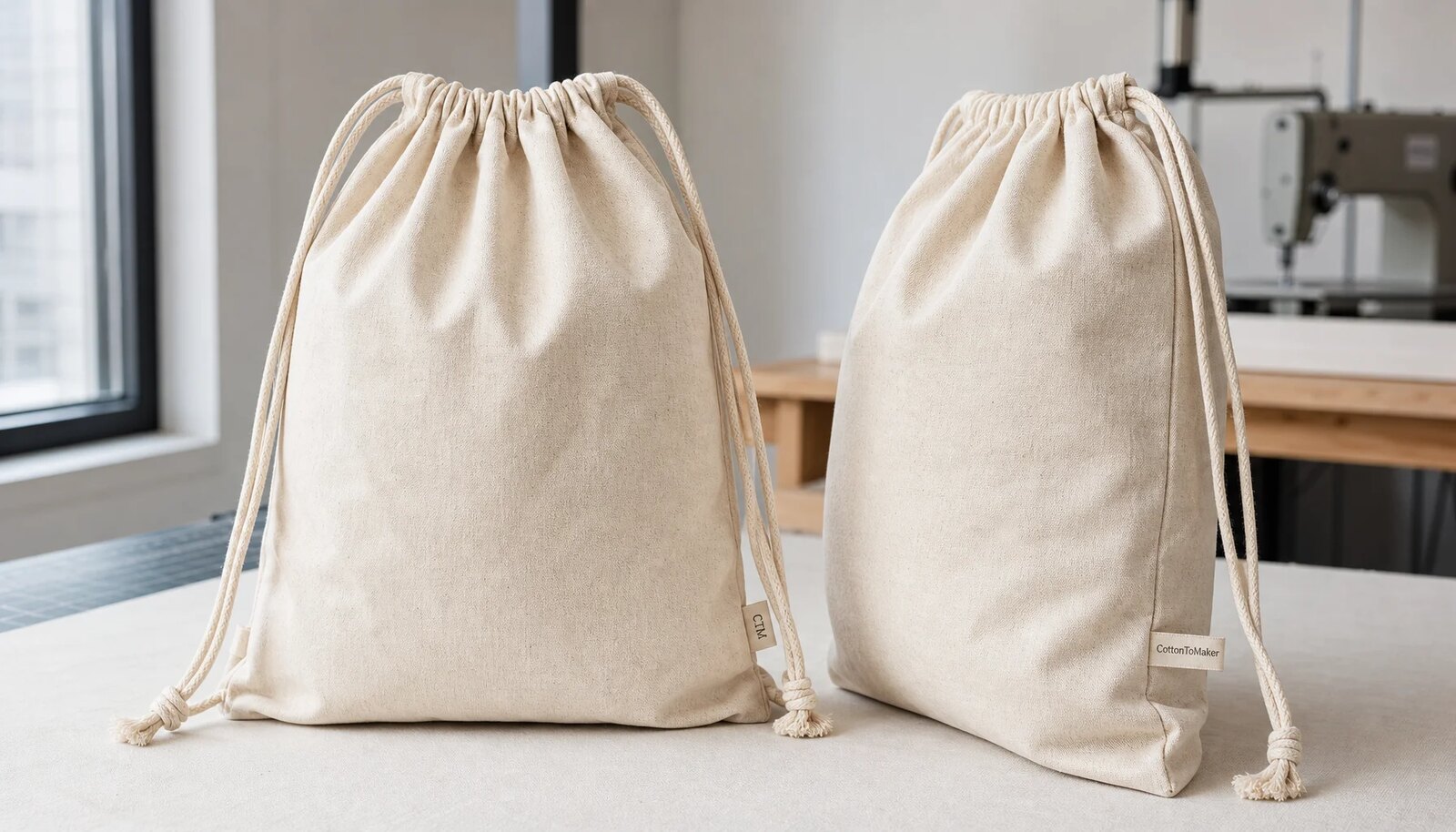
Start with the market job, not the bag name
A cotton drawstring backpack can mean several different things in a farmers market program. It may be a sponsor giveaway at opening weekend, a reusable shopper bag, a CSA pickup bag, a staff kit item, a volunteer pack, or branded merchandise sold from a booth. Those jobs do not need the same product. A bag that carries flyers and coupons can be lighter. A bag that carries jars, produce, packaged food, or folded apparel needs stronger seams, better cord comfort, and more controlled inspection.
Procurement teams get better wholesale quotes when they describe how the bag will be used before they ask for price. The phrase cotton drawstring backpacks wholesale buying checklist for farmers market vendors is useful for search, but it is too broad for a factory spec. Suppliers need to know expected contents, distribution model, launch date, destination, packing rules, and whether users will actually wear the backpack after filling it. Farmers market use is not industrial, but it is tougher than a one-day indoor promotion. Bags may be folded repeatedly, exposed to dust and moisture, carried between stalls, and opened and closed many times.
Decide early whether the product is functional, promotional, or retail-facing. A functional market bag should prioritize reinforcement, cord comfort, practical cotton finish, and simple packing. A promotional bag should prioritize cost, logo visibility, and on-time delivery. A retail-facing bag needs stronger handfeel, cleaner folding, trim consistency, and a presentation that looks intentional on a table display. When those priorities are ranked before quoting, suppliers are less likely to substitute a thin default construction just to hit a lower unit price.
- Define the end user: vendor staff, booth shoppers, CSA members, sponsor recipients, volunteers, retail customers, or market organizers.
- State expected contents by type and rough weight, such as paper goods under 1 kg, packaged food under 2 kg, or mixed produce where seam stress is likely.
- Clarify whether the backpack must support repeated seasonal use, one market weekend, or resale at a booth.
- Rank the top three priorities before RFQ: cost, durability, appearance, speed, low MOQ, sustainability claim, or packing control.
- Note outdoor conditions such as dust, damp produce, frequent folding, repeated drawcord use, and multi-location distribution.
Turn the use case into a written product spec
A useful spec does not need to be long, but it does need to remove guesswork. Start with finished size, fabric GSM, cotton finish, cord material, cord diameter, seam construction, decoration method, logo size, packing format, carton labeling, and inspection standard. Each missing detail gives the supplier room to choose a cheaper default. Sometimes that default is acceptable. Sometimes it changes the product enough that price comparisons become meaningless.
For farmers market vendors, finished dimensions should match the contents. A smaller bag may work for folded shirts, recipe cards, seed packets, or light packaged goods. A larger bag may be needed for produce bundles, but large panels in lightweight cotton can sag and distort the print. If the backpack is worn, cord length matters as much as bag size. A cord that looks fine in a flat photo can feel short or rough when the bag has weight inside it.
Write the spec in measurable language. Instead of saying strong stitching, request double stitching or bartacks at defined stress points if those features are needed. Instead of saying nice logo placement, give the print size and distance from the top edge or side seams. Instead of saying packed by location, list the carton split rules. A simple one-page spec can prevent long email threads, sample revisions, and disputes after production is complete.
- Include finished width and height, target tolerance, and measurement method.
- Name the cotton finish, color standard, GSM range, and any visible texture limits.
- Specify drawcord material, diameter, finished length, color, knotting, and end finish.
- Define seam reinforcement at top corners, cord exits, side seams, bottom seam, and lower anchor points.
- Attach artwork files, but also write print size, print location, color reference, and placement tolerance.
Set dimensions, GSM, and tolerance together
Fabric weight is one of the clearest cost drivers, but it should never be chosen alone. For cotton drawstring backpacks, 120-160 GSM is usually a light promotional range. It can work for sponsor handouts, paper goods, or short-term use. The 180-220 GSM range is a stronger starting point for farmers market vendor use, CSA pickups, and reusable shopper programs. A 240 GSM or heavier fabric gives a denser retail handfeel, but it also increases sewing resistance, folding bulk, carton weight, and freight cost.
Finished size changes how the same fabric behaves. Common adult drawstring backpack dimensions often fall around 33 x 40 cm, 35 x 45 cm, or 38 x 46 cm, but there is no universal standard. A large 140 GSM bag can look limp when filled, while a smaller bag in that same fabric may perform acceptably. If the artwork sits on the front panel, load distortion should be checked on the sample, not after bulk goods arrive.
Tolerances belong in the RFQ and purchase order. For sewn cotton bags, a practical finished-size tolerance may be +/- 5 mm for tighter programs or +/- 10 mm for lower-cost bulk production, depending on the supplier and construction. Logo placement needs its own tolerance, commonly around +/- 5 mm for standard screen printing when fixtures are controlled. If the buyer does not define tolerances until inspection, the conversation usually starts too late.
- Use 120-160 GSM for light giveaways, paper goods, sponsor handouts, or short-term promotional use.
- Use 180-220 GSM for stronger vendor bags, CSA pickup programs, and reusable shopper programs.
- Consider 240 GSM and above for retail merchandise after checking cost, sewing impact, folding bulk, carton weight, and freight effect.
- Write exact finished size, measurement method, and size tolerance into the RFQ and PO.
- Ask whether fabric GSM is controlled to a range such as target +/- 5 percent, and how the supplier verifies it.
Specify cotton type and finish without overclaiming
The word cotton is not a complete B2B material spec. Natural unbleached cotton, bleached cotton, dyed cotton, washed cotton, organic cotton, and recycled-content blends can differ in shade, shrinkage, print clarity, and price. Natural cotton may show seed flecks, slubs, and uneven texture. That look can fit a farmers market brand well, but it can also soften fine logo details or make small text harder to read. Bleached or dyed cotton can look cleaner, but shade matching becomes more important.
Claims need discipline. If the bag will be marketed as organic cotton, ask what certification documents apply to the material and whether transaction documentation is available for the actual order. A factory certificate alone may not prove that the specific batch is covered. If no customer-facing claim will be made, procurement can still choose a preferred material, but the RFQ should avoid language that creates an unnecessary compliance burden.
Shrinkage is practical, not theoretical. Drawstring backpacks are not always sold as washable products, but farmers market users may wash them after outdoor use. If washability matters, ask the factory for expected shrinkage after one gentle wash and whether the estimate comes from lab testing, mill data, or internal experience. If shrinkage is a pass/fail requirement, define the method and limit. If it is informational only, say so clearly so the supplier quotes the right level of control.
- State natural, bleached, dyed, washed, organic, recycled blend, or other cotton finish instead of using only cotton.
- For natural cotton, approve the acceptable level of slubs, seed flecks, shade variation, and print-surface texture.
- For dyed cotton, approve a physical reference or Pantone target and define acceptable shade variation.
- For organic or recycled claims, verify certificate scope, validity date, product coverage, and order-level documentation before using the claim.
- Ask for shrinkage expectations if the bag may be washed, and define whether shrinkage is informational or a formal QC requirement.
Do not leave cords and seams to supplier default
The drawcord system is the part users notice first in real life. If the cord is too thin, short, rough, or uneven, the backpack feels cheap even when the cotton panels look fine. For farmers market use, cord material and diameter should be written into the spec. Cotton cord, polyester cord, blended braided cord, and flat tape each have different cost, comfort, colorfastness, and durability implications. A cord that works for a small promotional pouch may be uncomfortable when the bag carries produce or packaged foods.
Seam construction decides whether the bag survives repeated use. The top corners and cord exit points take stress each time the drawcord is pulled. Lower cord anchor points can fail when the cord is sewn into a weak seam or attached through a poorly reinforced tab. Ask for adequate seam allowance, consistent stitch length, reinforced top corners, and a sample showing the final cord path. Do not approve bulk production from a sample with substitute cord or simplified stitching.
Reinforcement can be quoted in plain options. Ask the supplier to price an extra row of stitching, bartacks at stress points, a stronger folded channel, or reinforced tabs at the lower corners. The right choice depends on expected load and target price. The important point is that the decision is visible. A small difference in seam work can matter more than a small unit-price saving if failed bags reach vendors or customers.
- Specify cord material, diameter, color, finished length, knot style, and end finish.
- Confirm whether the cord channel is folded from body fabric or made with a separate reinforced strip.
- Require reinforcement at top corners, cord exit points, lower anchor points, and other load-bearing areas.
- Check whether cord length is comfortable for adult backpack wear after the bag is lightly filled.
- Ask suppliers to quote reinforcement options separately so procurement can compare cost and durability.
Choose decoration for repeatable bulk production
Branding on cotton is less predictable than branding on smooth synthetic fabric. Natural texture, slubs, and shade variation can soften print edges or change perceived ink color. Screen printing is often the practical wholesale choice for farmers market logos because it is cost-efficient, repeatable, and easy to inspect. It works especially well for one-color logos, market names, sponsor marks, farm branding, and bold typography. Still, buyers should approve ink opacity, edge quality, cure, rub resistance, and placement tolerance.
Heat transfer can help with lower quantities or complex artwork, but it brings a different risk profile. Transfers may feel less integrated with cotton, and edges can lift or crack if the bag is folded tightly or handled repeatedly. Digital printing may support detailed artwork, but buyers should check color consistency, rub behavior, and reorder stability. Embroidery, woven labels, and patches can elevate a retail product, yet they add setup time, trim MOQ, placement control, needle-mark risk, and possible puckering.
A mockup is useful for communication, but it is not a production standard. The pre-production sample should show the logo on final fabric using final ink, thread, patch, label, or transfer material. Measure from fixed points such as top edge, side seams, bottom seam, or center line. If the logo is intentionally offset, say so in the approval. Bulk inspection becomes much easier when the artwork position can be measured instead of judged by eye.
- Use screen print for simple logos, bold artwork, repeat orders, and cost-controlled vendor programs.
- Use heat transfer only when artwork complexity, low quantity, or timing justifies it after checking handfeel and fold behavior.
- Use woven labels, patches, or embroidery when the backpack is a retail item and the added cost fits the channel.
- Measure logo placement from fixed points such as top edge, side seam, bottom seam, or center line.
- Approve print color, line clarity, opacity, edge quality, cure, rub behavior, and distortion when the bag is lightly filled.
Build an RFQ that prevents quote drift
Many wholesale backpack quotes are hard to compare because each supplier fills in missing details differently. One supplier may quote 120 GSM natural cotton with bulk packing. Another may quote 180 GSM dyed cotton with individual polybags and a one-color print. The unit prices may appear close, but they are not the same product. A strong RFQ keeps every supplier quoting the same size, GSM, cotton finish, cord detail, seam reinforcement, decoration method, packing method, carton expectation, and inspection standard.
Ask for cost components instead of only a single unit price. Separate lines for fabric, cutting and sewing, drawcord, decoration, labels or patches, packing labor, inner packing materials, export cartons, setup charges, testing, and inland transport make negotiation cleaner. If the price is above budget, procurement can decide whether to reduce GSM, simplify packing, change logo method, increase quantity, remove a patch, or keep the specification unchanged. Without the breakdown, negotiation becomes guesswork.
Farmers market distribution should be included at the quote stage. If bags will be split by location, sponsor, produce category, membership tier, or vendor group, the supplier needs that information before pricing packing labor and carton labels. If the order may repeat next season, state the expected reorder quantity and whether color and logo must match. Reorder stability affects retained samples, artwork control, material planning, and future price breaks.
- Include finished size, target GSM, cotton finish, drawcord spec, seam reinforcement, decoration method, artwork size, and packing format.
- Ask for blank, decorated, packed, export-carton, setup, testing, and inland-freight assumptions as separate lines.
- State order quantity, possible reorder quantity, required delivery window, and destination region.
- Attach artwork files and reference images, but also write measurable placement and color requirements.
- Ask suppliers to list assumptions and exclusions so they do not silently change the spec to meet a target price.
Read MOQ, price breaks, and overrun terms carefully
MOQ is rarely one simple number. A supplier may advertise a low total MOQ but require minimums per fabric color, print version, artwork size, label style, trim color, packing version, or fabric lot. This matters for farmers market programs because one order may be split across several locations, sponsors, or vendor groups. A 2,000-unit order in one color with one logo is very different from 2,000 units split across four colors and six sponsor logos.
Setup charges should be normalized before supplier comparison. Screen printing may include screen charges, color separation, ink mixing, and sample setup. Embroidery may include digitizing. Woven labels and patches may carry their own MOQ and lead time. Some suppliers fold these charges into the unit price; others list them separately. Neither approach is automatically wrong, but the buyer should compare total cost for the exact order and the likely reorder.
Overrun and underrun terms are easy to miss. Soft goods production may not land on an exact quantity unless the buyer requires it and the supplier accepts that requirement. Some suppliers state +/- 3 percent or +/- 5 percent. Others ship exact quantity but build extra pieces for internal defect replacement. The PO should say whether exact quantity is required, how overruns are invoiced, and whether short shipments are acceptable. For pre-packed vendor kits, exact counts may matter more than a small unit-price saving.
- Ask for MOQ by total order, fabric color, artwork, print screen, label type, cord color, and packaging version.
- Separate one-time setup fees from repeat charges so reorder pricing is clear.
- Request price breaks at realistic quantities such as 500, 1,000, 2,500, 5,000, and the forecasted reorder level.
- Confirm overrun and underrun policy before issuing the PO, especially for kits and location-based packing.
- Check whether MOQ depends on stock fabric, custom fabric production, custom dyeing, or trim supplier minimums.
Approve samples with measurable pass criteria
Sample approval should do more than confirm that the backpack looks good in a photo. It should prove that the factory can make the agreed product with final materials and final methods. For cotton drawstring backpacks, request a pre-production sample using final fabric, final cord, final branding, final seam construction, and intended packing. A substitute-material sample can help early development, but it should not release bulk cutting.
Measure the sample and record the results. Check finished width, height, print size, logo position, cord length, visible seam allowance, fold method, label placement, and carton label if packing is part of the approval. Then handle the sample like a real market item. Fill it with representative contents, close and open the drawcord several times, wear it briefly if backpack use is expected, and inspect the top corners and lower anchor points. Rub the printed area by hand and flex the logo panel. Simple handling checks often reveal weak ink, rough cord movement, or seam stress before production starts.
Sample comments should be specific and written. Feedback such as logo too low or make stronger creates avoidable revision loops. Better feedback includes measurements, photos, and a clear pass or fail note. If the buyer accepts an exception, such as natural cotton flecks, slight cord shade variation, or a visible fold mark from packing, that exception should be written into the approval record. The approved sample then becomes the standard for production inspection and reorders.
- Require final fabric, final cord, final branding, final seam construction, and final packing for the pre-production sample.
- Measure finished size, logo position, print size, cord length, label location, and visible stitching quality.
- Load the sample with representative contents and check distortion, comfort, closure, and stress points.
- Rub and flex the printed area to check ink behavior under normal handling and folding.
- Keep an approved sample record with photos, measurements, date, supplier name, revision number, and accepted exceptions.
Control packing before cartons are made
Packing is not an administrative detail. It affects unit cost, carton volume, freight, cleanliness, distribution speed, and receiving accuracy. Individual polybags can protect the product and improve retail presentation, but they add material, labor, and volume. Bulk packing can reduce cost and packaging waste, but it requires clear folding, carton liners if needed, moisture protection, and accurate inner counts. Paper bands or grouped bundles may work when buyers want orderliness without full individual packaging.
Farmers market distribution often requires more than one carton of identical goods. Bags may need to be split by market location, sponsor, membership tier, color, artwork, or kit type. If a factory mixes colors or logos without clear carton marks, downstream sorting becomes slow and expensive. Carton marks, SKU labels, pack lists, and inner counts should be approved before packing starts, especially when goods ship directly to a fulfillment center, market organizer, or regional location.
Carton data should be collected before freight is finalized. A unit price can look attractive until oversized cartons, low units per carton, or high gross weight change the landed cost. Ask for carton dimensions, units per carton, net weight, gross weight, and pallet assumptions if relevant. For export shipments, cartons should be strong enough for handling and should protect against moisture, crushing, and contamination during transit.
- Choose individual polybags only when cleanliness, retail presentation, barcode handling, or fulfillment requirements justify the added cost.
- Use bulk packing for vendor kits, internal distribution, or programs where bags will be unpacked before use.
- Specify fold method, inner count, carton count, carton marks, SKU labels, location rules, and pack-list format.
- Request carton dimensions, gross weight, net weight, and units per carton before approving freight assumptions.
- Confirm whether inserts, barcodes, hangtags, paper bands, desiccants, carton liners, or replacement units are included or charged separately.
Specification comparison for buyers
| Buying decision | Best-fit option | Procurement advantage | Risk to verify before PO |
|---|---|---|---|
| Fast seasonal supply | Stock blank cotton drawstring backpack with local decoration | Shortest path for urgent market launches, sponsor events, staff kits, or small vendor runs | Confirm finished size, actual GSM, available inventory by color, cord spec, decoration surface, and whether future stock lots will match |
| Controlled blank program | Direct factory production without logo | Better control over cotton weight, dimensions, seam reinforcement, cord quality, folding, carton count, and repeatability | Blank price may exclude packing labor, export cartons, inspection, testing, inland freight, shrinkage limits, or carton labeling |
| Standard branded program | Direct factory one-color screen print on cotton | Strong balance of cost, logo visibility, repeatability, and inspection simplicity for market programs | Approve ink opacity, cure, rub resistance, artwork size, print position, placement tolerance, and acceptable shade variation on cotton |
| Multiple market locations | Factory packing by SKU, color, artwork, or destination | Cleaner receiving when bags are distributed to co-ops, market managers, sponsors, vendors, or fulfillment centers | Require carton marks, inner counts, SKU labels, pack lists, and written approval before mixed-carton packing |
| Retail merchandise bag | Heavier cotton with woven label, patch, or embroidery | More finished handfeel and stronger table presentation when the backpack is sold rather than given away | Higher MOQ, longer sampling, trim lead time, needle-mark risk, puckering risk, and tighter placement inspection |
| Low-volume artwork test | Import blanks and decorate domestically | Useful for changing sponsor logos, short runs, uncertain demand, or fixed event dates | Two-supplier workflow can create responsibility gaps for print defects, schedule slips, and final packing consistency |
| Multi-style sourcing | Trading company coordinating backpacks, totes, aprons, pouches, and trims | Helpful when the order includes several cotton bag SKUs or coordinated market merchandise | Ask whether reports identify the actual factory and how specs are controlled at production level |
| Schedule-sensitive order | Nearshore or regional supplier | Shorter transit, easier communication, and better timing control for fixed market dates | Fabric weights, cotton finishes, custom dyeing, and decoration choices may be narrower or more expensive |
| Compliance-sensitive program | Factory production with documented materials and QC file | Better traceability for organic cotton claims, care labels, barcodes, buyer files, or retail channels | Require certificates only for claims you will use, and verify scope, validity date, product coverage, and transaction documents |
Buyer checklist before sampling
- Define the exact use case: vendor resale, shopper carry bag, CSA pickup bag, staff kit, sponsor giveaway, booth merchandise, volunteer pack, or market welcome bag.
- Set the expected contents and target carry load in plain language, such as paper goods under 1 kg, packaged food under 2 kg, or mixed produce where seam reinforcement matters.
- Lock the finished bag dimensions before quoting; common adult drawstring backpack sizes include about 33 x 40 cm, 35 x 45 cm, or 38 x 46 cm, but the PO should state the exact size.
- Specify how measurements are taken: flat, empty, unwashed, after sewing, before packing, from side seam to side seam and top edge to bottom seam.
- Choose target fabric weight by application: 120-160 GSM for light promotional use, 180-220 GSM for stronger vendor use, or 240 GSM and above for denser retail handfeel.
- State cotton finish and claim level: natural unbleached, bleached, dyed, washed, organic cotton, recycled cotton blend, or color-matched to an approved reference.
- Ask for fabric shrinkage expectations after one gentle wash if washability is part of the product promise, and define whether shrinkage is informational or pass/fail.
- Specify drawcord material, approximate diameter, color, finished length, knot or end finish, and whether the cord is cotton, polyester, blended, braided, or flat tape.
- Require reinforcement at top corners, cord exit points, lower anchor points, side seams, and any area where the backpack cord path carries load.
- Define logo method, artwork size, number of colors, Pantone or physical color reference, print position from top and side edges, and placement tolerance such as +/- 5 mm for standard screen print.
Factory quote questions to send
- Which cotton fabric options can you quote for this backpack, and what are the unit price, handfeel, shrinkage expectation, carton-weight impact, and print-surface differences for 120, 160, 180, 220, and 240 GSM?
- Is the fabric weight tolerance controlled by your mill or checked in-house, and will bulk fabric stay within a written range such as target GSM +/- 5 percent or another agreed tolerance?
- Is your MOQ based on total units, units per fabric color, units per print version, units per artwork size, units per trim color, units per packaging method, or one complete fabric lot?
- Can you separate the quote into fabric, cutting and sewing, drawcord, decoration, label or patch, packing labor, inner packing materials, export carton, setup charges, testing, and inland transport?
- What finished size tolerance will you hold in bulk production, and how do you measure the bag for inspection: flat before packing, flat after packing, or after steaming or pressing?
- What seam construction do you recommend for repeated farmers market use, and can you quote added bartacks, double stitching, or reinforced tabs at top corners and lower cord anchor points?
- What drawcord materials, diameters, and colors are available, and which option do you recommend for comfort when the bag may carry produce, jars, packaged foods, or folded apparel?
- Which decoration method do you recommend for this artwork on cotton fabric, and what are the limits for fine lines, small text, color matching, print opacity, and placement repeatability?
- Can you provide a pre-production sample on final fabric, final cord, final print or label, final packing, and final carton label before bulk production starts?
- What tests or internal QC checks do you perform for GSM, fabric shade, size, seam strength, cord pull, print rub, ink cure, color variation, label placement, packing count, and carton condition?
Quality-control points to confirm
- Finished width, height, opening shape, and bottom seam line match the approved sample and stay within the written tolerance, commonly +/- 5 mm to +/- 10 mm depending on size and construction.
- Fabric weight is checked against the agreed GSM range, with no obvious panel-to-panel mismatch, excessive sheerness, weak slub concentration, stains, holes, or unexpected coating.
- Fabric shade matches the approved reference within the agreed tolerance, with no obvious front-to-back, panel-to-panel, or carton-to-carton color mismatch.
- Cutting is straight, panels are aligned, and the bag does not twist when laid flat, lightly loaded, or pulled closed by the drawcord.
- Side seams and bottom seams are secure, with even stitch length, adequate seam allowance, no skipped stitches, no open seams, no broken thread, and no loose thread bundles.
- Top corners, cord channel, cord exit points, and lower cord anchor points are reinforced according to the approved sample and do not tear under normal manual pull checks.
- Drawcord material, diameter, color, finished length, knotting or end finish, and left-right symmetry match the approved sample and PO.
- Drawcord moves smoothly through the channel and does not snag, fray, shed fibers, twist severely, or pull unevenly when the bag is closed and opened several times.
- Print placement is measured from approved reference points, centered or intentionally offset as specified, and consistent across inspected units within the written tolerance.
- Ink coverage is even, logo edges are clean, fine details remain legible, and there are no smears, pinholes, cracking, ghosting, unwanted gloss patches, or transfer marks.