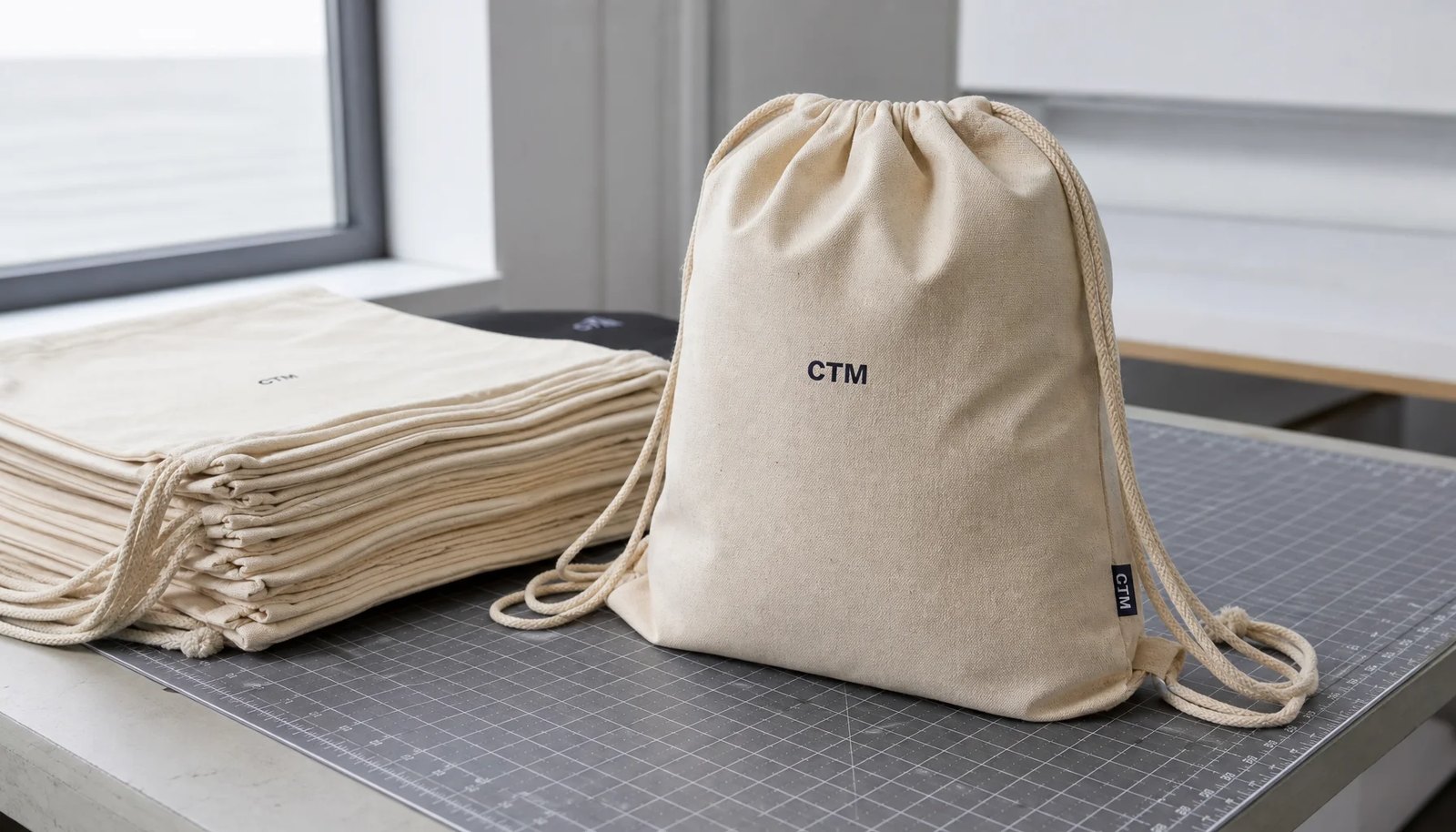
1. Start with the event job the bag must perform
A cotton drawstring backpack for a trade show exhibitor is not just a low-cost giveaway. It is part badge bag, literature carrier, sample holder, mobile advertisement, and sometimes a post-event reuse item. The buying decision should begin with the event job: who receives the bag, what it must carry, how long it will be carried, and what condition it needs to be in when the attendee leaves the hall.
For B2B procurement, the most useful RFQ starts with real contents instead of generic words like promotional quality. List the largest brochure, catalog, notebook, packaged sample, charger, bottle, or apparel item expected to go inside. Add the approximate fill weight. A simple literature bag may only need to hold 0.5-1.0 kg, while a kit with samples and a bottle may approach 2.0-3.0 kg. That difference affects fabric weight, corner reinforcement, cord diameter, and inspection criteria.
Also define presentation level. Staff bags and VIP kits usually need cleaner folding, better branding, and more consistent color than one-day public handouts. If the bag will be placed inside a conference kit, fold size and packing method matter. If it will be handed out at a booth, fast access and carton identification matter more. These details let suppliers quote the same job instead of guessing from a catalog photo.
The fastest way to get a useful quote is to write the use case in one paragraph before listing specs. Say whether the bag is meant for walk-in attendees, pre-registered prospects, speakers, staff, or distributor partners. Include whether it is expected to be reused after the event, because that changes what buyers should accept on fabric hand, seam finish, and print durability. A bag that survives one afternoon is not the same product as a bag that should stay in circulation for months.
Also capture the event environment. Indoor convention centers, outdoor tents, and outdoor summer shows place different stress on cotton goods. Humidity, dust, rain risk, and repeated stuffing all matter. If the bag will be used as a replacement for a tote at an airport or hotel, you may need a stronger build than the same bag used only for brochures at a booth counter.
- State the trade show date, ship-to location, and latest acceptable warehouse arrival date.
- List the actual contents and approximate total carry weight per bag.
- Identify whether the audience is public attendee, qualified buyer, VIP, staff, sponsor, or distributor partner.
- Decide whether the bag is a one-day handout, reusable branded item, or retail-adjacent kit component.
- Include any venue, retailer, or corporate restrictions on polybags, metal parts, labeling, or claims.
2. Specify dimensions from contents, not from a stock template
Many cotton drawstring backpacks are quoted in common sizes such as 33 x 43 cm, 35 x 45 cm, or 38 x 46 cm. Those sizes can work well, but they should not be accepted without checking the contents. A bag that fits an A4 brochure flat may not close cleanly around a boxed sample. A bag that is too large can look empty and low-value when carried with only a notebook and flyer pack.
Write dimensions as finished outside size and define the measurement method. For a flat drawstring backpack, buyers typically measure width seam-to-seam and height from the bottom edge to the top finished edge when the bag is laid flat and smoothed by hand. A practical production tolerance is often +/-1 cm for width and height on cotton bags, but tighter control may be needed for kits that go into molded trays, prebuilt mailers, or retail cartons.
The load path matters as much as the size. Drawstring backpacks carry weight through the top channel, cord, side seams, and bottom cord anchors. If rigid items sit in the lower corners, weak stitching will show quickly. For heavier fills, ask for reinforced bottom corners, adequate seam allowance, and a channel that lets the cord slide without cutting into the fabric. A larger size without stronger construction is not a stronger bag.
Do not forget the shape of the contents. A soft notebook stack behaves differently from a boxed gadget or bottle. If your contents are narrow but tall, the bag may need more height. If the contents are wide and flat, width matters more than total height. Many procurement issues start because the buyer approved the same stock size used for a different event last year and assumed it would still work.
Ask the supplier how the bag will be measured after sewing, after pressing, and after any washing or finishing step. Cotton can move. That is not a defect by itself, but it should be part of the approval conversation. If the contents are close to the edge of the bag's capacity, build in enough room so minor shrinkage or seam variation does not create a late-stage problem.
- Measure the largest item that must fit and add clearance for closing the drawcord.
- Define whether the bag is flat, bottom-folded, gusseted, or boxed-bottom construction.
- Use finished-size tolerances such as +/-1 cm only after confirming the factory can hold them in cotton.
- Ask where the cord anchors and lower corners are reinforced for loads above light literature use.
- Check whether the bag must fit into a master kit carton, fulfillment bin, or event welcome pack.
3. Choose fabric weight, weave, and finish with measurable terms
Fabric is the center of the cotton drawstring backpacks wholesale buying checklist for trade show exhibitors. The usual procurement mistake is asking for cotton canvas without defining weight or construction. Canvas can mean different things in different factories. A clearer specification states fiber content, GSM or oz/yd2, weave, color, finish, and shrinkage expectation.
For light giveaway use, 160-180 gsm cotton can be acceptable when the contents are flyers or a thin notebook. For most exhibitor kits, 200-220 gsm is a stronger starting point because it gives better body, a more stable print surface, and a more reusable feel. For premium programs or sample-heavy kits, 240-320 gsm cotton canvas or twill may be appropriate, but heavier fabric increases unit cost, carton weight, freight volume, and sometimes minimum order requirements.
Ask the factory to confirm whether the GSM is finished fabric weight. Fabric can change after washing, dyeing, calendaring, or other finishing. For QC, GSM should be verified with a cut-and-weigh method using a measured sample from bulk fabric. If the supplier only says 6 oz cotton, ask whether that is oz per square yard and how it converts to GSM. A useful conversion is 1 oz/yd2 equals about 33.9 gsm, so 6 oz/yd2 is roughly 203 gsm.
Weave affects both durability and appearance. Plain weave is common and cost-effective. Twill can feel smoother and may drape better. Canvas usually provides more body and abrasion resistance, but coarse texture can reduce print sharpness for small type or fine lines. Natural cotton can vary in shade and seed flecks, which may be desirable for an eco-forward look but should be approved physically before bulk production.
If the program is meant to look clean and premium on the show floor, ask for a fabric sample that reflects the final finish, not a generic swatch from a different order. The face of the bag matters when it is photographed, stacked on a registration table, or carried in a crowd. Small weave differences can be visible in print holdout, seam puckering, and how the bag folds in transit.
- Use 160-180 gsm only for light, low-load event handouts.
- Use 200-220 gsm as a common baseline for reusable trade show exhibitor bags.
- Use 240-320 gsm when the bag must carry heavier samples or feel more premium.
- Define plain weave, twill, or canvas instead of relying on the word cotton alone.
- Confirm finished GSM, fabric width, shrinkage expectation, and shade tolerance before sample approval.
4. Treat cord and reinforcement as performance specs
The drawcord system is where many low-cost bags fail first. A bag can have acceptable fabric and still feel weak if the cord is too thin, the channel is tight, or the bottom anchors are poorly stitched. For adult trade show use, a 5-8 mm cord is a practical range depending on bag size and load. Cotton cord has a natural look and matches the bag well. Cotton-poly cord may slide more smoothly and resist abrasion better. The choice should be intentional and written into the quote.
Cord length should be specified as a finished measurement or approved from the pre-production sample. If cords are too short, the bag is hard to wear over the shoulder. If they are too long, they drag, tangle, or look untidy in booth distribution. A tolerance such as +/-2 cm may be reasonable for cord length if the factory confirms it can control cutting and knotting.
Reinforcement needs clear language. Ask how the lower cord attachment is made: folded seam, metal eyelet, grommet, sewn tab, bar tack, or another method. Metal eyelets can look neat but may be restricted for some programs or create corrosion concerns if quality is poor. All-cotton or metal-free construction can be useful when the buyer wants a simpler recycling story or must avoid metal detection issues in fulfillment. Whatever method you choose, inspect the stress points, not only the front logo.
This is also where buyers should ask about friction. If the cord drags badly through the channel, the end user notices immediately. Test the draw motion on a filled sample. If it snags, the issue may be channel width, stitch tension, cord finishing, or lint inside the seam. That is a manufacturing detail, but it becomes a brand perception problem when the bag is used in public.
For heavier kits, it is worth asking if the factory can add extra bar tacks or reinforcement stitches at the points where the cords meet the lower corners. The extra cost is small compared with the cost of a bag failing at the event. If the supplier resists the request, ask them to explain the reason in writing. A good factory should be able to describe the load path and the practical limits of the build.
- Specify cord material, diameter, color, end finish, and finished length.
- Define whether cord ends are knotted, tipped, heat sealed, stitched, or left raw.
- Require smooth draw function after repeated opening and closing.
- Check lower cord anchors for lockstitching, bar tack, eyelet quality, or reinforced folded seams.
- Confirm whether metal parts are allowed for the destination market and brand policy.
5. Match logo method to artwork, fabric texture, and inspection needs
Branding is the most visible part of the order, but it should be selected after reviewing artwork and fabric. Screen printing is usually the best fit for one to four spot colors, bold logos, and wholesale quantities. It is economical at volume, easy to inspect, and works well on many cotton fabrics. The buyer should define print size, placement from top or side seams, Pantone references, and registration expectations.
Heat transfer can solve full-color or short-run artwork, but it needs more careful testing on cotton texture and folded packing. Transfers may show edge film, cracking, lift, or surface change if the process is not right. For premium branding, a woven label, sewn patch, or side tag can avoid some print limitations and give a more retail-style result, but it adds sewing labor and its own tolerance requirements.
Do not approve logo quality from a digital mockup alone. Ask for a strike-off on the actual production fabric color, especially when printing light ink on natural cotton or dark ink on coarse canvas. Fine type, thin lines, halftones, and gradients may not reproduce cleanly. A responsible supplier should tell you before approval if the artwork needs thicker lines, larger type, fewer colors, or a different method.
Set tolerances before mass production. For many drawstring backpacks, print placement tolerance around +/-5 mm may be workable; larger tolerances may be visible on centered logos. Color should be judged against Pantone or an approved physical sample under consistent light. If brand color is critical, say whether a visual match is enough or whether a tighter delta E target is required by your internal standard.
If the event has multiple sponsors or city-specific versions, keep the artwork logic simple. A bag can become expensive fast when each variation needs its own screen, label, and approval path. Buyers should ask whether the differences really need to live on the bag, or whether a printed insert card, sticker, or carton mark would do the job more cleanly. That question often saves money without reducing the usefulness of the program.
- Use screen print for simple spot-color logos and efficient bulk production.
- Use heat transfer only after checking adhesion, edge feel, cracking, and fold marks.
- Use woven labels or sewn patches when premium presentation matters more than lowest unit cost.
- Approve a strike-off on final fabric, not just a PDF proof.
- Specify logo dimensions, placement reference points, color references, and placement tolerance.
6. Build MOQ and price comparisons around real cost drivers
MOQ is not one number. For cotton drawstring backpacks, the minimum may come from fabric dyeing, fabric roll purchasing, cord color, print setup, label weaving, packing labor, or carton efficiency. A supplier who quotes 500 pieces may be quoting stock natural cotton with one color print and bulk packing. Another supplier quoting 1,000 pieces may include custom dyeing, label sewing, individual polybags, and export cartons. Those quotes are not comparable until the cost drivers are separated.
Ask suppliers to quote a base unit price and then list adders. Separate screen charges, patch or label charges, sample charges, custom dye charges, individual polybag charges, barcode label charges, and carton mark requirements. For trade show programs with multiple cities or sponsor versions, request a matrix by quantity and version. The cheapest-looking unit price may become expensive when every small logo variation creates a new screen or packing line.
Be careful with color splits. Ordering 3,000 pieces in one natural cotton color may be straightforward. Splitting the same order into six body colors can trigger fabric minimums, extra shade approvals, more QC time, and higher defect risk. If regions need different identification, carton labels, insert cards, or stickers may be cheaper than separate bag colors. Procurement should challenge every variant: does this difference improve the event outcome enough to pay for setup, sampling, and control?
The same discipline applies to packaging. Individual polybags are not free because they add material, labor, and carton volume. If the bags are going straight to a booth or warehouse, bulk packing may be better. If they are going into sponsor kits or e-commerce fulfillment, the added packing cost may be justified. Do not let the first quote decide the packing method; let the downstream workflow decide it.
When you compare quotes, make the suppliers quote the same commercial assumptions. Use the same art version, same packed quantity, same delivery term, same carton count, and same destination. Procurement problems often come from comparing a neat but incomplete quote from one supplier against a fully itemized quote from another. The right comparison is not the line item total. It is the landed cost at the point of use.
- Ask for MOQ by fabric color, print version, label version, and packing version.
- Request price breaks at realistic quantities such as 500, 1,000, 2,500, 5,000, and 10,000 pieces if relevant.
- Separate one-time setup charges from recurring per-unit costs.
- Confirm whether sample fees are refundable, credited, or separate from bulk order cost.
- Compare total landed cost by SKU, not only one blended ex-factory unit price.
7. Use sampling to lock production, not just to view a nice bag
Sampling should answer specific questions. A stock or reference sample proves that the supplier can make a similar product, but it does not prove your order. A print strike-off proves artwork on a specific fabric. A pre-production sample should prove final size, fabric, cord, construction, logo, label, fold method, and packing. For important B2B programs, the approved pre-production sample becomes the golden sample used for production and inspection.
Build enough time for sample rounds. A simple reference sample may ship quickly if available. A custom pre-production sample often needs 5-10 working days after artwork and material confirmation, plus courier time. If custom dyeing, woven patches, special labels, or unusual packing is involved, allow more time. Rushing sampling often moves the risk into bulk production, where mistakes are harder to fix.
Approval comments should be written and measurable. Instead of saying make logo higher, say move logo center 15 mm upward from the approved sample. Instead of saying fabric feels thin, state the approved target GSM and acceptable tolerance. Keep one signed or sealed physical sample with the buyer, one with the factory, and reference the approval date in the purchase order. If production changes any approved element, require re-approval.
A useful habit is to mark the sample itself. Put the sample version number, approval date, and key spec values on the retained sample card or record. That sounds basic, but it prevents a common dispute where everyone remembers a slightly different version of the same bag. When the shipment is on the water or in the air, the retained sample becomes the fastest point of truth.
If the product is going to multiple regions, sampling should also reflect any regional differences. Carton labels, language on inserts, barcode formats, and packing counts are part of the sample approval process when they affect receiving. A bag that looks fine in isolation can still fail the job if the warehouse cannot scan it, sort it, or assign it correctly.
- Use a reference sample only for general construction review.
- Use a strike-off to approve logo color, ink coverage, registration, and placement before bulk print.
- Use a pre-production sample to approve final bag construction and packing.
- Keep a retained golden sample for inspection comparison.
- Document approval comments with measurements, photos, and version dates.
8. Define QC tolerances and defect classes before production
Quality control works best when the factory, buyer, and inspector share the same definitions. For cotton drawstring backpacks, common critical issues include unsafe contamination, sharp metal, wrong artwork, wrong destination labeling, or a major compliance failure. Major defects may include open seams, failed cord anchors, wrong size outside tolerance, severe print defects, stains on the front panel, incorrect packing count, or nonfunctional drawcords. Minor defects may include small loose threads, slight shade variation within the approved range, or small non-facing fabric slubs that do not affect use.
Many buyers use an AQL inspection framework for wholesale orders. A common starting point is General Inspection Level II with critical defects at 0, major defects at 2.5, and minor defects at 4.0, although your company policy or order risk may require different levels. The exact plan should be written before inspection so there is no argument after defects are found. For smaller rush orders, even a simplified random carton check should define sample quantity, measurement points, and pass/fail rules.
Functional checks matter. The inspector should open and close the bag repeatedly, pull the cords with reasonable force, inspect stress points, measure a sample of finished bags, compare logo placement, and verify packing count. For expected heavier contents, include a practical load check based on the buyer's fill weight. This does not need to be presented as a certified lab test unless required, but it should be documented as an agreed production check.
Cotton also needs sensory inspection. Odor, moisture, mildew, oil stains, heavy lint, and dirt can create event-day complaints even if dimensions and print are correct. Cartons should be dry and intact, and goods should not be packed while damp after printing or steaming. If the event date is close, there may be no time for rework, so final inspection should happen before shipment release and final balance payment whenever possible.
A good inspection plan also says who signs off. If the buyer uses a third-party inspector, name the report recipient and define the hold point. If the factory sends photos instead of a full inspection, require clear images of the packed cartons, logo comparison, size measurements, and defect examples. The aim is not to build paperwork for its own sake. It is to make the decision defensible when a defect is found after delivery.
- Classify critical, major, and minor defects in writing before production.
- Set size tolerance, print placement tolerance, cord length tolerance, and acceptable shade range.
- Inspect stress points, not only front-panel appearance.
- Use random carton selection and record carton numbers in the inspection report.
- Require photos of measurements, logo comparison, defects, carton marks, and packed goods.
9. Specify packing, labeling, and carton marks for the receiving workflow
Packing is a procurement spec, not an afterthought. The right method depends on how the bags will be received and distributed. Bulk packing reduces material and can be efficient for event warehouses. Individual polybags protect each item and support kit assembly, but they add cost, labor, waste, and sometimes venue compliance questions. If sustainability rules are part of the program, ask whether recyclable polybags, paper bands, or bulk packing are acceptable.
Define fold method early because it affects logo appearance. A deep fold through a printed logo can leave a crease, especially with heavier ink or transfer graphics. A better pack method may fold below the print area or use a larger carton count to reduce pressure. The supplier should provide pack count, carton dimensions, gross weight, net weight, and estimated CBM. These figures let the logistics team estimate freight cost and receiving space.
Carton marks need the same discipline as artwork. Include PO number, SKU, event name, destination, quantity, carton number sequence, gross weight, net weight, and country of origin if required. For multi-city trade show programs, incorrect carton marks can create expensive sorting problems. If bags are being sent to a fulfillment partner, use their label template and barcode requirements rather than inventing a supplier format.
Moisture control is worth checking for cotton goods. Export cartons should be dry, clean, and strong enough for the selected freight mode. If goods move by sea or through humid conditions, ask whether desiccants, carton liners, or moisture checks are needed. Avoid overpacking damp printed bags. A good final inspection includes carton condition as well as product condition.
If the bags are being delivered directly to an event warehouse, ask for a carton strategy that makes counting easy. That may mean a consistent pack count per carton, sequential carton numbering, and pallet labels if pallets are required. The receiving team should be able to match the shipment against the PO without opening every box. That is a small operational detail, but it is often where a well-made product still creates avoidable friction.
- Choose bulk pack, paper band, or individual polybag based on downstream handling.
- Approve fold method so the logo is not sharply creased in transit.
- Confirm carton quantity, carton dimensions, gross weight, net weight, and CBM before freight booking.
- Provide exact carton mark copy and barcode files before production packing starts.
- Check carton dryness, strength, odor, punctures, and correct count before release.
10. Compare landed cost, lead time, and supplier route together
A strong quote should make cost visible. Ask for the unit price and a separate list of setup charges, sample charges, special packing charges, carton charges, export documentation, and any costs not included under the quoted Incoterm. FOB, EXW, CIF, DAP, and DDP prices can look very different because they assign freight, insurance, customs, duties, and local charges differently. For procurement comparison, normalize quotes to a landed-cost view at the required destination.
Lead time should be written as a timeline, not a promise. Include artwork review, sample making, sample shipping, approval time, material purchasing, bulk production, printing, finishing, final inspection, balance payment, freight booking, transit, customs clearance, warehouse receiving, and event buffer. A factory may quote 20 days production after sample approval, but the real calendar can be much longer once sampling and freight are included. For fixed trade show dates, build a buffer rather than depending on last-minute air freight.
Supplier route also affects risk. A direct factory can give better control over fabric, sewing, printing, and packing if it owns those steps. A trading company may be useful when the buyer needs consolidation across several promotional items. A distributor may be the best route for emergency stock with limited customization. The right choice depends on deadline, customization depth, quality risk, and communication discipline, not only price.
Before placing the purchase order, create a final spec sheet that includes everything approved: bag size, fabric, cord, construction, logo files, tolerances, sample version, packing method, carton marks, inspection plan, Incoterm, delivery address, and required delivery date. Attach the spec to the PO. That one document is the best defense against vague claims and late-stage disagreement.
For seasonal trade show calendars, plan backward from the event, not forward from the order date. Give yourself room for a second sample round, a delayed strike-off, or a freight switch if the first option slips. Procurement teams tend to underestimate calendar risk on low-ticket items because the unit price is small. In practice, the small item can create a large problem if it misses the booth opening by one day.
- Normalize all quotes to the same Incoterm and destination before comparing price.
- Add sampling, inspection, freight, customs, duties, and receiving costs to the landed-cost view.
- Build a timeline from artwork approval to warehouse arrival, not only factory production days.
- Choose supplier route based on control, deadline, and customization needs.
- Attach the final approved spec sheet and packing instruction to the purchase order.
Specification comparison for buyers
| Spec decision | Recommended option | When it fits | Buyer risk to check |
|---|---|---|---|
| Bag size | Common event sizes around 33 x 43 cm or 35 x 45 cm, with +/-1 cm finished-size tolerance unless the contents require tighter control | Trade show literature, notebooks, small samples, badge inserts, and lightweight attendee kits | Confirm whether dimensions are measured flat, seam-to-seam, before or after pressing, and whether shrinkage is already included |
| Fabric weight | 160-180 gsm for light giveaways, 200-220 gsm for standard exhibitor kits, 240-320 gsm canvas or twill for premium or heavier loads | Most B2B programs should start at 200 gsm if the bag must feel reusable after the show | Verify finished fabric GSM by cut-and-weigh method; do not accept only a catalog name such as 6 oz canvas |
| Fabric structure | Plain weave cotton for lower cost, twill for smoother drape, canvas for more body and abrasion resistance | Choose based on print detail, perceived value, load, and whether the bag must sit neatly in a kit | Ask for weave, yarn count if available, shrinkage allowance, and colorfastness expectations before approval |
| Cord system | 5-8 mm cotton or cotton-poly drawcord, lockstitched or bar-tacked at stress points, with knots or tips defined in the spec | Repeated opening and shoulder carrying by adult attendees during a full event day | Check cord length tolerance, pull smoothness, fraying, knot security, and whether metal tips are acceptable for the destination |
| Print method | Screen print for 1-4 spot colors, heat transfer for short-run or full-color art, woven label or patch for premium branding | Logo programs with defined Pantone references and repeat orders across multiple events | Approve a strike-off on production fabric; set print placement tolerance such as +/-5 mm and check ink cure or transfer adhesion |
| MOQ structure | Quote by body color, fabric order, print setup, packing format, and carton quantity instead of one blended minimum | Programs with multiple event locations, sponsor versions, or regional carton labels | A low MOQ may exclude custom dyeing, screen charges, labels, or special packing that appear later as add-ons |
| Sampling route | Reference sample, print strike-off, pre-production sample, then retained golden sample for bulk comparison | Orders where logo accuracy, delivery date, or brand presentation matters | Do not treat a stock sample as proof of bulk quality unless it matches fabric, size, cord, print, and packing |
| Packing route | Bulk pack 50-200 pcs/carton for fulfillment efficiency, or individual polybag for kit assembly and retail handling | Bulk packed for event warehouses; individually packed when bags are inserted into prebuilt kits | Confirm fold method, inner count, carton dimensions, gross weight, carton marks, moisture control, and barcode placement |
| Inspection plan | AQL-based final random inspection, commonly General Inspection Level II with critical 0, major 2.5, minor 4.0 unless your policy differs | Wholesale orders where defects can create event-day rework or brand complaints | Define defect classes, measurement method, carton selection, photo evidence, and hold point before final payment |
Buyer checklist before sampling
- The RFQ states event date, ship-to address, required in-hands date, attendee profile, and expected contents with approximate fill weight.
- Finished bag size is specified in centimeters or inches, with measurement points, tolerance, and whether the bag is flat, gusseted, or bottom-folded.
- Fabric is defined by fiber content, GSM or oz/yd2, weave, color, finish, shrinkage expectation, and whether undyed natural cotton is acceptable.
- Color references are listed with Pantone, lab dip, or approved physical swatch requirements, including tolerance under a consistent light source.
- Cord material, diameter, length, end finish, channel construction, and bottom-corner anchoring method are written into the spec.
- Logo artwork includes vector file format, print size, placement from edges, number of colors, Pantone references, and accepted placement tolerance.
- The quote separates unit cost, screen or plate charges, label cost, sample fees, packing cost, carton cost, and export charges.
- MOQ is broken down by fabric color, logo version, packing version, and delivery destination so variants can be priced fairly.
- Sampling is defined as reference sample, strike-off, pre-production sample, approval comments, and retained golden sample for inspection.
- Packing instructions include fold method, polybag requirement, inner quantity, master carton quantity, carton marks, barcode labels, and pallet limits if needed.
Factory quote questions to send
- What exact fabric will be used: fiber content, finished GSM or oz/yd2, weave, dyed or natural, and expected shrinkage after finishing?
- How do you verify GSM in production, and can you provide a cut-and-weigh result or fabric inspection record for bulk fabric?
- What are the finished bag dimensions, measurement method, and standard tolerance for width, height, cord length, and print placement?
- Is the quoted price based on a stock fabric color, custom dyed fabric, or undyed natural cotton, and what MOQ applies to each option?
- What cord material, diameter, length, channel construction, and end finish are included in the unit price?
- Are the bottom cord anchor points lockstitched, bar-tacked, double folded, or reinforced with another method?
- Which logo method are you quoting, how many colors are included, and what setup charges apply for screens, plates, patches, or labels?
- Can you provide a print strike-off on the same fabric and color planned for production, not only a paper proof or digital mockup?
- What tolerances do you apply for Pantone color, logo position, print registration, bag size, seam alignment, and carton quantity?
- What is included in the quoted unit price: fabric, sewing, print, cord, labels, individual packing, carton marks, export carton, and documentation?
Quality-control points to confirm
- Finished fabric GSM is checked from representative bulk fabric using a measured cut piece and scale, not only from supplier declaration or purchase invoice.
- Fabric color is compared with the approved lab dip, Pantone reference, or physical swatch under a consistent light source such as D65 daylight viewing conditions.
- Finished bag width and height are measured flat at agreed points, with common tolerance around +/-1 cm unless a tighter tolerance is approved in writing.
- Seam allowance, top channel width, bottom corner attachment, and stitch density are checked against the pre-production sample and construction spec.
- Stitching is straight and secure, with no open seams, skipped stitches, broken threads, heavy puckering, needle holes, or loose thread nests at stress points.
- Cord diameter, cord length, knot position, end treatment, and draw function are consistent across sampled cartons, with no fraying or binding in the channel.
- Logo size, placement, Pantone match, ink coverage, registration, edge sharpness, and curing or adhesion are inspected against the approved strike-off.
- Print defects such as ghosting, pinholes, heavy bleed, cracking, scorching, transfer lift, off-center placement, and visible contamination are classified before inspection.
- Bag function is checked by repeated open-close handling and a practical load check using the buyer's expected contents or an agreed test weight.
- Odor, stains, oil marks, dirt, mildew, excessive lint, and moisture damage are checked before packing and again by random carton inspection.