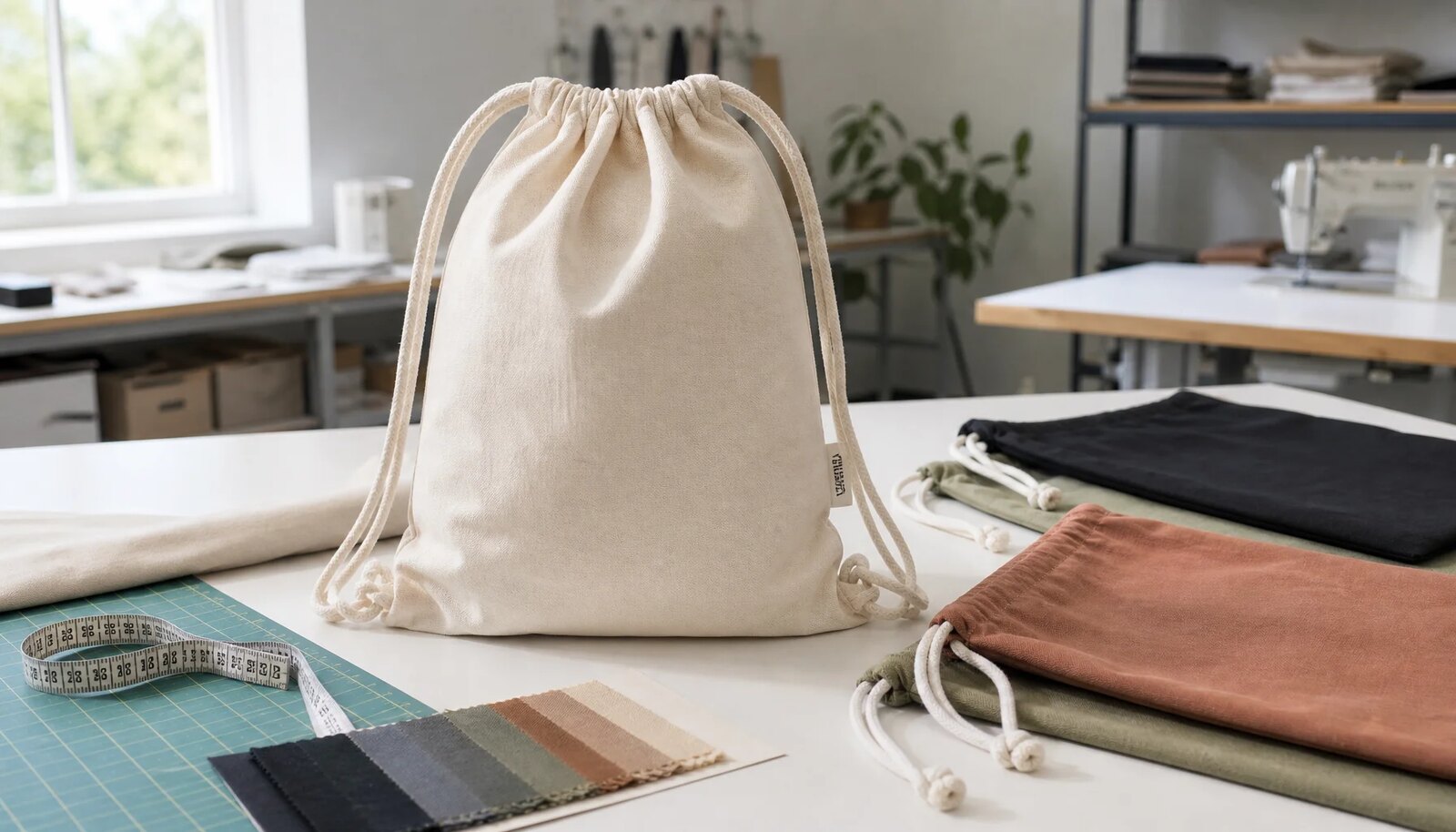
Start With the Commercial Job
A cotton drawstring backpack looks simple, but procurement should not source it as a generic bag. The same silhouette can be a retail accessory, an apparel bundle, a conference giveaway, a subscription-box insert, a store packaging layer, or a staff kit. Each use has a different acceptable level of fabric weight, construction, decoration, packing, and inspection. A bag that only carries a folded T-shirt for a campaign can be lighter and simpler than a bag a customer is expected to reuse for months.
Begin the brief with the commercial job. State where the bag will be used, what it will carry, how long it should last, and how visible it is to the customer. Eco apparel brands often use these bags as part of brand presentation, so the supplier needs more than a logo file and a quantity. They need to know whether the bag must look natural, feel durable, reduce plastic packaging, match a seasonal color story, or meet retailer receiving rules.
Translate brand language into production language. Instead of asking for a sustainable-looking drawstring backpack, define whether you mean unbleached cotton, a reusable construction, lower-plastic packing, recycled-content fabric if available, or documentation your compliance team can review. Suppliers can only price what they can identify.
- State the use: retail add-on, bundled garment pack, store packaging, event gift, employee kit, or wholesale account support.
- Name the load: T-shirt, hoodie, bottle, notebook, footwear box, folded set, or mixed sample kit.
- Define the visual standard: promotional, retail-ready, premium minimal, natural, color-matched, or private-label.
- Clarify any documentation needs before the quote, especially if marketing copy will mention material claims.
- Decide whether lowest unit cost, repeatability, speed, or customer reuse is the main procurement priority.
Build a Spec Sheet Buyers Can Enforce
The strongest wholesale buying process starts with one controlled spec sheet. This prevents a common problem: three suppliers quote the same product name but silently assume different fabric weights, cord thicknesses, stitch details, logo sizes, and packing methods. The numbers may sit neatly in a spreadsheet, but they are not comparable unless the underlying product is the same.
Finished size needs special attention. Some factories discuss cut-panel size; buyers often assume finished sewn size. Seam allowance, top channel depth, bottom folds, and gusset construction can all reduce usable capacity. If the bag must hold a folded hoodie or boxed set, the usable opening may matter more than the flat panel height. Put width, height, channel depth, opening width, and gusset or bottom depth into the spec.
Use revision control for repeat orders. A cotton bag program may be reordered across seasons, sales channels, or wholesale accounts. Without a dated spec and approved sample, the next lot can drift in shade, GSM, cord length, print placement, or carton pack-out. Keep the signed sample, artwork, shade reference, and packing instruction under the same revision number.
- Record finished dimensions in centimeters and identify all measurement points.
- List fabric composition, weave, GSM, finish, color, and source status.
- Define cord material, diameter, color, loop length, end finish, and channel construction.
- Attach artwork with size, placement, color reference, decoration method, and print side.
- Specify labels, hangtags, packing method, carton count, carton marks, barcode rules, and inspection tolerances.
- Add revision number, approval date, approver, supplier name, and linked purchase order.
Choose Fabric by Use, Not Habit
Fabric is the biggest driver of feel, cost, and customer perception. Lighter cotton around 110 to 130 GSM can work for short-term promotional use or low-cost inserts. Mid-weight cotton around 140 to 160 GSM is often more appropriate for eco apparel bundles and reusable customer-facing programs because it improves opacity, hand feel, and print stability. Heavier fabrics can feel more retail-grade, but they also increase material cost and freight weight.
GSM is not the whole story. Plain weave, twill, canvas-like constructions, brushed finishes, dyed cotton, and unbleached cotton all behave differently. Unbleached cotton has a natural look but may show seed specks, shade warmth, and roll variation. Dyed cotton improves brand-color control but requires lab dips, dye-lot approval, and usually a higher MOQ. Brushed cotton can feel softer but may soften print edges. Canvas or twill can give more structure but may change folding and carton volume.
Do not approve fabric from photos. Ask for swatches at two practical GSM levels and compare them with the intended product inside the bag. Check opacity under normal warehouse or retail lighting. Feel the cord against the fabric. Look at how the bag hangs when filled. A slightly higher unit cost may be justified if the bag presents the garment better and avoids a cheap promotional feel.
- Ask suppliers to quote at least two fabric weights with MOQ, unit price, and carton weight.
- Approve a shade band for natural cotton instead of expecting identical roll color.
- For dyed cotton, request lab dip timing, bulk shade tolerance, and MOQ by color.
- Check fabric opacity with the real garment or item inside the sample.
- Ask what documentation is available before making material or sustainability claims.
Specify Cord and Construction Details
Most drawstring backpack failures occur at predictable stress points: cord exits, bottom corners, side seams, and the top channel. A bag can use acceptable cotton and still fail if the cord rubs through the fabric, the channel catches, or the seam line opens under load. Avoid vague quality requests. Define the construction that matches the load.
Cord choice changes both comfort and product perception. Thin cord lowers cost but can make the bag feel disposable and less comfortable on the shoulder. Thicker cotton rope looks better for retail programs, but it requires more material and may need a wider channel. Polyester or blended cords can slide smoothly and resist fraying, though they may not support a cotton-focused brand story. State the cord material and diameter rather than accepting the supplier's standard.
Bottom-corner construction deserves a clear decision. Cord can pass through stitched fabric loops, reinforced tabs, eyelets, grommets, or folded corner openings. Eyelets and grommets can look clean, but they add inspection points for sharp edges, rust, poor setting, and tearing around the hole. For apparel-only loads, a simple reinforced fabric solution may be enough. For heavier kits, ask for pull testing on the actual sample.
- Define expected load and ask the supplier to recommend reinforcement based on that load.
- Specify stitch type, stitch density target if needed, bartacks, channel width, and bottom-corner treatment.
- Confirm cord material, diameter, color, length, shoulder-loop balance, and end finish.
- Test the filled bag by opening and closing it repeatedly, then inspect cord friction points.
- If using metal hardware, check edge safety, setting strength, rust risk, and fabric tearing.
Select Decoration With Production Risk in Mind
Decoration should be chosen for brand fit, durability, and repeatability. Screen print is usually practical for wholesale cotton drawstring backpacks with simple logos or flat artwork. It scales well, but each added color increases setup, registration, and color-matching risk. Heat transfer may suit certain artwork, though adhesion and hand feel should be tested on the selected cotton. Embroidery can look premium on a small mark but may pucker lighter fabric or become expensive on large designs.
Subtle branding often works best for eco apparel brands. A small logo, woven side label, or patch can make the bag feel reusable instead of disposable. Subtle does not mean imprecise. Give the factory the logo size in millimeters, distance from the top edge, distance from the side seam, print side, and acceptable placement tolerance. A visual mockup helps communication, but measured placement controls production.
Approve decoration on the actual production fabric. Ink can behave differently on unbleached cotton, brushed cotton, dyed fabric, and heavier canvas-like cloth. Ask for a strike-off or decorated pre-production sample. Check edge sharpness, color, curing, hand feel, and whether the logo stays centered after the bag is sewn and filled.
- Use screen print for simple logos, campaign marks, and cost-sensitive wholesale runs.
- Use embroidery for small premium marks only when fabric weight can support the stitch density.
- Use woven labels or patches when the brand wants durable, restrained identity.
- Ask whether decoration happens before or after sewing and how panel alignment is controlled.
- Approve strike-off color, placement, curing, and hand feel before bulk decoration.
Read MOQ and Price as a System
MOQ is not just a negotiation number. It reflects fabric roll size, dyeing minimums, cutting efficiency, print setup, labor planning, packing work, and the supplier's willingness to interrupt production for a small run. A low MOQ may mean the factory is using stock cotton, standard dimensions, and a simple one-color logo. That can be ideal for a pilot, but it may not support a custom-dyed repeat order later.
Compare total cost, not only unit price. Setup charges, sample fees, screen charges, embroidery digitizing, custom labels, hangtags, special packing, inspection, inland freight, and export terms can change the decision. A low unit price with high first-order setup may not be best for a small test. A higher unit price with no tooling may be smarter for a short run. For larger replenishment orders, the reverse may be true.
Ask suppliers to show first-order cost and repeat-order cost separately. The first order may include screens, digitizing, lab dips, label development, or packing setup. Repeat orders should be cleaner if the spec is unchanged. This view helps finance understand what the program costs now and what it will cost once demand is proven.
- Ask MOQ by fabric color, bag size, artwork version, cord color, and packing style.
- Separate sample, setup, decoration, labels, packing, inspection, and freight-related charges.
- Compare pilot order economics and repeat order economics at realistic quantities.
- Confirm whether quoted price assumes stock fabric, reserved fabric, or newly dyed fabric.
- Ask what cost changes if you simplify artwork, reduce colors, standardize size, or remove individual packing.
Choose the Right Supplier Route
Supplier structure affects accountability. A direct cut-and-sew factory with in-house decoration can be efficient when the bag is custom and repeatability matters. One team controls fabric cutting, sewing, printing or embroidery, trimming, and final packing. If placement or stitching fails, responsibility is easier to trace. The trade-off is that direct factories often expect a clearer technical brief and may have less flexibility for very small runs.
A trading company can be useful when the program includes several components: custom fabric, woven labels, hangtags, packaging, export documents, or multiple factories. The risk is lack of visibility. Procurement should know who cuts and sews the bag, who decorates it, who inspects it, and who pays for rework if a defect crosses responsibilities.
Local printers decorating imported blanks can be a good route for urgent tests, samples, or domestic fulfillment. The limitation is control. Blank bags may vary by batch in size, shade, GSM, and cord length. That may be acceptable for a short campaign, but it is not the same as a locked cut-and-sew specification for a repeat wholesale program.
- Ask who cuts, sews, decorates, trims, inspects, packs, and exports the goods.
- Confirm whether the bulk order will be made in the same facility as the approved sample.
- If decoration is outsourced, define who checks placement, color, curing, and final appearance.
- Ask whether fabric can be reserved or matched for repeat orders.
- Request production photos and inspection records from the actual facility, not only sales-room samples.
Approve Samples Like Inspection Tools
A sample is not only a nice object for the brand team. It is the reference that production and inspection should follow. For a serious wholesale order, the sample process may include a fabric swatch, lab dip if dyed, print strike-off, prototype, pre-production sample, and packed sample. The pre-production sample should use intended bulk fabric, actual cord, final decoration, final labels, and proposed packing.
Review the sample with a ruler and the intended load. Measure width, height, channel depth, opening width, gusset, cord length, logo placement, and label position. Fill the bag with the garment or item it is meant to carry. Pull the cords several times. Check whether the opening closes evenly, whether the shoulder loops balance, whether seams strain, and whether the logo distorts when filled.
Document accepted deviations. If the logo is approved 3 mm lower than the first proof, write it down. If natural cotton shade is warmer than the first swatch but still acceptable, record the approved shade reference. A signed sample, dated photos, and final spec sheet should match before the factory cuts bulk fabric.
- Measure the sample line by line against the spec sheet.
- Keep one signed physical sample with date, PO, revision, supplier, and approver.
- Approve decoration on actual bulk fabric, not substitute cloth.
- Request a packed sample if retail presentation, barcode scanning, or carton loading matters.
- Record any accepted deviation so production does not reinterpret the approval later.
Control Packing and Warehouse Receiving
Packing affects cost, waste, freight, presentation, and warehouse labor. Individual polybags protect retail appearance and simplify unit handling, but they add material and labor. Bulk packing reduces packaging but can create wrinkles, counting issues, or extra receiving work. Eco apparel brands should decide whether individual packing is required, optional, prohibited, or replaceable with paper bands, inner bundles, or carton-only packing.
Carton details should be part of the quote, not a late shipping discussion. Ask for pieces per inner bundle, pieces per master carton, carton dimensions, gross weight, net weight, and total shipment volume. Cotton bags compress, but over-compression can create deep creases that make the product look poor when unpacked. If your warehouse has carton weight limits or barcode rules, send them before the price is finalized.
Carton marks are operational quality. The carton should identify PO, SKU, color, quantity, carton number, country of origin marking if required, and any routing label or barcode the buyer specifies. Avoid mixed-color cartons unless the receiving team has approved the split. Clear carton instructions reduce recounting, relabeling, and chargeback risk.
- Decide individual pack, bulk pack, paper band, inner bundle, or retail hangtag before PO release.
- Confirm inner bundle count, master carton count, carton size, gross weight, and shipment volume.
- Specify carton marks, barcode rules, SKU labels, country of origin marking, and carton numbering.
- Avoid mixed-SKU cartons unless labels and warehouse instructions clearly support them.
- Inspect cartons for correct count, color split, folding method, and label accuracy before shipment.
Set QC Tolerances and Lead-Time Milestones
Quality control is stronger when tolerances are written before production. Define acceptable variation for finished size, fabric shade, GSM, print position, print color, cord length, label placement, carton count, and visible defects. For natural cotton, include realistic rules for specks and shade warmth. For decorated bags, separate major defects that affect saleability from minor issues that do not.
Lead time also needs detail. A quote that says 30 days after deposit may hide several dependencies: artwork approval, fabric sourcing, lab dip approval, bulk dyeing, cutting, printing, sewing, trimming, packing, inspection, and export preparation. Ask the supplier to identify the critical path. Fabric and decoration are often the slowest steps, and buyer-side artwork delays can be just as damaging as factory delays.
Build an approval calendar that both teams can follow. Confirm when the sample is due, when comments are due, when bulk fabric is ready, when decoration starts, when sewing starts, when inspection happens, and when the order is ship-ready. For repeat orders, ask what can be shortened because fabric, artwork, packing, and carton marks are already approved.
- Write tolerances for size, GSM, shade, logo placement, cord length, label position, and carton count into the PO.
- Define inspection level, sample size, major defects, minor defects, and who has authority to release shipment.
- Request a milestone calendar instead of one broad lead-time number.
- Confirm whether lead time starts after deposit, artwork approval, sample approval, or fabric approval.
- Keep internal artwork, compliance, and sample-review deadlines visible so buyer-side approvals do not delay production.
Specification comparison for buyers
| Buying decision | Best-fit option | Operational advantage | Risk to verify before PO |
|---|---|---|---|
| Pilot order for a new apparel launch | Stock-supported cotton fabric, standard size, one-color logo | Keeps MOQ, sampling time, and setup cost manageable while the brand tests demand | Confirm the exact stock fabric reference, shade range, and whether the same cloth can be reordered |
| Retail accessory or paid add-on | Mid-weight cotton, controlled size tolerance, reinforced cord exits, clean branding | Feels less disposable and supports repeated customer use | Check GSM, cord comfort, seam reinforcement, logo durability, and retail presentation under real load |
| Natural eco brand presentation | Unbleached or natural cotton with a shade band | Gives a low-dye, organic-looking visual without custom color development | Approve acceptable specks, warmth, and roll-to-roll variation before bulk cutting |
| Brand-color program | Custom-dyed cotton body or colored cord | Aligns the bag with a seasonal apparel palette or campaign color | Expect lab dips, higher MOQ, longer lead time, dye-lot control, and shade tolerance decisions |
| Low-friction promotional program | Lighter GSM cotton, simple stitching, bulk packing | Reduces unit cost for event giveaways, inserts, or short-term campaigns | Make sure the lighter fabric still carries the intended item and does not make the logo look weak |
| Premium subtle branding | Woven side label, small embroidery, or sewn patch | Creates a reusable accessory feel without a large promotional print | Inspect label alignment, stitching, backing comfort, puckering, and attachment strength |
| Large logo or campaign artwork | Screen print on approved cotton fabric | Usually efficient for wholesale runs with flat artwork and repeatable placement | Approve strike-off for ink color, edge clarity, curing, hand feel, and print position |
| Warehouse-friendly replenishment | Locked spec sheet with fixed carton pack, carton marks, and SKU rules | Reduces receiving errors, recounting, relabeling, and repeat-order drift | Keep signed samples, carton label files, artwork files, and revision history together |
| Complex multi-SKU program | Trading partner or factory group with clear component ownership | Can coordinate fabric, sewing, labels, packing, and export documents across several versions | Document the actual sewing factory, decorator, inspection owner, and rework responsibility |
Buyer checklist before sampling
- Define the commercial role of the bag: retail accessory, apparel bundle, e-commerce insert, wholesale account gift, event giveaway, staff kit, or reusable packaging layer.
- Set the expected load in practical terms: one T-shirt, hoodie, footwear box, bottle, notebook, sample kit, or mixed accessory set. Use that load to choose fabric weight and reinforcement.
- Specify finished dimensions in centimeters. Include width, height, gusset or bottom depth if any, channel depth, usable opening, and whether measurements are for the finished sewn bag.
- Choose fabric by composition, weave, GSM, color, finish, and source. Record whether it is unbleached stock cotton, dyed cotton, brushed cotton, canvas, twill, recycled-content fabric if available, or another approved fabric.
- Approve the hand feel and opacity from physical swatches, not photos. For apparel bundles, place the actual garment inside the sample and check coverage, drape, and shelf appearance.
- Define cord material, diameter, color, length, loop size, pull direction, channel width, and end finish. State whether ends are knotted, stitched, tipped, capped, or left natural.
- Tie reinforcement to the intended load. Specify double stitching, stitch density, bartacks, bottom-corner tabs, grommets, eyelets, or reinforced cord exits only where they are needed.
- Choose the decoration method before final pricing: screen print, heat transfer, embroidery, woven patch, woven side label, care label, hangtag, or combined branding.
- Provide artwork as production-ready files with logo size in millimeters, placement from top edge and side seam, print side, number of colors, Pantone or brand color references, and acceptable placement tolerance.
- Request the right sample sequence: fabric swatch, print strike-off, prototype sample, pre-production sample, and packed sample when retail presentation or warehouse receiving matters.
Factory quote questions to send
- What fabric are you pricing: composition, weave, GSM, finish, width, color, and whether it is stock, reserved, newly purchased, or custom dyed?
- Can you quote two GSM options with unit price, estimated carton weight, MOQ, and fabric availability shown separately?
- For natural cotton, what shade variation should we expect? For dyed cotton, what lab dip, bulk dye, and shade approval process do you use?
- What finished bag dimensions are included in the quote, and what tolerance do you hold for width, height, opening width, gusset, and channel depth?
- What cord material, diameter, color, loop length, and end finish are included? What is the price impact of thicker cotton cord or color-matched cord?
- How are the cord stress points built: stitched corner tabs, eyelets, grommets, bartacks, reinforced seams, or another construction?
- Which decoration method is included, and what are the adders for extra print colors, second-side artwork, embroidery, woven labels, patches, or hangtags?
- Is decoration completed in-house or by a subcontractor? Who checks artwork placement, ink color, curing, embroidery quality, and rework before final packing?
- What is the MOQ by fabric color, bag size, artwork version, cord color, and packing style? If one PO is split across versions, how do price and lead time change?
- What samples can you provide before bulk production: fabric swatch, lab dip, print strike-off, prototype, pre-production sample, and packed sample? What does each sample fee include?
Quality-control points to confirm
- Verify fabric GSM against the approved target and tolerance. A small GSM change can be visible in hand feel, opacity, drape, and print stability.
- Compare fabric shade to the approved swatch, lab dip, or shade band under consistent light. Natural cotton should be checked for acceptable specks and warmth, not treated as one flat color.
- Measure finished width, height, channel depth, opening width, cord loop length, and gusset or bottom depth across multiple pieces from different cartons.
- Check panel balance after filling the bag. The front logo area should not twist, side seams should not lean, and the opening should close evenly.
- Inspect side seams, bottom seams, channel stitching, and cord-exit areas for skipped stitches, loose thread nests, broken stitches, uneven stitch density, and missing reinforcement.
- Pull the cords repeatedly with the bag filled to the intended load. The cord should move smoothly, hold closure, and avoid fraying, snagging, sharp edges, or uneven shoulder loops.
- For eyelets or grommets, check setting pressure, clean edges, rust, cracking, loose metal, and fabric tearing after normal cord pulling.
- Check screen print for size, placement, registration, color, edge sharpness, curing, pinholes, bleeding, cracking, transfer marks, and ink on unintended areas.
- Check embroidery, woven labels, and patches for secure attachment, clean edges, backing irritation, thread loops, puckering, crooked placement, and correct orientation.
- Review odor, stains, oil spots, dirt, chalk marks, water marks, and handling marks before packing because light cotton shows contamination easily.