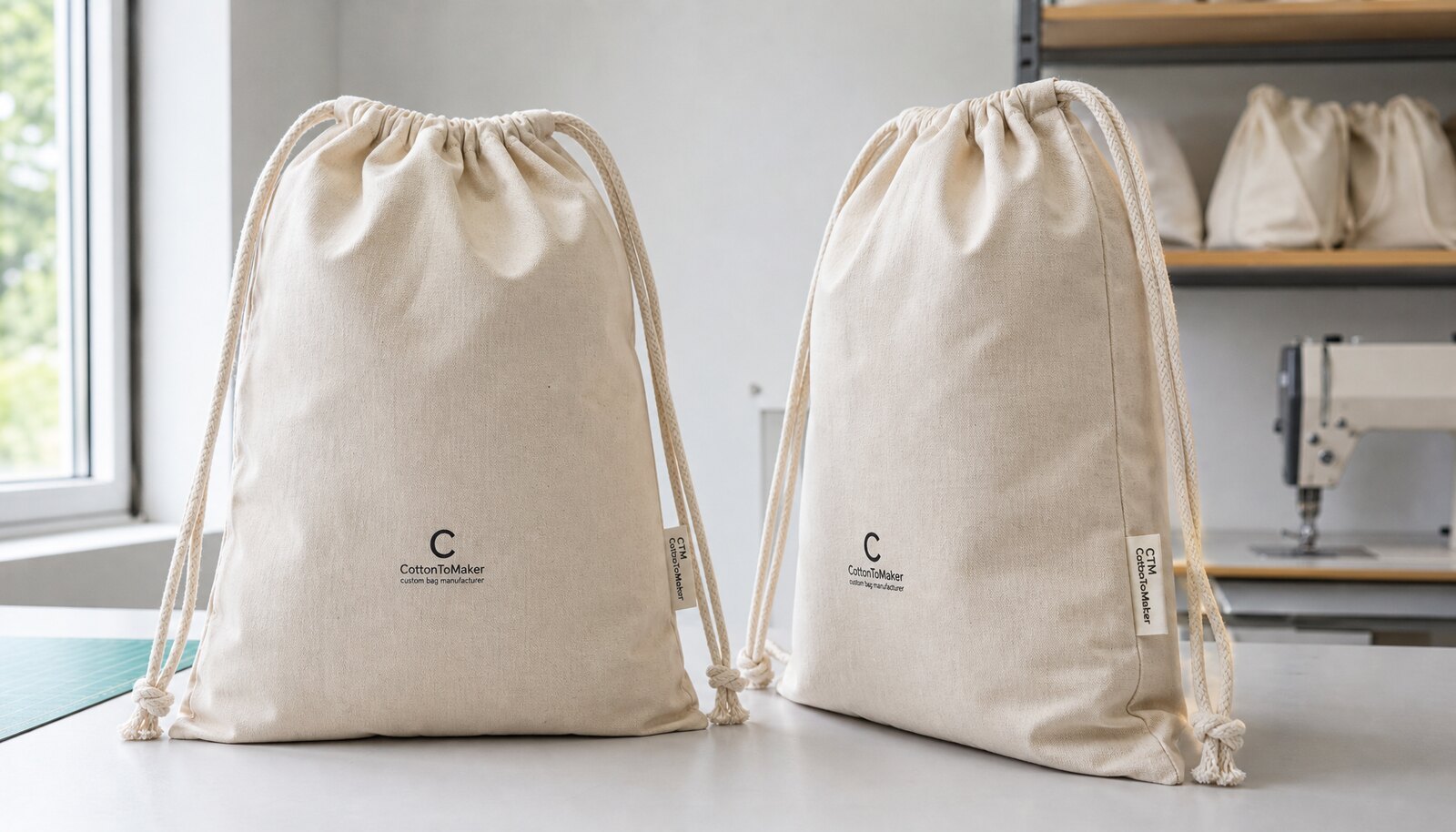
Start With the Job the Bag Has to Do
For boutique wineries, a cotton drawstring backpack is rarely just a giveaway. It may hold tasting-room purchases, club inserts, event materials, small merchandise, or a branded carry item that sits on retail shelves. That means the bag has to do two jobs at once: represent the brand well and survive enough handling that it does not feel disposable the first time a customer uses it.
Before you send a quote request, define the use case in plain terms. A bag for a wine club welcome kit can be lighter and simpler than a bag that is sold in the tasting room. If the supplier does not know whether the bag is intended for retail, events, or packing inserts, you will get vague pricing and a spec that is too generic to compare.
- State the end use: retail, club gift, event handout, or packing insert.
- Note whether the bag must be display-ready or only functional.
- Define the contents the bag needs to carry, not just the bag size.
Choose Fabric Weight Before You Compare Prices
Fabric weight is the first real cost and quality lever. For cotton drawstring backpacks, the common decision range is a lightweight body around 6 oz or 180 gsm, a balanced option around 8 oz or 270 gsm, and a heavier premium body around 10 oz or 340 gsm. The numbers matter because the bag's hand-feel, structure, print clarity, and freight weight all move with GSM.
A winery program that wants low cost and limited reuse can accept a lighter body, but it should still be opaque enough to feel intentional. If the bag is meant for resale or repeat use, the heavier body usually justifies itself through better drape and a cleaner retail impression. Do not let a supplier quote a vague cotton bag without stating GSM, finishing, and whether the weight is pre-wash or finished weight.
- 6 oz / 180 gsm: lowest-cost route, but watch for thinness and weak shape.
- 8 oz / 270 gsm: good balance of cost, structure, and broad buyer acceptance.
- 10 oz / 340 gsm: premium feel, higher freight, and stronger sewing requirements.
Build the Bag Around Brand Use, Not Decoration Alone
A lot of bag sourcing fails because decoration is treated as the main spec. For a winery, the bag body still matters more than the logo. A clean one-color screen print on the wrong fabric weight will still look cheap. A woven side label on a poorly stitched body will still fail QC. The best route is to fix size, fabric, closure, and seam construction first, then select the branding method that fits the buyer's margin and timeline.
If you want a premium retail look, consider a small front print plus a woven side label or a sewn-in brand tab. If you need a broad event bag with simple branding, one-color screen print is often the best balance. Heat transfer can work for short runs, but it needs strong approval on hand-feel and rub resistance. Embroidery is usually more expensive and can pull lighter fabrics out of shape, so it should be used only when the design and budget support it.
- Screen print works best for simple logos and volume.
- Woven labels help when the brand wants a cleaner, more durable identity point.
- Avoid mixing too many decoration methods unless the price clearly supports the complexity.
Compare Supplier Routes Before You Trust the Unit Price
The cheapest line on a quote is not always the best sourcing route. A direct factory can give you tighter control over fabric, stitching, printing, and packing, but only if the factory really owns those steps. A trading company can simplify communication and consolidate multiple items, yet it may hide the factory margin and make quality accountability harder to pin down. A local decorator can be useful for very short deadlines, but only if the base bag is already close to your spec.
For winery buyers, the question is not which supplier category is cheapest in theory. It is which route gives you the best control over the exact combination of size, fabric, decoration, and packing you need. If two quotes are close, the safer one is usually the supplier that can show sample-room control, prior work on similar cotton goods, and a clear path from approved sample to bulk production.
- Direct factory: best for control and reorders if the factory is real.
- Trading company: best for consolidation, but verify who owns QC.
- Local decoration: best for rush jobs, but less control over bag consistency.
Use the RFQ to Force Real Quote Data
A useful RFQ for cotton drawstring backpacks should force the supplier to price the actual build, not an abstract tote. Include bag dimensions, GSM, cord length, print area, print colors, label type, packing method, carton count, and the target ship window. If you skip those details, suppliers will quote different assumptions and you will spend time comparing numbers that are not comparable.
The best quote is itemized. You want to see whether the supplier is charging separately for printing screens, label sewing, polybagging, carton marks, and sample fees. You also want to know what drives MOQ: custom fabric color, custom cord color, extra print colors, or a separate label run. A low MOQ on one line can disappear if the supplier quietly treats the bag body as stock and bills the branding later.
- Ask for unit price, setup charges, sample fee, and packing cost separately.
- Require the supplier to state whether the bag body is stock or custom-made.
- Make MOQ logic explicit by artwork, color, and size.
Approve the Sample Like a Production Tool, Not a Display Piece
The sample is useful only if it matches the real production method. That means the same cotton weight, same stitching path, same cord, same print process, and the same label placement. A perfect sales sample that uses different fabric or decoration will create a false approval and a predictable dispute later. Tell the supplier to keep one sealed reference sample and mark it as the production standard.
When you review the sample, focus on the parts that fail in bulk: cord smoothness, top hem shape, seam symmetry, print edge quality, and whether the bag stands up cleanly when filled. If the sample smells strongly of dye or finishing chemicals, that is a production signal, not a cosmetic detail. A winery buyer should also look for loose lint or staining, because those problems are very visible in retail packaging and tasting-room presentation.
- Measure width, height, and cord length against the approved spec.
- Pull the cord and stress the corners to see how the bag reacts.
- Treat print position and label placement as hard acceptance points.
Set QC Thresholds That Catch the Common Failures
For drawstring backpacks, the common defects are usually simple and avoidable: off-center print, skipped stitches, weak cord channels, mixed shades, and inconsistent carton counts. The right QC standard is not theoretical perfection. It is a set of clear acceptance points that tell the factory what cannot slip through without notice. If the buyer never states the threshold, the factory will often treat minor variation as acceptable.
Ask for size tolerance, seam reinforcement details, print alignment tolerance, and carton inspection rules. You do not need a complicated testing program for every order, but you do need enough discipline to stop predictable warehouse problems. A bag that looks fine on a sample table can still fail if the side seams twist under load or the cord ends unravel during packing.
- Confirm tolerance for bag dimensions and cord length.
- Require bar-tacks or reinforced stress points where the cords and seams take load.
- Reject mixed shade lots unless the design explicitly allows natural cotton variation.
Plan Packing for Retail, Not Just for Shipping
Packing decisions affect labor, carton space, and how the product lands in your warehouse or store. A natural cotton bag packed loosely in a carton may be cheaper to move, but it can arrive wrinkled and harder to count cleanly. If the bag is destined for retail, you may need a folded standard, a polybag, a hangtag, or a simple insert card. If it is for club fulfillment, a denser carton pack may make more sense than a retail finish.
Carton planning should be part of the quote, not an afterthought. Ask how many pieces per inner pack and master carton, what the carton dimensions are, and whether the carton is designed for export stacking. Also confirm whether cartons are labeled by SKU, color, and quantity in a way your warehouse team can receive without repacking. Good packing saves labor; bad packing moves the cost downstream to your team.
- Decide whether the bag needs retail folding, a polybag, or bulk packing.
- Confirm master carton quantity and carton dimensions before booking freight.
- Make sure carton marks match your receiving system and SKU structure.
Treat Lead Time as a Schedule Risk, Not a Promise
Lead time on a cotton drawstring backpack order is not just sewing time. It includes sample approval, material reservation, printing setup, sewing, packing, carton confirmation, and export booking. When the order is tied to a winery event, holiday release, or club shipment, the real risk is usually not the sewing line. It is a late decision on artwork, sample revision, or packing detail that shifts the whole schedule.
The safest way to manage timing is to work backward from the ship window. Build in time for sample comments, one correction round if needed, and the possibility that a custom fabric or label run takes longer than the base bag. If the supplier gives you a very short timeline, make them state what they are assuming: stock body, simple print, no special packing, and no congestion in the line. That prevents misunderstandings when the order moves from quote to production.
- Start from the required arrival date, not the PO issue date.
- Allow time for sample revision if the first proof is not acceptable.
- Separate production time from freight time in the schedule.
Use Landed Cost to Compare Suppliers the Right Way
A low ex-works unit price can disappear once you add print setup, packing, carton specs, inland transport, freight, and import charges. The right comparison is landed cost per usable bag, not a bare factory quote. That is especially true for boutique wineries, where small order sizes can make freight and handling a larger share of the total than buyers expect.
When you compare quotes, line them up on the same basis. Put the bag body, decoration, packing, and shipping assumptions in one sheet. Then separate what is included from what is excluded. A supplier that quotes slightly higher but includes better packing, a cleaner sample process, and fewer hidden extras may produce the safer landed cost in the end. The goal is not to win the lowest line item. It is to avoid the cheapest quote turning into the most expensive order.
- Compare on the same Incoterm or the same delivery basis.
- Separate bag cost, decoration, packing, freight, and import charges.
- Use the approved sample as the benchmark for all final comparisons.
Specification comparison for buyers
| Spec decision | Recommended option | When it fits | Buyer risk to check |
|---|---|---|---|
| Direct factory with in-house printing | Use one supplier that cuts, sews, prints, and packs the bag | Best for private-label winery programs, repeat orders, and buyers who need one accountable QC point | Verify actual factory photos, sample-room control, and whether the printing is truly in-house |
| Trading company / exporter | Use when you need one PO across mixed bag styles or multiple factories | Useful for small procurement teams that value consolidation over factory direct pricing | Confirm who owns QC, whether markup is hidden in the unit price, and how sample approval is routed |
| Stock blank plus local decoration | Choose stock natural cotton bags and add local print or label only | Works for rush launches, tasting-room promos, and short seasonal runs | Check if stock size, cord length, and fabric shade vary by lot |
| 6 oz / 180 gsm cotton body | Pick a lightweight body for low-cost giveaways and light contents | Fits event kits, inserts, and short-life promo use | Risk of see-through fabric, weaker structure, and faster wrinkling |
| 8 oz / 270 gsm cotton body | Use as the balanced winery standard | Good for retail carry, club gifts, and repeat reuse without a heavy cost jump | Confirm seam strength and top hem stability so the bag does not distort |
| 10 oz / 340 gsm cotton body | Specify for a premium hand-feel and a more structured bag | Best for retail programs where the bag is part of the perceived brand value | Higher freight weight, slower sewing, and stronger MOQ pressure |
| One-color screen print | Choose for bold logos, simple artwork, and clean repeatability | Best for large runs and classic winery branding | Check ink cure, placement consistency, and hand-feel after drying |
| Woven side label plus small print | Use for a cleaner premium look and more durable brand identification | Fits retail merchandise and higher-end club programs | Verify extra sewing steps, label abrasion resistance, and any lead-time impact |
Buyer checklist before sampling
- Define the use case first: tasting-room retail, club gift, event handout, or insert bag.
- Lock the body size, fabric weight, and cord length before requesting quotes.
- Decide whether the bag needs a premium hand-feel or just a low-cost branded carrier.
- Choose one branding method and one backup method so the supplier does not improvise.
- Ask for a pre-production sample with the exact fabric, print, and label combination.
- Confirm carton pack count, inner packing, and whether cartons are export-ready for warehousing.
- State your target ship window, not just the order date, so production can be scheduled realistically.
- Request an itemized quote that separates bag cost, decoration, packing, and freight assumptions.
Factory quote questions to send
- What is the exact fabric weight in GSM, and is the weight before or after washing and finishing?
- Is the quoted price based on direct factory production, or are you sourcing through a trading company?
- How many print colors are included, what is the print size, and are there setup charges?
- What seam construction do you use at the side seams, top hem, and cord channel?
- What is the minimum order quantity per artwork, color, and size, and what drives it up?
- Can you supply a pre-production sample with the same fabric lot and decoration method?
- How are the bags packed per inner bag and per carton, and can you match retail-ready packing requirements?
- What lead time applies to sample approval, bulk production, and export booking, and what is excluded from that timeline?
Quality-control points to confirm
- Fabric GSM matches the approved spec within the supplier's stated tolerance.
- Bag dimensions are within agreed tolerance for width, height, and cord length.
- Side seams, bottom corners, and cord channels are reinforced and free from skipped stitches.
- Print registration, color density, and curing are consistent across the bulk lot.
- No staining, odor, loose threads, needle damage, or mixed fabric shade within the same carton.
- Cord ends are secured cleanly and do not unravel under normal pulling.
- Carton counts, labels, and carton markings match the purchase order exactly.
- The approved sample is attached to the production reference and used as the acceptance baseline.