Start With the Studio Use Case
A buyer asking for “cotton drawstring backpacks with logo” may receive quotes for very different products. One factory may price thin calico, another midweight canvas, and another a retail-packed bag with hangtags and barcodes. The product name sounds similar, but the cost basis is not comparable.
Wellness studios usually buy these bags for a specific moment: new-member onboarding, yoga retail shelves, pilates merchandise, spa welcome gifts, retreat arrival packs, teacher-training kits, or local event giveaways. That use case controls the right fabric weight, cord comfort, print durability, packing format, and inspection level.
Put the use case in the first line of the RFQ. For example: “Cotton drawstring backpack for a paid wellness studio retail SKU carrying socks, towel, and bottle.” That sentence helps suppliers avoid underquoting a disposable event bag when the buyer needs a reusable branded item.
- Name the program and sales channel before listing specs.
- List expected contents or a target carry weight if known.
- Separate must-have requirements from optional upgrades.
- Ask suppliers to label any lower-cost alternative as an alternate quote.
- Send the same RFQ version to every shortlisted supplier.
Use a Fill-In RFQ Block
A complete RFQ template does not need to be long, but it must be editable and measurable. Use one block for product details, one for commercial terms, and one for quality expectations. This keeps the request easy for suppliers to answer and easier for procurement to compare.
Practical buyer targets can be included as placeholders. For example, many adult drawstring backpacks are around 38 x 42 cm measured flat after sewing, but that is not a universal standard. A 6-8 mm cord may feel comfortable for many reusable studio bags, but the final choice depends on fabric weight, channel size, user comfort, and target cost.
Use placeholders where the studio has not finalized the answer. A supplier can then quote a base version and clearly price changes, instead of guessing. The goal is to remove hidden assumptions before samples and deposits.
- Product: cotton drawstring backpack for [use case/program].
- Size: [width] x [height] cm, finished measurement after sewing, tolerance [example: +/-1 cm].
- Fabric: [canvas/plain weave/twill/calico], [target GSM], tolerance [example: +/-5%].
- Cord: [cotton/polyester], [diameter], [color], [finished length], [knot/end finish].
- Logo: [screen print/heat transfer/embroidery], [colors], [size], [position], placement tolerance [example: +/-5 mm].
Choose Fabric by Performance Need
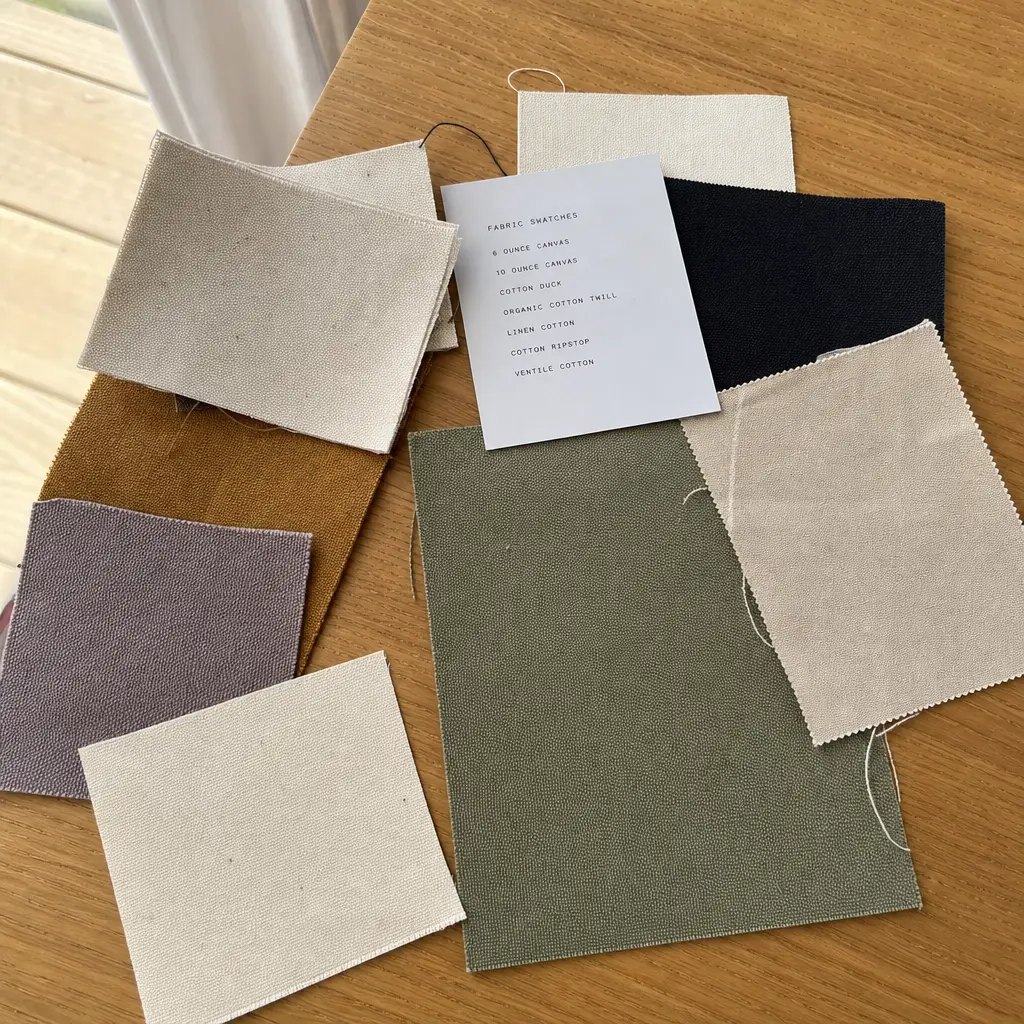
Fabric weight affects handfeel, durability, print result, carton weight, and freight. For many wellness studio programs, 200-270 GSM cotton canvas is a practical middle range: more substantial than lightweight promotional cotton, but still foldable and comfortable enough for daily use.
Lightweight cotton around 140-180 GSM can work for single-day events, sample sachets, or very light giveaways. It should be chosen deliberately, not because a vague RFQ allowed suppliers to quote the cheapest cloth. Heavy canvas around 280-340 GSM can create a premium feel, but it may be stiffer around the cord channel and more expensive to ship.
Do not specify only “cotton.” Ask for the construction: canvas, plain weave, twill, or calico. These behave differently in drape, texture, printing, and cost. If the supplier quotes stock fabric, ask for the actual GSM and tolerance. If dyeing or washing is involved, confirm whether GSM is measured before or after finishing.
- Use 140-180 GSM when the bag carries light items and price is the main driver.
- Use 200-270 GSM canvas for most reusable studio, retreat, and member-kit programs.
- Use 280-340 GSM only after checking stiffness, draw action, and freight weight.
- Set a buyer-approved GSM tolerance, often around +/-5% if acceptable.
- Require written approval before any fabric substitution.
Define Color Before Branding Claims
Natural cotton fits many wellness brands because it looks calm, tactile, and less processed. It may also show seed specks, slubs, neps, and shade warmth. Those features can be acceptable, but they need boundaries through an approved shade sample or boundary sample.
Bleached cotton gives a cleaner background and can make some logos look sharper. Dyed cotton supports franchise colors, seasonal merchandise, and retail assortments, but it creates dye-lot, shade tolerance, MOQ, and lead-time questions. Provide Pantone, TCX, or a physical swatch when color matters.
Be careful with sustainability language. If the studio plans to claim organic cotton, recycled packaging, low-impact dyeing, FSC paper, compostable packaging, or similar benefits, request documents before putting claims on hangtags, web pages, invoices, or product listings.
- Approve a physical shade reference for natural, bleached, or dyed cotton.
- Define acceptable specks, slubs, neps, and shade warmth for natural cotton.
- Ask whether color is stock dyed, fabric dyed, piece dyed, or pigment dyed.
- Confirm shade tolerance between approved sample and bulk lot.
- Request support documents before using environmental or fiber claims.
Lock Construction Details That Fail
Drawstring backpacks usually fail at predictable points: bottom tabs, side seams, cord channel, sparse stitching, rough cord ends, and weak anchor points. These areas may not show in supplier photos, so they need to be part of the RFQ and sample review.
Cord comfort matters because the cord functions as both closure and shoulder strap. Cotton cord supports a natural look and handfeel. Polyester cord may be smoother, more color-stable, and sometimes lower cost. A 6-8 mm diameter is a useful buyer target for many reusable wellness bags, but the channel must be sized to draw smoothly without bunching.
Bottom-corner tabs should match the load. A bag carrying a card and sample sachets does not need the same reinforcement as a retreat pack holding a towel, bottle, and apparel. Ask the supplier what reinforcement is included and request bar tack, box stitch, or extra rows where the cord anchors.
- Confirm finished size after sewing, not cut-panel size.
- State cord material, diameter, color, length, knot treatment, and end finishing.
- Require reinforced lower tabs for reusable or loaded kits.
- Check channel height and draw action on the approved sample.
- Compare stitch density with the approved sample, not only appearance.
Select Decoration for Cotton Texture
Decoration should be chosen for the cotton surface, not only for a digital mockup. Screen printing is often the most practical choice for one-to-three-color studio logos, icons, class slogans, and repeat orders. It can keep a textile-friendly feel when logo size and ink deposit are controlled.
Cotton texture affects opacity and edge sharpness. Natural or dyed cotton may absorb ink differently from a smooth synthetic material. Water-based ink can feel softer, but may need extra attention on darker cotton. Higher-opacity ink can improve coverage, but too much deposit can feel heavy or create tackiness.
Heat transfer is useful for full-color art, gradients, small runs, or complex marks. The trade-off is handfeel, especially for large panels. Embroidery can work for small premium marks on stable fabric, but may pucker lighter panels and is rarely ideal for large filled graphics.
- Use screen print for solid logos and repeat programs.
- Request opacity and rub checks on the actual fabric, not a substitute cloth.
- Approve heat-transfer handfeel, adhesion, and crack resistance before bulk.
- Use embroidery only for small marks on suitable fabric weight.
- Measure logo placement from fixed finished edges or center lines.
Compare Quotes on the Same Basis
A low unit price is not useful if the quote excludes the costs needed to receive and sell the product. Setup charges, sample courier, artwork adjustment, hangtags, barcode labels, carton marks, individual packing, export cartons, inspection support, and inland transport can change the landed cost.
Ask suppliers to quote the same quantity tiers, such as 500, 1000, and 3000 pieces, using the same construction, logo method, packing, incoterm, currency, payment terms, and quote validity. If a supplier recommends a cheaper fabric or thinner cord, keep that as a clearly marked alternate.
Incoterms change responsibility. EXW, FOB, CIF, DDP, and delivered-warehouse quotes are not equivalent. If the buyer manages freight, FOB with accurate carton data is often easier to compare. If delivery to a warehouse or studio network is required, ask the supplier to state the delivery address basis, duty assumptions, and exclusions.
- Request unit price and one-time charges as separate lines.
- Require carton dimensions, gross weight, net weight, and units per carton.
- Keep fabric, size, cord, logo, and packing identical across suppliers.
- State quote validity so sampling does not expire the offer unnoticed.
- Ask for price reconfirmation after any spec, quantity, or delivery-term change.
Understand MOQ Drivers
MOQ is often tied to production reality rather than supplier preference. Fabric stock, dye lot, screen setup, cutting efficiency, cord color, label purchasing, packing material, and carton printing can each create a minimum. A natural stock cotton bag with one-color print is usually easier to quote at lower quantity than a dyed retail-ready version with custom labels.
Quantity tiers reveal the cost curve. A 500-piece order may carry high setup cost per unit but reduce inventory risk. A 1000-piece order may balance cost and stock exposure for many studio programs. A 3000-piece order can lower unit price, but increases storage, cash tied in inventory, and risk if branding or location requirements change.
Ask which component controls the MOQ. Sometimes the bag itself is not the limiting factor; the constraint is custom cord, dyed fabric, printed carton, barcode label, or special polybag. Once the real driver is visible, procurement can adjust the spec, pay a surcharge, hold excess components for reorder, or increase the order.
- Stock natural cotton usually supports lower quantities than custom dyed fabric.
- Multiple fabric colors can reduce cutting efficiency and raise shade risk.
- Special cords, labels, bags, and cartons may have separate MOQs.
- Low-MOQ quotes should list setup and packing charges clearly.
- Reorder programs benefit from stable fabric, logo size, and packing format.
Approve Samples With Measurements
The pre-production sample should represent the intended bulk product: production fabric, actual cord, final logo method, approved logo size, final cord color, and proposed packing. If the supplier sends substitute material, treat it as a construction sample only and do not approve bulk cutting from it.
Sample approval should be written, measured, and photographed. Record finished width and height, logo size, logo placement, cord length, cord diameter, tab construction, stitch quality, print color, print handfeel, and folding method. Photograph the logo and placement with a ruler where accuracy matters.
Avoid vague approvals such as “looks good.” Once production starts, the approved sample becomes the practical standard for the factory, buyer, and inspector. Keep one reference with the buyer and require the supplier to keep one on the production line.
- Measure dimensions, cord diameter, cord length, logo size, and logo position.
- Check handfeel, shade, surface texture, stiffness, and cotton variation.
- Test draw action, shoulder comfort, seam security, and lower-tab strength.
- Review print opacity, edge sharpness, tackiness, rub result, and set-off risk.
- Approve folding, bulk count, individual packing, hangtag, barcode, and carton marks.
Set Packing and QC Before PO
Packing affects presentation, freight cube, warehouse handling, receiving accuracy, and packaging claims. Bulk packing often works for studio handouts, retreat assembly, and member kits. Individual packing is useful for retail shelves, distributor handling, barcode scanning, dust protection, and e-commerce picking.
Carton data should be collected before purchase order release. Units per carton, folding method, carton size, gross weight, net weight, and carton marks affect freight and receiving. A starting point such as 50 pieces per export carton may be practical for some bags, but the final count should match fabric weight, carton strength, logo creasing risk, and warehouse rules.
QC should be agreed before production. For first orders or retail-sensitive programs, use an AQL-style random inspection or another defined sampling plan. Checks should cover visual defects, finished size, GSM, logo placement, print adhesion, seams, cords, tab pull, packing, carton count, barcode accuracy, and carton labels. The PO should also state what happens after a failed inspection: rework, replacement, reinspection, shipment hold, or buyer-approved concession.
- Bulk pack lowers cost and packaging for staff distribution or kit assembly.
- Individual pack improves unit control for retail, distributor, and e-commerce handling.
- Carton marks should show PO, item code, color, quantity, carton number, and destination.
- Classify critical, major, and minor defects before inspection.
- Define rework, hold, or concession rules before balance payment.
Specification comparison for buyers
| Sourcing option | Best fit | RFQ detail to lock | Main trade-off |
|---|---|---|---|
| Lightweight stock cotton backpack | Budget events, open-house giveaways, light sample packs | 140-180 GSM target, finished size, cord type, simple logo, bulk pack | Lowest entry cost, but lighter handfeel and lower perceived reuse value |
| Midweight cotton canvas backpack | New-member kits, yoga or pilates merch, retreat welcome bags | 200-270 GSM canvas, agreed color, reinforced tabs, 6-8 mm cord target, approved logo sample | Balanced durability and cost; requires careful sample approval for shade and print opacity |
| Heavy canvas retail backpack | Premium spa gifts, paid retail SKU, higher-value retreat pack | 280-340 GSM canvas, channel construction, cord comfort, carton weight, decoration method | Better structure and perceived value, but higher freight and possible stiffness at the draw channel |
| Natural cotton with one-color screen print | Calm wellness branding, lower-complexity repeat programs | Physical shade reference, acceptable specks/slubs, logo size, ink color, placement tolerance | Natural variation must be bounded to avoid subjective shade disputes |
| Dyed cotton branded program | Franchise colors, seasonal collections, retail assortments | Pantone/TCX or swatch, dye method, dye-lot MOQ, shade tolerance, approval process | Stronger brand control, but higher MOQ, shade risk, and longer lead time |
| Retail-ready packed backpack | Warehouse picking, e-commerce, distributor handling, shop shelves | Individual pack, hangtag, barcode, carton labels, inner carton if needed | Better unit control, but adds packing cost, cube, labels, and receiving checks |
Buyer checklist before sampling
- Define the buying use: retail merchandise, new-member kit, spa welcome gift, retreat pack, event giveaway, e-commerce SKU, or franchise replenishment.
- State expected contents or target carry weight so fabric, seam strength, cord diameter, and tab reinforcement can be priced realistically.
- Use editable RFQ fields for finished size, fabric construction, target GSM, color reference, cord material, cord diameter, cord length, logo method, and packing.
- Clarify that practical targets such as 38 x 42 cm size, +/-1 cm size tolerance, +/-5 mm logo placement, 6-8 mm cord, and +/-5% GSM are buyer-defined examples, not universal standards.
- Ask all suppliers to quote identical quantity tiers, construction, decoration, packing, incoterm, currency, lead time, and payment terms.
- Separate unit price from screen charges, sample fees, courier, testing, hangtags, barcodes, carton labels, packing setup, export cartons, and inland freight.
- Require a pre-production sample using production fabric, actual cord, final logo method, final logo size, and proposed folding and packing.
- Approve the sample with measurements and photos, not only a written “approved” email.
- Set QC checks for GSM, finished size, logo placement, print adhesion, seam security, cord comfort, tab strength, carton count, and barcode accuracy if used.
- Confirm carton quantity, carton dimensions, gross weight, net weight, carton mark layout, PO number, destination label, and pallet or warehouse requirements before shipment.
Factory quote questions to send
- Which exact fabric are you quoting: canvas, plain weave, twill, or calico, and what are the target GSM and allowed GSM tolerance?
- Is the fabric natural, bleached, reactive dyed, pigment dyed, stock dyed, or piece dyed, and how will shade be approved?
- Are the quoted dimensions finished measurements after sewing or cut-panel measurements before sewing, and what tolerance can you hold?
- What cord material, cord diameter, finished cord length, cord color, knot treatment, and bottom-corner reinforcement are included?
- Which decoration method is quoted, how many colors are included, what maximum print area is included, and what setup charges apply?
- What print placement tolerance can you hold in bulk, and will it be measured from the top edge, side edge, center line, or another fixed reference?
- Which costs are excluded from the unit price: artwork adjustment, sample, courier, lab testing, screen setup, hangtags, barcodes, carton labels, export packing, or inland transport?
- What drives the MOQ for this version: fabric stock, dye lot, print setup, cord color, label purchase, packing material, or carton requirements?
- What are the sample lead time, revision lead time, bulk production lead time, inspection window, and earliest realistic ship date after approval and deposit?
- What packing is included in the quote: bulk pack, individual polybag, recycled-content polybag, tissue, hangtag, barcode label, inner carton, or retail-ready carton?
Quality-control points to confirm
- Finished dimensions are measured flat after sewing and short packing recovery, using the buyer-agreed tolerance such as +/-1 cm where appropriate.
- Fabric GSM is checked against the approved specification and tolerance, with no mixed fabric lots or unapproved substitutions unless accepted in writing.
- Logo placement is measured from fixed reference points on the finished front panel, using the agreed tolerance such as +/-5 mm only if the supplier confirms capability.
- Print color is compared with the approved reference under consistent lighting, with attention to opacity, edge sharpness, and color shift on natural or dyed cotton.
- Print adhesion is checked by an agreed tape, dry rub, wet rub, or wash-related method suitable for the ink, cotton surface, and expected use.
- Seams are straight and secure, with no skipped stitches, open seams, loose thread clusters, exposed raw edges, needle damage, or weak points at the cord channel.
- Stitch density is compared with the approved sample or agreed range because sparse stitching can reduce strength even when photos look acceptable.
- Cord length, cord diameter, cord material, knot finishing, and handfeel match the approved sample, with no rough splices, sharp cut ends, or uneven cord pairs.
- Bottom corner tabs and reinforcement stitching pass a practical pull check based on the expected load for towels, bottles, apparel, or welcome kits.
- Natural cotton specks, slubs, neps, and shade variation are judged against approved reference or boundary samples, not subjective opinion after shipment.