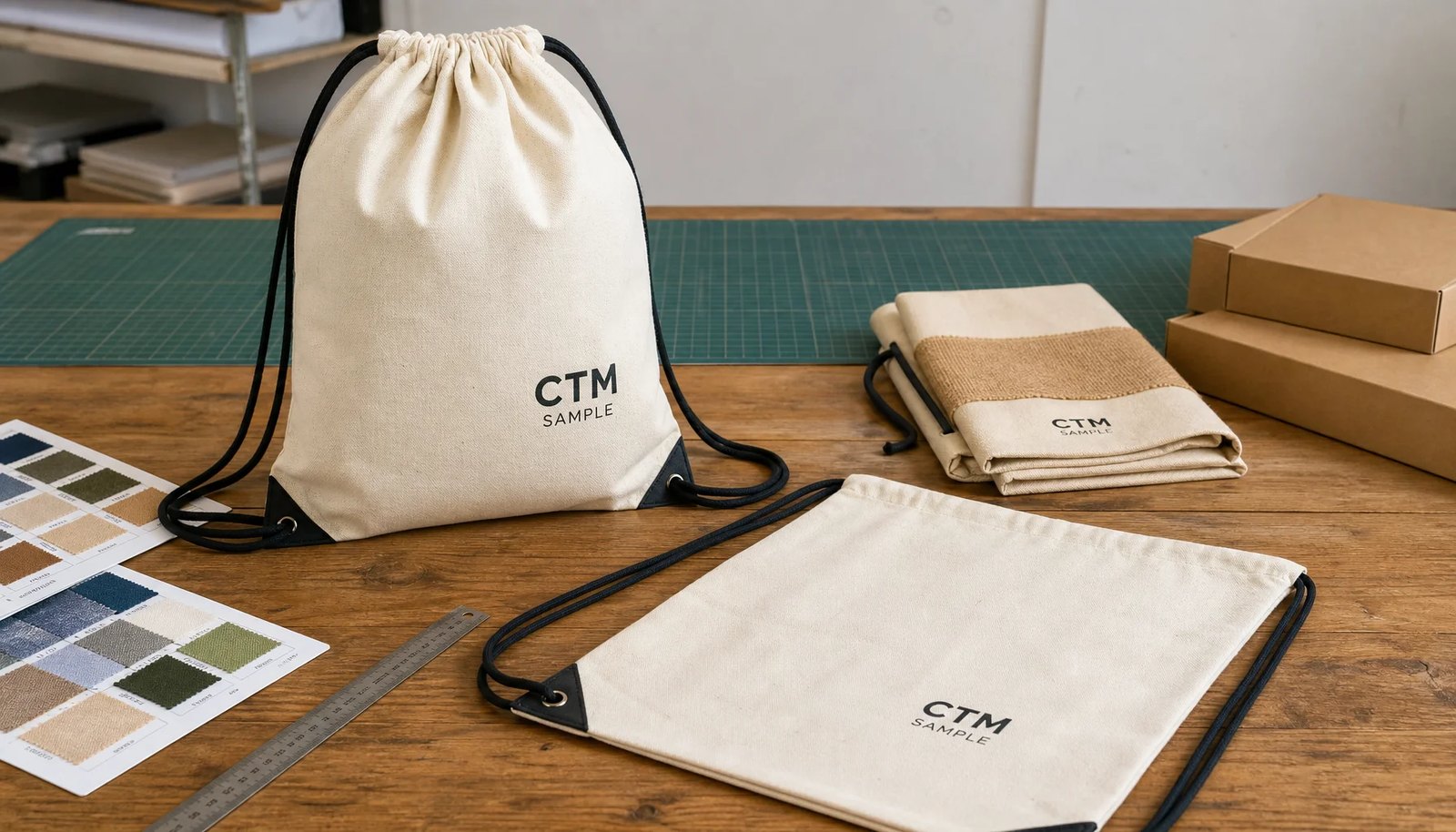
Define the Bookstore Use Before the Bag Spec
Cotton drawstring backpacks for university bookstores can look similar in photos, but the correct RFQ depends on how the bag will be sold or distributed. A bag for freshman orientation may need low cost, fast packing, and acceptable one-color branding. A bookstore retail item needs a better handfeel, stronger corner tabs, cleaner print registration, and retail-ready labeling. If the RFQ does not state the use case, suppliers will quote different construction levels and the price comparison will not mean much.
Start the RFQ with the commercial purpose, expected load, and selling environment. A bookstore bag carrying a hoodie, notebook, and water bottle should not be built like a thin event pouch. At the same time, overbuilding a giveaway bag with 12 oz canvas, individual barcodes, and multi-color print may push the landed cost outside the program budget. The strongest RFQ makes the supplier price the bag around the buyer's real operating problem, not around a vague product name.
- For orientation kits, prioritize cost control, on-time delivery, bulk packing, and simple logo execution.
- For bookstore retail, prioritize fabric handfeel, seam strength, hangtag presentation, and consistent logo placement.
- For alumni or department campaigns, prioritize logo accuracy, Pantone matching, and repeat-order consistency.
- For bundled merchandise, confirm the heaviest item placed inside the bag before choosing fabric and cord strength.
Fabric Weight and Cotton Construction
The most common mistake in RFQs is asking for a cotton drawstring backpack without defining fabric weight. Suppliers may quote 5 oz, 6 oz, 8 oz, or 10 oz cotton, and all may call it canvas or cotton depending on local terminology. For university bookstore programs, 8 oz cotton canvas is often a practical middle point: strong enough for typical campus merchandise, still printable, and not too bulky for export cartons. For a premium retail item, 10 oz gives a heavier handfeel and better perceived value, but it increases material cost, sewing time, carton weight, and freight.
GSM should be included together with oz because fabric naming varies by mill and market. A buyer can request, for example, 8 oz cotton canvas, approximately 270 GSM, natural color, with tolerance agreed in the sample stage. If the university requires dyed fabric, the RFQ should state whether the color is approximate, Pantone matched, or matched to a physical fabric swatch. Custom dyeing normally changes MOQ and lead time, while natural cotton or black stock fabric is easier for smaller bookstore orders.
- 5-6 oz cotton: suitable for light giveaways, not ideal for books or higher retail pricing.
- 8 oz cotton canvas: balanced option for bookstore merchandise and campus event bags.
- 10 oz cotton canvas: stronger retail feel, better for repeat use, higher landed cost.
- Natural cotton: lower dyeing risk and easier MOQ; may show cotton seed flecks and shade variation.
- Dyed cotton: better school color match, but requires shade approval and possible custom dye MOQ.
Size, Capacity, and Pattern Details
A practical bookstore drawstring backpack size is around 35 x 45 cm, but the RFQ should define the finished flat size and tolerance. Finished size is affected by fabric shrinkage, sewing margin, top channel width, and how the bottom corners are folded. If the bag must hold a specific notebook, sweatshirt, boxed bottle, or welcome kit, provide the item dimensions and weight. This avoids a sample that looks correct empty but becomes difficult to close when packed.
The top channel and corner tab construction need to be written into the RFQ. A narrow top channel can make the cord difficult to pull, especially with thicker cotton rope. Bottom tabs carry most of the load when the bag is worn as a backpack, so single thin tabs are a common failure point. For campus use, self-fabric reinforced triangles or folded tabs with bartack stitching are safer than a minimal loop sewn only into the side seam.
- Recommended finished size for general campus use: about 35 x 45 cm.
- Common tolerance: plus or minus 1 cm after sewing, if agreed before production.
- Top channel should allow smooth cord movement after the bag is printed and pressed.
- Bottom tabs should be reinforced because they carry shoulder load during use.
- If the bag includes gusset or pocket details, quote them separately from the base version.
Print Method and Logo Approval
Most university bookstore orders use screen printing because it is economical, durable, and suitable for bold logos, mascots, department marks, and sponsor artwork. A one-color or two-color screen print on natural cotton is usually straightforward, but buyers still need to control artwork size, placement, ink color, and curing. If the logo uses gradients, small text, or photographic effects, heat transfer or digital transfer may be proposed, but those methods need careful wash, flex, and handfeel review.
The RFQ should include vector artwork and Pantone references, not a low-resolution image pasted into an email. Print size should be stated in centimeters, with placement measured from the top edge or side seam. University licensing rules may require clear space around the mark, exact color standards, and no distortion. Suppliers can follow those rules only if they are included before the quote and confirmed again at strike-off approval.
- Screen print: best for solid logos, 1-3 colors, good unit cost at bulk quantity.
- Heat transfer: useful for fine detail or gradients, but review handfeel and cracking risk.
- Embroidery: premium but less common on lightweight drawstring backpacks due to puckering and cost.
- Discharge or water-based ink: softer feel, but needs fabric and color compatibility testing.
- Print strike-off should be approved on the actual cotton fabric, not only on paper.
MOQ Logic and Quote Comparison
MOQ is not only a supplier policy; it is linked to fabric availability, dyeing, cutting efficiency, print setup, and packing labor. A natural 8 oz cotton backpack with one-color screen print may be possible at a lower MOQ than a custom-dyed university color with four print colors and individual retail packaging. Buyers should avoid comparing a 500-piece quote from one supplier with a 3,000-piece quote from another without understanding what costs are fixed and what costs scale.
For a clean RFQ, request pricing at the same specification across quantity breaks such as 500, 1,000, 3,000, and 5,000 pcs. The buyer can then see where the screen setup cost, cutting efficiency, and material purchasing begin to improve the unit price. If a supplier offers a low MOQ, confirm whether the fabric is stock, whether color matching is approximate, and whether the sample will be identical to the production fabric.
- Low MOQ is practical when using stock natural or black cotton and simple screen print.
- Custom dyed cotton may require higher MOQ because the mill needs a dye lot minimum.
- Multi-color artwork increases screen cost and approval time even if the bag construction is simple.
- Retail labeling and individual polybags add labor cost that may not reduce much at small quantity.
- A quote should show unit price, setup charges, sample charges, packing cost, and Incoterm separately.
Sample Approval That Prevents Bulk Mistakes
A pre-production sample is not just a formality for cotton drawstring backpacks. It locks the fabric handfeel, size, drawcord, bottom tab construction, logo color, print placement, and packing method before bulk cutting. For university bookstore programs, the sample also becomes the reference for licensing review and internal buyer approval. If the buyer approves only a photo, later disputes about color, thickness, or print feel become difficult to resolve.
A practical sample path starts with fabric and color confirmation, then print strike-off, then a full pre-production sample. For repeat programs, a sealed sample can be kept by both buyer and factory. The RFQ should state that bulk production cannot begin until the written sample approval is received. This protects both sides: the buyer avoids surprise substitutions, and the factory avoids remaking goods because an artwork rule was changed after printing.
- Blank sample confirms size, fabric weight, sewing method, cord comfort, and corner strength.
- Print strike-off confirms ink color, line sharpness, logo size, and curing result.
- Pre-production sample confirms the complete approved construction before bulk cutting.
- Sealed sample should include signature, date, version number, and approved artwork file name.
- Any change after sample approval should trigger updated cost and schedule review.
Packing, Cartons, and Bookstore Handling
Packing affects landed cost and campus receiving efficiency. Many bookstore orders do not need individual polybags if the bags are distributed at events or unpacked in the stockroom. Bulk packing, such as 50 pieces per bundle and 100 to 200 pieces per export carton, can reduce plastic use, labor, and carton volume. For retail sale, however, the buyer may need hangtags, barcode stickers, size labels, or individual packaging to match store scanning and merchandising procedures.
Carton details should be part of the quote, not added after production. Carton dimensions, gross weight, net weight, quantity per carton, and carton marks affect warehouse planning and freight cost. If the bookstore uses pallets, master carton limits, or receiving labels, those should be included in the RFQ. Heavy cartons may reduce handling efficiency and increase damage risk, especially when 10 oz cotton bags are packed too densely.
- Bulk pack is cost-efficient for orientation kits, giveaways, and backroom distribution.
- Individual polybag is useful for retail presentation but adds plastic, labor, and carton volume.
- Barcode labels should be tested on the final packaging surface before bulk application.
- Carton marks should include PO number, item name, color, quantity, carton number, and destination.
- Request carton CBM so freight forwarders can estimate shipping cost before order placement.
Lead Time and Schedule Risk
Lead time should be counted from the last approval needed for production, not from the first inquiry date. For a custom cotton drawstring backpack, the clock usually starts after deposit, artwork confirmation, fabric approval, and pre-production sample approval. If custom dyeing or special labels are involved, those steps can become the schedule bottleneck. Bookstore buyers working around orientation week, graduation, homecoming, or semester launch should build in inspection and freight time, not only sewing time.
A realistic schedule separates sample development, material purchasing, cutting, printing, sewing, QC, packing, and export handover. Printing often sits between cutting and sewing, depending on the panel layout, so artwork delays can stop the entire production line. If the buyer needs air freight as a backup, that cost should be evaluated early because cotton bags are bulky compared with their unit value.
- Stock fabric plus one-color print is the fastest route for urgent campus programs.
- Custom dyeing adds shade approval, lab dip review, bulk dyeing, and possible rework time.
- Artwork changes after print screen preparation can add cost and delay.
- Final inspection should be scheduled before balance payment and shipment release.
- Freight buffer is important during holiday periods, port congestion, or semester launch peaks.
Quote Data Buyers Should Require
A useful quote is more than a unit price. For cotton drawstring backpacks, the quote should identify fabric weight, finished size, print method, color count, cord type, reinforcement method, packing, carton data, sample terms, lead time, payment terms, and Incoterm. Without this data, procurement teams may choose the lowest price and later discover the quote excluded print screens, hangtags, export cartons, or logo sample charges.
The RFQ should also request validity period and change conditions. Cotton fabric prices, exchange rates, and freight charges can move, especially when orders are placed close to seasonal peaks. A professional supplier should be able to show what is included, what is optional, and which changes affect price. This makes internal approval easier because the buyer can explain the price difference between suppliers with facts instead of assumptions.
- Quote fabric specification using oz, GSM, color, weave, and stock or custom status.
- Show print cost by method, color count, size, and setup or screen charge.
- Separate sample cost, courier cost, tooling or screen cost, and bulk unit price.
- State packing method, carton quantity, carton size, gross weight, and total CBM.
- Define Incoterm clearly, such as EXW, FOB port, CIF destination port, or DDP if offered.
Quality Thresholds for Final Inspection
Cotton drawstring backpacks are simple products, but final inspection still needs measurable acceptance criteria. Fabric weight, finished dimensions, print position, print adhesion, stitch quality, cord strength, and carton count should be checked against the approved sample and purchase order. A small number of loose threads may be acceptable after trimming, but open seams, torn tabs, wrong logo color, or missing carton marks should be treated as serious defects.
For bookstore orders, the highest-risk areas are print accuracy and bottom corner strength. A beautiful front logo does not help if the cord pulls out after a student carries books across campus. Inspection should include pull testing at the cord tabs, visual review of print cracking or smudging, and random measurement of the finished size. If the order is for retail sale, barcode scanning and hangtag placement should also be included in the inspection plan.
- Major defect examples: wrong artwork, wrong fabric weight, open seam, broken cord tab, severe stain.
- Minor defect examples: small removable thread, slight natural cotton fleck, minor wrinkle within packing tolerance.
- Print position should be measured from fixed edges, not judged only by eye.
- Cord pull testing should be done on both sides because left and right stress points may differ.
- Inspection photos should include defects, carton marks, packing layout, and approved sample comparison.
Specification comparison for buyers
| Spec decision | Recommended option | When it fits | Buyer risk to check |
|---|---|---|---|
| Fabric weight | 8 oz cotton canvas or 10 oz for premium campus retail | 8 oz works for orientation kits and bookstore promos; 10 oz fits higher resale value or heavier daily use | Quotes using only oz without GSM may hide thinner fabric; request GSM and finished fabric width |
| Bag size | Approx. 35 x 45 cm with tolerances stated | Fits notebooks, light apparel, water bottle, and campus welcome items without oversizing freight | Oversized bags increase fabric consumption and carton CBM; undersized bags cause return complaints |
| Drawcord | Cotton rope 6-8 mm or flat cotton tape for comfort | Cotton rope suits natural retail positioning; flat tape is better when shoulder comfort matters | Thin cord cuts into shoulders and may fail pull testing at the bottom corner |
| Corner reinforcement | Self-fabric triangle tabs with reinforced bartack or double stitch | Needed for bookstore bags expected to carry books, apparel, or bottled drinks | Low quotes may use single-layer tabs or weak stitch density, causing cord tear-out |
| Print method | Screen print for 1-3 spot colors; heat transfer only for fine gradients | Screen print is cost-efficient and durable for university logos and sponsor marks | Print cracking, color shift, or logo distortion if ink, curing, and fabric shrinkage are not controlled |
| MOQ structure | Quote 500, 1,000, 3,000, and 5,000 pcs on the same spec | Lets buyers see where printing setup, fabric cutting, and packing labor start to scale | A very low MOQ may carry high unit cost or substitute stock fabric without approval |
| Packing format | Bulk pack 50 pcs per inner bundle, 100-200 pcs per export carton | Best for bookstore backroom handling and campus event distribution | Individual polybags add cost, labor, plastic policy concerns, and carton volume |
| Supplier route | Direct factory for custom fabric, print, and QC control; trader only for mixed small accessories | Direct factory suits repeat bookstore programs and controlled logo approvals | Trader quotes may omit factory audit evidence, print curing details, and remake responsibility |
Buyer checklist before sampling
- State target use: resale item, orientation giveaway, alumni promotion, or merchandise bundle.
- Specify fabric in both oz and GSM, including color, dyeing requirement, and shrinkage tolerance.
- Define finished bag size with acceptable tolerance, not only a reference photo.
- Confirm drawcord material, diameter or width, length, and corner reinforcement construction.
- Provide vector artwork, Pantone references, print size, print placement, and logo clearance rules.
- Request tiered pricing at 500, 1,000, 3,000, and 5,000 pcs using the same specification.
- Separate tooling, sample, print screen, packing, inland freight, and export document charges.
- Require pre-production sample approval before bulk cutting or mass printing.
- Define carton packing, carton marks, pallet needs, and barcode or hangtag requirements.
- Ask for production lead time counted from deposit, artwork approval, and final sample approval.
Factory quote questions to send
- What exact cotton fabric will be used, including oz, GSM, weave, dyed or greige base, and expected shrinkage?
- Is the quoted fabric stock material or custom dyed, and what MOQ changes if the university color must be matched?
- What drawcord material, diameter, and end finishing are included in the unit price?
- How are the bottom cord tabs constructed, and what stitch reinforcement is used at the stress points?
- Which print method is quoted, how many colors are included, and what is the maximum print area?
- Are print screens, digital proofing, strike-off samples, and courier fees included or charged separately?
- What sample types are available: blank fabric sample, print strike-off, pre-production sample, and sealed sample?
- What is the production lead time after artwork approval, and how does it change at 3,000 or 5,000 pcs?
- What packing method is quoted, including polybag policy, inner bundles, carton size, gross weight, and carton CBM?
- Which Incoterm is used, what port is quoted, and what export documents are included?
Quality-control points to confirm
- Fabric weight verified by cutting and weighing a measured swatch, with tolerance agreed before bulk production.
- Finished size checked flat after sewing, with typical tolerance around plus or minus 1 cm unless otherwise agreed.
- Print color compared under consistent light against approved Pantone or signed strike-off sample.
- Print adhesion tested by rub, tape pull, and light bend tests after proper curing time.
- Drawcord pull strength checked at both lower corners, with no tearing, skipped stitches, or cord slippage.
- Stitch density inspected at side seams, top channel, and bottom tabs for consistency and no open seams.
- Top channel width checked to confirm cord slides smoothly without twisting or jamming.
- Needle marks, stains, oil spots, loose threads, and fabric slubs separated into agreed defect categories.
- Carton count, carton marks, barcode placement, and packing method matched against the purchase order.
- Random final inspection performed against an agreed AQL level before shipment release.