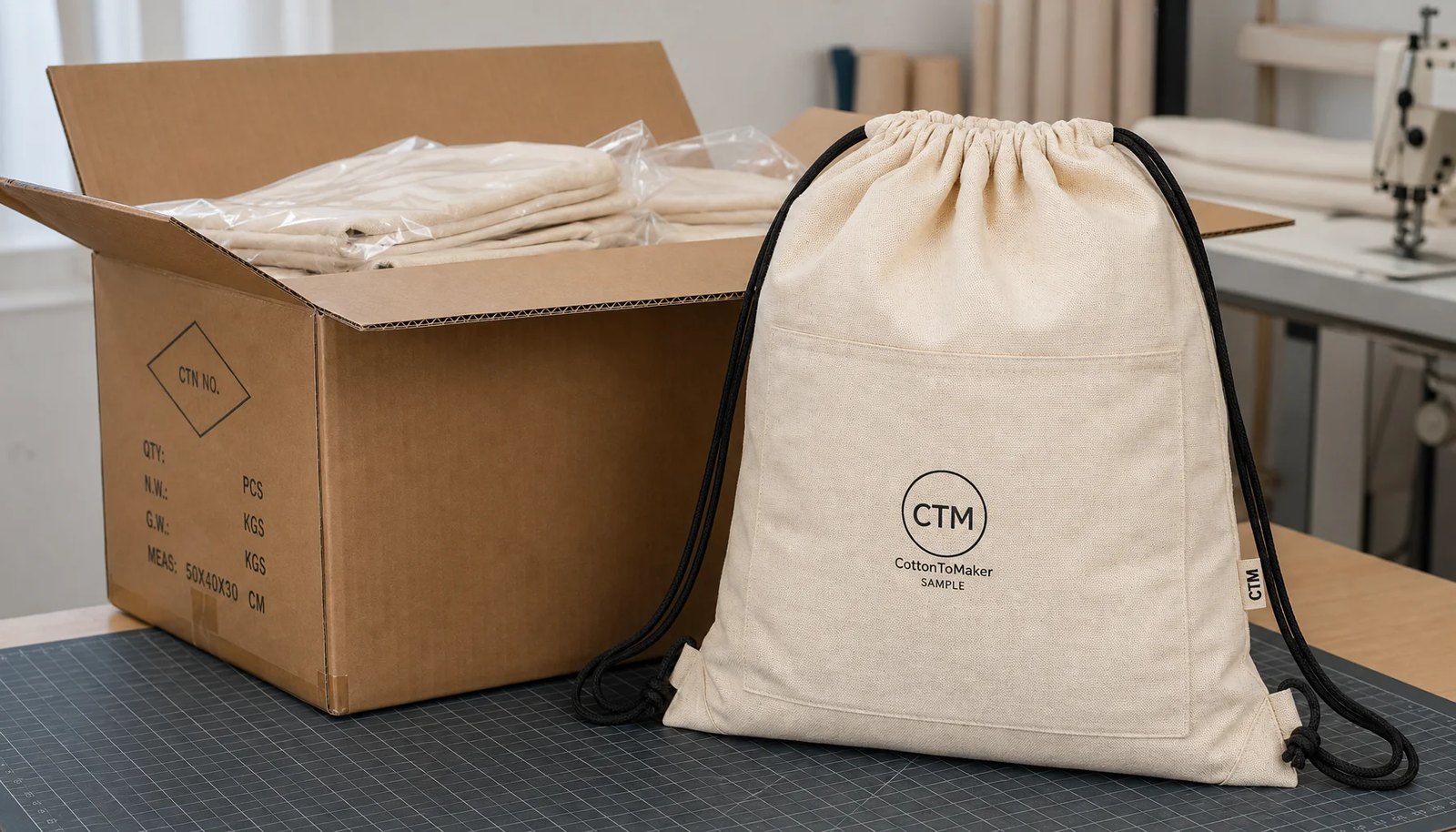
Why carton planning belongs in the backpack RFQ
Cotton drawstring backpacks for university bookstores look simple on a spec sheet, but carton planning can change the landed cost and receiving experience more than buyers expect. A 14 x 17 inch cotton backpack may be light as an individual unit, yet the packed carton can become bulky because cotton does not compress like thin polyester and because drawcords create uneven thickness when folded loosely.
For bookstore programs, the receiving location is often not a full import warehouse. Cartons may move through campus shipping rooms, retail backrooms, event storage, or distributor cross-docks. If the RFQ only requests a unit price and ignores carton size, gross weight, case quantity, and packing method, procurement may approve a low quote that creates higher freight cost, damaged cartons, slow replenishment, or extra repacking before store delivery.
- Treat carton planning as part of the product specification, not a logistics note added after production.
- Include target pieces per carton and maximum carton weight in the original inquiry.
- Require the supplier to quote CBM so freight comparisons are based on volume, not only unit price.
- Use the packed sample stage to validate the case pack before the full order is folded and sealed.
Start with the bookstore use case before setting carton quantity
The right carton plan depends on how the bookstore will use the backpacks. A retail item sold individually needs cleaner folding, better print protection, and possibly individual polybags. A welcome kit bag used to hold inserts may need bulk packing because staff will open every unit and fill it again. A campus department giveaway may accept bundle packs if the cartons are easy to count and distribute.
This decision affects the case pack. Individual polybags usually increase cube and reduce pieces per carton. Bundle packing can improve carton density but may expose natural cotton to dust or print rubbing. If the goods ship to multiple campus stores, smaller cartons can be easier to allocate by location. If they go to one central warehouse, larger cartons may reduce handling cost as long as the gross weight stays within the receiver's limit.
- Retail shelf replenishment: consider 25, 50, or 100 pieces per carton depending on unit thickness and store handling.
- Orientation or event distribution: bundle packing by 10 or 25 pieces can speed counting at the event site.
- Online bookstore fulfillment: individual polybags may protect the bag during pick/pack and reduce lint transfer.
- Distributor routing: carton marks and SKU labels matter as much as the physical carton size.
Fabric weight changes both retail value and shipping cube
Cotton drawstring backpacks are commonly quoted in 5 oz, 6 oz, 8 oz, and 10 oz cotton or canvas. In GSM terms, buyers may see roughly 140 to 150 GSM for light cotton, around 180 to 200 GSM for midweight, and 270 to 340 GSM for heavier canvas, depending on weave and finishing. A university bookstore should not select fabric only by the lowest unit price because hand-feel, opacity, durability, and carton compression are all connected.
Light cotton can work for short-term event bags, but it may look weak beside licensed apparel and gift items. Heavier cotton canvas has a better retail hand, holds screen print well, and stands up better to books and apparel, but it increases unit weight and reduces carton quantity. If the backpack must carry notebooks, a water bottle, and campus merchandise, 8 oz cotton canvas is often a practical balance. For premium retail presentation, 10 oz may be justified, but the freight impact should be visible in the quote.
- 5 oz cotton: lower cost and lower weight, suitable for basic giveaways, less suitable for retail durability.
- 6 oz cotton: common promotional grade, still may feel thin for bookstore resale.
- 8 oz canvas: stronger retail feel, better for repeated use, moderate carton weight.
- 10 oz canvas: premium structure, higher freight and folding bulk, useful for paid merchandise programs.
- Dyed fabric: confirm colorfastness and shade tolerance because re-dyeing or replacement delays shipment.
Build the carton plan around actual folded size, not drawing size
The drawing size is not the packed size. A backpack specified at 14 x 17 inches can fold into different thicknesses depending on fabric weight, side seams, bottom corner reinforcement, cord diameter, and whether the drawcord is tucked inside or left loose. Large screen prints also affect folding because buyers may not want the printed face creased sharply or rubbed against the next unit.
A practical RFQ gives the factory a target carton count but requires confirmation after sample folding. For example, the buyer may request quotation based on 100 pieces per export carton, with the final case pack confirmed after the pre-production sample is folded using the approved packing method. This prevents the supplier from forcing an unrealistic case quantity into a carton that bulges, tears, or exceeds warehouse weight limits.
- Define folded unit size if retail presentation matters.
- State whether the logo face should be protected by folding inward or separated by polybag.
- Avoid overfilled cartons; bulging cases create inaccurate CBM and poor pallet stacking.
- Set gross weight limits before production, especially for campus receiving rooms without material-handling equipment.
Print method affects packing, not only artwork cost
Most cotton drawstring backpacks for bookstores use screen printing because campus logos and bookstore graphics are usually solid-color artwork. Screen print is economical for repeat orders and gives durable results when ink curing is controlled. However, large ink blocks can make the print area stiffer, and thick ink layers may increase surface friction during packing. That matters when units are stacked tightly in cartons.
Heat transfer or digital transfer may be useful for full-color marks, small quantities, or designs with gradients, but buyers should test adhesion, edge feel, and folding behavior. A transfer that looks sharp on the sample can crack or leave impressions if folded under pressure before it fully settles. Embroidery is uncommon for basic cotton drawstring backpacks because it adds cost, weight, and backing, but it can be used for premium programs if the carton plan is recalculated.
- Screen print: best for 1 to 4 solid colors, stable repeat quantities, and standard cotton canvas.
- Discharge or water-based ink: softer hand on some cotton fabrics, but color result depends on fabric dye and pre-testing.
- Heat transfer: useful for detailed graphics, but require wash, rub, and fold-pressure checks.
- Large front prints: protect the print surface during folding to reduce abrasion and blocking.
- Multiple SKUs: separate carton labels by print design to prevent bookstore receiving errors.
MOQ logic: separate fabric, color, print, and packing minimums
The MOQ for cotton drawstring backpacks is not one single number in real factory planning. There can be a sewing MOQ, fabric dyeing MOQ, cord color MOQ, print setup minimum, and carton or packaging minimum. A buyer may request 600 units in three campus colors and assume the order is 600 pieces, while the supplier is actually managing three small fabric lots, three cord lots, and three print setups.
For university bookstores, the most efficient order is often built around shared base material with separated print designs. Natural cotton or stock black cotton can lower MOQ pressure because fabric is easier to source. Custom dyed cotton is more sensitive: shade approval, dye lot minimums, and possible shrinkage changes can affect both schedule and carton density. Packing also matters because individual retail polybags with barcode labels can carry their own minimum and setup time.
- Clarify MOQ per fabric color, not only total order quantity.
- Clarify MOQ per print design if departments, teams, or campuses use different graphics.
- Use stock fabric colors when the order is time-sensitive or split across many SKUs.
- Expect custom cord colors to add lead time unless the cord supplier has stock.
- Bundle small designs into one production batch only if carton labeling and packing separation are controlled.
Sample approval should include a packed-unit review
Many production mistakes happen after the product sample is approved because the packing sample is never reviewed. A backpack can meet size, fabric, and print requirements but still fail in receiving because the fold is messy, the print rubs, the carton is soft, or the case count does not match the purchase order. For bookstore programs, the approved sample should include the unit fold, inner packing, carton mark layout, and case quantity.
A complete sample path may include a fabric swatch, print strike-off, pre-production sample, and packed sample photo set. If time allows, a physical packed sample carton is the best evidence, especially for larger orders or DDP shipments where carton cube drives freight cost. At minimum, the factory should provide photos showing folded unit size, inner pack method, carton loading pattern, carton dimensions, gross weight, and the sealed carton.
- Approve fabric hand-feel and weight before bulk cutting.
- Approve print strike-off before mass printing, especially for school colors.
- Measure the finished sample after sewing and before packing.
- Review folding direction to protect the printed face.
- Confirm carton quantity and carton strength before the factory packs all units.
Set carton strength and markings for real distribution routes
A carton that survives a short courier shipment may not survive ocean freight, consolidation, long storage, and campus delivery. For cotton backpacks, the carton is often filled with soft goods, so it can deform if the board grade is weak or the carton is overfilled. A 5-ply export carton is usually safer for ocean freight, LCL shipments, and mixed distributor handling. A 3-ply carton may be acceptable for lighter domestic movement, but the route should justify the saving.
Markings should be treated as part of the packing specification. University bookstore orders often have PO numbers, department codes, SKU references, season names, and destination addresses. If a supplier uses only generic carton marks, the importer or distributor may need to relabel cartons after arrival. That creates labor cost and increases the chance that the wrong graphic or color reaches the wrong store.
- Use clear carton marks with PO number, SKU, color, print design, quantity, and carton number.
- Place labels on at least two adjacent sides if cartons will be palletized or stored tightly.
- Avoid oversized cartons that collapse under stacking pressure.
- Confirm whether destination requires barcode labels, routing labels, or retail compliance labels.
- Keep carton quantity consistent unless a short carton is clearly marked at the end of the packing list.
Lead time risks that affect bookstore receiving dates
University bookstore orders often connect to fixed academic dates: orientation, move-in week, homecoming, graduation, or seasonal merchandise resets. Missing the date can turn a profitable order into discounted inventory. Lead time should be built from approval milestones, not a vague production estimate. The clock may not truly start until deposit, artwork, fabric color, print proof, and pre-production sample are approved.
Cotton material lead time varies by fabric weight and color. Natural cotton may be faster than custom dyed fabric. Large print areas need curing capacity and inspection time. Packing takes longer when every unit has an individual polybag, barcode label, or size-specific insert. If a buyer changes carton quantity after production, the factory may need to purchase different cartons and repack, which can push shipment by several days.
- Separate sample lead time, bulk production time, packing time, inspection time, and transit time.
- Add buffer for school color approval because Pantone matching on cotton is not identical to coated paper.
- Freeze packing instructions before carton production begins.
- Reserve inspection time before the vessel cut-off or courier pickup date.
- For event dates, compare air upgrade cost against the cost of late goods before choosing the cheapest schedule.
Quote comparison: unit price can hide freight and handling cost
Two suppliers may quote the same cotton drawstring backpack at very different landed costs because their carton plans differ. One may pack 100 pieces into a stronger but larger carton; another may force 150 pieces into a weaker carton that looks cheaper until cartons arrive crushed or overweight. A quote without carton dimensions and gross weight is incomplete for any importer comparing FOB, CIF, DDP, or domestic warehouse delivery.
A practical quote comparison should calculate cost per usable unit after freight, duties if applicable, inspection, labeling, and repacking risk. If the bookstore program includes multiple designs, buyers should also compare how each supplier separates SKUs. Mixed cartons may save a small amount of packing time, but they can create expensive receiving errors. Clean SKU separation is usually worth the extra carton count for bookstore distribution.
- Compare FOB unit price together with CBM per 1,000 pieces.
- Review gross weight per carton against warehouse lifting limits.
- Include inspection and repacking risk when carton strength is low.
- Compare individual polybag cost against the receiving and e-commerce protection benefit.
- Avoid approving a supplier quote that lists only pieces per carton without carton dimensions.
Specification comparison for buyers
| Spec decision | Recommended option | When it fits | Buyer risk to check |
|---|---|---|---|
| Fabric weight | 8 oz cotton canvas or 10 oz canvas for heavier retail feel | University bookstores selling reusable campus bags, orientation packs, or spirit merchandise | Light 5 oz cotton may reduce carton weight but can wrinkle, show contents, and feel promotional instead of retail-ready |
| Bag size | Approx. 14 x 17 in or 15 x 18 in with tolerance stated | Fits notebooks, apparel, event materials, and bookstore impulse displays | Oversized bags increase carton cube quickly; undersized bags create return complaints when folders or sweatshirts do not fit |
| Drawcord | Cotton rope or braided polyester cord with reinforced bottom corner tabs | Retail programs needing better wear resistance than a simple cord-through-hem bag | Thin cord saves cost but can cut into shoulders and pull through seams during student use |
| Print method | Screen print for solid school marks; heat transfer only for detailed art after wash and rub testing | Bulk bookstore graphics with 1 to 4 colors and stable repeat orders | Large ink areas can stiffen cotton; misquoted transfer size may change carton folding thickness |
| Unit folding | Flat fold to a defined size, cord tucked, logo protected from abrasion | Bookstore receiving teams needing predictable case counts and fast shelf replenishment | Loose random folding causes bulging cartons, distorted case dimensions, and print scuffing |
| Inner packing | Individual polybag or 10-piece bundle depending on retail handling requirement | Individual bags for e-commerce pick/pack; bundle packing for backroom replenishment | Individual polybags add material cost and carton cube; bundle packing may not protect light color cotton from dust |
| Export carton count | 50 or 100 pieces per carton after actual sample folding test | Most cotton drawstring backpack orders where cartons must remain liftable and stackable | Only using theoretical carton quantity can produce overweight cartons or crushed lower cases |
| Carton board | 5-ply export carton for ocean freight or heavy stacking; 3-ply only for light air shipments | University orders shipped by LCL, mixed container, or distributor warehouse routing | Weak cartons collapse during long storage, increasing receiving deductions and repacking labor |
| Quote data | Request carton dimensions, gross weight, net weight, CBM, pieces per carton, and pallet plan if applicable | Any importer comparing FOB, CIF, DDP, or domestic warehouse quotations | Without carton data, the lowest unit price may become the highest landed cost after freight and handling |
Buyer checklist before sampling
- Define the actual bookstore use: retail sale, welcome kit, alumni event, online order insert, or campus department giveaway.
- State finished bag size with tolerance, not only approximate size from a previous order.
- Specify cotton fabric weight in oz or GSM and whether natural, dyed, or bleached fabric is required.
- Confirm drawcord material, cord diameter, cord color, and reinforcement method at the bottom corners.
- Provide print artwork size, placement, Pantone references, and maximum acceptable print hand-feel.
- Decide whether individual polybags, bundle packs, or no inner packing are acceptable for your receiving flow.
- Set a target export carton quantity but allow the factory to validate it after pre-production sample folding.
- Require carton dimensions, gross weight, net weight, and CBM in the quotation before comparing freight options.
- Approve a packed sample or at least a packing photo set before mass production packing begins.
- Include carton marks, PO number format, SKU barcode needs, and destination routing labels in the RFQ.
Factory quote questions to send
- What fabric weight and construction are you quoting: 5 oz, 6 oz, 8 oz, 10 oz cotton, plain weave, twill, or canvas?
- What finished bag size and tolerance will be used for production and carton planning?
- What is the estimated unit weight before packing, and how does it change with the selected print size?
- Which print method is included, how many colors, and what is the maximum print area in the quoted price?
- What cord material, cord diameter, and bottom reinforcement construction are included?
- What MOQ applies to the bag body, fabric color, cord color, and print design separately?
- What packing method is quoted: individual polybag, bundle packing, master polybag, or direct carton packing?
- How many pieces per export carton are planned, and what are the carton dimensions, gross weight, net weight, and CBM?
- What carton grade is included, and is it suitable for ocean freight stacking or only courier shipment?
- Can you provide photos or video of the packing test using the approved folded size?
Quality-control points to confirm
- Fabric GSM or oz weight checked against approved sample and tolerance before cutting.
- Finished size measured flat after sewing, with allowance for cotton shrinkage and seam tension.
- Drawcord length and diameter checked so both shoulder loops are even and functional.
- Bottom corner reinforcement pull tested by applying firm manual tension to cord attachment points.
- Print color compared against approved Pantone or physical strike-off under consistent lighting.
- Print adhesion tested by rub test after curing, especially for large white or dark ink areas.
- Needle holes, skipped stitches, loose threads, and seam allowance checked at top channel and side seams.
- Unit folding size verified before carton packing to prevent carton bulging and random case dimensions.
- Carton gross weight measured and compared with the buyer's warehouse handling limit.
- Carton drop or compression risk reviewed when using light cartons, long ocean transit, or high stacking.