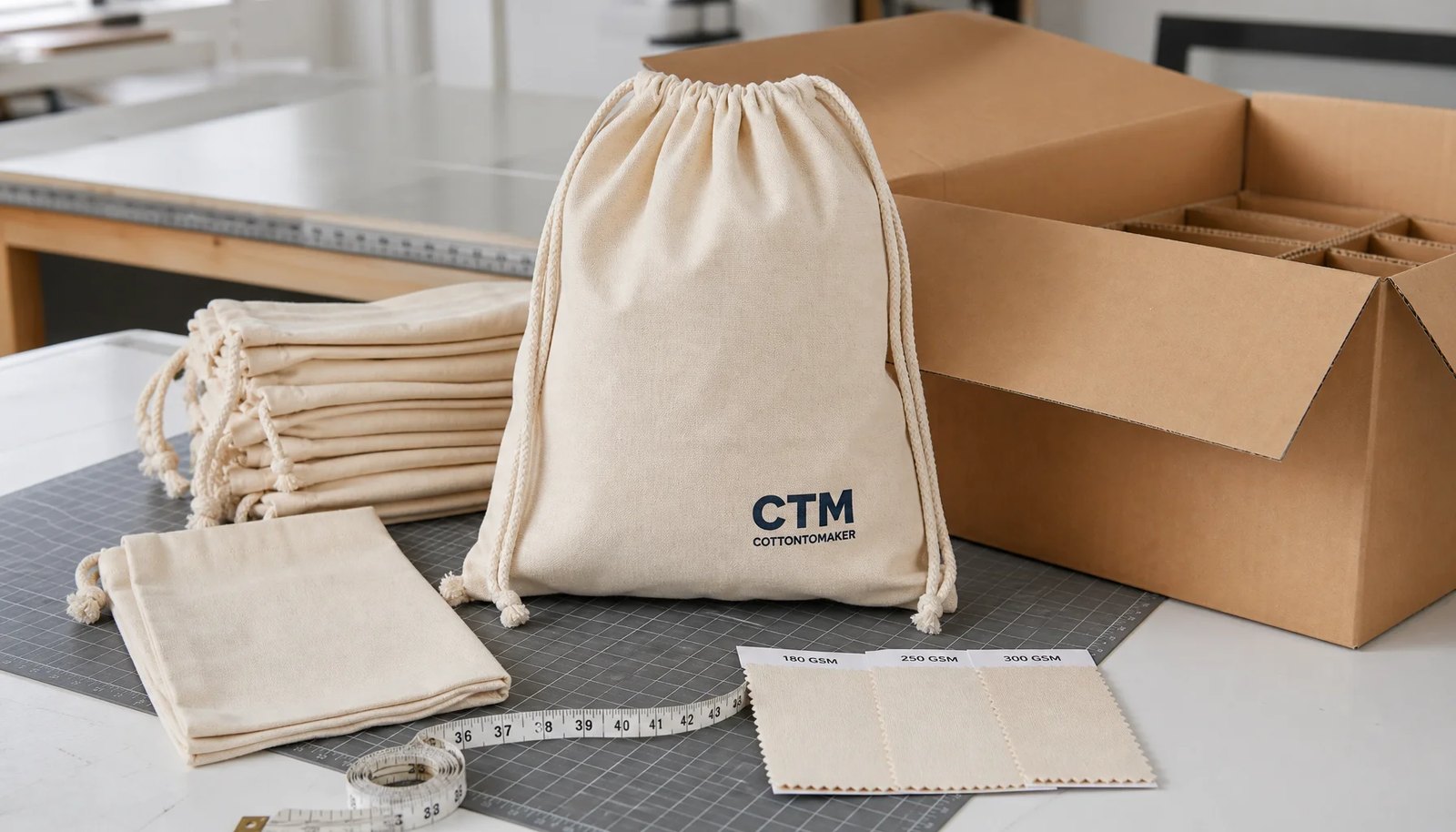
Start With the Use Case, Not the Carton
Cotton drawstring backpacks for university bookstores can look like an easy order: choose cotton, add a school logo, pack in cartons, ship. In practice, the same bag can move through very different campus channels. One SKU may sit on a bookstore retail rack. Another may go into a first-year orientation kit. A third may be split by residence hall, athletics, alumni relations, or academic department. Those paths affect more than presentation. They change fold direction, labels, carton marks, carton quantity, inspection points, and receiving labor.
That is why the carton packing plan should be connected to the product specification from the first quote. A retail SKU may need a crisp fold, logo facing outward, dust protection, UPC label, hangtag, and cartons sorted by style. An orientation giveaway may need fast counting, fewer unit materials, and simple carton marks that volunteers can read quickly. A kit insert may need the flattest possible fold so it fits into an existing kit box, even if that fold is not the prettiest retail presentation.
The best RFQs make these tradeoffs visible. Polybags protect individual units and support scanning, but they add plastic, labor, trapped air, and carton volume. Hangtags help shelf presentation, yet they can bend or snag under pressure. Higher pieces per carton can reduce carton count, but only if the print, cords, seams, and carton board tolerate compression. A lower carton count is not a saving if the campus receiving team has to re-sort, repack, or reject damaged cartons.
- Assign one channel to each SKU before quotation: retail, giveaway, kit insert, department order, e-commerce, or event distribution.
- Quote bulk packing and retail packing as separate options instead of blending assumptions into one unit price.
- Ask for pieces per carton, carton dimensions, net weight, gross weight, board specification, total CBM, and total gross weight with every price.
- Set a maximum carton gross weight when bookstore staff, student workers, or campus receiving teams will move cartons by hand.
- Treat polybags, hangtags, UPC labels, stronger cartons, destination labels, and carton marks as controlled quote items, not small afterthoughts.
Lock Finished Size and Functional Limits
A drawstring backpack is a simple construction, but buyers still need finished-goods measurements. A common planning size is about 14 x 17 inches. That size often works for notebooks, light apparel, event brochures, tablet sleeves, and small merchandise bundles. Still, it should be tested against the actual program. A welcome kit with a bottle, hoodie, and printed materials may need a different usable volume than a low-cost event giveaway.
Finished size means measured after sewing, pressing, and cord insertion. Cut panel dimensions do not tell the buyer enough. Cotton shrinkage, seam allowance, hem depth, and the top cord channel all reduce usable space. If the PO says 14 x 17 in, the inspection team should know whether that means total flat height, usable interior height, top width, bottom width, or another measurement. A tolerance such as ±0.5 in is often practical for this product type, but the acceptable range must be written and tied to the approved sample.
Use limits should also be honest. These are drawstring backpacks, not framed daypacks. If they are sold as campus merchandise, buyers should tighten expectations around cord comfort, corner reinforcement, stitch security, and clean presentation. If they are intended only for a one-day giveaway, the buyer may accept a lighter build. The point is not to over-specify every order. It is to match the construction to the way students, staff, and bookstore teams will actually handle the bag.
- State finished flat size, measuring method, tolerance, cord channel height, seam construction, and reinforcement method.
- Validate the size with the intended contents before approving the pre-production sample.
- Specify whether lower corners use metal eyelets, sewn tabs, reinforced stitching, fabric patches, or another approved structure.
- Define drawcord material, diameter, color, knot or tip finish, and acceptable movement through the channel.
- Check that size tolerance and logo placement tolerance work together so the print does not appear off-center on acceptable units.
Choose Fabric by Channel and Carton Impact
Fabric weight drives hand feel, cost, print appearance, carton volume, and handling weight. For many bookstore-quality programs, 8 oz cotton canvas, approximately 270 GSM, is a practical starting point. It feels more substantial than light promotional cotton but still folds well enough for carton packing. Lighter 5 oz to 6 oz cotton can be suitable for budget giveaways, especially where low cost and easy distribution matter more than retail presentation. Heavier 10 oz cotton can create a more premium feel, but it increases folded thickness, gross weight, sewing resistance, and freight exposure.
The quote should state both nominal weight and tolerance. A supplier quoting 8 oz cotton should also provide the GSM or ounce range they will control, such as ±5% or a buyer-approved GSM window. Without that range, two quotes may not describe the same fabric. Also clarify whether the fabric is natural, bleached, stock dyed, or custom dyed. Natural cotton may show seed flecks and slight shade movement. That can support an eco-style product, but it may not suit a clean school-color retail SKU.
Dyed school colors need additional discipline. Pantone references help, but fabric dye, cord material, print ink, labels, and packaging will not reproduce color in exactly the same way. Ask for lab dips when the body fabric is custom dyed. Keep an approved swatch for production and inspection. If repeat orders are likely, ask how dye lots are identified and how close the next lot can be held to the retained standard.
- Use 5 oz to 6 oz cotton only when a lighter promotional hand feel is acceptable.
- Use 8 oz cotton canvas as the default planning weight when durability, print appearance, and carton efficiency all matter.
- Use 10 oz cotton only after recalculating folded thickness, carton quantity, CBM, gross weight, and manual handling limits.
- State whether seed flecks, slubs, shade variation, crease marks, and minor cotton neps are acceptable, limited, or rejectable.
- For dyed school colors, require lab dip approval, retained shade standards, and dye-lot identification for future reorders.
Specify Drawcords and Reinforcement Clearly
Drawcord problems are easy for end users to notice. Students pull the cords to close the bag, wear them over the shoulder, and often load the bag unevenly. A backpack can pass a quick visual review and still fail if the cords are too thin, the channel is tight, the knot slips, or the lower corner tears. Procurement should therefore describe the cord system as a functional component, not just a color choice.
An 8 to 10 mm cotton rope or braided polyester cord is a common range for bookstore-quality cotton drawstring backpacks. Cotton rope gives a natural look and pairs well with undyed canvas, but it can absorb moisture and may vary slightly in shade. Polyester cord is often cleaner and more consistent for bright school colors, though the hand feel changes. Buyers should approve the cord on the finished bag because loose cord swatches do not show shoulder comfort, channel friction, or corner behavior.
Corner reinforcement deserves a close look. Metal eyelets, sewn tabs, bar-tacked corners, and reinforced fabric patches can all work when matched to the cotton weight and intended use. The factory should show the inside and outside of the reinforcement on the sample. The RFQ should also ask how pull strength is checked and what counts as failure: torn fabric, loose stitching, detached eyelet, slipping cord, distorted seam, or broken tab.
- Specify cord material, diameter, color, surface finish, knot style, and whether ends are tipped, knotted, or heat sealed.
- Check cord color against both fabric and print because school colors can shift across cotton, polyester, and ink.
- Require sample photos or physical samples showing lower reinforcement from the inside and outside.
- Include pull testing at both bottom corners and through the top channel in the inspection plan.
- Classify detached eyelets, torn tabs, cord slippage, open reinforcement seams, and channel tearing as major or critical defects.
Protect Licensed Logo Quality
University bookstore products often carry licensed marks, mascots, department logos, athletics artwork, and event branding. The print specification should be more precise than a mockup. Provide vector artwork, Pantone references, logo dimensions, print side, and placement measured from stable bag references such as the top edge and side seam. If there are multiple logo versions, list them as separate SKUs or print versions before the supplier quotes.
Screen printing is usually a practical choice for solid one-color to three-color artwork on cotton drawstring backpacks. It can be durable and economical when ink deposit, registration, and curing are controlled. Transfer printing may be useful for full-color artwork, gradients, small order splits, or detailed mascot art. It should not be approved on artwork complexity alone. Review hand feel, edge visibility, cracking risk, adhesion, and behavior after folding on the actual cotton fabric.
Packing is part of print quality. A heavy logo folded through the middle may crease. Thick ink can block, gloss, or mark the next bag if curing is poor and stack pressure is high. A transfer can show a film edge or stiffness after compression. Before mass packing begins, the pre-production sample should be folded in the approved direction, stacked under carton-like pressure, reopened, and reviewed. This is a simple step, but it catches problems that flat strike-offs miss.
- Provide final vector artwork, Pantone colors, logo size, print side, and placement measured from top and side references.
- Confirm whether the quote includes separate screens, transfer setups, PMS matching, artwork revisions, and licensing sample changes.
- Approve a printed strike-off on the final cotton fabric, not only a digital proof or paper color reference.
- Review print after dry rub, light wet rub where suitable, tape test if appropriate, folding, and stack-pressure simulation.
- Avoid placing heavy ink coverage directly on the main fold line unless the sample passes compression review.
Clarify MOQ, SKU Splits, and Tolerances
MOQ is usually shaped by materials, printing setup, labeling, and packing, not only by sewing capacity. A natural cotton backpack with one screen-printed logo and bulk packing is straightforward. A custom-dyed school-color body with matched cords, separate department logos, hangtags, UPC polybags, and destination-specific cartons is a different order. Buyers should ask what creates the MOQ so real production constraints are separated from general commercial preferences.
Bookstore programs often share one base bag across the main store, athletics, residence life, orientation, alumni relations, and academic departments. If all versions use the same fabric, cord, size, and packing, the supplier may be able to combine the fabric lot while charging separate print setups. If body color, cord color, label, hangtag, or packing method changes, MOQ may apply per component or per SKU. It is better to learn that during RFQ review than after the PO is approved.
Quantity tolerance also needs a written rule. Custom cutting and printing can create small overruns or underruns. A retail replenishment order may tolerate a small variation. An orientation kit order may need exact counts because every incoming student receives one unit. State whether overruns will be accepted and paid for, whether underruns are allowed, and whether cartons must ship in exact counts by SKU and destination.
- Request MOQ by fabric color, cord color, print design, label type, packing format, and destination split.
- Ask whether one fabric lot can support multiple printed versions with separate screen or transfer setup charges.
- Confirm screen, transfer, label, hangtag, barcode, carton-mark, and split-packing charges before PO release.
- State acceptable overrun and underrun rules by SKU, especially for orientation, event, or kit quantities.
- Separate mandatory bookstore requirements from optional upgrades before negotiating cost reductions.
Build Carton Quantity From Real Samples
For many 8 oz cotton drawstring backpacks, 50 pieces per export carton is a sensible planning number. It should not become an automatic rule. Final carton quantity should be based on finished folded sample thickness, cord bulk, print method, unit packing, carton dimensions, gross weight, and board strength. A carton plan built only around unit count can create compression marks, bulging cartons, weak tape seams, and unsafe manual handling weight.
The fold method is part of the approved product standard. Some bags fold horizontally, some in thirds, and some with the logo facing outward. The best fold depends on logo position, fabric thickness, cord location, hangtags, and polybags. Rope knots can make stacks uneven if every unit is oriented the same way. In some programs, the factory may need to align cords consistently or alternate unit orientation to keep the carton level.
Carton data must match the exact packing method quoted. If the supplier quotes 50 pieces bulk packed and the buyer later adds individual polybags, UPC labels, or hangtags, carton dimensions, CBM, and gross weight may change. This matters for ocean freight, air freight, parcel routing, warehouse receiving, and campus delivery. Ask for one-carton data and total-order data: carton dimensions, net weight, gross weight, carton count, board/flute specification, total CBM, and total gross weight.
- Start at 50 pcs/carton for 8 oz cotton, then validate with finished folded samples and packed carton weight.
- Recalculate carton data when fabric weight, size, print coverage, cord diameter, polybagging, hangtags, or label placement changes.
- Approve fold direction, logo orientation, cord placement, stack arrangement, carton fill level, and tape method.
- Set a maximum carton gross weight for manual receiving and specify carton strength suitable for export or parcel handling.
- Require total order CBM and total gross weight, not only dimensions for a single carton.
Make Labels and Carton Marks Easy to Receive
Bookstore receiving teams need information that is clear before cartons reach the sales floor. A master carton may need PO number, SKU, style name, logo version, quantity, carton number, destination, net weight, gross weight, and barcode-related information. If cartons are split by department, event, or campus location, the carton marks must prevent mixing during unloading, warehouse sorting, and final distribution.
Unit labeling should be decided before quotation. Individual polybags with UPC labels support scanning, dust protection, e-commerce handling, and SKU separation. They also add material, labor, carton space, and plastic use. Hangtags improve retail presentation but can bend or snag if packed under pressure. Sticker labels can peel or become hard to scan if applied over folds. If the bookstore has required barcode size, label stock, or placement rules, send those instructions before sampling.
Carton marks should be approved as a layout proof. For mixed-SKU programs, carton numbering should identify the sequence and the SKU or destination. For palletized shipments, labels should face outward after wrapping. For parcel or multi-warehouse routing, carton marks and tape integrity become more important because cartons receive more handling. A correct backpack in a mislabeled carton still creates receiving cost.
- Provide bookstore receiving rules, PO numbers, SKU names, destination codes, barcode files, and label placement instructions early.
- Specify whether UPC labels appear on polybags, hangtags, sewn labels, inner cartons, master cartons, or more than one location.
- Approve a carton mark proof before final packing begins.
- Test barcode scannability on the actual label material and placement, not only as a digital file.
- Require a packing list that reconciles carton numbers, SKUs, destinations, and quantities.
Approve Samples as Packing Simulations
A showroom sample can look polished and still fail the real bookstore process. The approved pre-production sample should represent the final product and the final packing method. That means confirmed fabric, shade, drawcord, reinforcement, logo print, unit label, fold, and carton arrangement. If the sample does not include packing assumptions, approval is incomplete.
A useful sample review includes compression. The factory can fold multiple finished units in the proposed direction, stack them as planned, apply carton-like pressure, and reopen them. The buyer should inspect print creasing, fabric fold memory, cord-knot impressions, label wrinkling, polybag trapped air, hangtag bending, and presentation after unpacking. This review is especially important for large logos, thick ink, transfer prints, heavier cotton, and retail polybagging.
Sample approval should create a reference standard that production and inspection can use. Keep one approved sample with the buyer and one sealed duplicate at the factory. Photograph the front, back, cord detail, lower reinforcement, print placement, label placement, fold sequence, and carton stack. If there are multiple logo versions, approve each version or document which parts are shared and which are SKU-specific.
- Approve fabric, shade, size, cord, stitching, reinforcement, logo print, label, fold, and carton arrangement together.
- Do not release production from a logo strike-off alone when carton compression or retail presentation matters.
- Keep signed or sealed reference samples with both buyer and factory.
- Photograph the approved fold, logo orientation, cord placement, label position, and carton stack.
- Require written approval for any change that affects carton count, CBM, gross weight, barcode placement, or presentation.
Inspect Product, Cartons, and Landed Cost Together
Quality control should be measurable before inspection day. AQL sampling can define how many units are checked, but the product-specific checklist defines what inspectors should judge. For natural cotton, small seed flecks may be acceptable if they match the approved sample. Holes, oil stains, wrong logo color, loose drawcords, open seams, unreadable barcodes, incorrect counts, and wrong carton marks should be classified clearly as major or critical defects where appropriate.
A strong QC plan covers incoming materials, in-line production, final product inspection, and packed-carton review. Incoming checks verify GSM, shade, fabric defects, shrinkage expectations, and cord color. In-line checks catch sewing defects, print placement drift, skipped stitches, weak reinforcement, and curing issues before too many units are complete. Final inspection confirms size, appearance, print quality, cord function, count, labels, carton marks, and carton condition.
Buyers should compare landed cost instead of focusing only on FOB unit price. A lower unit price can become more expensive if it excludes UPC labeling, uses weaker cartons, increases CBM, requires repacking, or creates campus receiving errors. Build the comparison using the same GSM, size, cord, print method, number of logo versions, setup charges, label format, packing method, carton quantity, inspection plan, freight mode, duties if applicable, and domestic delivery assumptions. The cleanest carton packing plan is the one that protects the product and gives the receiving team exactly what they expect.
- Define major, minor, and critical defects for fabric, stitching, print, function, labels, carton marks, carton condition, and count errors.
- Measure size and logo placement on random units from multiple cartons, not only top-of-carton samples.
- Open cartons to verify count, SKU separation, fold direction, labels, carton marks, and packing list accuracy.
- Hold wet, crushed, bulging, weak, mislabeled, underfilled, or overfilled cartons before shipment release.
- Compare quotes using total CBM, total gross weight, setup charges, packing labor, inspection requirements, and receiving rules.
Specification comparison for buyers
| Sourcing decision | Procurement specification to quote | Operational reason | QC or cost risk to control |
|---|---|---|---|
| Fabric weight | 8 oz cotton canvas, approximately 270 GSM, with a stated tolerance such as ±5% or a buyer-approved GSM range | Gives bookstore retail, orientation kits, department merchandise, and campus events a substantial but still packable hand feel | Low GSM can feel limp and show print-through; high GSM increases folded thickness, carton CBM, sewing resistance, and freight weight |
| Finished size | 14 x 17 in is a common baseline; state finished flat tolerance, such as ±0.5 in, after sewing, pressing, and cord insertion | Fits typical light campus use including notebooks, apparel, event materials, and retail display | Cut-size assumptions are misleading because seam allowance, shrinkage, hem depth, and cord channel height reduce usable area |
| Drawcord system | 8-10 mm cotton rope or braided polyester cord with specified color, knot/tip finish, channel construction, and reinforced lower corners | Improves shoulder comfort, appearance, and repeated opening/closing performance | Thin cords can cut into shoulders, slip from corners, or tear fabric if reinforcement is weak |
| Logo method | Screen print for solid 1-3 color artwork; transfer only after hand-feel, rub, fold, and carton-pressure approval | University marks, department logos, and mascot graphics need predictable color and licensing control | Poor curing, thick ink, or transfer film can crack, block, crease, or mark adjacent cotton under carton pressure |
| MOQ structure | Quote MOQ by fabric color, cord color, print version, label format, packing method, and destination split | Multi-department bookstore programs often share one base bag while separating logo versions or labels | A single MOQ can hide dye-lot minimums, screen charges, split packing labor, label setup, or overrun/underrun exposure |
| Unit packing | Bulk folded for giveaways or kit insertion; individual polybag, hangtag, or UPC label for retail and e-commerce SKUs | Packing format determines receiving speed, scanning, dust protection, plastic use, carton count, and labor cost | Changing packing after sample approval invalidates carton quantity, gross weight, CBM, and print-pressure review |
| Carton quantity | Plan around 50 pcs/carton for 8 oz cotton, then confirm by finished folded stack height and packed gross weight | Keeps handling practical while limiting over-compression of printed cotton and rope knots | 100 pcs/carton may reduce carton count but can exceed safe manual handling weight or crush prints |
| Master carton spec | State carton dimensions, board/flute strength, pieces per carton, net weight, gross weight, carton marks, and total CBM | Supports freight quotation, pallet planning, campus receiving, and mixed-SKU sorting | Weak, bulging, wet, or mislabeled cartons cause receiving delays, miscounts, damage, and repacking cost |
| Bookstore labeling | UPC, SKU, PO, destination, carton number, and logo-version labels only where required, with placement approved before packing | Helps retail scanning, inventory upload, e-commerce fulfillment, and department allocation | Late label decisions change labor, carton space, inspection scope, and bookstore compliance risk |
Buyer checklist before sampling
- Define finished flat size, tolerance, fabric GSM, cotton type, color standard, drawcord material, drawcord diameter, cord channel height, bottom reinforcement, seam type, stitch density target if required, and finished appearance standard in the RFQ.
- Attach final vector artwork with Pantone references, logo size, print side, placement measured from top edge and side seam, licensing approval status, and a list of SKUs that require separate screens or transfer setups.
- State the sales channel for each SKU: bookstore retail rack, orientation giveaway, welcome kit insertion, e-commerce fulfillment, department merchandise, alumni event, athletics promotion, or campus destination split.
- Confirm whether each SKU is bulk folded, individually polybagged, hangtagged, UPC labeled, inner-carton separated, mixed by destination, or packed as a kit component before comparing supplier prices.
- Request pieces per master carton, carton dimensions, net weight, gross weight, carton board/flute specification, carton mark layout, pallet loading suggestion if relevant, total order CBM, and total gross weight with the quotation.
- Set a maximum acceptable carton gross weight for manual handling when bookstore employees, student workers, or campus receiving teams will move cartons without lift equipment.
- Approve a pre-production sample using final fabric, final shade, final cord, final reinforcement, final logo print, final label, final fold, and carton-like compression rather than approving only a flat logo strike-off.
- Define inspection checks for GSM, shade, shrinkage expectation, size tolerance, seam strength, drawcord pull strength, print rub, print placement, fold-pressure marks, carton count, carton weight, and label scannability.
- Require a carton mark proof showing SKU, logo version, PO number, destination code, carton quantity, carton numbering, gross/net weight, and any bookstore receiving instruction before final packing begins.
- Build the order calendar backward from the required in-store date, allowing time for artwork approval, licensing review, sample production, courier transit, lab dip approval if needed, inspection booking, export paperwork, freight, and domestic delivery.
Factory quote questions to send
- What exact cotton fabric weight is quoted in GSM and ounces per square yard, what tolerance applies, and is the fabric greige, natural, bleached, stock dyed, or custom dyed?
- What finished flat backpack size is included, what tolerance applies after sewing and pressing, and which measurement points will be checked: top width, bottom width, total height, cord channel height, and logo placement?
- What shrinkage, shade-control, and colorfastness data can be provided for the fabric and cords, especially for school-color dyed cotton or repeat-order programs?
- Which drawcord material, diameter, color, knot or tip finish, channel construction, and lower-corner reinforcement method are included in the quoted unit price?
- How will drawcord pull strength and seam strength be checked, and what failure conditions will be classified as major or critical defects?
- Which print method is quoted, how many logo colors are included, what ink or transfer type will be used, and what curing, rub, tape, or fold-pressure review will confirm adhesion?
- Does the price include screen setup, PMS ink matching, transfer setup, licensing sample revisions, barcode label setup, hangtag application, polybagging, or split-carton labor?
- Is the price based on bulk packing, individual polybag packing, hangtagging, UPC labeling, inner carton separation, or another retail format, and what material/labor assumptions are included?
- What are the master carton dimensions, pieces per carton, net weight, gross weight, board/flute specification, estimated total CBM, and total gross weight for the exact packing method quoted?
- Will the factory provide a carton packing sample or approved photo standard showing fold direction, logo orientation, cord placement, stack arrangement, label position, carton marks, and carton fill level?
Quality-control points to confirm
- Fabric GSM checked by cutting and weighing a measured fabric sample during incoming material inspection, with the PO stating the accepted tolerance or approved range.
- Fabric appearance reviewed against the approved standard for shade consistency, slubs, holes, weaving defects, oil marks, stains, excessive seed flecks, crease marks, and unacceptable contamination.
- Finished size measured flat after sewing, pressing, and cord insertion at top width, bottom width, total height, cord channel height, and other buyer-specified points.
- Logo placement verified by measuring from stable references such as top edge and side seam, with separate checks for each logo version, print side, and licensed artwork variation.
- Drawcord pull test performed at both lower corners and through the top channel to confirm no tearing, slipping, eyelet detachment, tab failure, or weak corner stitching.
- Seam strength checked at side seams, bottom seam, top channel, and reinforcement points after a practical load or pull test agreed for the backpack's intended use.
- Print color compared against approved Pantone, signed strike-off, or production standard under consistent lighting on the actual cotton fabric, not only on paper.
- Print adhesion reviewed by dry rub, light wet rub where suitable, tape test when appropriate, curing check, fold-pressure review, and reopening after carton-like compression.
- Workmanship defects such as needle damage, loose threads, skipped stitches, raw edges, fraying, stains, fabric holes, crooked seams, wrong cord color, and poor knots classified by agreed severity.
- Unit packing checked for correct fold direction, logo protection, polybag size, trapped air, suffocation warning if required, UPC label scannability, hangtag placement, and SKU separation.