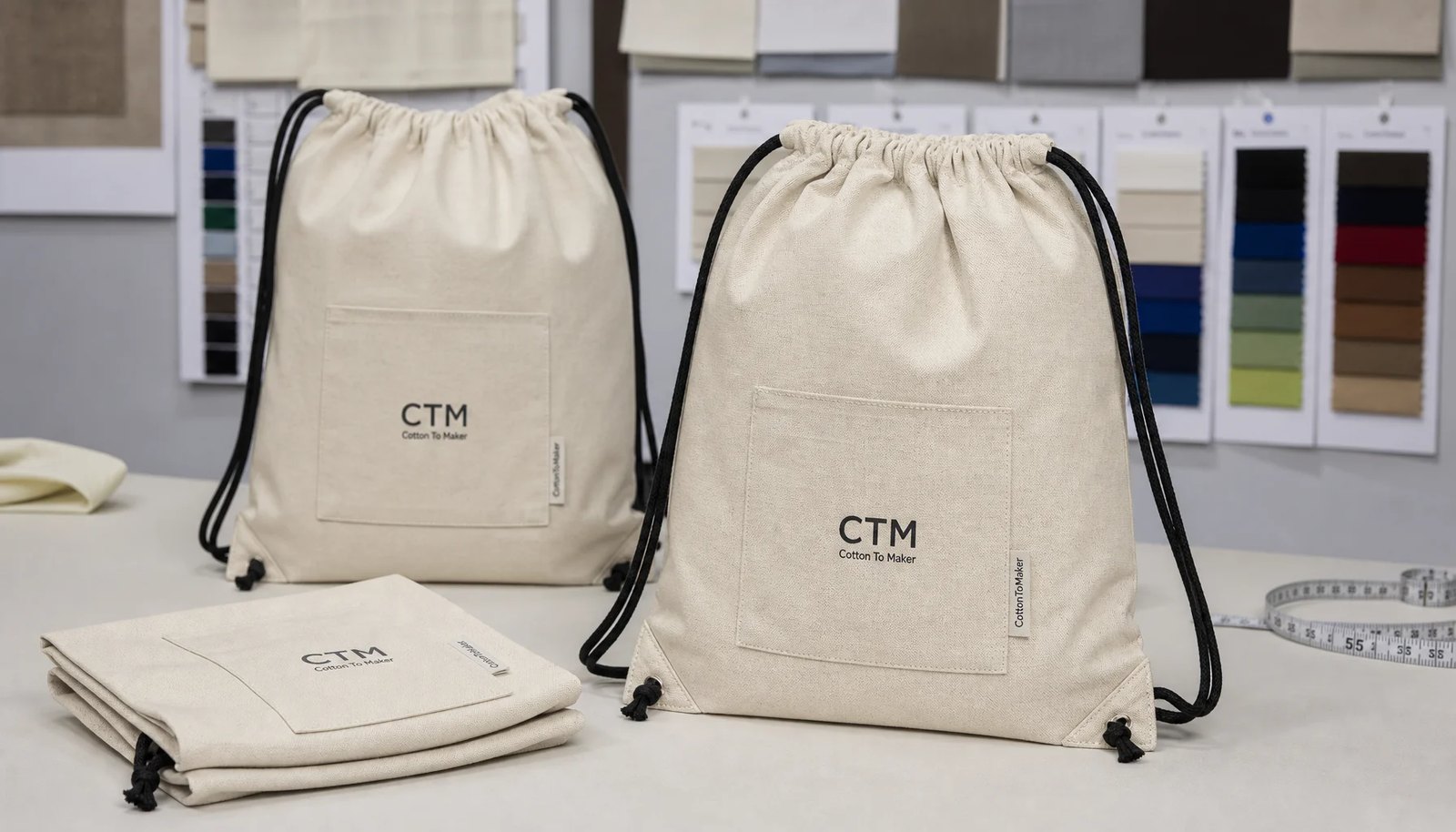
Start with the bookstore use case, not the cheapest unit price
Cotton drawstring backpacks for university bookstores are not one product. The correct wholesale specification depends on whether the bag will be sold as a campus logo item, handed out during student orientation, bundled with textbooks, or used for alumni events. A paid retail item needs better fabric hand feel, cleaner print edges, and more reliable packing presentation. A giveaway item can accept a simpler construction, but it still has to survive carrying a notebook, sweatshirt, and bottle across campus.
The buying mistake is treating every quote as equal because the product name sounds simple. One supplier may quote a lightweight cotton muslin cinch bag, another may quote 8 oz canvas, and another may include reinforced corners and cotton rope. The unit price difference may be real, but it is not meaningful until the RFQ defines usage, weight target, size, print method, and packing route.
- For bookstore retail: prioritize 8 oz to 10 oz cotton canvas, neat stitching, consistent logo placement, and retail-ready labeling.
- For orientation giveaways: use a cost-controlled size and simpler packing, but keep drawcord strength and print curing requirements.
- For alumni merchandise: consider heavier canvas, upgraded cord, woven side label, and more controlled color matching.
- For department orders: group similar designs by fabric color and print method to reduce setup charges.
Choose fabric weight and construction with the load in mind
Fabric weight is the first technical decision that affects cost, feel, durability, carton weight, and perceived value. Many RFQs say only cotton drawstring backpack, which invites suppliers to quote very different fabrics. For university bookstores, 6 oz cotton may work for a low-budget promotional bag, but it can feel too soft and thin for a retail shelf. 8 oz cotton canvas is a common balanced option. 10 oz canvas gives a firmer hand and better retail feel, but it increases fabric cost, shipping weight, and sewing resistance.
GSM can help compare quotes, but it does not tell the whole story. Cotton canvas with a tight weave can feel stronger than a loosely woven fabric of similar weight. Natural cotton may show small seed specks, which many buyers accept as part of the look. Dyed cotton needs shade approval and may require higher MOQ if the factory must dye fabric specifically for the order.
- 6 oz cotton: suitable for short-term promotions where low landed cost is the main target.
- 8 oz cotton canvas: practical baseline for many campus bookstore wholesale programs.
- 10 oz cotton canvas: better for paid retail, alumni ranges, and premium campus collections.
- Natural cotton: faster if stock fabric is available, but confirm acceptable speck level and shade variation.
- Dyed cotton: stronger brand color control, but requires lab dip approval and more schedule buffer.
Lock the size, cord, and reinforcement before comparing quotes
A typical cotton drawstring backpack for campus use is around 14 x 17 inches, but the finished size should be chosen around what students will actually carry. If the bag must fit a folder, notebook, hoodie, or bookstore purchase, a very small promotional size creates complaints. Oversizing also has a cost: more fabric, longer cord, bigger cartons, and higher freight volume.
The drawcord system is where low-cost bags often fail. Thin cord can cut through corner fabric or feel uncomfortable on the shoulder. Bottom corners should not be left as simple folded cloth if the bag is expected to carry weight. Reinforcement can be done with metal eyelets, stitched buttonholes, bartacks, or reinforced fabric tabs. Each method has a different cost and look, but the buyer should define the required pull strength and sample test, not just the appearance.
- Define finished size with tolerance, for example 14 x 17 inches plus or minus 0.5 inch.
- State cord material and diameter instead of accepting an unspecified drawstring.
- Review whether the cord color must match fabric, contrast with fabric, or match the printed logo.
- Require reinforced drawcord exits and bottom stress points for retail-grade bags.
- Test the sample with realistic contents, not an empty bag on a table.
Select the print method according to artwork, fabric, and volume
For most university bookstore logos, spot color screen printing is the safest wholesale option. It gives a clean flat result, works well on cotton canvas, and is cost-effective when the same design runs in volume. The RFQ should state print size, placement, number of colors, PMS references, and whether an underbase is needed. On dark fabric, a white underbase may be required to keep the school color from looking dull.
Heat transfer can handle gradients, small details, and full-color artwork, but it changes the hand feel and may not match the natural cotton look some bookstores want. Embroidery is possible but less common on basic drawstring backpacks because the fabric may pucker unless backed properly. Woven labels or sewn patches are useful for a subtle campus collection, but they add lead time and need their own approval process.
- Use screen print for one to four spot colors and repeat campus logo programs.
- Use heat transfer when artwork has gradients, photographic detail, or many colors.
- Use woven label or patch branding when a small premium detail is more important than large front graphics.
- Specify print placement from top seam and side seam in inches or centimeters.
- Approve a strike-off on actual fabric before releasing bulk printing.
Understand MOQ logic instead of negotiating blindly
MOQ is not only a factory sales rule. It is linked to fabric availability, dyeing minimums, cutting efficiency, printing setup, labor scheduling, and export packing. A natural cotton backpack using stock fabric can often be more flexible than a custom-dyed color. A one-color screen print has a different MOQ pressure than five bookstore designs each with separate artwork.
For university buyers and distributors, the practical way to reduce MOQ pressure is to consolidate specifications. Keep one fabric weight, one bag size, and one cord style, then vary print designs only where necessary. If every department wants its own color, cord, label, and print placement, the order becomes a collection of small custom jobs rather than one wholesale backpack program.
- Separate MOQ per fabric color from MOQ per print design.
- Ask whether the quoted MOQ changes if stock natural cotton is used.
- Group bookstore, athletics, alumni, and department designs on one base bag when possible.
- Expect setup charges for each screen print color and each artwork design.
- Do not compare a low MOQ quote against a higher MOQ quote without checking fabric and print assumptions.
Build your RFQ around comparable quote data
A good wholesale quote for cotton drawstring backpacks should let the buyer calculate landed cost and production risk. Unit price alone is not enough. The quote should show fabric weight, bag size, print method, number of print colors, packing, carton quantity, carton dimensions, gross weight, net weight, CBM, setup charges, sample charges, lead time, payment terms, and trade term such as EXW or FOB.
If quote data is incomplete, the lowest price may become the most expensive after freight and rework. For example, a bag packed 100 pieces per carton may have a different CBM from a bag packed 200 pieces per carton. Individual polybags add labor and material cost, but they may reduce dust and simplify retail receiving. Barcode labels and hangtags are small items, yet they create delays if the artwork and placement are not approved early.
- Request price by quantity break, such as 500, 1,000, 3,000, and 5,000 pieces if relevant.
- Require carton size and weight for each packing method quoted.
- List all extra charges: screens, setup, sample, label, hangtag, barcode, polybag, and mold or cutting pattern if any.
- Ask whether FOB includes export carton and standard export paperwork.
- Compare landed cost per sellable unit, not only factory unit price.
Use samples to remove uncertainty before bulk production
Sampling should be divided into clear approval stages. A fabric swatch confirms weight, color, and hand feel. A print strike-off confirms ink, color, registration, curing, and placement on the actual fabric. A fit or construction sample confirms dimensions, cord length, reinforcement, and sewing quality. A pre-production sample should combine all approved details before bulk cutting and printing.
University bookstore orders are often tied to fixed retail windows, so skipping sample approval can look faster but create bigger risk. The common failure points are logo color, print placement, bag size, and drawcord strength. A sample approval note should not say approved generally. It should say which sample version is approved, what changes are required, and what tolerances apply in bulk.
- Keep one approved sample at the buyer office and one at the factory.
- Mark the approved print size and placement directly in the approval document.
- Photograph the sample with a ruler for size and logo position reference.
- Do not approve bulk production from a digital mockup alone.
- Require written confirmation if the bulk fabric lot differs from the sample fabric lot.
Set QC thresholds that match bookstore expectations
Cotton drawstring backpacks are simple products, but QC still needs defined thresholds. Fabric defects, loose threads, skipped stitches, weak corners, crooked print, shade variation, odor, and incorrect carton marks can all create receiving problems. For retail bookstore stock, visual consistency matters because bags may be displayed together. A shade difference that is acceptable in a giveaway may not be acceptable on a shelf.
Inspection should include both product tests and packing checks. Pull the cords repeatedly, inspect the top channel, load the bag with realistic weight, rub the print after curing, and compare logo placement against the approved sample. Carton inspection matters too. If mixed designs are not clearly labeled, bookstore receiving teams waste time sorting goods during their busiest season.
- Measurement tolerance: commonly around plus or minus 0.5 inch unless a tighter tolerance is agreed.
- Fabric weight tolerance: agree a percentage range before production, especially if comparing 8 oz and 10 oz options.
- Print tolerance: define acceptable placement shift and color variation against PMS or approved strike-off.
- Cord test: repeated pull at top channel and bottom corner, not one visual inspection.
- Packing accuracy: verify SKU, design, color, quantity, and carton marks before shipment.
Plan packing for receiving, freight, and retail handling
Packing is a commercial decision, not just a factory afterthought. Bulk flat packing is usually economical and works well when the bookstore or distributor will unpack and display the bags. Individual polybags protect the product from dust and moisture, and they may be required when the bag has a barcode sticker or retail hangtag. However, polybags add cost, increase plastic use, and can trap odor if the print is not fully cured.
Carton planning affects landed cost. Heavier 10 oz canvas bags may hit carton weight limits before carton volume is fully used. Lighter bags may be packed in larger quantities, but over-compression can crease the print. For bookstore replenishment, inner packs by 25 or 50 pieces can make backroom counting easier. Carton labels should identify purchase order, SKU, school design, color, quantity, gross weight, and destination if shipping to multiple locations.
- Use bulk flat pack for cost-efficient wholesale receiving.
- Use individual polybag when barcode, dust protection, or retail unit handling is required.
- Avoid packing before print is fully cured to reduce blocking and ink transfer.
- Specify carton quantity and maximum gross weight to match warehouse handling rules.
- Use inner packs when multiple designs or bookstore branches share one shipment.
Protect the launch schedule with approval deadlines
The largest schedule risks are usually before sewing starts: slow artwork approval, unclear PMS colors, delayed lab dip comments, missing barcode files, and late packing instructions. Bulk production time is easier to manage when all inputs are approved. For back-to-school and orientation programs, the buyer should work backward from the in-store date, then add time for receiving, inspection, domestic distribution, ocean or air freight, production, sampling, and artwork corrections.
A realistic schedule separates sample time, approval time, material preparation, printing, sewing, QC, packing, and freight. If a supplier quotes a short lead time, clarify what the lead time starts from. It should start after deposit, final artwork, approved sample, and confirmed packing data. If the buyer changes logo size or fabric color after approval, the schedule should be reset honestly.
- Start planning earlier for custom dyed fabric than for natural cotton stock fabric.
- Approve artwork and PMS colors before requesting final production booking.
- Reserve buffer for print strike-off correction, especially on dark cotton.
- Confirm whether lead time is counted from purchase order date or sample approval date.
- Do not use factory ship date as the bookstore launch date; include freight and receiving time.
Specification comparison for buyers
| Spec decision | Recommended option | When it fits | Buyer risk to check |
|---|---|---|---|
| Fabric weight | 8 oz cotton canvas or 10 oz canvas for heavier bookstore use | 8 oz works for orientation giveaways and low-cost retail; 10 oz fits paid merchandise and repeated campus use | Quotes using only GSM may hide loose weave; request oz, GSM, yarn feel, and pre-production swatch |
| Bag size | Approx. 14 x 17 inches with usable drawcord opening | Fits notebooks, light apparel, water bottle, and bookstore impulse purchase needs | Oversized bags increase fabric consumption and carton volume; undersized bags create returns when folders do not fit |
| Drawcord material | Cotton rope or thick braided cotton cord with reinforced corner eyelets | Better hand feel for campus retail and aligns with natural cotton positioning | Thin cord cuts into fabric and shoulders; verify pull strength and corner reinforcement method |
| Print method | Spot color screen print for campus logos; heat transfer only for complex gradients | Screen print gives durable flat logos at volume and predictable PMS matching | Dark fabric needs underbase; low-cure ink or poor drying can cause blocking during carton packing |
| MOQ logic | MOQ based on fabric dyeing, print setup, and carton efficiency, not only unit price | Useful when ordering for multiple departments, bookstore branches, or seasonal campus programs | Very small mixed designs may carry repeated setup charges and inconsistent shade lots |
| Supplier route | Direct factory for custom fabric, size, and print control; trading company only if consolidating many unrelated SKUs | Direct factory suits repeat bookstore programs and controlled logo approvals | Middle suppliers may not disclose subcontracted printing, making rework responsibility unclear |
| Packing style | Flat bulk pack by color/design with carton labels; individual polybag only when retail barcode or dust control is required | Bulk pack lowers plastic use and packing cost for backroom receiving | Loose packing can crease prints; polybag requests must specify suffocation warning, barcode, and size placement |
| Lead time buffer | Prototype sample, pre-production sample, then bulk production with shipping buffer before semester launch | Best for back-to-school, alumni weekend, orientation, and bookstore floor resets | Late artwork approval and delayed lab dip confirmation are more common than sewing delays |
Buyer checklist before sampling
- Define the sales use first: paid retail item, orientation giveaway, alumni event, or bundled bookstore promotion.
- Specify fabric by construction and weight: natural cotton, dyed cotton, 8 oz canvas, 10 oz canvas, or requested GSM with acceptable tolerance.
- State finished size, drawcord length, seam construction, bottom corner reinforcement, and whether shrinkage tolerance applies after washing.
- Provide logo artwork in vector format with PMS colors, print size, placement distance from top seam, and acceptable color tolerance.
- Choose the print method before quoting: screen print, discharge print, pigment print, heat transfer, embroidery patch, or woven label.
- Separate required sample types: fabric swatch, print strike-off, fit sample, pre-production sample, and shipment sample.
- List packaging requirements including bulk pack count, individual polybag, barcode label, hangtag, carton marks, and pallet preference.
- Require quote data in comparable units: EXW or FOB price, carton quantity, carton size, gross weight, net weight, CBM, setup cost, sample cost, and lead time.
- Set QC thresholds for fabric defects, seam strength, print adhesion, color shade, measurement tolerance, and carton label accuracy.
- Build a launch calendar backward from bookstore receiving date, not from factory ship date.
Factory quote questions to send
- What exact fabric construction are you quoting: cotton canvas weight in oz and GSM, yarn density if available, and natural or dyed finish?
- Is the quoted price based on greige fabric stock, ready dyed fabric, or new dyeing production?
- What is the minimum order per color, per print design, and per shipment carton configuration?
- Which print method is included in the base price, how many colors are included, and what are the screen or setup charges?
- Can you provide a print strike-off on the actual production fabric before bulk printing?
- What reinforcement is used at the drawcord exit and bottom corner: metal eyelet, stitched buttonhole, bartack, leather patch, or folded fabric channel?
- What measurement tolerance and weight tolerance do you apply to finished cotton drawstring backpacks?
- How many units per export carton, what is the carton size, gross weight, and CBM per 1,000 pieces?
- Are individual polybags, barcode stickers, hangtags, carton side labels, or inner packs included or charged separately?
- What is the realistic production lead time after sample approval and deposit, and which steps can delay it?
Quality-control points to confirm
- Fabric weight tolerance should be agreed before production; a practical range is often within approximately plus or minus 5 percent unless the buyer requires tighter control.
- Finished bag measurement should be checked flat, seam to seam, with tolerance normally around plus or minus 0.5 inch for cotton canvas drawstring backpacks.
- Print placement should be measured from the top seam and side seam, not judged by eye only.
- Screen print adhesion should pass a basic rub test and tape test after full curing, especially for dark fabric with underbase.
- Drawcord pull strength should be tested at the top channel and bottom corner reinforcement using repeated pulling, not one gentle inspection.
- Seams should be checked for skipped stitches, loose thread, open seams, and weak bartacks at stress points.
- Color shade should be compared against approved lab dip or production swatch under consistent lighting.
- Carton marks should match purchase order, SKU, color, print design, quantity, and destination receiving requirements.
- Random finished goods should be reviewed after packing to detect print blocking, odor, excessive creasing, or moisture risk.
- Shipment sample should be retained by both buyer and factory for claims reference.