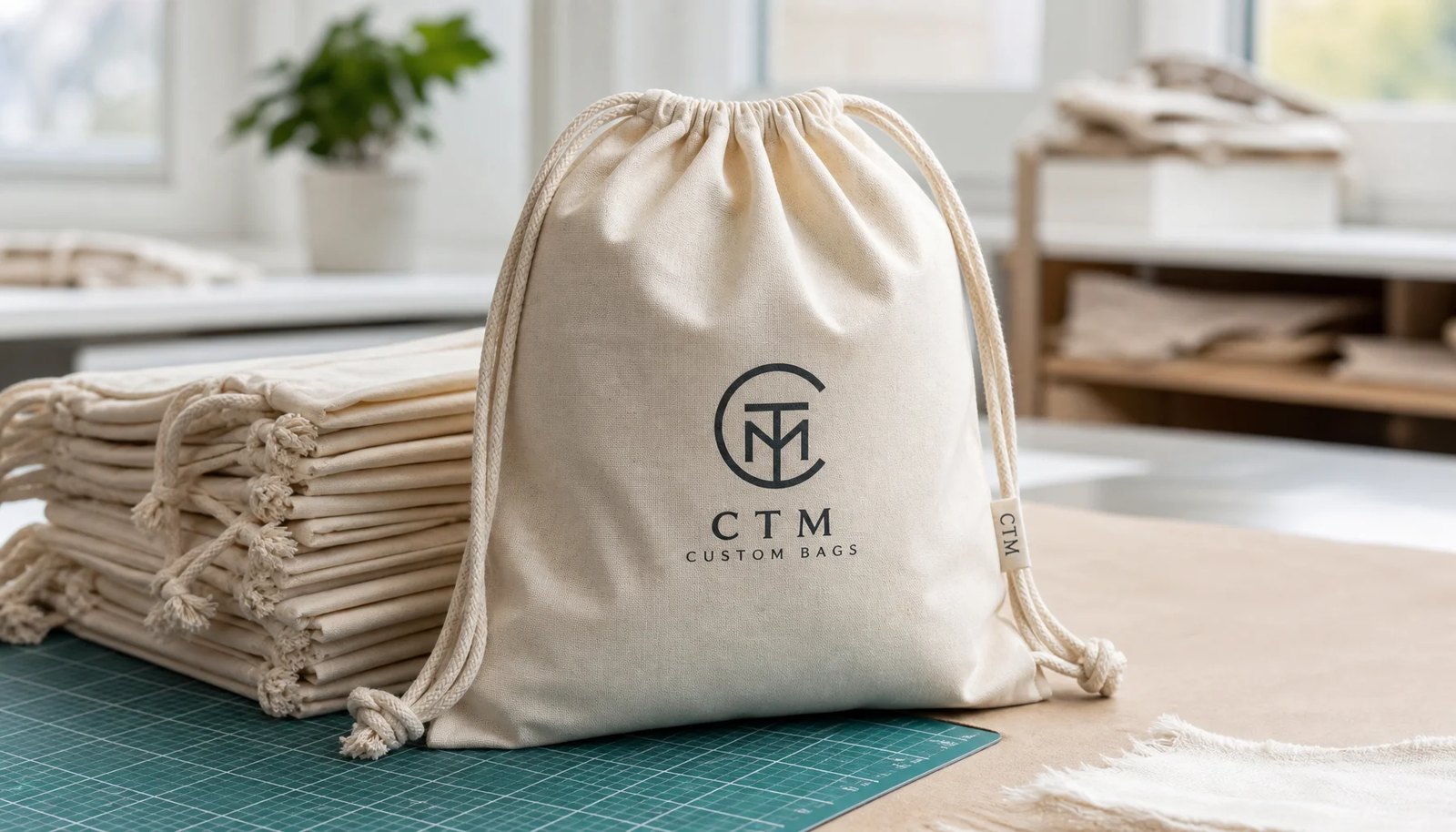
Start With The Use Case, Not The Mockup
For trade show exhibitors, cotton drawstring backpacks are not just promotional carryalls. They move literature, samples, badges, water bottles, and small giveaways, but they also move a brand through the venue for hours. That makes logo placement a procurement decision, not a design preference. A logo that looks balanced in a flat mockup can land too close to the cinch channel, disappear under a fold, or skew visually once the attendee pulls the cords closed.
The right starting point is the event job the bag must do. Is it a registration giveaway, a VIP kit insert, a staff bag, a speaker pack, or a sponsor item packed inside another box? Will it be worn immediately, stacked on a booth table, mailed in advance, or handed out at a check-in desk? Each use case changes the safest print zone, the acceptable level of detail, and the packing method.
Buyers should also separate brand visibility from decoration area. A large print zone is not automatically better. The useful area is the surface that stays readable after sewing, cinching, folding, stuffing, and handling. For most cotton drawstring backpacks, that means a centered front print with enough margin to absorb normal production movement. The procurement task is to make that margin measurable so every supplier quotes the same target.
The quickest way to reduce risk is to write the use case into the RFQ. State the audience, the event type, whether the bag will be worn on the floor, whether it needs to photograph well, and whether the bag is expected to be reused after the show. A supplier can price those needs. A vague request for a 'promo backpack' invites assumptions that usually show up later as artwork disputes or packing surprises.
- Define the bag's event role before choosing artwork size or placement.
- Use the finished backpack, not the flat panel drawing, as the print reference.
- Prioritize readable logo exposure when worn and carried, not only when photographed flat.
- Translate design preference into measurements, tolerances, and sample approval steps.
Define The Print Zone On The Finished Bag
The usable print zone is smaller than the visible front panel. Cotton drawstring backpacks lose space to side seams, bottom seam allowance, the top hem, the cinch channel, cord exits, bar tacks, and normal fabric movement. A supplier may show a generous rectangle on a mockup, but procurement should verify where the logo can actually sit without being interrupted by construction details.
The most practical way to specify placement is with fixed reference points. Do not stop at 'center front.' Give the artwork width and height, the distance from the top seam to the top edge of the logo, and the distance from the left seam to the logo centerline. If the supplier measures from a different point than the buyer, the order can still fail even when both sides think they agreed on the same placement.
Use the finished bag as the measuring target, not the flat cut panel. Sewing and cording change the apparent print area. A print that looks safe on a dieline can move closer to a seam after the bag is assembled. Buyers should ask the factory to mark the proposed print zone on a sewn blank sample before decoration. That simple step catches many placement errors before screens, transfers, or embroidery files are committed.
It also helps to leave more margin than the artwork technically needs. Cotton shifts more than rigid substrates, especially when it is cut, pressed, stacked, and packed at volume. If the logo fills the full available zone, normal tolerance can make a good unit look defective. A narrow border around the mark gives the factory a buffer and gives procurement a cleaner acceptance standard.
- Measure from finished seams, top hem, and bottom seam rather than from the supplier's digital mockup.
- Keep artwork away from the cinch channel and cord exits so the mark does not wrinkle when closed.
- Leave clear margin around all sides of the logo for normal fabric and print tolerance.
- Ask for a photo of the taped print zone on the real bag before approving the decorated sample.
- Include a simple placement sketch in the RFQ so every quote uses the same measurement reference.
Choose Placement By How The Bag Will Be Seen
Front center placement is the default for a reason. When the bag is worn on the back, the logo faces outward and gets the most visibility in aisle traffic. It is also easier for the factory to align consistently across a large run. For simple exhibitor branding, this is usually the cleanest choice and the one with the lowest production risk.
Upper-middle placement can work when the bag will be handed out flat or displayed on a registration table. The risk is the drawstring channel. When the cords are pulled, the top of the bag changes shape, and a mark that sits too high can curve, wrinkle, or partially fold over the logo. If a buyer wants that placement, the sample should be reviewed with the bag closed and lightly loaded, not just flat on a table.
Lower-front placement solves a different problem. It works when a pocket seam, woven label, sponsor line, or channel detail crowds the upper panel. The tradeoff is folding. Some factories fold from bottom to top for carton packing, and a low logo can land on a crease. If the bag will also carry rigid brochures or boxed inserts, the lower panel can disappear behind the contents once filled.
Side labels and small woven tags can add a premium note, but they are not a substitute for the main exhibitor logo when the goal is visibility. They work better as secondary branding, material identification, or supplier branding on higher-value reusable bags. If a side label is used, its placement must be confirmed before sewing because it cannot be moved after the seam is closed.
For buyer teams that care about photography, angle matters as much as position. Front-center prints hold up better in wide venue shots than logos placed low or near one side. Staff bags also create their own visual problem: once the wearer turns or puts on a jacket, lower artwork can disappear. Placement should follow the most likely viewing condition, not the layout that looks best in a presentation slide.
- Use front center when the main goal is moving brand visibility across the show floor.
- Use upper-middle only after checking how the closed channel changes the panel shape.
- Use lower front when construction details crowd the upper panel, but test the fold line.
- Use side labels for secondary branding or premium detail, not as the main exhibitor mark.
Match Artwork To The Decoration Method
Screen printing is usually the strongest starting point for exhibitor cotton drawstring backpacks. A one-color print gives clear visibility, predictable cost, and good production speed when the artwork is bold. Two-color printing can also work well, but procurement should confirm registration tolerance and whether the second color requires trapping or a slower print speed. For trade show use, legibility from a few feet away is often more valuable than a detailed brand file.
Heat transfer and DTF are useful when the artwork includes gradients, several colors, a short run, or event-by-event personalization. They can reduce setup complexity, but the physical behavior of the decoration still needs checking. Transfers may feel heavier on soft cotton, and the edges can lift if the process, temperature, adhesive, or fabric preparation is not controlled. A fold and rub test matters because these bags are stacked tightly in cartons and then handled fast during booth setup.
Embroidery can look premium on heavier cotton, but it is not the safest default for lighter promotional bags. Stitch tension can pucker the front panel, especially around dense filled logos. It also adds weight and can leave a rough reverse side inside the bag. If embroidery is required, ask for backing details, stitch count, thread color references, and a finished sample on the same GSM cotton planned for production.
Artwork should be simplified for the surface. Fine legal lines, tiny URLs, small QR codes, and delicate gradients often disappoint on woven cotton because the texture breaks up the edge. If a QR code must be included, it should be tested on the real printed sample at the intended scan distance. In most exhibitor programs, a strong logo, short event message, or booth identifier performs better than a crowded layout.
The cleanest procurement approach is to tie the method to the order profile. For stable artwork and volume, screen print usually gives the best mix of cost and consistency. For short runs or frequently changing artwork, transfer methods may be justified. For premium reusable bags, heavier fabric plus controlled decoration may be worth the higher unit price. The supplier should quote those options side by side so the buyer can compare landed cost, not just decoration cost.
- Use one-color screen print for the most predictable mix of cost, visibility, and durability.
- Use two-color screen print when brand colors matter and registration tolerance is agreed in writing.
- Use heat transfer or DTF for complex artwork only after fold, rub, and adhesion checks.
- Avoid dense embroidery on light cotton unless the finished sample stays flat and clean.
- Remove tiny text, thin outlines, and decorative details that will not survive cotton texture.
Specify Fabric, Color, And Construction Together
Fabric weight changes how the logo prints, how the bag hangs, and how premium the item feels in hand. A 120 to 140 gsm cotton drawstring backpack is a common starting point for standard trade show giveaways because it keeps cost and freight weight under control while still offering a workable surface for a simple print. It is practical when the bag will hold literature and light booth items rather than heavy retail merchandise.
A 140 to 180 gsm bag gives the panel more body and can improve print appearance by reducing show-through. It is better for sponsor kits, press drops, VIP programs, and reusable event bags. The tradeoff is price, sewing behavior, carton weight, and sometimes a longer material lead time. Buyers should not upgrade GSM without checking landed cost, carton count, and whether the event budget values the improved hand feel.
Color is a separate risk. Natural cotton is popular because it gives a familiar textile look and usually prints well with dark ink. Bleached white can make colors look sharper but may show stains more easily. Dyed cotton can help with brand alignment, but dark shades often need an underbase or heavier ink coverage to keep the logo readable. Cotton shade variation is normal enough that buyers should request a physical swatch or lab dip when color matters.
Construction details also change the print result. A double drawstring may close more evenly than a low-cost single cord. Reinforced corners can help the bag carry more weight, but they may reduce the clean front print area. Eyelets, metal tips, knots, and bar tacks all need to stay out of the logo zone. The quote should describe these details clearly so a cheaper price is not hiding a weaker bag.
Finishing matters too. Pre-washed, enzyme-washed, brushed, or heavily calendared cotton can change print absorption and hand feel. If the supplier is using a recycled or organic cotton blend, ask whether the blend ratio changes the print result or the label requirements. The goal is not to over-specify every variable. It is to lock the details that change the decorated bag the buyer will actually receive.
- Use 120 to 140 gsm for standard promotional giveaways with simple logos.
- Use 140 to 180 gsm for higher perceived value, better opacity, and more reusable event bags.
- Request swatches for natural, bleached, dyed, recycled, or organic cotton before final color approval.
- Check whether cords, reinforcements, eyelets, and bar tacks reduce the usable logo area.
- Compare construction details line by line when supplier prices differ sharply.
Build A Quote Sheet Suppliers Can Price Cleanly
A strong quote sheet prevents vague pricing. The buyer should ask suppliers to price the same finished bag, not a generic cotton drawstring backpack. The sheet should list finished size, cotton GSM, fabric color, cord type, cord color, reinforcement style, print method, logo size, logo position, print color count, packing method, carton quantity, sample charge, setup charge, lead time, and payment terms.
Separating costs helps procurement see the real drivers. Ask for blank bag cost, decoration cost, setup cost, packing cost, and export carton details as separate lines. That makes it easier to compare a factory-direct offer with a trading company offer, or a screen print quote with a heat transfer quote. It also helps when the buyer later changes the program by adjusting artwork versions, reducing packaging, or increasing GSM.
The quote should also show assumptions. If one supplier quotes natural cotton while another quotes dyed cotton, the unit prices are not equivalent. If one supplier includes individual polybags and another assumes bulk packing, the landed cost and booth preparation labor will differ. If one quote includes a finished sample and another includes only a digital proof, the risk profile is different.
For recurring trade show programs, ask suppliers to spell out reorder conditions. Screens, transfer files, woven labels, and approved samples may be reusable, but only if the supplier stores them and confirms how long they remain valid. A small detail like screen storage can reduce setup cost on repeat orders, while a fabric change may require a new sample even if the logo stays the same.
A useful quote request also asks the supplier to identify known limits. If the factory warns that a fine-line logo needs a minimum stroke width or that a light ink on dark cotton needs an underbase, that should be visible before award. Strong procurement comes from comparing the same risk, not only the same unit price.
- Require one quote format so every supplier prices the same finished specification.
- Break out blank bag, decoration, setup, packing, sample, and freight assumptions.
- Ask suppliers to state what is excluded, not only what is included.
- Confirm whether sample charges, screen charges, or artwork setup fees apply again on reorders.
- Use the quote sheet as the basis for the PO so approved details do not disappear.
Treat MOQ And Packing As Part Of The Spec
MOQ is rarely one simple number. A supplier may have one minimum for blank natural cotton bags, another for dyed fabric, another for screen printing, and another for custom packing. If the order has multiple sponsor logos, each artwork version may create its own setup and minimum. Procurement can negotiate more effectively by identifying which part of the order creates the constraint.
For many trade show programs, the lowest-risk MOQ strategy is to standardize the base bag. One fabric color, one GSM, one finished size, one cord color, and one packing method make the factory run easier. Artwork variations can then be reviewed as the main variable. If the buyer needs several sponsor versions, it may be cheaper to print separate logo runs, or it may be better to use one shared front logo and add a smaller label, hangtag, or insert for sponsor-specific information.
Packing can raise MOQ because it changes labor flow. Bulk-packed bags are faster to count and carton. Individual polybags, paper sleeves, belly bands, barcode labels, or kitting instructions add time and may require separate packing lines. If a trade show warehouse needs each exhibitor's bags separated by booth number or destination, procurement should treat that as a packing spec, not an afterthought.
Buyers should also ask about overruns and underruns. For event-dated goods, a five percent short shipment can create a real problem if every attendee or sponsor kit needs one bag. The PO should state whether overproduction is allowed, whether exact quantity is required, and how replacement units will be handled if defects are found during final inspection.
A useful sourcing tactic is to ask the supplier to quote MOQ at three levels: blank bags only, printed bags with one color, and printed bags with custom packing. That gives the buyer a clean picture of where the threshold sits. If the MOQ is being driven by mill purchase minimums or by print setup waste, the factory can sometimes propose a standard base spec that keeps the order under control without changing the end-use experience.
- Ask for MOQ by body color, GSM, artwork version, print method, and packing style.
- Standardize the base bag when multiple logos or events are involved.
- Compare separate print runs against shared base bags with secondary labeling.
- Treat individual packing, labeling, and event sorting as MOQ and labor drivers.
- Define whether exact quantity, overrun, or underrun is acceptable before production.
Use Sampling To Prove Placement And Production Reality
A useful sample is not just a pretty approval photo. It should prove that the chosen logo placement works on the actual cotton drawstring backpack construction. The best pre-production sample uses the same fabric GSM, same fabric color, same cord material, same sewing method, same decoration method, and same folding approach planned for mass production. If the supplier cannot make that sample, the buyer should know which details are approximate.
Digital proofs still matter, but they should not replace a finished sample for new artwork, new suppliers, new fabric colors, or new print methods. A proof can confirm scale and general layout. A finished sample shows whether the logo sits straight, whether the cotton texture breaks up the edge, whether the ink coverage is strong enough, and whether the cords pull the panel into wrinkles.
Sample review should be physical and repeatable. Lay the bag flat and measure the print from the top hem, side seams, and bottom seam. Close the drawstring and check whether the artwork distorts. Put in a typical event load: a booklet, water bottle, light sample, or badge envelope. Wear the bag or hang it at shoulder height to judge visibility. Fold it the way the factory will pack it and check whether the logo lands on a hard crease.
For larger orders, ask for a top-of-production sample or production-start photos before the full run continues. This catches setup drift between the approved sample and the first mass-production units. The buyer should keep one approved sample and require the factory to keep one sealed reference sample. Both sides then inspect against the same physical target instead of relying on memory or a screen image.
This is also the right stage to check consistency across more than one unit. Ask for two or three decorated samples if the design is sensitive to placement or if the factory tends to vary panel alignment. A buyer does not need lab-grade testing for every promo order, but a simple side-by-side check can reveal whether the print is centered, whether the cotton shade is uniform, and whether the finish will hold once production scales from one sample to a full run.
- Use a finished backpack sample for new placements, not only a printed fabric strike-off.
- Measure the logo after sewing and cording because those steps change the panel.
- Test the sample flat, closed, loaded, worn, folded, and stacked.
- Keep approved reference samples with both buyer and factory.
- Request production-start confirmation before the factory completes the full run.
Write QC Tolerances Before Production Starts
Quality control works best when it is written before production starts. Without defined tolerances, logo placement becomes a subjective argument. A buyer may see a shifted logo as unacceptable, while a factory may see it as normal variation on sewn cotton. The PO and approved sample should define what matters and how it will be judged.
Logo position tolerance should be realistic for fabric. The buyer can specify an allowed shift from the approved centerline and an allowed vertical movement from the approved top-edge measurement. The exact tolerance depends on bag size, artwork size, and print method, but it should be agreed in writing. Dense artwork, tight borders, and centered geometric logos need tighter control than loose organic artwork.
Print quality checks should cover opacity, registration, edge clarity, ink voids, pinholes, smudges, cracking, transfer lift, and contamination. For screen print, small text and fine lines should be compared with the approved sample. For two-color prints, registration should be checked at several points across the run. For transfer methods, edge adhesion and fold behavior matter as much as visual appearance.
Sewing and material defects can also damage brand presentation. A strong logo still looks poor if the bag has stains, slanted seams, broken stitches, puckered corners, mismatched cord lengths, or a top channel that closes unevenly. Inspectors should check the full item, not only the print. Carton-level inspection is equally important because bags can leave production clean but arrive with crushed folds or print rub if packed too tightly.
Procurement should choose inspection depth based on order risk. A small repeat order from a known supplier may need a simpler check. A new supplier, new artwork, tight event deadline, or large multi-destination order deserves pre-shipment inspection with photos and measured results. The goal is not to overcomplicate the order. It is to prevent discovering placement defects after the bags are already at the venue.
A practical way to write the tolerance is to separate critical and cosmetic defects. Critical defects include the wrong logo version, the wrong bag color, a broken cord, or a print that lands on the seam. Cosmetic defects may include minor thread ends or slight shade variation if they remain within the approved range. If the buyer does not make that distinction, the factory will not know where to spend time controlling the process.
- Define acceptable logo shift, registration, and vertical placement before printing starts.
- Compare production units against the sealed approved sample, not only the digital proof.
- Inspect print, sewing, cotton cleanliness, cord function, and carton condition together.
- Increase inspection depth when the supplier, artwork, fabric, or deadline is new.
- Require defect photos and measured examples when approving shipment remotely.
Control Packing, Cartons, And Event Distribution
Packing is part of the logo placement decision because it determines how the printed area looks when the bag is finally handed to an attendee. A fresh print stacked face-to-face can rub. A lower logo can land on a fold line. A large solid ink area can pick up pressure marks if cartons are overfilled. If the buyer cares about brand presentation at the booth, packing instructions belong in the original spec and PO.
Bulk packing is efficient for large exhibitor giveaways. It reduces material and can make booth setup faster if bags are simply counted into stacks. The buyer should still define stack direction, whether printed faces touch, whether tissue or paper dividers are needed, and how many bags go into each inner bundle or carton. Those details reduce handling damage and make receiving easier.
Individual packing is useful for sponsor kits, VIP registration packs, e-commerce style fulfillment, or bags that must stay clean until handout. It adds labor, material, and time. If the event has sustainability requirements, procurement should ask whether paper bands, recyclable sleeves, or no individual packing are preferred. The right answer depends on how the bags will be transported and distributed, not on appearance alone.
Carton labeling matters when shipments go to show sites, event warehouses, or multiple booth destinations. Labels should identify PO number, SKU or style, bag color, logo version, quantity, carton number, gross weight, and destination. For multiple events, include event name and delivery sequence. Clear labels prevent warehouse teams from opening cartons unnecessarily, which can expose bags to dirt, mixing, or repacking errors.
The final distribution route should be shared with the supplier. A bag shipped directly to a booth has different risk than a bag shipped to a kit packer, then to a warehouse, then to a venue. Each handling step can crease, soil, or mix the product. If bags will be repacked at destination, the buyer may choose a packing method that protects the print during the longest transit leg but remains easy to open on site.
If the bags are intended for repeated use after the event, ask the factory to avoid tight compression that leaves a permanent crease across the print zone. This is a small detail, but it matters for items that should remain presentable after the event. A good print can be undermined by a carton spec that saves volume but damages the visual result.
- Write packing direction, stack method, and carton count into the PO.
- Avoid print face-to-face stacking unless the supplier proves the ink will not transfer.
- Use individual packing only when cleanliness, kitting, or distribution control justifies the added cost.
- Require carton labels that match the receiving team's event and SKU structure.
- Share the full distribution route so the supplier can pack for real handling conditions.
Specification comparison for buyers
| Spec decision | Recommended option | When it fits | Buyer risk to check |
|---|---|---|---|
| Sourcing route | Factory direct with in-house cutting, sewing, printing, inspection, and packing | Repeat trade show programs with the same bag spec, stable artwork, and a buyer who can manage approvals closely | Confirm whether the same factory controls every step; if decoration is subcontracted, ask who owns rework, scrap, and delay risk |
| Sourcing route | Trading company with one named production site and a controlled factory list | Broader promotional programs where one PO covers backpacks, pouches, lanyards, or event kits | Ask which factory actually runs the order, whether it can change after sample approval, and who signs off on defect claims |
| Logo placement | Front center panel, measured from finished seams | Best default for exhibitor giveaways because the mark stays visible when the bag is worn in aisle traffic | Keep artwork clear of the top hem, cinch channel, side seams, bottom seam, reinforcement stitches, and carton fold lines |
| Logo placement | Upper-middle front panel | Useful when the bag is handed out flat, displayed on a registration table, or carried briefly before use | Check that the top hem does not curve into the artwork when the cords are pulled closed; upper placements can distort on a loaded bag |
| Logo placement | Lower front panel | Works when the top channel, pocket seam, or sponsor line makes center placement crowded | Test the exact folding method; a low logo can disappear into a crease if cartons are compressed or the bag is folded bottom-up |
| Logo placement | Front print plus woven side label | Appropriate for premium reusable bags or programs with one main sponsor and subtle supplier branding | Confirm label placement before sewing and make sure the label does not pull the side seam, scratch the wearer, or sit inside the print zone |
| Print method | 1-color screen print | Most cost-efficient for bold exhibitor logos, simple type, event dates, and high repeat quantities | Check ink opacity on the selected cotton color and agree on minimum line thickness so small text does not fill in during production |
| Print method | 2-color screen print | Good for brand marks that need a second spot color but still have simple shapes | Confirm registration tolerance, trapping, and whether the second screen changes MOQ, setup time, or lead time |
| Print method | Heat transfer or DTF | Useful for short runs, gradients, small multi-color marks, or artwork that changes by event | Request fold, rub, and adhesion checks because transfers can crack, lift, or feel stiff after repeated stuffing and carton compression |
Buyer checklist before sampling
- Confirm the finished bag size, not only the flat fabric panel size, before approving any artwork position.
- Measure the usable print zone on a sewn and corded sample, including the top hem, side seam allowance, bottom seam, corner reinforcement, and cord exit points.
- Define the logo placement using distances from fixed physical points, such as top seam to artwork top edge and left seam to artwork centerline.
- Lock fabric GSM, cotton color, weave appearance, cord material, cord color, bag dimensions, and reinforcement details before comparing supplier quotes.
- Choose the print method based on artwork color count, minimum line thickness, expected order quantity, hand feel, durability requirement, and event deadline.
- Ask the supplier to quote blank bag cost, decoration cost, setup cost, sample cost, packing cost, carton details, and freight assumptions separately.
- Request a pre-production sample made with the real fabric, real logo method, real cording, and the same folding or packing method planned for bulk shipment.
- Approve the logo on a finished backpack, then test it flat, closed, worn, folded, lightly stuffed, and stacked against another printed bag.
- Set written tolerances for logo shift, registration, ink opacity, stains, seam puckering, cord length, broken stitches, loose threads, and carton damage.
- Require carton labels that show PO number, style, color, artwork version, quantity, carton number, and destination or event name when shipping to multiple shows.
Factory quote questions to send
- What finished bag dimensions are you quoting, and what is the usable print area after sewing, hemming, and cord installation?
- What exact cotton GSM is included in the quote, and is that weight measured before or after washing, dyeing, and finishing?
- Is the cotton natural, bleached, dyed, recycled, organic, or conventional, and can you provide a physical swatch from the production material lot?
- Which logo placement zone is priced, and does the cost or setup change if we move the artwork higher, lower, or closer to the side seam?
- What print method are you quoting: screen print, heat transfer, DTF, embroidery, woven label, or another method?
- For screen print, what is the maximum print size, number of screens, setup charge per color, minimum line thickness, and expected registration tolerance?
- For heat transfer or DTF, what adhesion, rub, fold, and wash checks do you perform before bulk packing?
- For embroidery, what stitch density, backing, thread type, and maximum fill area are included in the quote?
- What is the MOQ by bag color, fabric GSM, artwork version, print color count, and packing style?
- Can you provide a finished pre-production sample using the same factory line, fabric, ink or transfer, cord, folding method, and carton packing planned for mass production?
Quality-control points to confirm
- Measure the printable area on the actual sewn bag, not only the flat pattern, digital dieline, or supplier mockup.
- Check the logo centerline from seam to seam and confirm the distance from the top hem to the artwork edge matches the approved sample.
- Confirm the artwork clears the cinch channel, cord holes, eyelets, bar tacks, side seams, bottom seam, and any pocket or label seam.
- Verify ink opacity on the chosen cotton color under daylight and typical indoor exhibition lighting.
- Inspect fine lines, small type, negative space, and trademark details for fill-in, broken edges, or poor registration.
- Rub the print after folding, stuffing, stacking, and light abrasion against another printed bag.
- Check whether transfer prints crack, lift, bubble, or form hard ridges when the bag is folded into carton position.
- Inspect cotton stains, oil marks, shade variation, weaving slubs, loose lint, and contamination that may distract from the logo.
- Test cord length, cord tension, knot security, eyelet or channel alignment, and whether the top closes evenly with a loaded insert.
- Pull gently at side seams, bottom seams, and reinforced corners to confirm the printed panel is not distorted by weak sewing.