Start With the Event Risk, Not the Artwork File
Cotton drawstring backpacks for trade show exhibitors look simple on a sourcing spreadsheet. They are not complicated bags, and most factories can sew the basic shape. The risk sits elsewhere: the show date is fixed, the booth team needs the right version in the right carton, marketing may be protecting several logos, and the artwork often gets approved by people who never see the production sample in their hands.
That is why proofing should begin with the event use, not with a PDF. A digital layout can confirm the logo file, scale, and spelling. It cannot show how white ink behaves on natural cotton, whether sponsor text fills in, how a QR code scans on a textured weave, or whether the print still looks centered after the drawstring channel is sewn and the bag is cinched. Cotton has texture, lint, absorbency, shade variation, seam movement, and cord stress points. Those details matter when thousands of bags are handed out under bright booth lighting.
For B2B procurement teams, the goal is to turn a loose approval chain into a clear production gate. Decide which items can be approved digitally, which require a printed fabric strike-off, and which justify a complete pre-production sample. Then make each approval traceable to the PO, artwork revision, fabric, print method, and sample date. A strong cotton drawstring backpacks for trade show exhibitors print proofing checklist gives sourcing, marketing, logistics, inspection, and receiving teams the same reference before bulk production starts.
- Classify the use before quoting: mass giveaway, attendee kit, sponsor gift, product sample carrier, internal team bag, or premium event merchandise.
- Define the likely load: flyers only, catalog plus bottle, apparel sample, boxed item, or mixed exhibitor kit.
- Name the approvers for artwork, construction, packing, and delivery schedule because these are separate decisions.
- Require written proof approval that references the PO, artwork revision, fabric color, print method, sample date, and approved deviations.
- Avoid releasing bulk printing from a digital proof alone when color, opacity, registration, QR readability, or placement is brand-critical.
Freeze the Bag Specification Before Proofing
Proofing cannot be reliable while the base bag is still moving. A logo that feels balanced on a 14 x 18 inch backpack may look crowded on a smaller finished size. A mark approved on 6 oz natural cotton may look dull if the order later changes to 8 oz dyed cotton. Even a channel height change can push the print into the wrong visual position. Before marketing signs off, procurement should freeze the construction that the artwork will live on.
The minimum specification should cover finished width, finished height, fabric weight, fabric color, composition, cord material, cord color, cord diameter or tape width, channel construction, lower-corner reinforcement, stitching color, label placement, and packing method. Ask for fabric weight in both oz/yd2 and GSM. A useful reference is that 6 oz/yd2 is roughly 203 GSM, although the finished number can vary because of yarn, weave, washing, finishing, and the supplier's measurement practice.
The proof should show the usable print area, not just the total bag outline. The drawstring channel removes height at the top. Lower corners may include eyelets, stitched tabs, reinforced triangles, or bar-tacked cord loops. Side and bottom seams can make artwork near the edge look warped or off-center. If the artwork is tall, includes sponsor grids, or carries a QR code, confirm the printable rectangle on a finished sewn sample before approving the print size.
- Specify finished dimensions after sewing, not cut-panel dimensions only.
- Confirm whether printing is done on cut panels before sewing or on finished bags after sewing, because this changes placement accuracy and maximum print area.
- Ask for channel height, bottom seam allowance, side seam allowance, and the recommended distance from the channel seam to the top of print.
- Mark no-print areas around side seams, bottom seam, corner reinforcements, cord exits, eyelets, and tabs.
- For heavier event kits, prioritize reinforcement and cord comfort before increasing logo size.
Choose Cotton for Printability, Not Only Weight
Fabric weight affects cost, hand feel, print quality, and freight. Promotional cotton drawstring backpacks are often quoted around 5 oz, 6 oz, 7 oz, or 8 oz, but those labels are not enough for purchasing. Ask for the GSM, tolerance, composition, and finish. A lighter fabric can work well for a high-volume booth giveaway carrying a flyer and a small sample. Heavier cotton usually feels more substantial and may give a better print base, but it can raise unit cost, carton weight, and shipping cost.
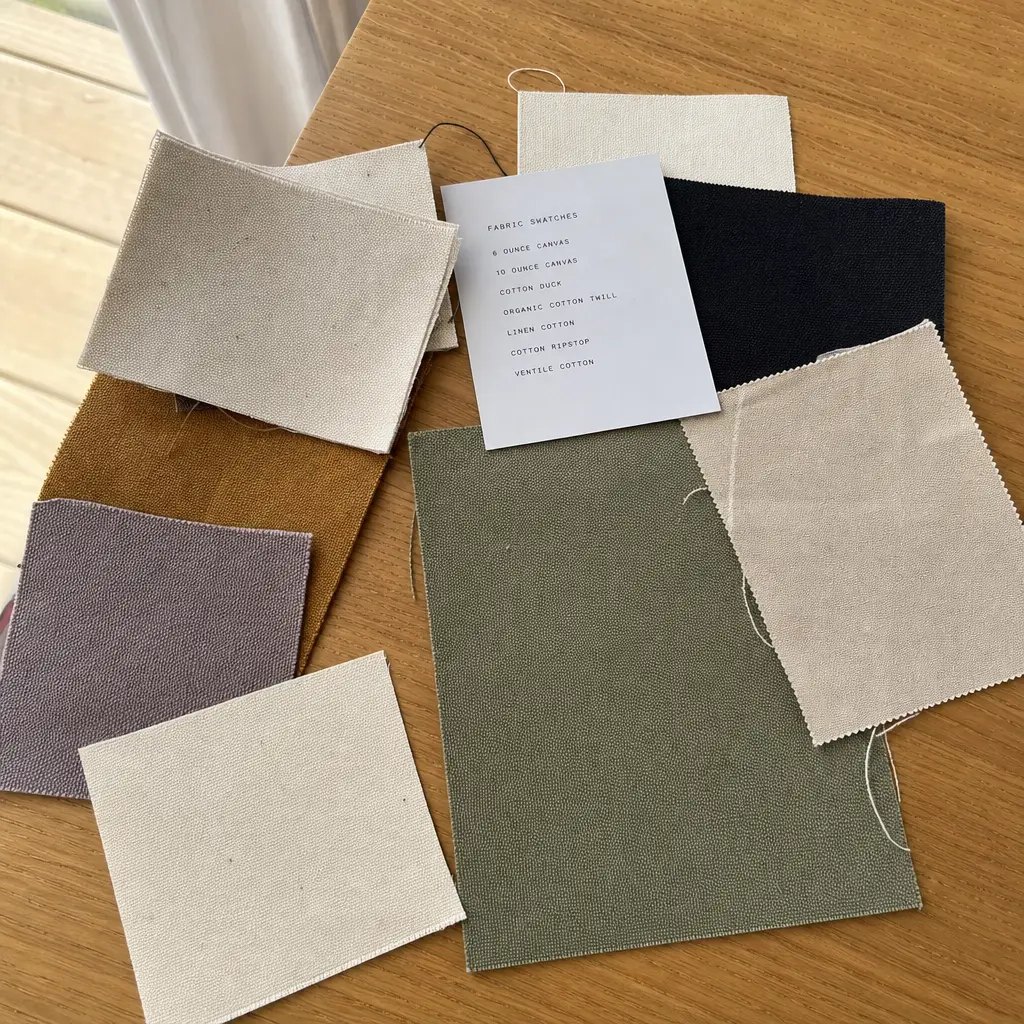
Natural cotton is popular because it looks reusable and low-key. It is also a warm, textured base, not a white sheet of paper. Seed flecks, slubs, and shade variation can make small text look less clean. Bleached cotton gives brighter artwork a cleaner ground. Dyed cotton can look polished, yet dark colors such as black, navy, and charcoal often require an underbase, extra ink passes, or a transfer method designed for opacity. A Pantone chip viewed on paper will not predict all of that.
Avoid vague specifications such as eco cotton, heavy canvas, or premium cotton unless they are tied to measurable details. If the artwork includes fine lines, small sponsor marks, or a QR code, request a smoother plain weave with controlled slub and low lint. A rustic fabric may suit the brand, but it is not always the best surface for precise marks. For procurement, the better question is not simply how heavy the cotton is. It is whether that cotton can carry the artwork cleanly at the required quantity and deadline.
- For broad giveaway use, 6 oz cotton is often a practical balance of cost, hand feel, printability, and shipping weight.
- For more substantial exhibitor kits, 7 oz to 8 oz cotton usually provides better body and a stronger perceived value.
- For fine detail, choose smoother cotton with controlled slub and request close-up proof photos showing edge quality.
- For natural cotton, approve the base shade and fleck level so the bulk lot does not surprise the marketing team.
- For dark fabric, ask whether the quote includes underbase, extra passes, or a transfer route suitable for the required opacity.
Match the Print Method to the Artwork
Screen printing is still the common route for bulk cotton drawstring backpacks when the design uses one to three solid spot colors. It can be cost-effective at volume, supports strong opacity, and works well for bold exhibitor logos, simple slogans, large sponsor marks, and one-color brand graphics. The quote should still spell out the screen charges, setup fees, underbase charges, maximum print area, number of included colors, and curing method.
DTF, heat transfer, and other digital transfer routes solve a different set of problems. They can help when artwork includes gradients, photographic detail, many colors, or multiple exhibitor versions in smaller quantities. They also introduce their own proofing questions. Transfers can feel heavier than direct ink, show a carrier edge, leave press marks, or react poorly to sharp folding and compression if packing happens too soon after pressing.
Choose the method after reviewing artwork complexity, quantity per version, fabric color, hand-feel expectations, and approval timing. The lowest unit print price is not always the lowest-risk choice. A sponsor grid may need larger artwork, smoother fabric, simplified detail, or a different print route. QR codes deserve special attention: they should be scanned from the actual finished sample at final size, under realistic light, not assumed readable because they worked on a monitor.
- Use screen print for bold spot-color logos, larger quantities, and cost-sensitive exhibitor handouts.
- Use DTF or transfer printing for many-color artwork, gradients, or multiple low-quantity versions after checking hand feel, edge film, and fold behavior.
- Avoid tiny reversed text, thin outlines, and tightly spaced sponsor logos unless the supplier proves the detail with a strike-off.
- Ask whether white ink on natural or dark cotton needs an underbase, double hit, or different ink system.
- Scan QR codes from the finished sample under realistic booth lighting and from the distance attendees will use.
Write Placement Rules an Inspector Can Measure
Centered on front is not a production specification. A cotton drawstring backpack is a soft sewn item. The front panel can shift during sewing, the top channel may consume more height than expected, and the bag will not always lie perfectly square once cords are inserted. Placement needs physical reference points: print width, print height, distance from the top finished edge to the top of artwork, and the horizontal centering rule.
For many soft cotton drawstring backpacks, a practical placement tolerance is around +/-5 mm to +/-10 mm. The right number depends on bag size, artwork scale, print method, and whether printing happens before or after sewing. Tighter placement may be possible, but it should be agreed before pricing and sample approval. If the buyer expects a retail-like alignment standard on a low-cost promotional bag, the factory needs to know before the calendar, labor plan, and inspection method are set.
Good placement rules also protect the artwork from functional areas. A logo too close to the top may look pinched by the drawstring channel. A design too close to the lower corners may wrinkle when the bag is cinched or loaded. Artwork near side seams can appear off-center once the bag has contents inside. For sponsor grids and copy-heavy art, define minimum readable text height and reject artwork that is technically printable but not useful at trade show distance.
- State print width and height in millimeters or inches, not only as a percentage of bag size.
- Define top placement, such as top of logo 90 mm below the top finished edge, with the agreed tolerance.
- Confirm whether horizontal centering is based on finished bag width, front panel width, or usable area between seams.
- Keep artwork away from the drawstring channel, lower cord corners, eyelets, heavy seam zones, and stitched reinforcement patches.
- Ask the supplier to send sample photos with a ruler along top and side reference points before approval.
Use Samples as Acceptance Tools
A sample is not just a courtesy photo. It is the reference that production, inspection, and receiving teams will use when opinions differ. The strongest route is a full pre-production sample made with the same fabric weight, color, print method, ink or transfer, cord, stitching, reinforcement, label, and near-final packing planned for bulk. A digital proof is useful for layout. A printed fabric strike-off is useful for color, edge detail, and opacity. A blank sample is useful for construction. Only a finished printed sample shows how the whole backpack works together.
Sample comments should be specific enough to survive forwarding. Looks good is not a quality record. Better notes say whether logo size, placement, Pantone shade, opacity, registration, cord length, channel function, corner reinforcement, stitching, label position, and packing are approved or need revision. If the buyer approves a sample with exceptions, those exceptions should appear on the PO or production instruction. Otherwise the factory may reasonably follow the physical sample exactly.
Remote approval can work when time is tight, but it needs structure. Request high-resolution front, back, and close-up photos under neutral light. Ask for ruler photos showing the distance from the top edge and side seams. For functional checks, a short video of the bag opening, cinching, and flexing at the print area is often more useful than another flat photo. Physical samples are still stronger, but disciplined remote review reduces blind spots.
- Measure the finished sample flat and record width, height, channel height, cord length, print size, and print position.
- Compare print color under consistent lighting, including daylight-equivalent light for sensitive brand colors.
- Rub the cured print with a clean white cloth and note obvious transfer, smearing, tackiness, or powdery residue.
- Cinch and open the bag several times to check cord movement, lower-corner strain, and print wrinkling.
- Seal one approved sample at the factory and keep one with the buyer, inspector, or receiving team when possible.
Separate MOQ, Versions, and Setup Costs
MOQ can come from several places: fabric buying, dyeing, cutting efficiency, cord color, sewing setup, print setup, private labels, or packing labor. A supplier may be flexible on natural cotton with a one-color print and bulk packing, then much less flexible when the order adds custom dyed fabric, unusual cord color, four artwork versions, and individual packaging. Procurement should separate the bag MOQ from the print-version MOQ so quotes can be compared fairly.
Trade show programs often involve more than one logo. There may be sponsor versions, regional versions, booth-specific allocations, or separate bags for different attendee groups. A 2,000-piece order split into four 500-piece designs is not the same job as one 2,000-piece design. Screen printing may require separate screens, setup time, and color checks for each version. Transfer methods may handle version changes more easily, but the unit price and hand feel may differ.
Packing must follow the version plan. If the right cartons do not reach the right booth, the print quality will not save the program. The quote should show base bag cost, fabric upgrade, print setup, screens, underbase, extra positions, artwork adjustment, sample cost, private label, inner bundle labor, individual packing, carton marks, inspection support, and freight basis. Without that detail, a cheap unit price can become expensive after versions and event handling are added.
- List total order quantity and quantity per artwork version in the RFQ.
- State fabric color quantities separately when the program uses more than one body color.
- Ask whether MOQ applies per logo, per fabric color, per cord color, per label, per packing style, or per destination.
- Confirm whether screens, print files, color records, and sealed samples can be retained for repeat orders.
- Freeze artwork before sampling whenever possible because post-approval changes can reset setup, sampling, and delivery timing.
Turn Supplier Quotes Into Comparable Data
A low price means little when suppliers are not quoting the same bag. Cotton drawstring backpack pricing changes with finished size, fabric weight, surface smoothness, fabric color, cord material, reinforcement method, print method, number of colors, print size, labels, sample route, packing method, carton size, and inspection support. A 6 oz natural cotton bag with one-color bulk packing should not be compared directly with an 8 oz dyed cotton bag with reinforced corners, inner bundles, and four logo versions.
The quote should make inclusions and exclusions visible. Common missing costs include screen charges, artwork cleanup, sample courier fee, Pantone matching fee, underbase for dark fabric, extra print position, inner bundle labor, individual bagging, special carton marks, third-party inspection support, and local delivery. For landed-cost planning, carton dimensions and gross weight matter because drawstring backpacks can be bulky even when each unit is light.
Use an RFQ format that forces suppliers to fill in the same fields. That saves time, but it also improves quality control. The accepted quote becomes the commercial version of the product specification, and the inspector can compare production against it. If a supplier cannot state fabric weight, maximum print area, carton quantity, or placement tolerance, resolve that gap before sample approval. The cheapest time to clarify a requirement is before the factory cuts fabric.
- Request fabric weight in both oz/yd2 and GSM, plus fabric color, composition, weave, and finishing description.
- Ask for line items for bag unit price, print setup, extra colors, extra versions, sample cost, packing cost, inspection support, and shipping terms.
- Require maximum print size included in the price and added cost for larger artwork or additional print locations.
- Collect carton quantity, carton dimensions, net weight, and gross weight before freight booking or landed-cost comparison.
- For delivered quotes, clarify duties, taxes, destination handling, storage limits, appointment delivery, and local delivery scope.
Define QC Thresholds Before Production
Quality control works best when the purchase order contains measurable acceptance criteria. For cotton drawstring backpacks, inspection should cover fabric, cutting, sewing, printing, cords, lower-corner reinforcement, trimming, packing, carton marks, and version separation. A general visual check may catch stains or the wrong logo, but it may miss the problems that disrupt an event: print drift, unreadable sponsor text, weak cord corners, mixed artwork versions, wrong bundle counts, or cartons that do not match the allocation plan.
Classify defects before inspection. Critical defects may include wrong artwork, wrong fabric color, unsafe sharp hardware, missing cords, severe print peeling, or mixed versions that cannot be separated in time. Major defects may include obvious misplacement, poor opacity, open seams, loose bar tacks, stains, incorrect print size, unreadable required text, failed QR codes, or wrong carton quantity. Minor defects may include small thread ends or slight shade variation inside the approved range.
Inspection should compare bulk production to the sealed sample, not to memory or a screenshot. Random samples should be pulled from multiple cartons and, for multi-version orders, from each artwork version. Defect photos should show a ruler, carton number, version name, and sample reference when useful. If rework is required, the reinspection plan should include packing and version separation, because fixing one issue can disturb carton counts.
- Measure finished bag width, height, channel height, cord length, print size, and print position on random samples.
- Check print opacity, pinholes, registration, color, edge sharpness, transfer film, curing, rub behavior, and adhesion.
- Pull lightly at lower corners, cord exits, bar tacks, eyelets, and fabric patches to identify weak construction.
- Open cartons to verify inner bundle count, artwork version, carton mark, carton sequence, and destination label.
- Record defects by severity and version so corrective action is targeted and traceable.
Plan Packing and Lead Time Around the Show
Packing is a procurement decision, not just a warehouse detail. Bulk packing is usually lowest cost when all bags go to one fulfillment center and will be kitted later. Inner bundles of 25 or 50 pieces make counting easier for distributors, event staff, and booth teams. Individual polybags can protect premium bags and improve presentation, but they add cost, plastic use, packing time, and unpacking labor. For many exhibitor programs, inner bundles with clear carton marks are the practical middle ground.
Carton marks should match the receiving workflow. If bags are split by sponsor, booth, sales region, or kit type, each carton should show PO number, item name, artwork version, quantity, destination code, and carton sequence. Mixed cartons should only be used when the receiving team asks for them and the mix is clearly labeled. Saving a few minutes at the factory can cost hours if event staff have to open and sort every carton before the show.
Lead time is more than production days. Build a schedule for artwork checking, proof preparation, sample making, courier transit, buyer review, revisions, fabric booking, cutting, printing, curing or pressing, sewing, trimming, inspection, packing, export documents, shipping, customs, local delivery, and warehouse receiving. The PO should state when the lead time starts: after deposit, artwork approval, or sample approval. It should also show the latest ship date and the inspection date, because those dates are often harder to move than the factory expects.
- Choose bulk packing, inner bundles, or individual packing based on receiving workflow, booth allocation, and kitting requirements.
- Define pieces per bundle, pieces per carton, folding method, carton marks, destination codes, and whether mixed cartons are allowed.
- Request carton dimensions and gross weight before freight booking, especially for air shipments or show-site delivery.
- Build in time for sample revision, curing, inspection, rework, repacking, document correction, and local distribution.
- When proof approval is late, update the production and delivery schedule in writing instead of assuming the original delivery date is protected.
Specification comparison for buyers
| Proofing decision | Recommended procurement control | Best fit | Buyer risk to check |
|---|---|---|---|
| Fabric weight and hand feel | Specify finished fabric weight in oz/yd2 and GSM, with a written tolerance such as +/-5% to +/-8% if the supplier can support it | General trade show giveaways, conference kits, light sample bags, and booth visitor gifts | A quote that says cotton canvas only may hide a lighter construction; too light can show contents and distort print, while too heavy raises carton weight and freight cost |
| Finished bag size | State finished width and height after sewing, measured flat with the channel included, plus tolerance such as +/-10 mm for common promotional styles | Orders where bags must fit brochures, catalogs, bottles, apparel samples, or pre-packed kits | Cut-panel size is not finished size; shrinkage, seam allowance, channel height, and sewing variation affect the usable front panel |
| Fabric surface for logo clarity | Request plain weave cotton with controlled slub, low lint, and a smooth face when artwork contains fine lines, small text, QR codes, or sponsor grids | Brand logos, sponsor marks, QR codes, tagline prints, and detailed one-color artwork | Heavy slub, seed flecks, open weave, and lint can break thin strokes, reduce opacity, or make small text look dirty |
| Fabric color and ink behavior | Approve color on the same fabric color and finish planned for bulk production: natural, bleached, dyed, black, washed, or recycled blend | Orders where brand color, white ink, metallic ink, or bright colors matter | Pantone on paper does not predict cotton appearance; natural cotton warms color, dark cotton may need underbase, and dyed fabric can shift perceived shade |
| Screen print route | Use screen print for 1-3 solid spot colors, with screen charges, underbase needs, maximum print area, and curing method stated in the quote | Bulk event programs with simple logos, strong opacity needs, and repeatable unit cost | Digital PDF approval does not prove ink deposit, edge quality, rub performance, or opacity on the selected cotton |
| Transfer or DTF route | Use DTF, heat transfer, or digital transfer only after checking hand feel, edge film, press marks, fold behavior, and wash or rub expectations | Short runs, many artwork versions, gradients, photographic art, or sponsor-heavy layouts | Transfers can feel stiff on soft cotton, may show carrier edge, and can mark if packed hot, folded sharply, or compressed too soon |
| Artwork placement tolerance | Define print size plus distance from top finished edge, side seams, channel seam, and lower reinforcement; agree +/-5 mm to +/-10 mm only if realistic for the process | Most front-panel logos on soft sewn cotton drawstring backpacks | Soft bags move during sewing and handling; centered in artwork software may not look centered on a finished, cinched bag |
| Sample approval path | Require a full pre-production sample using approved fabric, print, cord, stitching, reinforcement, label, and near-final packing for brand-sensitive orders | Fixed-date trade shows, multi-stakeholder approvals, private label programs, and repeatable event merchandise | A blank bag proves construction only; a printed panel proves ink only; neither proves final print position on the sewn backpack |
| Cord and corner construction | Specify cord material, diameter or tape width, channel opening, knotting, eyelet or tab type, bar tack positions, and lower-corner reinforcement | Bags expected to carry catalogs, bottles, apparel, boxed samples, or heavier exhibitor kits | Cord corners often fail before the cotton body; missing bar tacks, loose eyelets, or weak corner tabs may not show in a flat proof photo |
Buyer checklist before sampling
- Define finished bag width and height, fabric weight in oz/yd2 and GSM, fabric color, cotton type or blend, cord material, cord color, cord length, lower-corner reinforcement, stitching color, and packing method before artwork proofing begins.
- Send vector artwork with Pantone references, final print width and height, required print position, minimum text height, QR code size if applicable, and no-print areas caused by seams, channel, eyelets, tabs, or corner patches.
- State whether the logo should be visually centered on the finished front panel, centered within the printable rectangle, or aligned to a specific measurement from the top finished edge.
- Require the supplier to confirm print method, ink or transfer type, maximum print area included in the quote, number of included colors, screen or setup charges, and added cost for each extra color, position, or artwork version.
- Approve print color on the same cotton fabric color, weight, and finish planned for bulk production, because natural, bleached, dyed, black, washed, and recycled-blend fabrics change ink appearance.
- Set written acceptance tolerances for finished size, fabric weight, print size, placement, color variance, registration, pinholes, edge sharpness, ink coverage, transfer edge visibility, and cord length before bulk production starts.
- Request a pre-production sample using the same fabric lot when available, or a documented approved substitute, plus the final print method, ink or transfer type, cord, stitching, reinforcement, label placement, and packing method.
- Review the sample under normal office light and daylight-equivalent light, especially for white ink, natural cotton, dark fabric, dyed fabric, brand colors, QR codes, and multi-color artwork.
- Perform a simple dry rub check on the cured print with a clean white cloth, then flex and fold the printed area to check cracking, powdering, smearing, lifting, or obvious transfer.
- Measure a finished sewn sample flat, including usable front panel height below the channel, because cut-panel dimensions do not show final print constraints or placement risk.
Factory quote questions to send
- What exact fabric will be used, stated in oz/yd2 and GSM, and is it greige, natural, bleached, dyed, washed, recycled cotton blend, organic cotton, or conventional cotton?
- What tolerances do you hold for fabric weight, finished bag size, channel height, cord length, print size, and print placement on this cotton drawstring backpack style?
- Will the strike-off or pre-production sample be made on the same fabric color, weight, and finish as bulk production? If not, what difference should the buyer expect and approve in writing?
- Which print method is quoted, what ink or transfer type will be used, what curing or pressing process is required, and what maximum print size is included in the unit price?
- How many print colors, screens, transfers, artwork positions, or logo versions are included, and what is the added cost for each extra color, underbase, position, or exhibitor version?
- What MOQ applies separately to the bag body, fabric color, dyed fabric, cord color, print design, private label, packing style, and shipment destination?
- Can you provide a printed fabric strike-off, full pre-production sample, sealed approval sample, and bulk production sample? What are the cost and lead time for each?
- What color tolerance and placement tolerance do you normally hold for cotton drawstring backpacks, and how will approval be documented before cutting, printing, and sewing?
- Can the lower cord corners be reinforced with bar tacks, metal eyelets, stitched fabric triangles, folded cotton tabs, or double-layer patches, and how does each option affect cost, durability, and lead time?
- How soon after screen printing, heat pressing, or transfer application can bags be folded and packed without blocking, offset marks, sticking, scorch marks, or transfer impressions?
Quality-control points to confirm
- Fabric weight checked against the PO in GSM or oz/yd2, with consistent hand feel, color, weave density, and surface condition across approved sample and bulk production.
- Finished bag width and height measured flat after sewing, including drawstring channel and seam allowance, within the agreed tolerance.
- Usable front print area confirmed below the top channel and away from side seams, bottom seam, lower corners, eyelets, cord exits, or reinforcement patches.
- Logo print size, position, orientation, and visual centering compared with the approved proof or sealed sample within written tolerance.
- Pantone or brand color compared on actual cotton fabric under consistent lighting, with an approved shade range or signed physical sample used as the reference.
- Print opacity checked for patchiness, pinholes, lint contamination, poor underbase coverage, visible fabric show-through, and uneven ink deposit.
- Registration checked for multi-color artwork, outlines, small text, sponsor marks, QR codes, reversed text, knockout details, and overlapping color edges.
- Print curing or adhesion checked through basic dry rub and flex handling after the correct curing time, with no obvious ink transfer, powdering, cracking, or tackiness under normal use.
- Transfer prints checked for edge film, lifting, scorch marks, press marks, cracking on folds, poor wash or rub performance, and excessive stiffness compared with the approved sample.
- Cord length, cord material, channel movement, knotting, cinch function, lower-corner reinforcement, and bar tack security checked across random samples from different cartons.