Why the RFQ Must Be More Specific Than a Promo Bag Inquiry
Cotton drawstring backpacks for trade show exhibitors sit between a low-cost giveaway and a visible brand carrier. The buyer is usually not trying to build a technical outdoor backpack. The real job is simpler but still easy to damage: the bag must carry brochures, a water bottle, samples, and booth literature for a full day while showing the sponsor logo cleanly. A vague RFQ such as cotton backpack with logo, quote 5,000 pieces leaves too much room for the supplier to choose the thinnest fabric, cheapest cord, smallest print area, and most basic packing.
A better RFQ gives the factory enough information to price the same bag you expect to receive. It also makes supplier comparisons fair. If one quote is based on 5 oz cotton and another on 10 oz canvas, the cheaper quote is not a better offer; it is a different product. For exhibitors, the buying problem is usually not finding any bag supplier. It is getting a bag that arrives before the show, looks acceptable under booth lighting, fits the printed collateral, and does not create repacking work at the warehouse.
- Use finished size, fabric GSM, and construction details as the base of the RFQ.
- Treat logo method, print size, and packing as cost items, not afterthoughts.
- Give the event delivery deadline early so the factory can protect sample and production time.
- Compare suppliers only after the fabric weight, print method, carton plan, and Incoterm are aligned.
Set the Backpack Specification Around the Event Load
Most exhibitor buyers choose cotton drawstring backpacks because they are lighter and easier to distribute than structured bags. The correct size depends on what the attendee is expected to carry. A bag around 33 x 43 cm works for brochures, notebooks, and small samples. A size around 35 x 45 cm gives more room for catalogs, apparel inserts, or event kits. Larger sizes can look generous but may sag if the fabric is too light or the cord is too thin.
The RFQ should describe the actual trade show use. If the bag is handed out empty at booth reception, 6 oz cotton can be enough for budget campaigns. If it is packed with samples before the show, 8 oz cotton canvas is a safer middle point. If the bag is positioned as a reusable sponsor item or sold through a retail channel after the event, 10 oz or heavier canvas gives a more substantial hand feel. The important point is to match the GSM to the load and brand level rather than simply chasing the lowest unit price.
- Common event size: 33 x 43 cm for standard brochures and light samples.
- Larger event kit size: 35 x 45 cm when catalogs, shirts, or boxed samples are included.
- Budget fabric: around 6 oz or 200 GSM cotton for light use and high-volume giveaways.
- Balanced fabric: around 8 oz or 270 GSM cotton canvas for better perceived value.
- Premium fabric: 10 oz to 12 oz cotton canvas for heavier kits or retail-grade presentation.
Choose Cotton Fabric Weight Without Creating Hidden Costs
Fabric weight is one of the biggest cost drivers, but it also affects printing, folding, freight, and attendee perception. Light cotton is cheaper and packs tightly, but it can become semi-transparent, wrinkle more sharply, and distort around cord exits. Heavy cotton feels stronger and prints well, but it increases carton volume and may require more labor to sew neatly at the corners. When a supplier gives a surprisingly low price, the first question should be the exact fabric weight and construction.
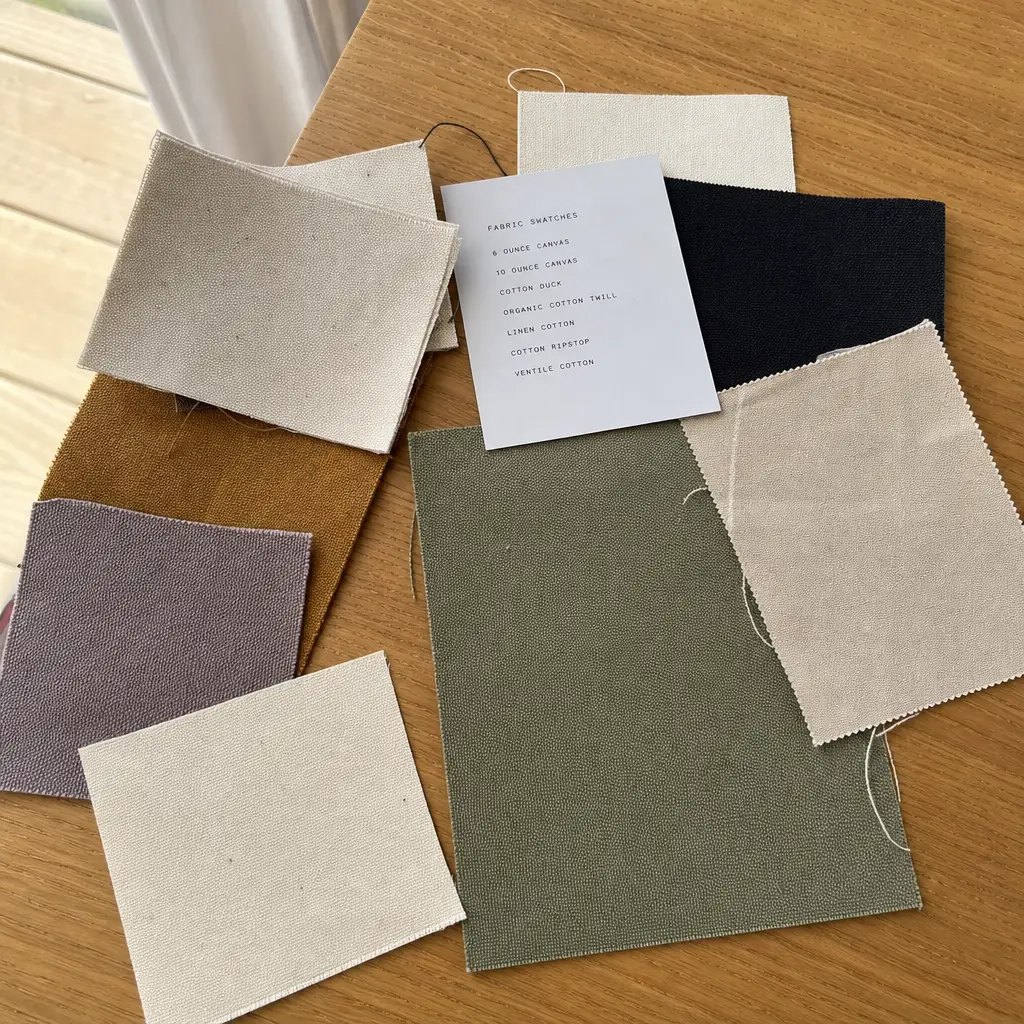
For RFQ purposes, state both ounces and GSM where possible. Some suppliers quote in oz, some in GSM, and some use shorthand names that are not consistent across mills. Also clarify whether the material is plain cotton, cotton canvas, recycled cotton, organic cotton, or cotton blended with polyester. These are not interchangeable in cost or appearance. Natural cotton also varies in seed flecks and shade, so buyers who need a cleaner retail look should specify acceptable fabric appearance or request a fabric swatch before sample approval.
- Do not accept a quote that only says cotton fabric without weight.
- For natural cotton, define whether visible specks and shade variation are acceptable.
- For dyed cotton, request color standard and tolerance before bulk fabric dyeing.
- For recycled cotton, review hand feel, shade consistency, and strength because batches can vary.
- For heavy canvas, confirm whether the factory has suitable sewing machines for clean corner reinforcement.
Match Print Method to Artwork and Cotton Surface
Screen printing is usually the practical choice for cotton drawstring backpacks used by trade show exhibitors. It works well for solid logos, event slogans, sponsor marks, and one to three color artwork. It is cost-effective at volume and gives a clean result on cotton canvas when the print surface is flat. The RFQ should include artwork size, Pantone colors, print position, and whether the logo must be centered on the finished bag after sewing. Centering based only on fabric panel before stitching can shift visually after side seams and drawstring casing are formed.
Full-color graphics require more care. Heat transfer can reproduce gradients and small details, but the transfer hand feel may be less natural on cotton and edges can become noticeable. DTG may suit small sample runs or complex art, but bulk consistency, pretreatment marks, and production speed must be reviewed. Embroidery is possible but less common for large drawstring backpack logos because it adds cost, weight, and fabric puckering risk. Buyers should approve the print method based on a physical sample, not only a digital mockup.
- For solid logos: quote screen print with Pantone references and print size in centimeters.
- For sponsor panels: define the minimum spacing between multiple logos to avoid blurred small text.
- For heat transfer: test folding, rubbing, and edge adhesion on the selected cotton fabric.
- For dark fabric: confirm underbase printing if light logo colors must stay bright.
- For natural cotton: expect a slightly softer print appearance than on coated synthetic fabric.
Build MOQ Logic Before Comparing Supplier Prices
MOQ is not only a factory policy; it is tied to fabric purchase, dyeing, cutting efficiency, print setup, and packing labor. A single order of 5,000 natural cotton backpacks with one logo is much easier to quote than 5,000 pieces split across five sponsor logos, three fabric colors, and individual polybags. If the RFQ does not separate these variables, the first quote may look attractive and then climb after artwork and packing details are clarified.
A clean RFQ lists quantity by version. For example, 3,000 pieces natural cotton with Logo A, 1,000 pieces black cotton with Logo B, and 1,000 pieces natural cotton with Logo C should be treated as three line items. Each line may have its own screen setup, cutting plan, and carton mark. This helps the factory calculate real production flow and helps the buyer see where costs are coming from. If budget is tight, reduce version count before reducing fabric quality below the intended use.
- State order quantity per logo version, not only total project quantity.
- Separate fabric colors because dyed fabric may require a higher minimum than natural cotton.
- Identify shared artwork elements where one screen or setup can serve multiple versions.
- Ask whether MOQ applies per style, per color, per print design, or per shipment.
- For distributors, request a price ladder at realistic breaks such as 1,000, 3,000, 5,000, and 10,000 pieces.
Use Sample Approval to Prevent Bulk Production Surprises
A sample is not just a sales photo. For cotton drawstring backpacks, the buyer should use the sample to lock fabric hand feel, finished size, cord quality, corner construction, logo appearance, and packing fold. A pre-production sample is especially important when the project uses new artwork, a new fabric color, recycled cotton, heavy canvas, or a tight event deadline. Once bulk fabric is cut and printed, changes become expensive and sometimes impossible before the show date.
The sample approval process should produce clear acceptance criteria. Measure the sample flat. Pull the cords several times. Put brochures or expected event items inside. Check whether the print cracks when folded or looks uneven over cotton slub. Review thread color, seam finish, and loose thread trimming. If the buyer only approves a front-view photo, they may miss weak cord exits, narrow opening width, poor inside finishing, or a bag that is too small for the planned literature.
- Approve finished size with a tape measure, not from a photo alone.
- Test the bag with the actual catalog, notebook, bottle, or sample kit planned for the booth.
- Confirm cord length allows the bag to open fully and sit comfortably on shoulders.
- Sign off print color and placement using a physical sample when brand color is important.
- Keep one approved sample with the buyer and one with the factory for production reference.
Define QC Thresholds the Factory Can Actually Inspect
Quality control language must be inspectable. Saying high quality stitching is too broad. A better standard says no open seams, no skipped stitches longer than a defined length, no loose thread tails beyond the agreed trim limit, and no tearing at cord exits during normal pull testing. For trade show exhibitors, the most visible defects are stains, print smudges, crooked logos, shade variation, and bad folding. These defects affect brand presentation immediately, even if the bag technically functions.
For many promotional textile orders, buyers use AQL inspection or a simplified internal standard. Whether the buyer arranges third-party inspection or relies on factory QC, the RFQ should identify the major defect categories. Critical issues include wrong logo, wrong fabric color, unsafe sharp components, or severe contamination. Major defects include open seams, broken cords, severe print offset, large stains, and wrong carton count. Minor defects may include small thread ends or slight natural cotton specks if they were accepted in the material standard.
- Measure logo placement from fixed edges and define an allowed tolerance, such as plus or minus 5 mm to 10 mm depending on design.
- Classify wrong artwork, wrong color, and missing print as major or critical defects.
- Set a practical visual standard for cotton specks, wrinkles, and slub before mass production.
- Test cord strength by repeated opening and closing, especially on heavy fabric or large size bags.
- Inspect cartons for count accuracy because event fulfillment often leaves no time for shortage correction.
Packing Decisions Affect Freight, Warehouse Work, and Event Readiness
Packing is a commercial decision, not just a warehouse detail. Flat packing without individual polybags usually reduces plastic use, carton volume, and unpacking time at the booth. Individual polybags may be needed for retail distribution, pre-kitted attendee packs, or clean handling through a 3PL. Bundle packing can work when the bags are handed out quickly from a booth storage area. The RFQ should state the expected distribution method so the factory can recommend pieces per carton and packing style.
Trade show orders often ship to a decorator warehouse, event venue, distributor warehouse, or several regional offices. Carton marks become important. A carton that only says cotton bag is not enough when multiple exhibitors, booths, or event cities are involved. Buyers should provide carton mark format before production packing starts. Carton dimensions, gross weight, and CBM should be requested before purchase order approval because they affect freight quote, pallet planning, and warehouse handling fees.
- Flat bulk pack: lower cost and less waste for direct booth giveaway programs.
- Individual polybag: cleaner presentation but higher labor, material, and disposal burden.
- Bundle pack: useful for quick counting by booth staff, often 25 or 50 pieces per bundle.
- Carton count: commonly 50 to 100 pieces depending on fabric weight, size, and packing style.
- Carton marks: include item name, PO number, event name, booth number, quantity, carton number, and destination.
Plan Lead Time Backward From the Show Arrival Date
The delivery date that matters is not the factory completion date. For exhibitors, the goods must arrive early enough for receiving, counting, possible repacking, and movement to the booth or event warehouse. A realistic schedule works backward from the required arrival date. It includes artwork confirmation, sample making, sample transit, approval time, bulk fabric purchasing or dyeing, printing, sewing, inspection, packing, export customs, international freight, import clearance, and final delivery.
Rush orders fail most often because artwork approval and sample decisions take longer than expected. Another common issue is booking freight too late after production is complete. If the buyer has a fixed show date, the RFQ should include the latest acceptable arrival date and ask the supplier to identify schedule risks. Air freight can rescue some timelines, but cotton backpacks are bulky enough that air freight may change the landed cost sharply. For heavy canvas versions, carton volume can become more important than unit weight.
- Allow time for artwork review before sample making, especially when sponsor logos are still changing.
- Reserve sample shipping days in the schedule instead of assuming same-day review.
- For dyed fabric, add buffer for color approval and fabric production.
- For ocean freight, request CBM early so the forwarder can estimate cost and booking options.
- For event delivery, target arrival before the warehouse deadline, not the opening day.
Compare Quotes by Landed Cost, Not Only Unit Price
A low unit price can hide cost in setup, sample charges, packing, inland freight, documents, carton volume, and import handling. Cotton drawstring backpacks are simple products, but they are still textiles with variable fabric cost and freight impact. The quote should show what is included and what is excluded. If one supplier quotes EXW and another quotes FOB, the comparison is incomplete. If one uses 100 pieces per carton and another uses 50 pieces, warehouse handling and freight CBM may differ.
Procurement teams should create a quote comparison sheet that includes unit price, fabric weight, print method, setup fees, sample cost, packing method, carton data, lead time, Incoterm, payment terms, inspection allowance, and validity period. This makes commercial tradeoffs visible. A buyer may decide that a slightly higher unit price is better if it includes stronger fabric, clearer carton marks, faster sample support, or better packing for a multi-city event schedule.
- Request price by Incoterm so logistics responsibility is clear.
- Add screen charges or digital setup fees into the total project cost.
- Compare CBM per 1,000 pieces when freight is material to the decision.
- Check whether sample cost is refundable, credited, or separate from bulk order.
- Record quote validity because cotton fabric and freight costs can move before order approval.
Specification comparison for buyers
| Spec decision | Recommended option | When it fits | Buyer risk to check |
|---|---|---|---|
| Fabric weight | 8 oz cotton canvas, about 270 GSM, for most exhibitor giveaways | Good balance when the backpack must feel better than a basic promo sack but still ship in volume | Very light cotton can look transparent after printing; very heavy canvas raises freight and may feel stiff when cinched |
| Budget fabric option | 6 oz cotton, about 200 GSM, with reinforced drawcord stress points | Useful for short event campaigns, low unit budget, or large booth traffic programs | Confirm tear strength near cord exits and whether dark prints show fabric slub or pinholes |
| Premium fabric option | 10 oz to 12 oz cotton canvas, about 340 to 400 GSM | Best for retail-style exhibitor kits, speaker gifts, VIP meetings, or reusable post-show bags | Higher GSM reduces carton quantity, increases ocean freight per piece, and may need thicker cords |
| Print method | Screen print for solid logos, large front marks, and repeat trade show programs | Fits one to three spot colors, clean brand marks, and orders where color consistency matters | Specify Pantone, print size, placement tolerance, and whether print can cross seams or fold areas |
| Full-color artwork | Heat transfer or DTG sample test before bulk approval | Fits gradients, photo graphics, sponsor art, or many-color campaign artwork | Transfers can feel plasticky on cotton; wash, rub, and fold tests should be approved before mass production |
| Cord and closure | 8 mm cotton cord or polyester cord with metal-free tips for giveaway safety | Works for standard trade show use where attendees carry catalogs, water bottles, and brochures | Thin cords cut into fabric corners; mismatched cord color can make the bag look cheaper than quoted |
| MOQ logic | One fabric color and one print setup per MOQ line item | Best when distributors need predictable pricing and fewer pre-production variables | Splitting the order into many logo versions or fabric colors can trigger separate MOQs, setup charges, and longer lead time |
| Packing plan | Flat packed, 50 to 100 pcs per export carton, with carton marks by event and booth destination | Reduces wrinkles and makes warehouse allocation easier for multiple show locations | Overpacked cartons can crush cords, wrinkle prints, and exceed warehouse handling weight limits |
Buyer checklist before sampling
- Define the finished backpack size in width by height, not only by approximate capacity; common trade show sizes are around 33 x 43 cm or 35 x 45 cm.
- State the cotton fabric weight in oz and GSM, and clarify whether the quotation is for plain weave cotton, cotton canvas, recycled cotton, or blended cotton.
- Include fabric color, logo color, Pantone references, print size, print position, and whether artwork must be centered after sewing.
- Specify cord material, cord diameter, cord color, cord exit construction, and whether reinforced corner tabs or metal eyelets are required.
- Separate the RFQ quantity by artwork version, fabric color, and delivery destination so the factory can price setup and packing correctly.
- Request pre-production sample photos plus a physical sample approval before bulk cutting for new fabric, new logo, or new construction.
- Define acceptable size tolerance, print placement tolerance, seam strength expectation, and visual defect limits before production starts.
- Require carton dimensions, gross weight, net weight, pieces per carton, carton marks, and palletization option if the goods go to a 3PL or show decorator warehouse.
- Give the event date, required warehouse arrival date, and latest acceptable shipment date instead of only asking for the fastest lead time.
- Ask the supplier to quote fabric, printing, packing, sample cost, tooling or screen charge, inland freight, export documents, and Incoterm separately.
Factory quote questions to send
- Which fabric construction and weight are included in your quote: 6 oz, 8 oz, 10 oz, or another GSM, and is the fabric pre-shrunk or untreated?
- What finished size tolerance will you hold after sewing, and will the quoted price change if we require reinforced bottom cord corners?
- Which print method do you recommend for our artwork on cotton fabric, and what is the maximum print area without distortion near the drawstring opening?
- Are print screens, digital setup, artwork adjustment, and Pantone matching included or charged separately?
- What is your MOQ per fabric color, per logo version, and per packing method?
- How many days are required for sample making, sample shipping, bulk material preparation, production, inspection, and export packing?
- Can you provide carton dimensions, pieces per carton, estimated gross weight, and CBM before we issue the purchase order?
- What inspection standard do you use for fabric stains, broken stitches, print smudges, color deviation, and carton shortages?
- Can you label cartons by booth, event city, SKU, or distributor order number, and is any barcode label included in the quote?
- Which Incoterms can you quote for this project: EXW, FOB, CIF, DAP, or another term, and what is excluded from each option?
Quality-control points to confirm
- Fabric weight should match the approved specification within a practical tolerance, usually checked by GSM cutting scale or supplier lab record.
- Finished size should be measured flat after sewing, with width and height tolerance agreed before production, commonly within plus or minus 1 cm for this product type.
- Drawcord length should be consistent by sample standard so the backpack opens fully and closes without excessive loose cord.
- Cord exit points and bottom corner reinforcements should withstand repeated pulling without seam tearing or fabric distortion.
- Print color should be compared against approved Pantone or signed physical sample under consistent light, not only from a phone photo.
- Logo placement should be measured from the top edge and side seams, with tolerance defined before mass production.
- Inside seams should be locked, overlocked, or otherwise finished cleanly enough that loose threads do not catch brochures or samples.
- Cartons should match the approved packing plan, with correct piece count, carton marks, and no over-compression that damages printed panels.