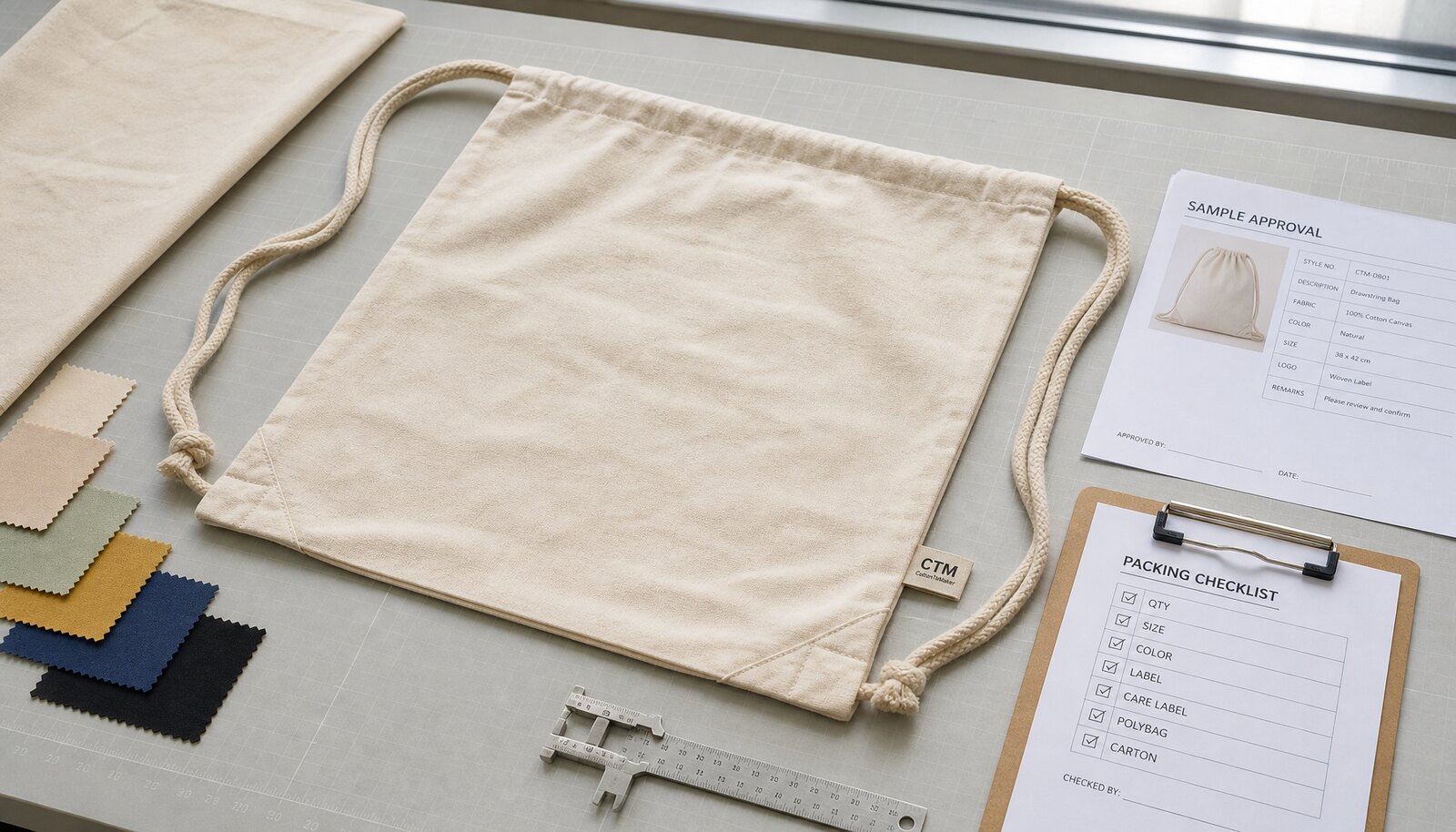
Why gift shop buyers need a compliance checklist before quoting
Cotton drawstring backpacks look straightforward, which is exactly why many buyers underestimate the sourcing risk. A simple bag can still fail on fabric body, seam strength, cord quality, print sharpness, carton packing, or missing documents. For gift shops, presentation is part of the product. The bag has to arrive clean, consistent, and ready to sit on a shelf or move through retail receiving without extra rework. A low unit price does not help if the bags arrive limp, off-center, or packed in a way that slows store operations.
That is why a supplier compliance checklist matters more than a loose product description. Procurement needs a way to compare offers on the same basis: what fabric was used, how the seams are built, what test evidence exists, who approves deviations, and what packing the factory will actually deliver. If those items are not pinned down before quoting, the supplier is not really quoting the same product. They are quoting a guess based on their own assumptions.
For gift shop programs, the cost of a mistake is usually operational, not just financial. A display-ready bag that arrives with weak print adhesion, dirty edges, or inconsistent cords may force extra inspection, relabeling, rework, or a replacement order. This article is designed as a working procurement checklist, not a style guide. The goal is to help buyers ask better questions, compare suppliers fairly, and reduce avoidable quality disputes later in the order cycle.
- Use one written spec for all supplier comparisons.
- Treat sample approval as a production gate, not a design exercise.
- Separate product cost from setup, packing, and documentation cost.
- Make the supplier show evidence, not just describe capability.
Start with the bag spec that customers will actually handle
The most common sourcing mistake is specifying "cotton drawstring backpack" too broadly. That label covers a wide range of fabric weights, weaves, cord types, and construction methods. For gift shops, the practical sweet spot is often 120-140 GSM cotton twill or about 8-10 oz canvas when the bag needs enough body to look retail-ready. Lighter fabrics can work for giveaway-style programs, but they may look softer, show the contents more easily, and feel less substantial in hand. Heavier fabrics usually print better and hold shape more consistently, but they add cost and can affect pack-out dimensions.
Weave type matters because it changes how the bag looks under a logo. Twill usually gives a cleaner retail appearance and better drape control, while plain weave can feel simpler and sometimes less premium. If your program is meant for souvenir shops, museum stores, or branded retail counters, the bag should usually feel like a finished retail item rather than a temporary promotion. That does not mean it must be expensive. It means the fabric and construction should support the selling price and the customer’s first impression.
Finished size is just as important as fabric choice. A bag that is too short can make the drawcord tunnel sit awkwardly high, while a bag that is too wide can reduce the vertical shape that shoppers expect from a drawstring backpack. The supplier should confirm finished width, height, gusset or flat profile if applicable, and the allowed tolerance for each dimension. A practical buyer should also ask whether the bag is cut from pre-shrunk fabric or whether shrinkage must be accounted for after finishing or after washing. The answer affects not only size but also print placement and overall presentation.
For gift-shop procurement, the best spec is one the factory can reproduce consistently. That means asking for the unit of measure, the exact fabric composition, and the process that holds the dimensions in range. A vague order may still produce a bag, but it will be much harder to compare quotes or enforce quality when the first bulk lot differs from the sample.
- Ask for exact GSM or oz instead of generic cotton wording.
- Specify finished dimensions and tolerance in millimeters or inches.
- Confirm weave type and whether the fabric is pre-shrunk.
- Match the bag shape to the intended retail presentation, not only to the artwork.
Choose the sourcing route before you compare unit price
A procurement team should evaluate the sourcing route, not only the supplier name on the quotation. A direct sewing factory is usually best when you need control over fabric, seam construction, and bulk consistency. The tradeoff is that the buyer must be more disciplined: the factory may not do a good job of cleaning up ambiguous specs, and it may assume the buyer understands the production details. A trading company can make communication easier and can sometimes bundle packing, labels, and mixed items, but the buyer needs to verify the real factory, the real QC process, and where decisions are actually made.
Specialized bag workshops often perform better when the order depends on construction details. If you want reinforced corners, a specific cord tunnel finish, or custom retail packing, a workshop that handles bags every day may be more reliable than a general promotional supplier. On the other hand, a low-price general supplier may be useful for simple promotional runs when the buyer accepts looser packaging and a simpler decoration method. The risk is that the quote may look attractive because it excludes the hard parts: material consistency, inspection rigor, or packaging detail.
For any route, the central question is the same: who owns the full chain from sample to bulk? If a trading company approves the sample but the factory changes the fabric later, responsibility can become blurred. If the print is subcontracted, the color and placement tolerances must still be owned by one party. Buyers should ask the supplier to identify the production site, the decoration site, and the packing site, then state who signs off on deviations. That one step eliminates a lot of later confusion.
The table below is useful only if you use it as a decision tool. Do not let suppliers compete on price before they have answered the same compliance questions and shown the same level of documentation.
- Match the sourcing route to order complexity, not just to price.
- Ask which site makes the bag, which site prints it, and which site packs it.
- Require one named owner for sample approval and deviation sign-off.
- Compare total landed cost after labels, packing, testing, and cartoning are included.
Supplier comparison table for cotton drawstring backpacks
Gift-shop buyers often get several very different kinds of quotes that all appear to describe the same product. In reality, one quote may assume a lighter fabric, another may exclude labels, and a third may use a different packing method. Use this table to identify where the differences come from before you accept a lower number as a better deal. The correct supplier is not the one with the lowest headline price; it is the one who can deliver a consistent retail-ready bag with the right documents behind it.
When you compare offers, look for the evidence behind each line item. If a supplier claims a lower MOQ, ask what changed to make that possible. If the supplier promises a faster lead time, ask whether fabric is in stock or whether printing will be subcontracted. If the supplier says it is compliant, ask which documents it can actually provide and in what format. Procurement is much easier when the quote is broken into a unit cost, setup cost, sample cost, packing cost, and documentation scope.
- Require the same RFQ sheet for every quote.
- Insist on separate pricing for the bag, decoration, packing, and documents.
- Ask how the MOQ changes when a second print color or different label is added.
- Check whether the quoted fabric is stock, greige, or dyed-to-order.
How print method changes quote quality and shelf appeal
Print method is one of the biggest drivers of both cost and visual quality. For simple logos, city names, or souvenir text, screen printing is often the strongest commercial choice because it gives crisp opacity on cotton and works well at medium volumes. It is usually easier to control on natural fabrics than more delicate methods, especially when the design uses one to three colors. If the artwork is more complex, a supplier may propose heat transfer, digital printing, or another process, but the buyer should test the appearance and wear characteristics on the real fabric before approval.
The real issue is not which process sounds modern. It is how the print behaves on the chosen fabric weight. A design that looks clean on a digital proof may sit too heavily on a softer cotton, or the color may absorb differently than expected. A strong supplier quote should state the print area, the number of colors, any registration limits, and whether the setup charge is per color or per design. If the supplier cannot explain how it will control opacity, edge sharpness, or placement consistency, the quote is incomplete.
Gift shops often want a print that feels retail-ready at a glance. That means the artwork should not wander across the panel, the color should not look washed out, and the image should not crack or blur in a way that makes the bag feel cheap. The best practice is to request a strike-off or printed sample on the approved fabric, not only a digital rendering. If the order uses multiple colorways or store-specific variants, ask for the same check on each version. A one-color sample does not necessarily prove a three-color production run.
You should also ask whether the factory prints in-house or uses a subcontractor. That matters because print quality often changes when work is moved outside the main production site. If decoration is subcontracted, the buyer should know who approves the sample, who checks the first piece, and who fixes misregistration if the bulk run shifts. In procurement terms, print method is not only a decoration choice; it is a control point.
- Use screen print for bold, simple retail graphics when the run size supports setup.
- Require a printed sample on the approved fabric, not a file proof alone.
- Ask for print placement tolerance so bags match on shelf.
- Confirm whether print work is in-house or subcontracted and who owns the approval.
MOQ logic: what really drives minimum order quantity
MOQ is one of the most misunderstood parts of a backpack quote. Buyers often assume it is just a sales policy, but for cotton drawstring bags it is usually tied to real production variables. Fabric sourcing may require a minimum cut, print setup may require a minimum number of impressions, and packing labor can create its own threshold. A low MOQ for the base bag may disappear once the buyer adds a woven label, retail hangtag, or barcode sticker. That does not automatically mean the supplier is inflating the order. It may simply mean the offer is becoming more realistic.
The key procurement question is not "What is your MOQ?" but "What exactly does that MOQ cover?" Ask whether the minimum applies to the bag body only, the print design, the color count, the size, or the packing format. If a supplier offers multiple gift-shop SKUs using one shared body and only different artwork or labels, the buyer may be able to lower inventory risk by standardizing the fabric and size while changing only the decoration. That is often better than chasing a low unit price on a highly customized order.
Buyers should also be careful about hidden MOQ tradeoffs. A supplier may accept a smaller order but raise the setup fee, push the buyer into a simple one-color print, or limit the available packing choices. Those tradeoffs can be fine if they are transparent. They become a problem only when the quote does not reveal them. For chain gift shops or souvenir retailers that need replenishment, the best MOQ is the one that supports future reorders without forcing a complete re-spec every time.
If you plan to repeat the bag across seasons, ask the supplier to keep a stable fabric and construction record by lot number or batch. That makes reorders easier and reduces the chance of a reorder coming back slightly different because the original fabric was not reserved or the original trim was replaced. In a retail program, consistency is often more valuable than a one-time MOQ concession.
- Tie MOQ to each production variable, not just final bag quantity.
- Ask whether the fabric lot can be reserved for reorder continuity.
- Watch for small MOQ quotes that shift cost into setup or decoration charges.
- Standardize the bag body first if you need multiple SKU variants.
Sample approval should test construction, not just appearance
A lot of sourcing mistakes happen because the buyer approves a sample that looks good but says little about production behavior. For cotton drawstring backpacks, the sample should prove fabric weight, seam quality, reinforcement, cord glide, print opacity, and packing method. A pretty photo sample does not tell you whether the cord tunnel will hold shape or whether the bottom seam will look neat after handling. The sample is where procurement checks whether the commercial promise matches the factory’s actual build method.
A proper sample stage usually has more than one purpose. First, it confirms appearance: artwork position, color, label placement, and bag proportion. Second, it confirms structure: stitch density, bar-tacks, seam allowance, and the way the cord feeds through the channel. Third, it confirms packaging: whether the bag is folded correctly, counted correctly, and labeled the way the warehouse expects. If any of those elements change later, the buyer should treat it as a revision rather than an informal tweak.
The most effective approval process ends with a written record. That record should identify the approved fabric, the approved print method, the approved label placement, and the approved packing format. If the supplier later proposes a change because a trim is unavailable or a fabric lot has shifted, the buyer can compare the new version against the signed sample. This is the simplest way to keep a production order from drifting. It also helps separate real deviations from the normal noise of manufacturing.
For higher-value retail orders, request a cut sample or construction sample as well as the visual sample. A cut sample lets the buyer see the seam allowance, reinforcement placement, and internal finish. If the factory resists that request, the buyer should at least ask for detailed close-up photos of the inside and stress points. Those images are more useful than a single beauty shot.
- Approve a sample that matches final fabric, print, and packing.
- Ask for internal close-ups or cut samples to check construction details.
- Record the approved version in writing with a date and version number.
- Treat any later material or artwork change as a formal revision.
Construction specs that affect durability and retail presentation
Cotton drawstring backpacks are often judged visually, but the hidden construction choices are what decide whether the bag feels solid or flimsy. Stitch density matters because it influences seam strength and how tidy the lines look along the edges. Seam allowance matters because it affects whether the edges can hold together under stress. Reinforcement matters because the cord channel and bottom corners take repeated loading whenever the bag is opened, closed, or carried with contents inside. If the factory does not specify these elements clearly, the buyer cannot properly judge the quote.
A buyer should ask where the highest stress points are and how they are reinforced. The cord entry area and the top channel are obvious risk points because they bear most of the opening and carrying load. Bottom corners can also need reinforcement if the bag is intended to hold heavier souvenirs, water bottles, or bundled retail sets. Even on lightweight gift-shop bags, a little extra reinforcement can help the product hold shape and reduce customer complaints about tearing or drooping. This does not require overbuilding the bag. It requires matching the construction to the use case.
Stitch count is worth checking, but it should be handled practically. Instead of asking for a vague "strong seam," request the expected stitches per inch or stitches per centimeter where the factory controls it. Ask whether the seam is single-needle, double-needle, or otherwise reinforced at specific zones. Ask how the seam will be inspected for skipped stitches, thread breaks, and loose ends. If the supplier only talks about appearance and not stitch control, it is not giving procurement enough information to compare one factory against another.
The drawcord itself deserves similar scrutiny. A thin cord may reduce cost, but it can cut into comfort and make the bag feel less premium. Ask for cord diameter, fiber content if known, and end finish. If the cord ends are not cleanly sealed or tipped, they can fray during use and make the bag look worn before it is sold. For gift shops, small details like this often separate a basic promotional bag from a product that looks ready for retail markup.
- Ask for stitch density or stitches per inch at critical seams.
- Require reinforcement at the cord tunnel and stress corners.
- Confirm cord diameter, end finish, and pull consistency.
- Check inside finish and thread trimming, not only the outer appearance.
Compliance documents and traceability the buyer should own
The sourcing and compliance side of the order should not be vague. Even if the product is a simple cotton bag, the buyer still needs to know what material is in the bag, where it was made, and what evidence supports the supplier’s claims. At minimum, procurement should ask for a material declaration that identifies the fiber content, the fabric source if available, and any relevant finishing treatment. If the supplier says the bag is 100% cotton, that should be supported by a document or specification, not just a sales line.
Testing requirements depend on the destination market and the buyer’s internal risk policy. For some programs, a supplier’s own test report may be enough if it clearly identifies the sample, the test date, and the method used. For higher-risk or retailer-specific programs, the buyer may need colorfastness information, fiber content declarations, azo-related documentation, or other conformity evidence depending on the market and the customer’s standards. The exact test package should be defined before production starts, not after the shipment is already booked. If the factory needs time to arrange testing, that should be folded into the lead time.
Traceability should be practical and usable. The buyer should know which batch or lot the fabric came from, which production run used it, and how the cartons can be linked back to the order. That becomes important if a defect appears later and the buyer needs to isolate only the affected units. Procurement should also ask who is responsible for document ownership across a factory-trading company route. If the trader is the commercial contact but the factory holds the actual production records, the buyer needs a clear rule for who supplies what and who answers for deviations.
One of the best questions you can ask a supplier is very simple: if there is a quality issue after delivery, which documents prove what was made, when it was made, and with which materials? The answer should be specific. If it is not, the compliance system is too weak for a retail buyer who needs repeat orders.
- Request material declarations, not only sales descriptions.
- Define the test package and the responsible party before production begins.
- Keep lot, batch, or order traceability tied to cartons and records.
- Clarify who owns records when a trader and factory are both involved.
QC thresholds that prevent retail complaints
Quality control needs to be written in the language of visible defects and measurable limits. Gift shops do not want to hear that a bag passed because it was "close enough." They want products that look consistent on display and feel consistent in hand. That means the inspection scope should include fabric surface condition, seam straightness, print placement, cord length, label spelling, odor, and packing accuracy. If the bag will be hung on a peg, a shelf, or a display wall, consistency across the lot matters as much as structural strength.
The buyer should set accept/reject thresholds before the factory starts bulk work. A practical standard might define allowable size variation, acceptable print shift, maximum number of loose thread ends, and which defects are automatic rejects. For example, stains, oil marks, holes, misprints, or missing brand labels should usually be treated as major or critical defects, not as minor deviations. If the bag is retail-ready, packing errors such as mixed SKUs, wrong barcode labels, or crushed cartons can be just as damaging as a seam issue.
Load testing should be part of the conversation if the bag will carry more than a token item. The purpose is not to turn a gift-shop bag into a heavy-duty backpack. The purpose is to confirm that the seam, cord channel, and reinforcement points hold under the intended use. A filled sample can reveal whether the top opening distorts, whether one cord side slips, or whether the bag sags awkwardly. Those are common customer complaints, and they are much cheaper to discover in sampling than after shipment.
Inspection should also include a simple appearance audit under normal viewing conditions. Bags need to be checked for color consistency, print alignment, label orientation, and overall finish in light that resembles retail use, not only in a factory work zone. If possible, compare the final packed sample to the signed approval sample side by side. That makes small differences easier to spot. The cleaner the visual standard, the easier it is to keep a replenishment program stable over time.
- Define defect classes for stains, holes, misprints, and missing labels.
- Set measurable limits for size, print shift, and loose thread count.
- Test a filled sample for cord behavior and seam performance.
- Inspect packed units under normal viewing light, not only under factory conditions.
Specification comparison for buyers
| Supplier option | What to verify | Commercial advantage | Buyer risk to control |
|---|---|---|---|
| Direct sewing factory | cord material proof, reinforcement close-ups, load-test photos, approved sample tag, and bulk-line first-piece record | Better sample-to-bulk control and faster production feedback | May be weaker on export paperwork or branded packing unless checked early |
| Trading company | Factory name, production photos, trim-source proof, and who owns QC decisions | Can coordinate small mixed orders and extra services | Markup can hide real factory capability and slow defect decisions |
| Specialized bag workshop | cord diameter, eyelet or reinforced channel, bottom corner reinforcement, seam allowance, bar-tack position, and load target | More practical for detailed construction, trims, and repeat programs | Capacity may be limited during peak seasons |
| Low-price general supplier | 6-10 oz cotton canvas, 210D polyester, rPET, or blended cotton with shrinkage and colorfastness expectations set before sampling | Useful for simple promotional runs with loose specs | Material downgrades, weak packing, and vague inspection scope can erase savings |
| Retail-ready supplier | fold direction, cord protection, bundle count, carton compression, moisture bag, and retail label position | Can handle labels, SKU separation, carton marks, and receiving rules | Higher unit cost must be compared against reduced warehouse work |
| Compliance-focused supplier | Fabric records, labeling review, test plan, and production traceability | Safer for retail programs and repeat brand orders | Documentation claims need evidence, not only sales language |
| Local sample room plus bulk factory | Signed sample, bulk factory handoff, first-piece photos, and deviation owner | Good for complex branding before large production | Sample room quality may not match bulk line unless handoff is controlled |
Buyer checklist before sampling
- Confirm the exact fabric composition, weave, and GSM or oz before any sample is approved.
- Lock finished size, seam allowance, and tolerance in writing so the bag fits the intended retail use.
- Specify the drawcord material, diameter, tip finish, and tunnel construction, not just the word "cotton."
- Require photos or cut sections showing seam density, bar-tacks, and reinforcement at stress points.
- Define the print method, print size, color count, and artwork placement against a signed proof.
- Ask for material declarations, test reports, and traceability by lot or batch before bulk production.
- Separate unit price from setup, label, packing, testing, and freight-ready carton charges.
- Approve one pre-production sample that uses final fabric, final decoration, and final packing.
- Set accept/reject rules for stains, loose threads, skipped stitches, print shift, and carton damage.
- Confirm who owns approvals across the factory, trader, and subcontracted printing or packing routes.
Factory quote questions to send
- What is the exact fabric specification, including composition, GSM or oz, weave type, and any pre-shrink treatment?
- What seam allowance do you use, and where are the critical reinforcement points placed at the cord channel and bottom corners?
- What is the drawcord material and diameter, and do you use heat-sealed, knotted, or tipped ends?
- Which print method will you use for this artwork, how many colors are included, and what is the setup charge per color or per design?
- Can you quote the bag body, print, woven label, hangtag, barcode label, individual polybag, and master carton separately?
- What is your minimum order quantity by fabric lot, print color count, size, and packing format?
- What sample stage will you provide first, what exactly will it prove, and how are revisions charged?
- What is the production lead time after sample approval, and which step is the most likely bottleneck?
- What compliance documents can you provide: fiber content declaration, testing reports, colorfastness data, and batch traceability records?
- What inspection standard do you work to, and can you share the defect classification and AQL table you use?
Quality-control points to confirm
- Fabric identity should match the approved specification, with a documented GSM or oz tolerance and consistent hand feel across panels.
- Finished dimensions should stay within an agreed tolerance so the bag sits correctly in retail display and holds the intended gift items.
- Seam quality should be checked for stitch count consistency, skipped stitches, broken thread ends, puckering, and loose tension.
- Bar-tacks or reinforcement stitches should be positioned consistently at stress points such as cord exits, corners, and strap joins.
- The drawstring channel should pull smoothly without twist, excessive friction, or uneven cord length from side to side.
- Print registration should stay within the approved shift tolerance, with no blur, bleeding, cracking, or under-coverage on natural cotton.
- Color consistency should be checked against the approved reference under daylight-equivalent lighting, including bag body and print color.
- Colorfastness should be verified with a supplier report or test method reference if the bag will be handled, washed, or displayed long enough to matter.
- Load performance should be tested on a filled sample to confirm that seams, cord attachment, and channel construction hold under expected retail use.
- Defect limits should be written in advance for stains, holes, oil marks, misprints, missing labels, and uneven cord length.