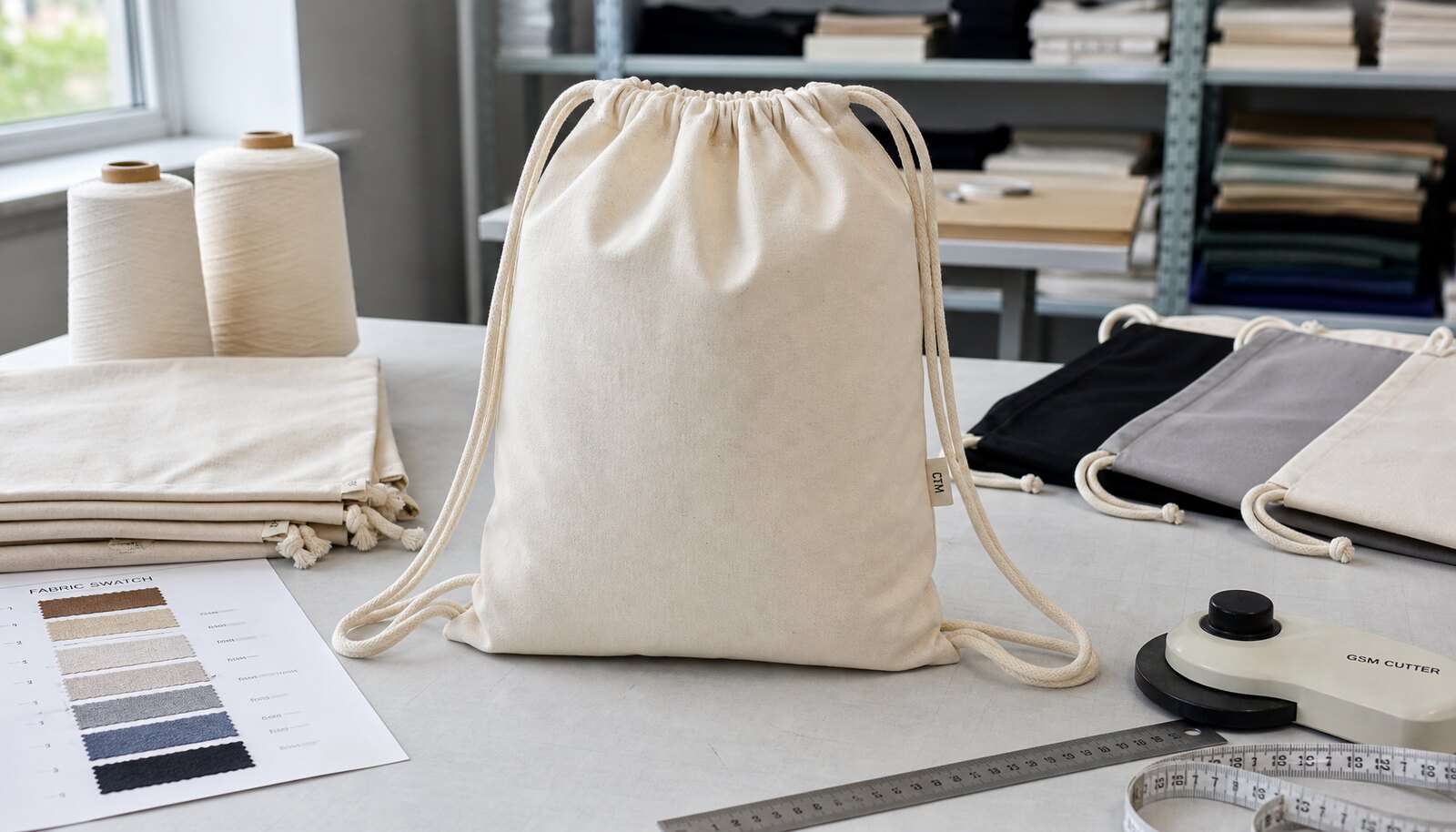
1. Begin with the gifting job, not the bag name
A cotton drawstring backpack used for corporate gifting is more than a simple cloth pouch with cords. It may carry event materials, sit inside an employee onboarding kit, ship to regional offices, or support a retail gift-with-purchase campaign. The right specification depends on the recipient, the handoff moment, the items inside, the expected use life, and how visible the logo must be. A conference bag holding a badge, brochure, pen, and snack can be lighter than a welcome-kit bag carrying a notebook, hoodie, charger, bottle, and HR documents.
Before asking for prices, turn the marketing brief into purchasing language. “Nice cotton drawstring bag” leaves too much open to interpretation. A stronger RFQ states the use case, target contents, finished size, fabric weight, construction level, logo method, packing format, delivery point, and document requirements. This is the starting point for a useful cotton drawstring backpacks supplier compliance checklist for corporate gifting because it stops suppliers from quoting different products under the same casual description.
A practical opening line might read: “Natural cotton drawstring backpack for employee onboarding kit, finished size 35 x 42 cm, intended to carry notebook, T-shirt, 500 ml bottle, and small accessories, 180 GSM cotton canvas, reinforced lower corners, 5 mm cotton cord, one-color front screen print, bulk packed for kitting warehouse.” That one sentence gives the factory enough context to price fabric, seams, cords, printing, cartons, and lead time. It also gives internal stakeholders a baseline when a cheaper quote appears.
- Write the end use in one clear line: event giveaway, employee kit, conference pack, distributor promotion, retail gift-with-purchase, or internal campaign.
- List the expected contents before choosing GSM, cord diameter, or reinforcement.
- Decide whether the bag is the gift itself or packaging for other gifts.
- State the quality position: budget promotional, mid-tier reusable, or premium branded presentation.
- Include event date, warehouse deadline, and destination because schedule pressure affects material and printing choices.
2. Select the supplier route by control level, not only by unit price
Supplier type changes the risk profile. A direct cut-and-sew factory is often the best route when the order needs custom fabric weight, exact sewing, controlled cord quality, repeatable logo placement, private labels, or future reorders. You can discuss seam allowance, stitch density, channel width, reinforcement, and first-piece approval with the people who will actually make the bag.
A trading company can still be useful, especially when a campaign includes multiple products or when the buyer needs help coordinating several factories. The important word is transparency. Ask for the real production site, whether subcontracting is allowed, where the pre-production sample will be made, and who can approve rework. If a polished sample comes from one room and bulk production moves to another workshop without a formal handoff, the approved sample is a weak control.
Stock blank suppliers and local decorators are helpful for urgent event orders. They may already have cotton drawstring backpacks ready for fast printing. The compromise is reduced control over GSM, cotton shade, seam construction, cord diameter, and reorder consistency. That can be acceptable for a small local campaign with flexible standards. It is less suitable for brand-sensitive programs, multi-location distribution, or buyers that need factory compliance evidence.
Compliance capability should be checked as early as sewing capacity. If the end customer requires vendor onboarding, country-of-origin support, restricted-substance declarations, labeling review, or final inspection records, confirm those items before the PO is issued. A supplier that cannot identify the production site, fabric source, or trim source should not be treated as compliance-ready.
- Use a direct factory when construction details, repeatability, and sample-to-bulk control are priorities.
- Use a trading company only after clarifying the production site, subcontracting rules, and QC authority.
- Use stock blanks for urgent simple orders where shade and construction flexibility are acceptable.
- Ask about compliance documents before final negotiation, not after production starts.
- Confirm monthly capacity and peak-season availability for orders tied to fixed event dates.
3. Write fabric specifications in measurable purchasing terms
Cotton bag quotations often rely on soft descriptions: canvas, calico, muslin, natural cotton, heavy cotton, or eco cotton. Those words may help a sales conversation, but they are not enough for procurement. A comparable quote should state fiber content, weave, finished GSM or oz/yd², color status, finishing method, and tolerance. Finished GSM matters because dyeing, bleaching, washing, and printing can change hand-feel, shrinkage, surface appearance, and final weight.
For light giveaways, 120-150 GSM cotton is often used to control unit cost and freight weight. It can work for brochures, event badges, small samples, and short-term use. For employee kits, reusable gift bags, brand campaigns, or heavier contents, 160-220 GSM is usually a safer range because the bag feels more substantial and gives the seams a better base. Heavier cotton may create a more premium impression, but it can also increase shipping weight, stiffness, sewing difficulty, and decoration cost.
If suppliers quote in ounces, slow down and confirm the basis. Cotton canvas may be described as 6 oz, 8 oz, or 10 oz, while many international factories quote GSM. Do not assume every supplier uses the same conversion or measures at the same production stage. Ask whether GSM is checked on finished fabric and whether the tolerance is plus or minus 5%, plus or minus 10%, or another agreed range.
Color needs the same discipline. Natural cotton can include seed flecks, small dark fibers, and shade variation. That look may support a natural brand style, but it should be approved before production. Bleached cotton gives a cleaner base and can make some logos look sharper, while dyed cotton offers brand-color flexibility but introduces dye-lot minimums, rubbing colorfastness questions, and shade variation risk between lots.
- Require fiber content, weave, finished GSM or oz/yd², color status, and finishing method in every quote.
- Ask whether weight is measured before or after dyeing, washing, bleaching, printing, or coating.
- For light use, consider 120-150 GSM; for stronger gifting, consider 160-220 GSM.
- Define whether natural cotton flecks are acceptable and how much shade variation can be tolerated.
- For dyed cotton, ask about dye-lot MOQ, rubbing colorfastness, and possible dye transfer to light-colored contents.
4. Lock construction before suppliers start trimming cost
Two drawstring backpacks can look almost identical in a front photo and still perform very differently. Cost can be cut by lowering GSM, using a thinner cord, reducing seam allowance, skipping reinforcement, shortening drawcord length, lowering stitch density, or using weaker cartons. If the construction baseline is not written, the lowest quote often belongs to the supplier that assumed the least.
Start with finished size and usable capacity. Many promotional drawstring backpacks sit around 34-38 cm wide and 40-45 cm high, but the correct size depends on what goes inside. If the bag must hold an A4 folder, laptop sleeve, bottle, hoodie, boxed gift, or apparel set, check usable opening and internal fit during sampling. State measurement points: width measured flat from seam to seam, height measured from top edge to bottom seam, and opening measured across the channel when flat.
Then define the sewing. Ask for seam allowance, stitch type, approximate stitch density, rope-channel width, and raw-edge treatment. A basic promotional bag may be acceptable with a clean overlocked or enclosed edge. A stronger corporate gift may need bar tacks, reinforced lower corners, or fabric tabs. Metal eyelets can look neat, but they must be securely set and matched to the fabric weight; a loose eyelet can cut into cotton under load.
The drawcord deserves its own line in the specification. Define material, diameter, length, color, knot or end finish, and whether the cord is cotton, polyester, polypropylene, or a blend. Cotton cord supports a natural look but can fray or absorb dye differently from the bag body. Polyester cord may slide smoothly and resist abrasion, but it changes the material story. If marketing plans to describe the item as cotton, clarify whether that claim refers only to the bag body or also to trims.
- Define finished size, usable opening, measurement points, and tolerance before sampling.
- Specify seam allowance, stitch density, rope-channel width, and raw-edge finish.
- Choose lower-corner construction: plain seam, reinforced tab, folded corner, eyelet, or bar tack.
- State cord material, diameter, length, color, and end finish.
- When a supplier offers a lower price, ask exactly what changed in GSM, cord, sewing, reinforcement, logo, or packing.
5. Match logo decoration to artwork, fabric texture, and use life
Logo decoration is where many corporate gifting orders run into stakeholder disappointment. The front mark is usually the first thing recipients, executives, and brand teams notice. A simple one-color logo on natural or dyed cotton is often a good fit for screen printing, especially at higher quantities where setup costs spread across the order. Still, screen print is not automatically the right answer. Fine text, gradients, many colors, photographic artwork, or small production runs may point toward heat transfer, DTF, woven label, patch, or embroidery.
Each method has tradeoffs. Screen print can be economical and durable when mesh, ink deposit, and curing are controlled, but coarse cotton texture can soften small details. Heat transfer and DTF can reproduce detailed multicolor artwork, yet the buyer should check hand-feel, edge adhesion, cracking, and compatibility with the chosen cotton surface. Embroidery can look premium on a smaller logo, but it may pucker lighter fabric and is not ideal for large filled designs. Woven labels and side tabs are useful when the brand wants a quieter, premium mark rather than a large front print.
Artwork instructions should be production-ready. Provide vector files when possible. Specify logo width and height, color count, Pantone or brand-color references, and placement coordinates. For example: “Logo centered horizontally, top of logo 100 mm below top edge, print width 180 mm, placement tolerance plus or minus 5 mm.” A digital mockup helps everyone see the layout, but it is not a production standard. It does not prove ink behavior, cotton absorption, curing, or hand-feel.
For brand-sensitive programs, request a strike-off or decorated pre-production sample on the intended fabric. If exact color matters, remember that ink on natural cotton will not always look like ink on coated paper, polyester, or a backlit screen. Approve a physical reference with written notes rather than relying on “match as close as possible.”
- Use screen print for simple artwork and larger quantities when curing control is available.
- Use heat transfer or DTF for detailed, multicolor, or lower-quantity artwork after checking hand-feel and adhesion.
- Use embroidery, woven labels, or patches for smaller premium marks on a fabric weight that can support them.
- Define logo size, coordinates, color reference, and placement tolerance in writing.
- Approve a physical decorated sample or strike-off on the intended fabric before bulk production.
6. Use MOQ and price breaks to uncover hidden assumptions
MOQ for cotton drawstring backpacks is rarely driven by one factor. It may come from fabric roll quantity, dye-lot minimum, stock cord availability, screen setup, embroidery setup, woven-label MOQ, carton printing, or packing labor. A supplier may advertise a low MOQ while assuming natural stock fabric, one artwork, one print color, no custom label, no special carton marks, and bulk packing. Add three fabric colors, four department logos, individual bags, and destination labels, and the real MOQ changes quickly.
Ask suppliers to break MOQ down by fabric color, artwork version, print color count, decoration method, label type, and packing format. Separate one-time setup charges from recurring unit costs. Screen charges, embroidery digitizing, label tooling, sample fees, artwork separation, and custom carton printing may not repeat on a reorder if the design stays the same. That distinction helps procurement compare the first order with the likely reorder cost.
Normalize quotes before discussing which one is cheapest. A 5,000-piece quote for 150 GSM natural cotton, thin polyester cord, one-color print, no reinforcement, and bulk packing is not comparable to a 5,000-piece quote for 180 GSM cotton canvas, 5 mm cotton cord, reinforced corners, individual bags, and destination labels. Put size, GSM, cord, reinforcement, logo method, logo size, MOQ, setup charges, packing, carton count, incoterm, lead time, inspection scope, and quote validity into one grid.
Corporate gifting campaigns often include artwork splits for departments, sponsors, regions, distributors, or event tracks. Ask how the unit price changes when the total order is divided into several versions. Sometimes one master logo plus printed inserts is more efficient. Sometimes separate artwork versions justify the setup cost because they improve local relevance or sponsor value.
- Request MOQ by fabric color, dye lot, artwork version, print colors, label type, and packing method.
- Separate setup charges from recurring unit costs for accurate reorder planning.
- Compare quotes only after normalizing GSM, size, cord, reinforcement, logo method, packing, and incoterm.
- Ask for realistic price breaks such as 1,000, 3,000, 5,000, and 10,000 pieces.
- Confirm quote validity and which inputs may change, including cotton, dyeing, labor, packing material, and freight.
7. Request compliance evidence that fits the destination and the claim
Corporate gifting is not always retail compliance, but it still requires evidence. At minimum, buyers should know who makes the bag, what materials are used, what claims are being made, how the shipment is labeled, and how quality is documented. If the bags are distributed in a regulated market, given to children, sold as part of a promotion, or supplied to a corporate customer with strict vendor rules, compliance review should happen before PO release.
Common document requests include factory profile, business registration where relevant, production site address, material declaration, country-of-origin support, restricted-substance declaration, and recent test reports when required by the customer or destination. For dyed cotton or heavily printed bags, buyers may ask for colorfastness, azo dye, heavy metal, phthalate, or other chemical testing depending on market rules and corporate policy. The supplier should not guess the regulation; the buyer should state the destination and required standard.
Sustainability language needs extra care. Words such as natural, eco, organic, recycled, biodegradable, compostable, certified, low-impact, or carbon neutral should not appear in corporate marketing unless the buyer has documents to support them. If the bag is described as organic cotton, request valid certification and chain-of-custody evidence. If it is described as recycled cotton, ask for documentation supporting recycled content. If those documents are not available, use plain descriptive language such as natural-colored cotton rather than an unsupported environmental claim.
Traceability is a practical form of compliance. Ask how the supplier links your PO to fabric lots, cord lots, print batches, production dates, inspection records, and carton numbers. The system does not need to be complicated for every promotional order, but it should be good enough to investigate a complaint. If one destination reports staining, odor, or weak seams, traceability helps determine whether the issue is limited to a carton, a production day, a fabric roll, or the full shipment.
- State the destination market, recipient group, and customer compliance requirements in the RFQ.
- Request factory identity, material declaration, country-of-origin support, and restricted-substance controls where applicable.
- For dyed or printed bags, consider colorfastness and chemical testing if required by the customer or market.
- Do not use organic, recycled, certified, biodegradable, compostable, or eco claims without valid supporting documents.
- Ask how fabric lots, production dates, inspection reports, and carton numbers connect to your PO.
8. Treat samples as production controls, not sales photos
A sample should prove that the supplier can make the agreed product, not simply that a bag can look good on a screen. The strongest sample is a pre-production sample made with the intended fabric GSM, cord, reinforcement, sewing method, decoration process, label, and packing format. If an early sample uses substitute fabric or a different print method, mark it clearly as non-final. It can help with shape or layout, but it should not become the production reference.
When the sample arrives, inspect it like bulk goods. Measure flat width, height, opening, drawcord length, logo width, logo height, and placement from fixed reference points. Pull the cords repeatedly to check closing and reopening. Load the bag with realistic contents and watch the rope channel, side seams, lower corners, and reinforcement. Bend the printed area to check cracking and hand-feel. Look inside the bag too; interior finishing often reveals whether the construction matches the gift level promised.
Sample approval should create a controlled reference package. Keep the approved physical sample, fabric swatch, cord sample, artwork proof, measurement sheet, packing instruction, and deviation notes together. If the buyer accepts an off-shade sample only because bulk will be corrected, write that correction into the approval. Informal approval such as “looks fine” creates room for disputes because the supplier may treat every visible detail as accepted.
For first-time, large, or brand-sensitive orders, request bulk first-piece approval after mass production starts. This confirms that the production line, bulk fabric lot, cord, print setup, and packing match the approved sample. A useful first-piece photo set includes front, back, inside seam, rope channel, lower corners, cord close-up, logo close-up, measurement photos, folded unit, inner pack, and carton mark.
- Identify whether the sample is a stock sample, custom layout sample, pre-production sample, or bulk first-piece sample.
- Measure the sample and record actual results against the specification sheet.
- Test drawcord movement and load behavior using realistic gift contents.
- Approve samples with written comments and correction points, not informal approval only.
- Keep a signed, sealed, or clearly labeled approved sample as the bulk production reference.
9. Define QC tolerances, defect classes, and inspection evidence early
Quality control belongs in the PO, not in a late exchange after defects appear. For cotton drawstring backpacks, inspection should cover fabric, dimensions, stitching, cord function, lower-corner strength, decoration, cleanliness, packing, carton marks, and quantity. Cotton naturally has some variation, but a corporate gift still needs controlled presentation because the item carries the brand in front of many recipients at once.
Set measurable tolerances before production. Fabric GSM may be controlled to plus or minus 5% for tighter programs or plus or minus 10% for basic promotional orders if accepted in writing. Finished bag dimensions often use plus or minus 0.5 cm to 1.0 cm depending on size, sewing method, and fabric behavior. Logo placement should be measured from fixed points and may need a tighter tolerance, such as plus or minus 5 mm to 10 mm. Drawcord length tolerance also matters because uneven cords make the bag look inconsistent and can affect closure.
Defect classification prevents long arguments. Critical defects are safety, legal, or severe contamination issues, such as sharp metal, mildew, prohibited material, or a wrong mandatory label. Major defects affect function or brand appearance: open seams, wrong logo, severe print cracking, large stains, missing cords, wrong size outside tolerance, or weak corner construction. Minor defects are small issues that do not materially affect use or presentation, such as a short loose thread within the trimming standard or a tiny slub approved for natural cotton.
Functional checks should match the intended use. If the bag will carry a notebook and bottle, inspection should not stop at a flat visual check. Inspectors should pull the cords repeatedly, check channel stitching, and perform a simple load spot-check agreed in advance. Define the load, duration, number of pulls, and pass/fail signs such as seam opening, tearing, cord slippage, eyelet movement, or visible distortion.
- Define tolerances for GSM, finished size, logo placement, drawcord length, and carton quantity.
- Classify critical, major, and minor defects before inspection begins.
- Include functional checks for drawcord pull, channel stitching, lower-corner stress, and realistic load handling.
- Require first-piece photos and final inspection photos for first-time suppliers or brand-sensitive orders.
- Document rework, replacement, concession, or shipment-hold decisions before goods leave the factory.
10. Put packing, labeling, lead time, and logistics in the RFQ
Packing is part of product quality for corporate gifting. Bags may be bulk packed for a kitting warehouse, individually packed for direct handout, sorted by destination, or prepared for retail gift-with-purchase distribution. Each route needs a different plan. Bulk packing can reduce material cost and waste when the buyer will repack the bags with other items. Individual bags, tissue, hangtags, barcode labels, inserts, or presentation folds can improve cleanliness and handoff appearance, but they add labor and cost.
Specify fold direction, inner pack count, master carton quantity, carton dimensions, carton material, gross weight limit, and whether mixed SKUs are allowed. Cotton bags can crease, absorb moisture, collect dust, or receive print offset marks if packed too soon or compressed poorly. If goods travel through humid environments or sit in storage, discuss moisture protection, clean cartons, desiccants where appropriate, and print curing time before packing. For heavy ink coverage, print QC and packing QC should be reviewed together.
Carton marks should make receiving easier. Include buyer PO, item number, SKU, color, artwork version, quantity, carton number, destination, country of origin if required, gross weight, net weight, and carton dimensions. For multi-location programs, destination-specific labels reduce sorting errors. If the goods are palletized, define pallet height, label direction, stretch wrap, corner protection, and whether mixed cartons can share a pallet.
Lead time should be broken into stages instead of quoted as one vague number. Ask for timing for artwork review, material booking, dyeing if required, sample production, sample transit, sample approval, mass production, printing, internal QC, final inspection, rework buffer, packing, export handoff, and shipping. Corporate gifting deadlines are often fixed by event dates, so build the approval calendar backward from the final warehouse-needed date.
- Choose bulk packing for repacking and individual packing for direct handout, cleanliness, or presentation.
- Define fold method, inner quantity, master carton quantity, carton size, carton strength, and gross weight limit.
- Use carton marks that show PO, SKU, artwork version, quantity, carton sequence, destination, and origin details if required.
- Ask about moisture protection, print curing, and offset prevention for long transit or storage.
- Confirm lead time by stage and include buffers for sample approval, inspection, rework, and freight delays.
Specification comparison for buyers
| Supplier option | What to verify | Commercial advantage | Buyer risk to control |
|---|---|---|---|
| Direct sewing factory | cord material proof, reinforcement close-ups, load-test photos, approved sample tag, and bulk-line first-piece record | Better sample-to-bulk control and faster production feedback | May be weaker on export paperwork or branded packing unless checked early |
| Trading company | Factory name, production photos, trim-source proof, and who owns QC decisions | Can coordinate small mixed orders and extra services | Markup can hide real factory capability and slow defect decisions |
| Specialized bag workshop | cord diameter, eyelet or reinforced channel, bottom corner reinforcement, seam allowance, bar-tack position, and load target | More practical for detailed construction, trims, and repeat programs | Capacity may be limited during peak seasons |
| Low-price general supplier | 6-10 oz cotton canvas, 210D polyester, rPET, or blended cotton with shrinkage and colorfastness expectations set before sampling | Useful for simple promotional runs with loose specs | Material downgrades, weak packing, and vague inspection scope can erase savings |
| Retail-ready supplier | fold direction, cord protection, bundle count, carton compression, moisture bag, and retail label position | Can handle labels, SKU separation, carton marks, and receiving rules | Higher unit cost must be compared against reduced warehouse work |
| Compliance-focused supplier | Fabric records, labeling review, test plan, and production traceability | Safer for retail programs and repeat brand orders | Documentation claims need evidence, not only sales language |
| Local sample room plus bulk factory | Signed sample, bulk factory handoff, first-piece photos, and deviation owner | Good for complex branding before large production | Sample room quality may not match bulk line unless handoff is controlled |
Buyer checklist before sampling
- Define the gifting use case in the RFQ: event giveaway, employee welcome kit, conference pack, sales incentive, retail gift-with-purchase, distributor promotion, or internal campaign.
- List the expected contents and approximate load class: paper inserts only, brochure plus pen, notebook and bottle, apparel kit, or repeated daily carry.
- Confirm fabric in measurable terms: fiber content, weave, finished GSM or oz/yd², natural/bleached/dyed status, finishing method, and acceptable GSM tolerance.
- Lock finished dimensions, measurement points, usable opening, seam allowance expectation, rope-channel width, drawcord diameter, drawcord material, and lower-corner construction before comparing quotes.
- Specify whether stress points require bar tacks, reinforced fabric tabs, folded corner reinforcement, metal eyelets, or another agreed construction method.
- Define artwork file format, logo size, number of colors, placement coordinates, decoration method, Pantone or brand color references, and placement tolerance before sampling.
- Ask for decoration durability expectations: print curing, adhesion, cracking resistance, rub resistance, embroidery backing cleanup, label edge security, and acceptable hand-feel.
- Request compliance evidence appropriate to the destination market and customer: material declaration, restricted-substance statement, country-of-origin support, labeling review, and required test reports if applicable.
- Ask whether any organic, recycled, certified, biodegradable, compostable, carbon-neutral, or low-impact claim is supported by valid documents before the claim appears in corporate marketing.
- Require a pre-production sample or approved reference sample made with the same fabric weight, cord, sewing construction, decoration method, labeling, and packing format as bulk production.
Factory quote questions to send
- What exact fiber content, weave, and finished fabric GSM or oz/yd² are included in this quote? Is the weight checked before or after dyeing, washing, printing, or other finishing?
- What GSM tolerance do you propose for bulk fabric, and how do you verify it during incoming material inspection?
- Is the quoted cotton natural, bleached, dyed, or pigment printed? If dyed, what is the dye-lot minimum and what shade tolerance will you follow?
- Will you declare any cotton-polyester blend, recycled blend, substitute canvas, stock fabric, or alternative material before production and before invoicing?
- How does the unit price change if we move from 120 GSM to 160 GSM, 180 GSM, or 220 GSM cotton while keeping the same size, logo, cord, and packing?
- What finished bag-size tolerance do you propose for width, height, opening width, side seam alignment, and drawcord length?
- What cord material, diameter, color, length, and knot or end finish are included? Can you provide a photo or physical trim card of the exact cord?
- How are the lower corners reinforced: plain seam, folded fabric reinforcement, sewn tab, metal eyelet, bar tack, or another construction? What load expectation is this designed for?
- What stitch type, approximate stitch density, seam allowance, and raw-edge finishing are included in the price?
- Can you quote the same bag with screen print, heat transfer, DTF, embroidery, woven label, and patch application so we can compare cost, lead time, durability, and appearance?
Quality-control points to confirm
- Finished fabric GSM checked against the approved specification using an agreed tolerance, commonly plus or minus 5% for tighter programs or up to plus or minus 10% for basic promotional orders when accepted in writing.
- Fabric content, weave, surface, and color checked against the approved swatch; no unauthorized substitution to a cotton blend, lower GSM, different weave, or stock fabric is acceptable without buyer approval.
- Shade evaluated by fabric lot and panel, especially for dyed cotton; obvious shade panels, uneven dyeing, stains, mildew, oil marks, and unacceptable odor should be classified before inspection.
- Bag dimensions measured flat at defined points, with width, height, opening, side alignment, and seam position within the written tolerance, commonly plus or minus 0.5 cm to 1.0 cm depending on size and construction.
- Rope channel checked for adequate width, clean folding, secure stitching, and smooth drawcord movement without twisting, snagging, or excessive friction.
- Side seams, bottom seams, and reinforcement points checked for skipped stitches, broken threads, open seams, severe puckering, loose thread tails beyond the trimming standard, and exposed raw edges if not approved.
- Lower-corner construction checked against the approved sample: eyelets secure, bar tacks correctly positioned, fabric tabs aligned, folded reinforcements closed, and no tearing around stress points.
- Drawcord material, diameter, color, length, knot security, and end finish verified against the trim card or approved sample; cords should not slip through the channel or lower corner during normal pulling.
- Drawcord function tested by pulling both sides repeatedly; the bag should close evenly, reopen smoothly, and show no immediate seam distortion at channels or corners.
- Logo position measured from agreed reference points such as top edge and side seam; placement tolerance should be written, often plus or minus 5 mm to 10 mm depending on artwork and process.