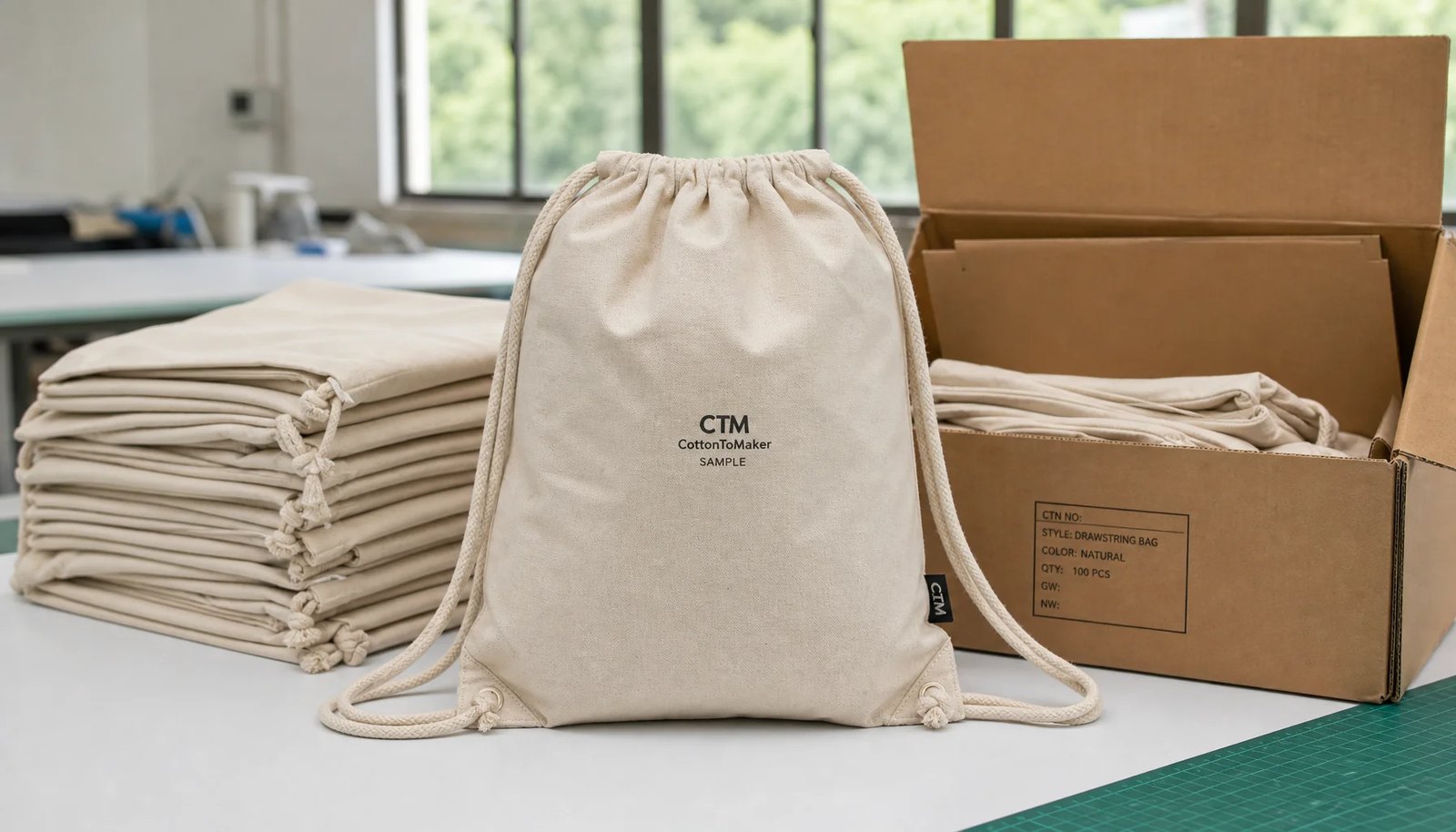
Start Carton Planning Before the Bag Is Final
For cotton drawstring backpacks shipping carton planning for university bookstores, the carton is not a last-minute warehouse detail. It affects fabric choice, folded size, print curing time, receiving labor, freight class, and whether the bookstore can process the order during a short campus selling window. A bag that looks correct on the approval sample can still create problems if the final carton is too heavy, too soft, poorly labeled, or packed in a way that wrinkles the printed logo.
University bookstore orders often involve many small variations: campus logo, department logo, event year, color assortment, or retail barcode. If those variations are not reflected in the carton plan, receiving teams spend time opening boxes, recounting stock, and separating SKUs. The buyer’s RFQ should connect the product specification with the packing method, instead of asking for a bag price first and carton details later.
- Treat carton quantity, folded size, and gross weight as quoted specifications, not warehouse estimates.
- Use the same carton logic for samples, production approval, freight quote, and receiving instructions.
- Avoid approving a bag sample without seeing how the printed panel behaves after folding and packing.
- Write the packing method into the purchase order so the factory does not substitute a cheaper carton plan.
Choose Fabric Weight With Carton Cube in Mind
Cotton drawstring backpacks for bookstores are commonly made from 5 oz, 6 oz, 8 oz, or 10 oz cotton fabric. In GSM terms, that usually means roughly 170 GSM, 200 GSM, 270 GSM, and 340 GSM, depending on supplier conversion and fabric construction. A lighter 5 oz bag can work for low-cost giveaways, but it may look thin when printed with a bold university logo. An 8 oz cotton backpack gives better body and perceived value while still packing efficiently.
Fabric weight changes more than unit cost. It changes folded thickness, carton cube, gross weight, seam stress, and the number of cartons per pallet. A buyer comparing two quotes should not only look at the unit price. A low unit price using thinner cotton may require more quality complaints management, while a heavy canvas version may push freight cost and make cartons difficult for bookstore staff to lift.
- Use 5 oz to 6 oz cotton for large event giveaways where price and freight cube matter most.
- Use 8 oz cotton for bookstore retail programs, orientation kits, or co-branded merchandise.
- Use 10 oz cotton only when durability and premium handfeel justify lower carton quantity.
- Request both fabric weight in oz and GSM because suppliers may use conversion terms loosely.
- Include acceptable fabric shrinkage if the backpack may be washed by end users.
Define the Backpack Construction That Affects Packing
A cotton drawstring backpack is simple, but small construction choices affect packing density. The common 14 x 18 inch size folds flatter than oversized versions, and a simple top drawstring channel packs better than thick padded details. Reinforced bottom corners are useful because the cords carry weight at stress points, but bulky corner patches can create uneven stacks inside the carton.
Drawcord selection also matters. Cotton rope supports a natural campus merchandise look, but it can be thicker and less slippery than polyester cord. Polyester cord may pack smaller and pull smoother, but it can look less aligned with an eco-positioned cotton bag. The buyer should define cord diameter, color, end finish, and attachment method so the factory does not quote a thin cord to protect unit price.
- Specify open dimensions, seam allowance expectation, and whether the bag has boxed corners or flat seams.
- Define cord diameter and material instead of accepting the supplier’s default drawcord.
- Require reinforced lower cord points for backpacks expected to carry books, bottles, or apparel.
- Confirm whether cord knots, metal tips, plastic tips, or sewn ends are allowed.
- Measure the packed sample after cords are included because cord bulk changes carton fit.
Select Printing That Survives Folding and Transit
Most bookstore cotton drawstring backpacks use screen printing because campus logos are often solid color, repeatable, and cost-sensitive. Screen print is reliable when the artwork has clean edges, the fabric surface is stable, and the ink is cured properly. For complex gradients, photo-style art, or short pilot runs, heat transfer may be considered, but it can add handfeel stiffness and may not age the same way on cotton fabric.
Carton planning should include print drying and curing time. If printed backpacks are folded and packed too soon, ink can transfer, block, or crack at fold lines. Dark ink on natural cotton and large white ink areas on colored cotton need particular attention. The RFQ should require print tests and packed sample review, not just an artwork proof on a flat bag.
- Use screen print for one to three color bookstore logos and repeat campus programs.
- Request Pantone or approved color references, but allow a realistic tolerance on cotton fabric.
- Set print placement tolerance, such as within 5 mm to 10 mm depending on logo size.
- Test ink cure with dry rub, wet rub where relevant, tape pull, and light stretch at the print edge.
- Avoid folding through a heavy ink area when an alternate fold can protect the logo.
Build the MOQ Around SKUs, Not Total Units
Minimum order quantity is often misunderstood in bookstore programs. A supplier may accept 1,000 total pieces, but the practical MOQ can be per fabric color, per print design, per cord color, or per packing method. Ten campus departments ordering 100 pieces each may create more setup work than one bookstore ordering 1,000 pieces under one logo. The quote should show exactly where the MOQ applies.
Carton planning becomes more complex when many small SKUs are involved. Mixed cartons may reduce freight cube, but they increase receiving risk unless the carton mark and inner packing are disciplined. Separate cartons by SKU are easier for the bookstore but may create half-empty cartons. The buyer needs to decide whether receiving simplicity or freight efficiency has priority.
- Request MOQ per body color, per logo, per print color change, and per label or barcode variation.
- Separate setup charges from unit cost so small runs can be compared honestly.
- Use mixed cartons only when the carton has a clear assortment sheet and inner bundle separation.
- Avoid forcing too many low-volume SKUs if the bookstore receiving team cannot audit them quickly.
- For repeat programs, standardize fabric color and packing while changing only the print design.
Set Carton Quantity by Weight, Cube, and Handling
A round carton count such as 100 pieces per carton is easy to write but not always correct. For cotton drawstring backpacks, the better method is to simulate the folded bag stack, then balance carton cube, gross weight, carton strength, and receiving convenience. A carton that is too large may crush or arrive rounded at the sides. A carton that is too heavy may create handling complaints at the bookstore dock.
For export shipments, 5-ply corrugated cartons are usually safer than thin cartons, especially when the goods move through consolidation warehouses, ocean freight, and campus distribution. The carton should be strong enough for stacking but not so oversized that bags shift inside. If the buyer plans parcel delivery to individual stores, carton size and weight may need stricter limits than a full-pallet warehouse delivery.
- Request estimated carton dimensions in length, width, and height, plus gross weight and net weight.
- Limit carton weight to a handling level suitable for the destination, often around 15 kg to 20 kg for manual receiving.
- Use 5-ply export cartons for ocean freight or mixed handling routes.
- Avoid overcompression because it can create deep fold marks and distort printed panels.
- Require carton fit photos before mass shipment if the order has a new size, heavier fabric, or individual polybag.
Decide Between Bulk Pack and Retail-Ready Pack
Bulk packing is efficient for event giveaways and back-room distribution. The factory can fold the bags flat, group them into bundles, and place them into export cartons with less material and labor. For a bookstore selling the backpacks individually, bulk packing may create extra labor because staff must add price tags, barcodes, or hangtags after receiving. The lower factory packing cost can shift work to the buyer’s warehouse.
Retail-ready packing may include individual polybags, barcode stickers, hangtags, size or color labels, and sometimes shelf-ready inner cartons. It improves stock control but increases material cost, packing labor, carton cube, and sustainability concerns. University buyers may also have restrictions on disposable plastic. A paper band around bundles or individual paper sleeves may be a better compromise when the program wants cleaner presentation without full polybagging.
- Use bulk bundles for orientation kits, campus events, and internal distribution.
- Use individual packing when the bookstore needs barcode scanning, clean shelf stock, or direct store allocation.
- Specify whether polybag suffocation warnings are required for the destination market.
- Confirm barcode size, position, scan grade expectation, and SKU data before mass labeling.
- Compare freight cube after packing, not only the cost of the packing material.
Approve Samples Using Packing Acceptance Criteria
A flat sample approval is not enough for this product. The buyer should approve the bag, print, folded shape, bundle method, carton fit, and carton mark. A pre-production sample can be sent as one bag, but for carton planning the better evidence is a packed bundle or carton simulation using the same fabric weight, cord, print, and packing material planned for production.
Acceptance criteria should be measurable. Instead of saying the bag should be packed neatly, define the fold direction, maximum visible crease on the print, bundle quantity, carton quantity, and acceptable carton bulging. If a logo sits near the fold line, approve the fold method before bulk packing. This prevents a factory packing team from choosing the fastest fold rather than the safest fold for the printed face.
- Approve one open sample and one folded packed sample before production packing.
- Record the folded width, folded height, and stack thickness for a fixed number of pieces.
- Compare print color and placement after the sample has been folded for at least 24 hours.
- Check drawcord function after unpacking because tight bundles can twist or trap cords.
- Keep approval photos with measurements so QC can compare production cartons.
Use Carton Labels That Match Bookstore Receiving
Carton marks should be written for the people receiving the goods, not only for the exporter. A good carton label includes purchase order, SKU, design name, color, quantity, carton number, total carton count, gross weight, net weight, carton dimensions, and destination code if the order ships to multiple campuses or stores. If the bookstore works through a 3PL, the 3PL may also require routing labels or advance shipment notice data.
Mixed cartons need special control. A carton containing multiple colors or designs should have the outside mark state that it is mixed, and the inside should include an assortment sheet. Inner bundles should be separated and marked so the receiving team can count without dumping the whole carton. This is especially important near semester openings, when bookstore docks are processing textbooks, apparel, supplies, and promotional merchandise at the same time.
- Use two-side carton marks so labels remain visible when cartons are palletized.
- Number cartons sequentially, such as 1 of 40, 2 of 40, and continue without duplicates.
- Do not allow unmarked mixed cartons unless the buyer has approved the exact assortment.
- Place barcode labels on a flat carton side, not across tape seams or crushed corners.
- Require final carton label photos before shipment release.
Compare Quotes by Landed Cost, Not Unit Price
Two suppliers can quote the same cotton drawstring backpack at different unit prices because they are not quoting the same packing. One quote may include 8 oz cotton, screen print, individual barcode polybag, 5-ply cartons, and detailed carton marks. Another may include 6 oz cotton, bulk loose pack, lighter cartons, and no barcode labels. The cheaper unit price may become more expensive once repacking, relabeling, freight cube, and receiving labor are included.
A practical landed-cost comparison should include product cost, print setup, sample fee, packing material, carton quantity, estimated carton cube, gross weight, inland freight, ocean or air freight, duty basis, destination handling, and any 3PL relabeling cost. The buyer does not need perfect numbers at RFQ stage, but the supplier must provide enough data to prevent surprises before booking freight.
- Compare cost per usable received unit, not only ex-factory unit price.
- Request carton cube and gross weight early so freight forwarders can estimate accurately.
- Separate optional packing costs, such as barcode labels and individual polybags, from the base unit cost.
- Include rejected or reworked packing risk when comparing very low carton specifications.
- Use the same artwork, fabric GSM, carton count, and packing method when comparing suppliers.
Specification comparison for buyers
| Spec decision | Recommended option | When it fits | Buyer risk to check |
|---|---|---|---|
| Fabric weight for bookstore giveaways | 6 oz to 8 oz cotton, about 200-270 GSM, pre-shrunk if washing is expected | Campus welcome packs, orientation kits, alumni event bags, and retail-priced basic drawstring backpacks | Below 5 oz may look flat after packing and can show print-through; above 10 oz increases carton weight and freight cost |
| Bag size and carton cube | Common size around 14 x 18 inches, with a clear max folded size agreed before production | Fits folders, apparel, water bottles, and bookstore merchandise without becoming oversized for parcel handling | A small size change can reduce units per carton; approve folded dimensions, not only open bag dimensions |
| Drawcord material | Cotton rope or polyester cord at consistent diameter, packed without hard creasing | Cotton cord gives a natural look; polyester cord slides more easily for high-volume student use | Thin cord can cut into the shoulder; thick cord raises weight and may deform the carton if overcompressed |
| Print method | Screen print for solid bookstore logos; heat transfer only for complex gradients or short pilot runs | Screen print is usually best for one to three color logos on cotton panels | Ink build-up, poor curing, and print cracking become more likely if the bag is packed before ink is fully dry |
| Individual packing | Flat bulk pack or individual polybag depending on retail shelf use and receiving requirements | Bulk pack lowers material and labor cost; polybag supports barcode handling and cleaner retail presentation | Individual polybags increase carton volume and may trigger sustainability objections from campus buyers |
| Units per inner bundle | Bundle 10 or 25 pieces with a paper band or clear count mark | Helps bookstore receiving teams count stock without opening the full carton on a busy dock | Loose bulk packing causes count disputes and makes mixed color assortments harder to audit |
| Export carton strength | 5-ply corrugated carton for ocean or mixed handling, with edge tape and moisture control where needed | Works for importers consolidating with apparel, stationery, or gift merchandise | Thin cartons crush when cotton bags are compressed; crushed cartons create retail receiving claims even if bags are usable |
| Carton marking | Two-side carton marks with PO, SKU, color, quantity, gross weight, net weight, carton number, and destination code | Necessary for university bookstores, distributors, and 3PL warehouses handling multiple campus SKUs | Missing carton numbers or mixed SKUs inside one carton create receiving delays and chargebacks |
Buyer checklist before sampling
- Define the open bag size, folded size target, fabric GSM, cord type, print location, and print color before requesting carton dimensions.
- Decide whether the bookstore needs retail-ready individual polybags, bulk bundles, or barcode labels before the supplier quotes packing labor.
- Require a pre-production sample packed in the proposed way, then measure the actual folded thickness and carton fit.
- Set carton quantity by weight and cube, not only by a round number such as 100 pieces per carton.
- Limit gross carton weight to a level your receiving dock and parcel carrier can handle without repacking.
- Specify whether mixed colors or mixed designs are allowed in one carton, and require an assortment sheet inside the carton if they are.
- Approve carton marks, SKU labels, and barcode placement before mass packing starts.
- Request carton photos showing open-carton packing, sealed carton, side marks, gross weight, and carton dimensions.
- Include moisture control expectations for ocean shipments, especially for natural cotton and long transit routes.
- Keep one sealed production carton as a reference sample until bookstore receiving is completed.
Factory quote questions to send
- What fabric weight in oz and GSM are you quoting, and is the cotton plain weave, twill, or canvas?
- What is the proposed open bag size, seam allowance, drawcord diameter, and reinforced corner construction?
- What print method, ink type, curing process, print size, and number of print colors are included in the price?
- What MOQ applies per fabric color, per print design, and per packing style?
- How many pieces will be packed per bundle and per export carton, and what are the expected carton dimensions?
- What are the estimated gross weight and net weight per carton after production packing?
- Will the quote include individual polybags, barcode labels, hangtags, inner bundles, desiccants, and carton marks?
- Can you provide a packed pre-production sample or carton simulation before mass packing approval?
- What sample lead time, bulk production lead time, and packing completion date are assumed in the quote?
- What inspection standard will be used for stitching, print placement, color matching, carton count, and carton drop resistance?
Quality-control points to confirm
- Fabric GSM tolerance should be agreed, commonly within plus or minus 5 percent unless the buyer accepts a wider commercial tolerance.
- Bag open size and folded size should be measured on production samples, not estimated from the pattern only.
- Print placement should have a written tolerance, such as within 5 mm to 10 mm depending on artwork size and fabric behavior.
- Screen print curing should be tested by rub, tape, and light stretch checks before packing.
- Drawcord pull strength should be tested at both top channel and bottom corner attachment points.
- Seam allowance, backstitching, and corner reinforcement should be checked because backpacks carry more load than simple pouches.
- Carton quantity should be counted by bundle and verified against carton marks before sealing.
- Gross weight and carton dimensions should be checked against the booking data used for freight quotation.
- Carton compression, tape sealing, and edge condition should be reviewed before shipment release.
- Moisture, odor, and mildew risk should be inspected before loading, especially for unbleached cotton.