Start With the Skincare Kit Route
Carton planning for cotton drawstring backpacks should start with the route the bag will take, not with a default carton count. A backpack shipped empty to a brand warehouse has different risks from one sent to a co-packer, distributor, retailer, or factory kitting line. Empty bags need efficient CBM and clean folding. Co-packer shipments need easy counting, version separation, and predictable opening presentation. Pre-loaded skincare kits need stronger cartons and testing with the actual bottles, jars, sleeves, and inserts inside.
For procurement, the first RFQ line should explain the commercial use: gift-with-purchase, retail bundle, spa welcome kit, sampling program, launch mailer, or distributor pack. That one detail changes fabric selection, inner packing, carton strength, label data, and inspection points. A carton plan that saves a few cents per unit can become expensive if a co-packer has to sort mixed versions, remove damaged polybags, or reject cartons with crushed front logos.
- Empty backpack shipment: optimize fold consistency, carton count, CBM, and carton label accuracy.
- Co-packer shipment: prioritize fast counting, bundle control, clean presentation, and SKU separation.
- Pre-loaded kit shipment: test carton compression and drop handling with real skincare components inside.
- Retail program shipment: protect the front-facing logo and avoid fold lines through premium artwork.
- Distributor shipment: separate region, language, retailer, fragrance line, and campaign code on carton marks.
Define Fabric Weight as a Planning Range
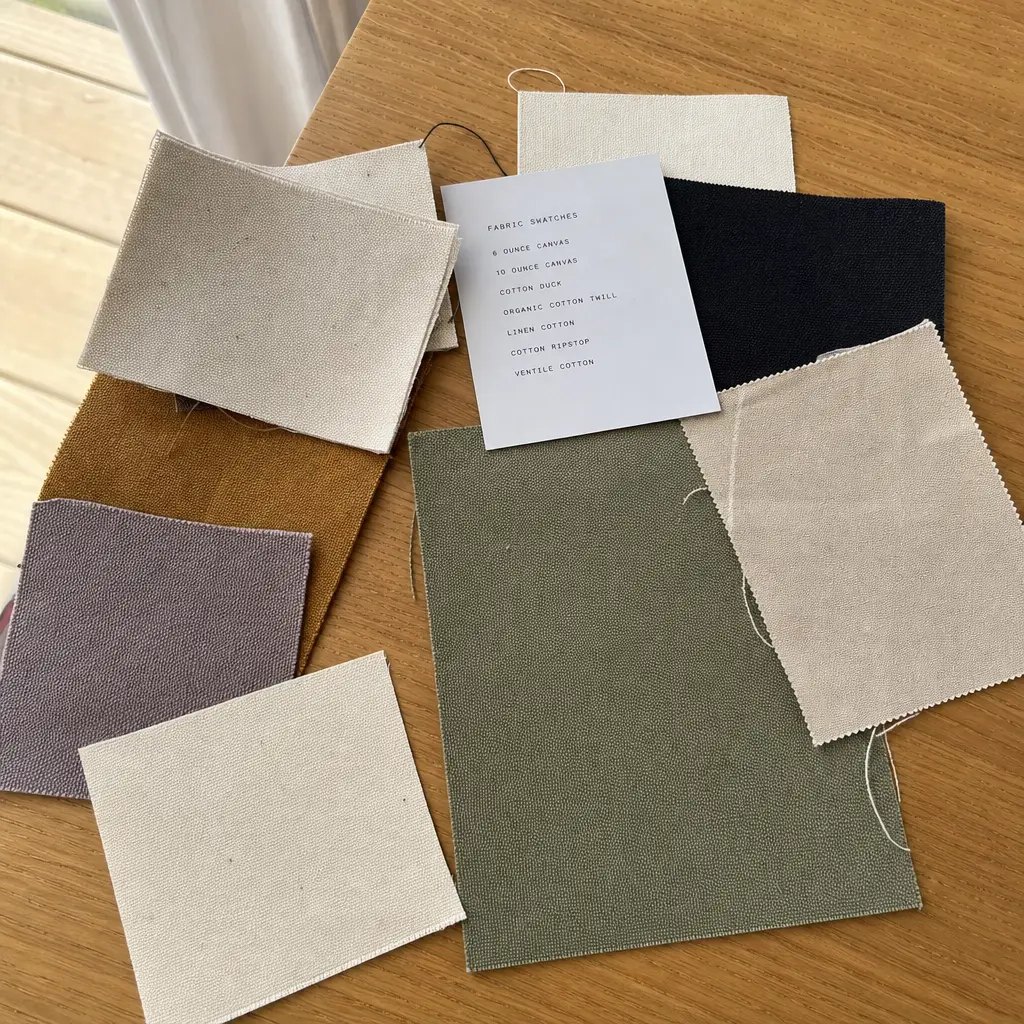
Fabric weight drives carton quantity, gross weight, folded thickness, and presentation. For skincare promotions, 6 oz to 8 oz cotton canvas is often a practical planning range because it has more structure than very light cotton without creating unnecessary bulk. Lightweight 5 oz cotton can work for simple sampling or event giveaways. Heavier 10 oz canvas may suit refill sets or higher-value retail bundles, but it can reduce pieces per carton and raise freight cost.
These weights are planning ranges, not fixed universal standards. Mills, weave types, finishing, washing, and moisture content can change the actual GSM and hand feel. As a rough conversion for RFQ discussion, 5 oz may be near 170 GSM, 6 oz near 200 GSM, 8 oz near 270 GSM, and 10 oz near 340 GSM. Procurement should ask the supplier to state the quoted GSM or oz, the fabric finish, and the tolerance used for bulk acceptance.
- Use 5 oz to 6 oz only when the bag carries light samples or ships as an empty promotional item.
- Use 6 oz to 8 oz as the first planning range for most skincare GWP and retail kit backpacks.
- Consider 10 oz only when the kit contains heavier bottles, refill packs, or premium retail contents.
- Ask whether natural cotton shade variation is acceptable, or whether a controlled dyed shade is required.
- Do not compare unit prices unless fabric weight, weave, finishing, and shrinkage assumptions are aligned.
Size the Backpack From Real Products
A flat artwork file does not prove that the backpack will fit the skincare kit. Rigid cartons, pump caps, glass jars, folded tissue, and insert cards all change the loading shape. A bag that is technically wide enough may still distort the logo when the drawcord is pulled tight around product corners. A bag that is too tall may make the final kit feel loose and underfilled.
A common finished size around 34 x 42 cm can work for many promotional backpacks, but procurement should treat this as a starting point only. Measure the tallest product or wrapped bundle, then leave clearance before the drawcord channel. If products are loaded side by side, width matters more than height. If products are stacked, bottom seam strength and shape retention become more important. A simple fit test with product dummies before bulk approval prevents repacking and redesign later.
- Add about 20-30 mm clearance above the tallest product before the drawcord channel begins.
- Allow extra width when several boxed products are inserted side by side.
- Keep the main logo visible when the filled backpack is closed, not only when it is flat.
- Avoid fine artwork near side seams, bottom folds, cord knots, and high-pressure fold lines.
- For heavy bottles or jars, review seam construction before simply increasing fabric weight.
Connect Print Approval to Folding
For skincare brands, print quality often carries the brand impression more than the bag construction. Water-based screen print is a strong option for clean logos, one-color marks, and repeated production because it can sit naturally on cotton when cured correctly. Heat transfer may be useful for gradients, small runs, or complex artwork, but the hand feel and fold behavior should be approved on the actual fabric.
The print decision must be connected to carton planning. Thick ink coverage can crack at fold lines, transfer to adjacent bags, or show pressure marks after cartons are stacked. A logo that looks clean on an open sample may fail when the fold passes through the center of the artwork. Before mass packing, approve a folded sample that uses the final fabric, print method, cord, inner packing, and proposed carton quantity.
- Use screen print for simple brand marks and larger repeat orders where color consistency matters.
- Use heat transfer when detail or low quantity justifies the different surface feel.
- Keep the main logo away from hard folds, cord knots, and carton compression points.
- Require dry rub testing for dark prints and wet rub testing when bags touch light cartons or tissue.
- Do not allow bulk packing until printed panels are cured, cooled, and free of tackiness.
Build the Carton Plan With Numbers
Pieces per carton should be calculated from folded thickness, carton strength, gross weight, handling limits, and freight cost. For empty cotton drawstring backpacks, 100 to 200 pieces per carton is a common planning range, not a standard. A 6 oz bag may pack well at 150 pieces. An 8 oz bag with cotton rope, individual polybag, and a large front print may need 100 to 120 pieces to protect presentation.
A worked example makes the tradeoff clear. Assume a 5,000-piece order of 34 x 42 cm, 8 oz cotton drawstring backpacks with cotton rope and paper-band packing. If the supplier proposes 120 pieces per carton in a 50 x 40 x 34 cm carton, each carton is 0.068 CBM. The order needs 42 cartons, or about 2.856 CBM, with an estimated gross weight of 15 kg per carton and 630 kg total gross weight. If the supplier changes to 150 pieces per carton in a 50 x 40 x 38 cm carton, each carton is 0.076 CBM. The order needs 34 cartons, or about 2.584 CBM, with an estimated gross weight of 18 kg per carton and 612 kg total gross weight. The second plan saves about 0.272 CBM and eight cartons, but it may increase pressure on the logo and drawcord channel. That is a commercial decision, not just a packing decision.
- Ask for pieces per carton, carton dimensions, net weight, gross weight, total cartons, and total CBM in every quote.
- Compare CBM per piece as well as total shipment CBM.
- Set a maximum gross carton weight that the receiving warehouse will accept.
- Require actual packed sample measurements before freight booking.
- Reject carton plans that save volume by crushing the front print or deforming the drawcord channel.
Select Inner Packing for the Next Handler
Inner packing should match the next handling step. Bulk packing can be efficient when the goods go to a warehouse that counts by master carton. Bundles of 10 or 20 can speed counting without creating individual plastic waste. Paper bands can keep folded bags neat for lower-plastic programs. Individual polybags protect light cotton and premium presentation, but they add cost, carton volume, and unpacking labor at the co-packer.
The RFQ should avoid vague language such as standard packing. State the fold direction, whether the logo faces inward or outward, whether the cord knot is kept away from the print, bundle count, inner label need, and barcode requirement. For light natural cotton, also consider dust control, carton paper transfer, and moisture. A clean bag that arrives with lint, odor, or pressure marks can still fail a skincare brand's presentation standard.
- Use bulk packing only when dust risk, counting method, and presentation expectations are low risk.
- Use bundles when the warehouse or co-packer needs fast count verification.
- Use paper bands when neat folding and reduced plastic are both priorities.
- Use individual protection when the bag is light colored, premium, or handled through several locations.
- Match inner labels to the same SKU and campaign version used on the master carton.
Use Carton Marks as Version Control
Skincare brands often run several similar backpack versions at the same time: different fragrance lines, skin types, languages, retail chains, regional claims, or seasonal artwork. If carton marks only say cotton backpack and quantity, warehouse teams may mix versions before anyone opens the goods. The mistake may not be found until a distributor or co-packer receives the wrong campaign component.
Good carton marks connect the physical carton to the purchase order, SKU, artwork version, destination, and packing list. They also make receiving faster for 3PL teams. Approve the carton mark template before packing starts, not after cartons are already sealed. For split shipments, each destination should have its own carton numbering and packing list so partial shipments can be reconciled without opening every carton.
- Include item name, PO, SKU, color, print version, quantity, carton number, carton size, net weight, and gross weight.
- Add destination, retailer, language, or campaign code when versions look similar.
- Use carton numbering such as 1 of 42 for each shipment or destination split.
- Keep shade lots separated if natural or dyed cotton varies noticeably.
- Make sure packing list totals match physical carton count, carton marks, and invoice data.
Control MOQ, Splits, and Lead Time Early
MOQ pressure often appears after the buyer has already compared prices. A 5,000-piece order in one natural cotton fabric with one logo is not the same production job as 5,000 pieces split across five retailers, three languages, two drawcord colors, and several carton marks. Splits create more setup time, more staging space, more inspection work, and more risk of mixed cartons.
Lead time should also include packing decisions. Fabric purchase, artwork proof, print trial, pre-production sample, bulk sewing, trimming, pressing, inner packing, carton label approval, final inspection, and freight handover all take time. If carton size or carton strength is decided after production, the factory may need to repack finished goods. For launch calendars, the packed pre-production sample should be approved before bulk packing materials are ordered.
- Provide the supplier with a split table by color, artwork, language, destination, and carton mark.
- Keep fabric and cord consistent across versions when possible to reduce setup pressure.
- Approve carton labels and packing list format before cartons are printed or sealed.
- Allow extra time for dyed fabric, custom cords, special labels, multiple artworks, or retailer compliance marks.
- Do not schedule freight pickup for the same day mass packing is expected to finish.
Inspect Cartons, Not Only Bags
Final inspection should cover the backpack and the shipping carton as one system. A bag can pass sewing inspection and still arrive poorly if the carton is weak, overfilled, damp, mislabeled, or stacked under heavier goods. For export orders, agree on inspection level, AQL, defect classification, and carton checks before production starts. A common planning approach is General Inspection Level II under ANSI/ASQ Z1.4 or ISO 2859-1, with critical defects at zero tolerance and AQL targets such as 2.5 for major defects and 4.0 for minor defects, if appropriate for the buyer's risk level.
Carton checks should include quantity per carton, carton dimensions, gross weight, compression condition, tape strength, label legibility, numbering, moisture, odor, and SKU separation. For shipping carton planning, a simple landed-cost comparison is only reliable when the packing data is real. Ask the supplier to update estimates after the packed sample and confirm that the final packing list matches the physical cartons.
- Open sampled cartons and count pieces instead of checking only the master packing list.
- Measure actual carton dimensions and compare them with the approved freight estimate.
- Check for bulging, crushed corners, weak tape, damp board, mold risk, and unreadable labels.
- Confirm that similar campaign versions are not mixed in the same carton unless approved.
- Hold shipment release until carton data, inspection results, and packing list totals match.
Specification comparison for buyers
| Carton scenario | Planning data to request | Commercial impact | Buyer decision |
|---|---|---|---|
| Scenario A: 150 pieces per carton, tight fold | Carton 50 x 40 x 38 cm, 0.076 CBM, gross weight 18 kg, 150 pcs, 0.00051 CBM per pc | Lower CBM and fewer cartons, but higher compression risk on front print and cord knots | Use only after packed sample confirms no logo creasing, print transfer, or distorted drawcord channel |
| Scenario B: 120 pieces per carton, safer fold | Carton 50 x 40 x 34 cm, 0.068 CBM, gross weight 15 kg, 120 pcs, 0.00057 CBM per pc | Slightly higher CBM per piece, easier handling, less pressure on folded artwork | Often the safer planning option for premium skincare kits or light-color cotton |
| Scenario C: 100 pieces per carton, individual polybag | Carton 52 x 42 x 36 cm, 0.079 CBM, gross weight 14 kg, 100 pcs, 0.00079 CBM per pc | Higher freight volume and unpacking labor, but better dust and handling protection | Use when presentation risk is higher than freight sensitivity, especially for retail kitting |
| Scenario D: 200 pieces per carton, bulk pack | Carton 55 x 45 x 45 cm, 0.111 CBM, gross weight 24 kg, 200 pcs, 0.00056 CBM per pc | Good CBM per piece but heavy cartons may create warehouse handling and drop-damage risk | Use only if receiving warehouse accepts the weight and carton compression test is acceptable |
| Sea freight comparison point | Total CBM, total cartons, carton stack height, moisture control, carton board grade | Volume usually drives cost for empty textile goods; weak cartons can collapse in long transit | Compare suppliers by CBM and carton quality, not only FOB unit price |
| Air freight comparison point | Gross weight, dimensional weight, carton count, shipment urgency | Chargeable weight may change when carton size increases for presentation protection | Use a packed sample measurement before approving urgent launch freight |
| 3PL receiving comparison point | Carton marks, SKU separation, carton numbering, inner bundle count | Poor marks and mixed versions increase receiving time and misallocation risk | Require carton mark approval and version-separated packing lists before shipment |
Buyer checklist before sampling
- Confirm whether the backpacks ship empty, go to a co-packer for skincare kit assembly, or ship as pre-loaded retail kits.
- Measure the largest skincare carton, bottle, jar, or wrapped bundle and confirm bag size from the real loading direction.
- State fabric weight as a planning target in oz and GSM, and note whether it is a planning range rather than a fixed industry standard.
- Define drawcord type, cord diameter or tape width, cord color, knot finish, channel width, and any metal tip or aglet requirement.
- Approve one folded unit showing logo position after folding, cord knot placement, inner packing, and protection from print pressure marks.
- Set a maximum gross carton weight before finalizing pieces per carton, especially if warehouse handling is manual.
- Require quote data for pieces per carton, carton dimensions, net weight, gross weight, total cartons, and total CBM.
- Ask the supplier to update estimated carton data after a packed pre-production sample is made.
- Approve carton marks covering PO, SKU, artwork version, color, quantity, carton number, gross weight, net weight, dimensions, and destination.
- Separate carton marks for fragrance line, language, retailer, region, or campaign version when similar bags run together.
Factory quote questions to send
- What fabric weight is included in GSM and oz, and is it natural, bleached, dyed, washed, or unwashed cotton?
- Is the stated fabric weight a confirmed bulk specification or a planning range that may vary by mill tolerance?
- What finished size tolerance applies after sewing and pressing, and how is cotton shrinkage controlled before cutting?
- Which print method is quoted, how many colors are included, and what curing, dry rub, and wet rub checks are performed before packing?
- What is the proposed pieces per carton, carton size, net weight, gross weight, total carton count, and total CBM for the order quantity?
- Will carton data be measured from an actual packed sample before final carton ordering and freight booking?
- What inner packing is included: bulk pack, bundles, paper band, individual recyclable bag, or standard polybag?
- What export carton board grade is used, and is it suitable for sea freight stacking, humidity exposure, and repeated warehouse handling?
- Can you provide a packed pre-production sample, carton packing photo, and carton label proof before mass packing starts?
- How do price, MOQ, and lead time change if the order is split by color, artwork, language version, destination, or carton mark?
Quality-control points to confirm
- Use ANSI/ASQ Z1.4 or ISO 2859-1 sampling where applicable; common final inspection planning is General Inspection Level II with AQL targets agreed before production.
- For critical defects, set zero tolerance for wrong artwork, wrong SKU, mold, odor contamination, severe stains, unsafe metal tips, or mixed campaign versions.
- For major defects, define an AQL such as 2.5 for issues that affect saleability or kit assembly, including broken seams, poor drawcord function, wrong size beyond tolerance, or visible print failure.
- For minor defects, define an AQL such as 4.0 for small slubs, light shade variation, or slight packing marks that do not affect use or presentation.
- Measure finished backpack width, height, drawcord channel width, cord length, and print placement against the approved sample and tolerance sheet.
- Check fabric GSM, hand feel, shade lot, weave defects, slubs, stains, oil marks, lint, and odor before or during cutting.
- Verify print color, edge sharpness, curing, adhesion, dry rub resistance, and wet rub resistance when bags may contact light skincare packaging.
- Pull-test side seams, bottom corners, drawcord channel stitching, and bar tack points when reinforcement is part of the approved design.
- Open and close the drawcord repeatedly to confirm smooth running, no cord shedding, no channel tearing, and no excessive twisting.
- Inspect folded unit presentation so the front logo is not creased, scratched, blocked by knots, or pressed by cord tips.