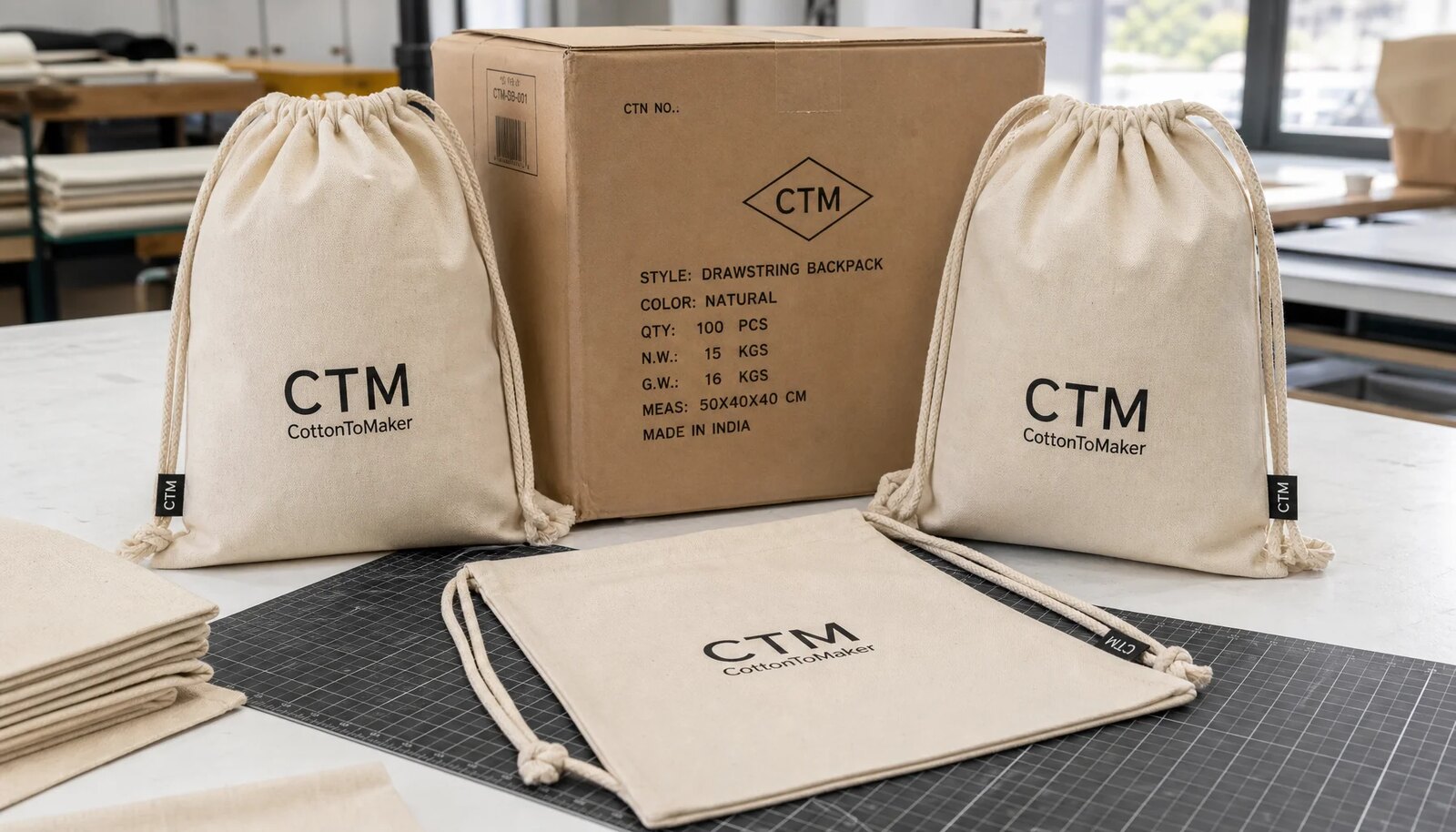
Why Cartons Need a Plan
Cotton drawstring backpacks look simple on a quote sheet. They are flat, soft, and familiar. The trouble usually appears later, when cartons arrive at a hotel dock, convention center, school gym, outdoor venue, or 3PL and the event team has two hours to sort thousands of bags by room, sponsor, booth, or volunteer station.
For B2B procurement, carton planning is part of the product specification. It affects freight cost, handling labor, storage space, shortage claims, and the pace of on-site setup. A carton that is cheap for the factory to pack can be expensive for the buyer to receive if it is too heavy, poorly marked, damp, crushed, or mixed in a way the event team cannot use.
Cotton drawstring backpacks also change volume as the specification changes. Fabric GSM, cord thickness, screen-print cure, heat-transfer film, embroidery, woven labels, patches, insert cards, and fold method all influence carton cube and gross weight. A 140 GSM printed giveaway bag will not pack like a 220 GSM canvas backpack with a stitched label and sponsor insert.
Good cotton drawstring backpacks shipping carton planning for event planners begins with one practical rule: quote, approve, inspect, and freight the bags in the same condition the venue will receive them.
- Treat carton count, carton weight, carton dimensions, and carton marks as controlled specifications.
- Plan cartons around receiving and distribution work, not only factory packing speed.
- Use one approved packing standard so product and freight quotes stay comparable.
- Avoid unclear mixed cartons when event staff need fast, low-error distribution.
Lock the Bag Before the Box
Carton math starts with the finished backpack, not with an estimated box size. Procurement should lock the finished dimensions, cotton type, fabric GSM, color, cord material, cord diameter, cord length, seam construction, reinforcement, decoration method, packaging inserts, and expected event contents before asking suppliers for final carton data.
For light handouts such as maps, schedules, brochures, or small samples, many promotional cotton drawstring backpacks sit around 120-160 GSM. Reusable conference or campus bags often move into the 180-220 GSM range. Premium merchandise or heavier contents may justify 240-300 GSM cotton or canvas. The heavier choice may be right, but it should be intentional because it increases unit weight, carton cube, and often reduces pieces per carton.
Tolerances should be written into the PO. A practical B2B approach is to define the target finished size with a tolerance such as +/- 1 cm for sewn cotton bags, unless the function requires tighter control. Print placement also needs a tolerance, often around +/- 5 mm to 10 mm depending on artwork size and production method. These numbers prevent arguments during inspection.
Decoration cannot be left vague. One-color screen print is usually efficient for larger simple-logo runs, but cure time and rub resistance still matter. Multi-color screen print needs setup and registration control. Heat transfer can handle detailed artwork, yet fold points and edge lift should be checked. Embroidery, woven labels, and patches add thickness and can press into nearby bags if cartons are packed too tightly. A blank-bag shipping estimate is not enough for decorated goods.
- Specify finished size, fabric GSM, color, weave or canvas type, and measurement tolerance.
- Include cord material, diameter, length, knot style, and reinforcement details.
- Define print or label placement with a written tolerance and artwork approval process.
- Require carton data based on final decorated, folded, and packaged bags.
Set Carton Limits Early
A useful quote gives the buyer more than a unit price. It should include finished unit weight, pieces per inner bundle, pieces per master carton, carton L x W x H, net weight, gross weight, carton board type, and closure method. With those details, procurement can estimate total cartons, total CBM, pallet footprint, courier dimensional weight, warehouse labor, and venue handling.
The densest carton is not always the smartest carton. When cases will be carried by hotel staff, volunteers, or temporary event teams, many buyers prefer gross weights around 8-12 kg. Dock teams and warehouses may handle 12-15 kg cartons comfortably, but the actual limit depends on stairs, elevators, liftgate access, receiving distance, local handling rules, and whether carts are available.
Dimensions need the same attention. Long cartons can be awkward to lift and more vulnerable at corners. Very small cartons are easy to move but multiply label scans, delivery touches, and receiving time. For palletized shipments, ask for a pallet pattern showing cartons per layer, number of layers, total cartons per pallet, loaded height, and label-facing direction. For parcel or courier delivery, ask the supplier or forwarder to calculate billable dimensional weight by carton.
Put the carton math into the quote comparison sheet. Supplier name, bag spec, decoration method, packaging method, units per carton, carton dimensions, gross weight, total cartons, total CBM, incoterm, freight estimate, and receiving notes should sit together. That view makes it easy to see when a lower piece price creates a bigger freight or handling problem.
- Request unit weight, pieces per carton, carton dimensions, net weight, and gross weight on every quote.
- Set a maximum carton gross weight before bulk packing begins.
- Calculate total cartons, total CBM, and dimensional weight before choosing freight mode.
- Ask for a pallet pattern when cartons will move through a warehouse, 3PL, or venue dock.
Match Counts to Distribution
Factories often pack for speed. Events need cartons packed for accuracy. If registration desks issue bags in batches of 100, cartons of 50 or 100 may beat a factory-preferred count of 72. If a hotel room drop is organized by floor, 25-count inner bundles may save the operations team hours. If sponsors receive separate allocations, the carton mark should identify sponsor, logo version, and quantity at a glance.
Ask the event operations team what happens after delivery. Will all cartons sit in one storage room, or will they be split across booths, classrooms, buses, meeting rooms, tents, or staff stations? Will volunteers have cutters, carts, gloves, time, and a clean counting surface? Can the venue accept pallets? Can cartons be stored away from moisture, dust, food service traffic, and public access?
Mixed cartons deserve caution. A carton with three colors, two logo versions, or several kit types can look efficient in production and become painful at receiving. Shortages are harder to prove, and staff may open every carton to find the right version. If mixed cartons are unavoidable, require a clear external mark and an internal packing list that shows the exact assortment.
Quantity language should be exact. If the program needs 4,000 attendee bags, 150 staff bags, and 50 spares, write those quantities into the PO. Do not rely on a loose phrase such as about 4,000 pieces. After export or venue delivery, fixing a shortage before the event may not be possible.
- Ask how many bags each room, desk, booth, floor, wave, or volunteer group needs.
- Use carton or inner-bundle counts such as 25, 50, or 100 when they match distribution.
- Keep colors, logo versions, and kit types in separate cartons whenever practical.
- Add event routing marks so cartons can move directly to the right location.
Choose Protective Packing
Packaging should match the route, the decoration, and the presentation standard. Individual polybags keep cotton cleaner, reduce cord tangling, and help printed panels avoid rubbing during long transit. They also add cost, labor, plastic waste, and carton volume. Tissue can improve presentation for premium kits but slows packing and may compress unevenly. Paper bands or counted bundles keep bags countable with less material, but they offer limited moisture protection.
For many basic event giveaways, a consistent flat fold with cords tucked inward is enough if cartons are clean, dry, and sealed correctly. The fold still needs approval. A fold through a screen print can leave a crease, especially if ink is packed before full cure. Heat transfers can crack or show gloss variation at fold points. Raised embroidery, patches, and woven labels should not press directly into the next bag under carton pressure.
Moisture control needs a specification, not a casual note. Cotton can absorb humidity and odor during storage, ocean freight, or long domestic routing. Depending on the route, the buyer may require dry cartons, clean packing tables, carton liners, sealed polybags, desiccant, moisture-resistant outer cartons, or pallet covers. These controls only work when applied consistently.
If insert cards, hangtags, sponsor flyers, barcodes, or inner labels are included, their placement should be photographed. Inserts change density and can bend if they shift inside the folded bag. A good packed-carton photo set shows one folded bag, one inner bundle if used, the first carton layer, the full carton before closure, the carton label, the measured carton, and the carton on a scale.
- Use individual polybags when cleanliness, print protection, moisture protection, or premium presentation justifies added cube.
- Use paper bands or counted bundles when quick event counting is more important than individual wrapping.
- Keep folds away from sensitive decoration whenever the bag shape allows it.
- Document liner, desiccant, tissue, insert, barcode, and band placement with photos.
Write a Quote-Ready RFQ
A strong RFQ removes guesswork. It should include finished dimensions, dimension tolerance, fabric GSM and tolerance, fabric color, cord type, cord color, reinforcement, decoration method, artwork size, number of colors, print placement, label or patch details, packaging method, target carton count, maximum carton gross weight, carton marking requirements, incoterm, delivery deadline, and inspection expectations.
Artwork requirements should be production-ready. State vector file needs, Pantone or brand color references where relevant, maximum print area, whether the logo may cross a fold, whether a digital proof is enough, and whether a physical strike-off is required. When the event uses multiple sponsor logos, ask whether each version carries its own setup charge, MOQ, schedule, and carton mark.
MOQ questions should be separated by component. A supplier may have one MOQ for blank stock, another for cut-and-sew production, another for screen printing, another for embroidery, another for woven labels, and another for printed cartons. Ask for price breaks that match real planning quantities, such as 1,000, 2,500, 5,000, and 10,000 pieces. Also ask what changes when the order is split across colors or logo versions.
Freight should be quoted on the same physical basis. EXW, FOB, and delivered options are useful only when they use the same pack count, carton size, and gross weight. If freight is included in the unit price, request the carton assumptions behind that number.
- Attach one controlled spec sheet and require suppliers to quote that exact version.
- Ask for carton count, dimensions, gross weight, total CBM, and packing method with every quote.
- Separate product price, decoration setup, packing, inland freight, export charges, and main freight.
- Request MOQ and price breaks for blank, printed, labeled, and custom-packed versions.
Approve Shipping-Condition Samples
A fresh flat sample is helpful, but it does not prove the order will arrive ready for distribution. The buyer should approve the backpack as a finished item and then review how it behaves after folding, bundling, and cartoning. Check wrinkles, print blocking, cord tangling, raised decoration pressure, and the way the bag looks after normal carton compression.
If the backpack will carry a notebook, brochure pack, bottle, apparel item, or sponsor materials, test a realistic fill weight before approving construction. A seam that looks fine on an empty sample may fail when the bag is used on-site. Cord tunnels, lower corners, side seams, and bar-tacks deserve extra attention because event users tend to load quickly and pull hard.
A packed sample can be a physical pilot carton for large or sensitive programs. For simpler orders, a detailed photo set may be enough. The reference should show the approved fold, bundle or polybag method, carton loading sequence, full carton before closure, tape or strap closure, carton marks, measured dimensions, and gross weight.
Sample approval should name tolerances. State acceptable variation for bag dimensions, print position, fabric shade, cord length, and carton quantity. Cosmetic tolerance can be practical for giveaway items, but structural failures, uncured print, strong odor, dirty cotton, wrong logo version, wrong color, or inaccurate carton counts can disrupt the event.
- Approve one finished product sample and one packed sample standard before mass production.
- Test realistic contents if the backpack will carry event materials.
- Record tolerances for dimensions, print placement, cord length, fabric shade, and carton count.
- Use first-production packed-carton photos as the reference before all cartons are sealed.
Inspect in Three Layers
QC works best when it is split into product quality, decoration quality, and carton quality. Product checks cover fabric GSM, finished dimensions, seam strength, cord length, cord channel stitching, corner reinforcement, loose threads, stains, odor, and workmanship. Decoration checks cover logo placement, color, opacity, cure, adhesion, rub resistance, embroidery backing, patch attachment, and fold performance.
Carton checks are just as important. Verify pack count, carton dimensions, gross weight, label accuracy, board condition, closure, moisture condition, and match to the approved packing standard. Random carton remeasurement is useful because a small packing drift can change total CBM and handling weight across a large order.
Inspection should sample across the order. Do not check only the easiest open carton. Multiple colors, logo versions, sponsor versions, or production batches should each be represented. If cartons are marked by room, booth, department, or sponsor, the inspector should verify that the contents match the mark. For palletized delivery, labels should face outward according to the receiving plan.
Print cure deserves special attention because cotton bags are often folded soon after decoration. Under-cured ink can transfer, smell, crack, block, or rub off. Practical checks may include dry rub, light abrasion, fold testing, and tape testing where appropriate for the ink and fabric. Heat transfers should be checked at edges and flex points. Embroidery should be checked for thread tension, backing trim, and pull resistance.
- Inspect product, decoration, and carton quality as separate categories.
- Check every color, logo version, distribution batch, or production batch represented in the order.
- Verify carton count, carton labels, gross weight, and dimensions during inspection.
- Give the receiving team a short shortage and damage procedure before delivery.
Plan Freight Backward
Event orders should be scheduled backward from the setup date, not forward from the factory's most optimistic production estimate. The timeline should include artwork lock, sample making, sample transit, sample review, revisions, material booking, cutting, printing or embroidery, curing, sewing, trimming, packing, inspection, carton marking, export documents, freight booking, customs, inland delivery, delivery appointment, and venue receiving.
Different shipping modes change carton priorities. Sea freight rewards efficient cube, stable palletization, and early approval. Air freight rewards compact packing because dimensional weight can dominate cost, but cartons still need to protect cotton and decoration. Courier can be convenient for small or split shipments, yet oversize cartons can create steep surcharges. Domestic trucking to a venue may require liftgate service, appointment delivery, limited receiving hours, pallet restrictions, or labels by room.
When the calendar is tight, ask for a base scenario and a rush scenario. The base scenario should show normal sample approval, production, inspection, and freight. The rush scenario should state what changes: available fabric only, simplified decoration, expedited sampling, air freight, fewer packaging options, reduced carton customization, or tighter inspection windows.
Buffers belong on the riskiest steps. Artwork revisions and sample approval often consume more time than expected. Print curing, inspection booking, carton printing, export handoff, customs, and appointment delivery can also create delays. The goods should arrive before setup begins, not on the morning they are first needed.
- Work backward from the setup date, not only the public event date.
- Include sample approval, inspection, freight booking, customs, and appointment delivery in the schedule.
- Choose sea, air, courier, or trucking only after carton dimensions and gross weight are known.
- Ask for base and rush scenarios with separate cost and risk notes.
Compare Landed Cost Fairly
Landed cost comparison has to use the same physical shipment assumptions across suppliers. Put every quote into a worksheet with product price, decoration charge, setup charge, packaging cost, units per carton, carton dimensions, total cartons, total CBM, gross weight, incoterm, inland freight, export charges, international freight, customs estimate where applicable, delivery charges, and receiving notes.
Dimensional weight can surprise buyers. Cotton bags are soft, but loose folding, individual polybags, stiff transfers, patches, and insert cards can create bulky cartons. A cheaper bag that ships in larger cartons can lose its price advantage. The reverse can also happen: an overly dense carton may reduce freight but increase crushing, print transfer, moisture concentration, or venue labor.
Incoterms should be written clearly. EXW may look low but leaves the buyer responsible for pickup and export coordination. FOB can work well when the buyer controls the forwarder. Delivered-to-port or delivered-to-door quotes help budget holders, but only if the supplier separates freight from product cost and confirms the carton configuration behind the freight number.
Receiving labor belongs in the comparison even when it is not on the supplier invoice. Extra cartons, unreadable marks, mixed assortments, heavy cases, and venue repacking all consume time. For event planners, the best quote is not always the lowest unit price. It is the one that delivers usable bags in the correct count, dry, labeled, and practical to move.
- Normalize quotes by product spec, packaging method, units per carton, carton size, gross weight, and total CBM.
- Compare EXW, FOB, and delivered options only when the carton basis is identical.
- Include venue handling, sorting, storage, and repacking labor in the practical landed cost.
- Require a revised freight quote if pack count, carton size, or packaging changes after approval.
Specification comparison for buyers
| Procurement decision | Recommended carton-planning approach | When it fits | Buyer risk to check |
|---|---|---|---|
| Factory-direct cut-and-sew production | Approve one product spec, one fold, one master carton size, one pack count, and one carton-mark format before bulk packing | 1,000-20,000 pcs with stable artwork, fixed event dates, and buyer-controlled QC approval | Confirm carton dimensions, pack count, net weight, gross weight, and carton marks are based on finished decorated bags, not blank samples |
| Importer or trading company coordinating production | Require the trading company to own the final packing standard even if fabric sourcing, printing, or sewing moves between factories | Mixed colors, multiple logo versions, backup capacity, or programs with uncertain material availability | Ask who approves revised carton specs if the factory changes; require written notice before any carton-size or pack-count change |
| Domestic decorator using imported blank stock | Use when the event schedule is too tight for overseas decoration or when final delivery must be domestic | Rush events, small runs, late artwork, or simple logo decoration on stock cotton bags | Check whether original blank-stock cartons survive reshipment after decoration and whether repacking changes carton count or dimensional weight |
| Overseas supplier quoting landed cost | Accept bundled landed estimates only when product, packing, inland, export, freight, and delivery assumptions remain visible | Budget approval where the buyer needs one expected delivered cost | Require the carton data behind the freight quote; a landed number without carton CBM and gross weight cannot be audited |
| Blank cotton bags with light branding | Plan cartons around the final fold after print, label, insert, banding, or barcode work is added | Sponsor handouts, conference welcome kits, campus events, and volunteer programs | Blank-bag carton density often changes after decoration; request final packed-carton photos before shipment |
| One-color screen print on 140-180 GSM cotton | Use flat folds, allow curing time before packing, and check blocking or ink transfer under carton pressure | Large promotional runs with simple artwork and cost-sensitive freight | Verify print cure, rub resistance, odor, and whether tissue, paper bands, or interleaving are needed |
| Multi-color print, transfer, woven label, or patch | Reduce carton compression and inspect fold points, backing, raised areas, and pressure marks | Premium giveaways, retail-style merchandise, VIP kits, and sponsor-branded programs | Stiff or raised decoration can reduce pack count, mark adjacent bags, or create uneven stacks inside the carton |
| Distribution-ready event packing | Set carton or inner-bundle counts to match rooms, desks, booths, race waves, classrooms, departments, or sponsor allocations | Multi-room conferences, hotel drops, expos, festivals, races, school programs, and staff kits | Factory-efficient counts such as 72 or 96 may slow event sorting; request 25, 50, or 100-count units if operations need them |
| Palletized warehouse or venue dock delivery | Approve pallet pattern, max pallet height, carton orientation, stretch-wrap, corner protection if needed, and label-facing direction | 3PL receiving, convention center docks, hotel loading areas, and larger multi-pallet shipments | Confirm the venue accepts pallets, has liftgate or dock access, and can store the pallet footprint before the event |
Buyer checklist before sampling
- Finished bag size, fabric GSM, weave or canvas type, cotton color, cord material, cord diameter, cord length, seam construction, reinforcement, and decoration method are locked before quotes are compared.
- Specify reasonable tolerances in the PO: finished bag dimensions commonly need a written tolerance such as +/- 1 cm, print placement such as +/- 5 mm to 10 mm, and carton quantity as exact unless an approved over/under rule is stated.
- Artwork size, placement, color references, print method, print area, setup charges, proof requirements, and approval file format are written into one RFQ spec sheet.
- Target units per carton, inner-bundle count, maximum gross weight, carton dimensions, carton board strength, tape method, and whether cartons ship loose or palletized are confirmed before production packing starts.
- Carton dimensions are checked against courier limits, dimensional-weight rules, pallet patterns, warehouse rack limits, container load planning, elevator access, dock restrictions, and event-site receiving constraints.
- Master carton marks include PO number, style, fabric color, logo version, carton number, total cartons, quantity, gross weight, net weight, carton size, country of origin where required, and event routing marks such as room, booth, department, sponsor, or wave.
- One pre-production product sample and one packed sample, pilot carton, or detailed packed-carton photo set are approved before mass production is released.
- Polybag, tissue, paper band, insert card, silica gel, carton liner, inner label, barcode, and waste-reduction requirements are confirmed in writing, including who pays for the added material and cube.
- Shipping mode, incoterm, export handoff date, inspection date, delivery appointment date, and buffer days are planned backward from the event setup date, not from the factory's best-case lead time.
- Freight quotes are compared using the same pack count, carton dimensions, gross weight, total CBM, incoterm, origin handoff point, and final delivery location.
Factory quote questions to send
- What finished bag size, measurement tolerance, fabric GSM tolerance, weave, cord material, cord diameter, seam construction, and reinforcement details are included in the unit price?
- Is the quote based on blank stock, cut-and-sew production from available fabric, custom-dyed fabric, or fully custom material sourcing?
- Which decoration method is quoted, how many colors are included, what is the maximum print area, what artwork format is required, and what setup, screen, mold, or digitizing charges apply?
- What print-placement tolerance, color-matching method, cure standard, and rub or adhesion check will be used before packing?
- How many pieces are packed per inner bundle and per master carton, what are the carton L x W x H dimensions, and what are the net weight and gross weight per carton?
- Are the carton data based on blank bags, printed bags, bags with insert cards, individual polybags, tissue, paper bands, labels, or final event-ready packing?
- What carton board specification is included, such as single-wall or double-wall corrugated, and is it suitable for export handling, pallet stacking, or courier reshipment?
- Can you provide a packed sample, pilot carton, carton layout photo, carton weighing photo, or first-production carton photo before the full run is sealed?
- What is the MOQ for the chosen fabric, decoration, label, carton marking, packaging method, and carton printing combination?
- What is the lead time after artwork approval, sample approval, deposit, material booking, and final packing approval?
Quality-control points to confirm
- Finished bag dimensions checked against the PO tolerance after sewing, decoration, folding, and normal carton compression, not only on an unpressed cutting sample.
- Cotton fabric GSM checked by lot or roll where practical, with shade consistency, weave, hand feel, lint, stains, oil marks, odor, and contamination reviewed before cutting and before packing.
- Stitch density, seam allowance, overlock or edge finishing, loose-thread trimming, bar-tacks, and reinforcement at the cord tunnel, lower corners, side seams, and pull points.
- Cord length consistency, cord diameter, knot security, cord-end finish, draw action, and whether cords snag, twist, or tangle after the approved fold.
- Print alignment, print-placement tolerance, color match, opacity, edge sharpness, cure quality, odor, blocking, cracking, and dry or wet rub resistance appropriate to the ink system.
- Heat-transfer checks for edge lift, gloss mismatch, cracking at folds, scorching, and adhesion after the bag is flexed and folded.
- Embroidery, patch, or woven-label placement, backing trim, stitch pull, needle marks, hard edges, and whether raised decoration leaves pressure marks on adjacent bags.
- Packing method consistency: fold direction, cords tucked position, band or polybag placement, insert position, quantity per inner bundle, and orientation inside the master carton.
- Carton pack count, carton gross weight, net weight, carton dimensions, carton board condition, tape closure, strapping if used, and random carton remeasurement during inspection.
- Master carton label accuracy, barcode or SKU legibility, carton numbering sequence, country-of-origin marking, PO reference, logo version, and event-specific routing marks.